— — — —— — —
×
— —— —

The phrase, “That which does not kill us makes us stronger”, is one that's been made popular over the last century through various means. Originally coined by ‘entry-level’ philosopher Friedrich Nietzsche, paraphrased later by the likes of award-winning artist Kanye West and only last year, happened to be used by me: one random person on the internet, in reference to the anime community and its initial reaction to the 2018 anime, Goblin Slayer. With it I pleaded to the community, fans and haters alike, to learn from the controversy it garnered off a single implied rape scene lasting no more than 15 seconds. To not cast people aside with shoddy labels that only commit more harm, and maybe, just maybe, grow stronger as a community from all this.
It’s six months later, and I’m upset.
In no more than two weeks since Goblin Slayer finished airing, we all got ourselves up in arms again. For another popular anime series had started that deserved all the vitriol received, well deserving of the titles thrown towards it. Disgusting. Outrageous. Repugnant. A dozen other adjectives synonymous with the terms aforementioned. And a complete abomination in the eyes of the community. But it was not due to using horrendous-looking cell shading CG that could have possibly caused eye-cancer, nor did it feature explicit and gratuitous fanservice to sexualise numerous female characters, or even repeat the sin of its predecessor with another rape scene. No, instead the thing that really got underneath everyone’s skin was simply the use of a false rape allegation…
I apologize for having to bring this up, but this is important to mention. Community discussions of seasonal anime deemed controversial, whether on Reddit, Twitter, internet forums, etc. seem to now become the focal point of how the average joe is likely to judge the show’s quality. How much does this piece of media adhere to our beliefs and who are the people this series offends are questions becoming more apparent as time goes on. While I believe there’s value in viewing a fictional work through this sort of lens, there’s something we need to understand. We can ignore the fact that we’re applying these notions upon Asian cartoons, made primarily for an Asian audience, probably speaking to the social issues and politics of Asian countries if anything. Because just as these aspects have been disregarded by the vocal side of the community, so too were attempts to critique the series for quality.
Does the use of a false rape allegation intrinsically equate to bad writing? In my opinion, no. I find it difficult to say any mere concept or premise is of inherent poor quality, instead being determined through the presentation and execution of such. But Lord Almighty, with a series like this, it certainly tests the extent of that view. Make no mistake, I am not a fan of Rising of the Shield Hero, nor was I a fan of Goblin Slayer, but these two series were bad to me for more… defensible reasons. Reasons that relate back to the core elements of the show and will be further explained in my review. So sit back, relax, have a cool beverage beside you and let the catharsis commence. Might as well call this ‘Late Registration’, cuz you know I’m takin motherf*ers back to school.
THIS REVIEW CONTAINS SPOILERS
Rising of the Shield Hero initially seemed to be the most typical of isekai light-novel adaptations in the last decade. Naofumi Iwatani, the protagonist is introduced as a completely run-of-the-mill otaku, who through reading a generic-looking light novel is transported to a standard RPG-themed fantasy world alongside three other ordinary otaku who must become heroes of the land. Sounds like a typical isekai, right? It even goes so far as to provide some of the shallowest reasoning for why people dislike Naofumi: out of the four who wield legendary weapons, he is burdened with a shield – the “weakest” of the four weapons that only bad MMORPG players would use. Because what kind of elite gamer would ever play a support role? Omegalul. Regardless, the series appears as though it’ll follow the standard formula of many isekai stories that came before, forming a fantastical adventure centring around a main character who may lack in personality, but has generally good upstanding morals we can all appreciate. Right?
Well fellow gamers, it ain’t that simple.
One of the most common tropes of isekai stories in recent memory is how circumstances are created largely to garner as much sympathy onto the protagonist as sincerely possible. But here, forget the last three words of the previous sentence. In one day since arriving to this new world, Naofumi’s world is turned upside-down in a way only conceivable through the power of isekai. He’s falsely accused of rape in a matriarchy by Princess Myne, one of the most powerful women of the land, for motives implied as a way for her to gain the affection of another hero. This is not the first instance where rape has been used in fiction, but it might be one of the densest examples, even in the anime medium. It was explained in the same episode how the four heroes were prophesized to save the world from total destruction, only for her to risk that just for attention. What kind of self-centred egomaniac would one have to be, to do this when already being a princess and potential heir to the throne? It doesn’t do the show any favours to demonstrate how obvious of a false accusation it is, from explaining how no trial or investigation can be made, to the princess rubbing this fact in the protagonist’s face. Tactfulness on such topics can go a long way to evoking genuine emotion from an audience, and here they’re simply treated to outline the most disastrous sequence of events that could have occurred to dear Naofumi.
It’s no secret the show paints its protagonist as the picture-perfect example of an innocent victim. His situation is as unfair as one can imagine; literally everything goes wrong for him in the span of one episode, with almost no one wishing to lend a helping hand. The royal family hate him, the other heroes are disgusted with him, regular civilians see him as less than human and on top of that, he is exiled from the Kingdom. It’s probably the show’s biggest strength with how easy it is to root for someone in Naofumi’s position no matter how contrived and exaggerated the events that led him there were, akin to rooting for a clear underdog. But there’s a limit where the show goes out of its way to demonstrate how much garbage is piled onto Naofumi’s shoulders, that it becomes hard to take seriously. And the rubbish is constantly brought up throughout the series progression. As soon as someone is considerate for his troubles, you can bet money on the chances that a villain is right around the corner, specially to remind the audience about his victimisation. As a result, Naofumi is no longer receiving as much sympathy as intended; instead the emotions evoked are more along the lines of anger and frustration towards the series and its direction.
To the show’s credit, it does play around with the limitations placed upon Naofumi. While he is reduced to a supporting role on the battlefield at first, the story utilizes clever ways to him to still act in a valuable way by making the shield the most versatile of all weapons. Possessing what appears to be an unlimited skill tree for abilities that coincidentally factor in to how he is able to survive after being outcast, that simultaneously explores the internal mechanics and lore of the series noticeably. But he still cannot attack effectively, and thus is reliant on using companions to fight for him, the first of which being a sickly demi-human girl named Raphtalia as a slave. In all honestly, I found this to be interesting setup; bringing some of the lowest of the low in society together and grow stronger, co-operating in a relentless struggle to overcome all the obstacles thrown their way, and maybe have something to say on the nature of slavery. And while most of these do happen, we have to remember: this is anime, and adapted from a light novel at that. Even these expectations aren’t met with satisfaction.
What showed promise as a character drama that slowly builds a respectful relationship between the two is also exiled from the conversation. There are potent moments worth commendation, like Raphtalia confronting her fears and regret, as well as the pair declaring their loyalty to one another. But these moments are few and far between the amount of times Naofumi treats her as beneath him – an almost exact parallel to how everyone else views him, and this continues past these scenes of reaffirmation. Whenever Naofumi has shining moments of noble morale, he always reverts back to his brooding nature and clear disdain of women. It’s not like one could miss the latter fact about him either, with the series continuously portraying him as a self-insert main character who just so happens to have multiple monologues detailing on how terrible everyone other than him must be, especially women. Because why else could he have such intense hatred towards everyone around him? They all must be guilty of this. This would have been much easier for viewers to digest if it had shown Naofumi significantly learn from this and find trust again in others, except that his development (if at all) is so drawn out, inconsistent and the fact that we are never shown what the character was like previously besides Mr. Generic 101.
The show never views Naofumi in the wrong, with anyone allied alongside him being good and everyone pitted against him being bad. Classic black and white dynamic with Naofumi hailed as the arbiter of morality, regardless of how questionable his ethics really are. Let’s not forget that our protagonist and epitome of goodness justifies his “tough love” towards Raphtalia with the reason that at least he gives her basic necessities such as food and water. Kanye may not have been great at articulating his thoughts on slavery, but they come off as truly profound compared to the protagonist’s morally-bankrupt mindset. Not once does the series condemn his views or actions towards others, and it’s this kind of favouritism toward the most important character that no longer makes him the underdog of his own story.
If you haven’t realised it yet, the protagonist is also a clear-cut Gary Stu, even with being hated by the majority of characters. Not only is Naofumi the owner of truth and knowledge, he happens to have the most overpowered weapon in the world, overcomes nearly every obstacle set in front of him with little to no sweat and, by pure accident (of course), is surrounded by a harem of attractive women. Seriously, even with all the unfair disdain put on him, this seems like a dream scenario for otakus around the globe. Even with a defensive weapon, he is still shown to be the most powerful of the four heroes, even overwhelming one on several occasions. The shield is versatile, so much so, that it almost nullifies the initial limitation put on Naofumi. This shield can:
At what point here can we call the shield broken like a motherer? Of course, he has to always get a sudden power up from “pure hatred” when it’s convenient. But Naofumi’s overpowered abilities aren’t just restricted to battles; he doesn’t even have to fight someone, just put Naofumi in a race with a 2-day old bird against cheaters and he’ll still find the ways to win fair and square. There's no excuse. How can one man have all this power? This is the type of lazy writing you can find in more episodes than not. It’s concerning when your self-insert protagonist has incel-like tendencies, and the story panders like this to the wish-fulfillment part of the fanbase. When you constantly push one character up on the highest pedestal, other characters are unintentionally going to be pushed down, which leads me to every other character in the show. Because while everyone might hate Naofumi in the world, it’s everyone else in the show that actually suffer.
Naofumi’s harem is comprised of a few distinct characters. Raphtalia, the demi-human that went from loli to “maybe” legal over the course of a couple episodes. Filo, a Filorial loli who hatched from an egg and openly calls Naofumi her master ( ͡° ͜ʖ ͡ °). And Princess Melty, a good-natured woman whose main service to the plot is acting as opposition to the woman that accused Naofumi in the first place. Out of the three, Raphtalia is the only one to receive any focus from the narrative, but even then her arc is scattershot. Wanting to fight for Naofumi and essentially falling for him in the first few episodes, to subtly vying with Filo over his attention. She is given an interesting moral dilemma in multiple episodes about whether or not she should kill a slave master. Only for her to not have to decide as the man falls from the windowwwwwwwww, to the floor! That is the general overview for Raphtalia over this season. It may not seem like much, but that is still more than either her companions had. The most development Filo had was how she reached “adulthood” in just two days. As it stands, Filo is only there to fight and look cute. As for Melty, her motives are simply to restore whatever relationship there was between Naofumi and the King, and wherever Melty goes, her sister is always close by, waiting to give more reasons to pity the Shield Hero.
If you thought the characters above sounded bad, you do not want to know about the villains in this show. Thankfully, there isn’t much to tell, since they can all be summarised by “everyone hates Naofumi”. This is the extent for everyone that is not helping Naofumi on his quest. The other heroes aren’t exempt; they turn out either oblivious, stubborn, delusional, or a combination of the three nearly all the time. Ever since the first episode aired, fans of the source material promised that the arc where both Princess Myne and the King got their just desserts was all worth it. I cannot comment on how accurate the arc was adapted, but here, in the anime world, this arc proved just how insufferable these characters can be. It took this show over 20 episodes to get to this point, and finally – after months of build and anticipation – FINALLY, the heroes take off their invisible blindfolds, remove their imaginary earplugs, and finally stop acting so mentally challenged towards Naofumi. The sad part here, is that you could feel this was meant to be the show’s climax, regardless of how juvenile it was. And they could have gotten any with it too, if it weren’t for all these characters being forced into a position, where they had to go along with everything that was so obviously propagated against the protagonist…
It's been six months, and I’m upset.
I’m upset because even with the crass use of rape allegations, the contradictory worldbuilding, the lacklustre characterization, the Gary Stu, the inconsistent development, the fact it's another f*ing isekai, etc. I don't hate this show as much as you would expect. For all the issues I’ve described, there was still part of me that kept hoping, yearning and wanting this to turn out alright. It’s easy to want to root for an underdog, and even with being one the most popular shows of the season, it got laid out to dry by the community almost instantly. No concept or premise is inherently bad, at least that’s how I feel. And what better way to prove that, than to see a show take one of the most controversial topics in the current day and turn out something special. I sincerely wanted this show to succeed, but Rising of the Shield Hero was not meant to be. There are still parts I like about it though: the shield’s versatility is still very intriguing, the animation and sound while inconstant and not great is still better than many other past isekai shows, most of the battles that took place were enjoyable, there’s still an insane amount of lore for the series to explore… And I do feel some sympathy for Naofumi’s character.
This was not the show for me, but very well could be a show for anyone interested in the isekai genre, MMORPG’s and a story about one man given the worst circumstances, overcoming the hatred of the world and, maybe somewhere down the line, can learn to trust again. If this is a show you enjoy, all the power to you. While it wasn’t my personal cup of tea, we each have our own unique tastes, and I can respect that.

“I want to connect, but I want to lie.”
Sarazanmai presents two sides of the same coin. On one side, we have desires; the sense of longing and hoping for a certain outcome. Often considered an innate part of our humanity, they can also be attributed with the darker aspects of one’s personality. They’re the deep secrets we hold to ourselves, not wanting the world around us to know about, and dreading the thought of if they were found out. But as much as the show focuses on desires, it’s just as focused on connection. The world is comprised of all kinds of connections, whether by blood, through communities or even with similar desires. We are all connected in some way to one another… But connections can be broken just as easily as they were formed. And even with a desire to connect with other, can we truly form the connections we want with the desires we hold still intact?
“I want to connect, but I want to take.”
Sarazanmai is the latest series of one of anime’s most stylistic and socially-conscious directors in Kunihiko Ikuhara. His ability to tackle thematic topics such as love, adolescence, destiny and power hierarchies through surreal plotlines and symbolism is arguably unmatched in the entire industry. Lauded as a visionary by fans, Ikuhara seems to increasingly escalate the bizarre nature of his works as they’re churned out. Sarazanmai does little to change this notion, taking viewers on a journey that’s honestly hard to describe on first impression. It should come as no surprise that the show can be very difficult to follow at first despite how overtly direct it is in its ideas. There’s such a unique blend of sexual symbols and homoerotic imagery on display that could easily warrant essays analysing just those aspects. But my interest in the show lies more in the characters here, with Ikuhara having crafted in my opinion an oddly compelling character drama in the span of 11 episodes.
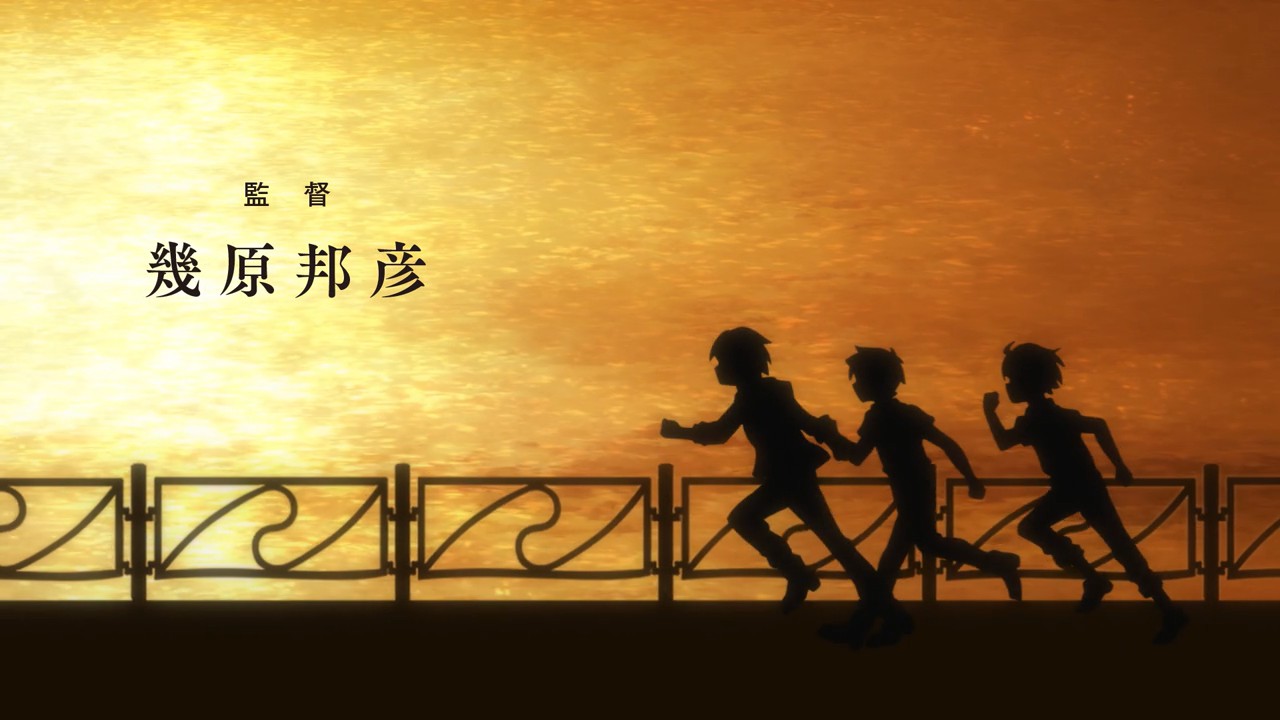
“I want to connect, but it’s not meant to be.”
The main cast of Sarazanmai consists of three middle school students, all vying to protect the desires they hold dearest. The first of the trio to be established, Kazuki Yasaka, also happens to be the most fortunate of the group on the surface. Liked and appreciated by practically everyone around him, it’s not until his more startling hobbies are brought to light that reveals a clearer picture of Kazuki. He’s a child burdened with self-guilt, feeling responsible for crippling his younger brother because of his own selfish wishes, and as a result tries giving him the happiness he felt was taken away. But make no mistake, Kazuki’s actions are made for his own sake, not his brother, show a fundamental flaw in his character: maturity. Kazuki understands his own mind and wishes, but is unable to recognize the minds of others, and without the latter remains wary of the connections he still has. Until he’s able to appreciate others more, his struggle with connection can only continue.
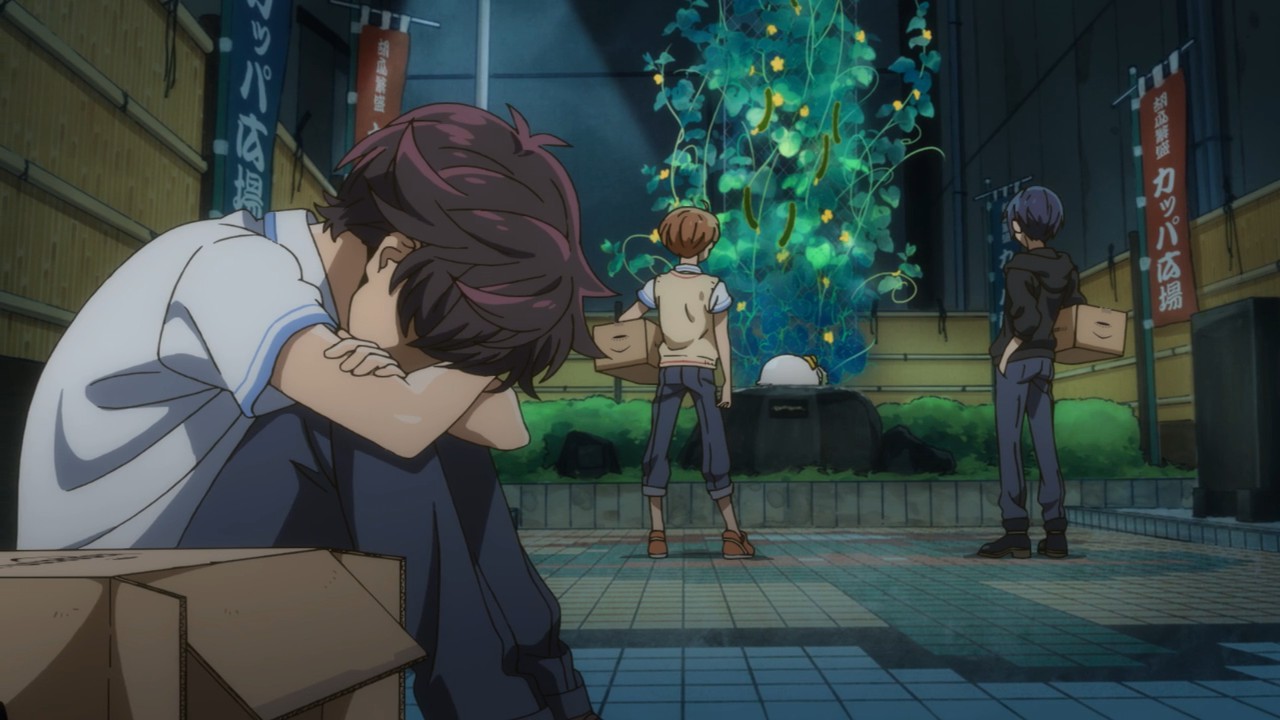
“I want to connect, but you’re so far away.”
Toi Kuji is an interesting case in that he acts as a direct opposite to Kazuki initially. The delinquent to Kazuki’s upstanding persona, he ironically counters Kazuki’s self-centredness through being the most empathetic and mature of the three. He understands the feelings and relationships of others best, and despite some troubles with communicating his own thoughts, connections can be formed with others. But in Toi’s case, it’s not so much about forming them, but preserving them. Toi underneath his mysterious nature and dubious actions does have respectable desires – to save the soba shop his parents owned and to get away from the illegal circumstances his brother pushed him towards. From an early age he was taught of the importance of familial bonds, though under the inkling that it ultimately came at the cost of other potential bonds. However now he arrives at a crossroad between preserving the relationship he has with his brother, or valuing the connections made through friendship more. Maybe more importantly, is he worthy of having these new connections?
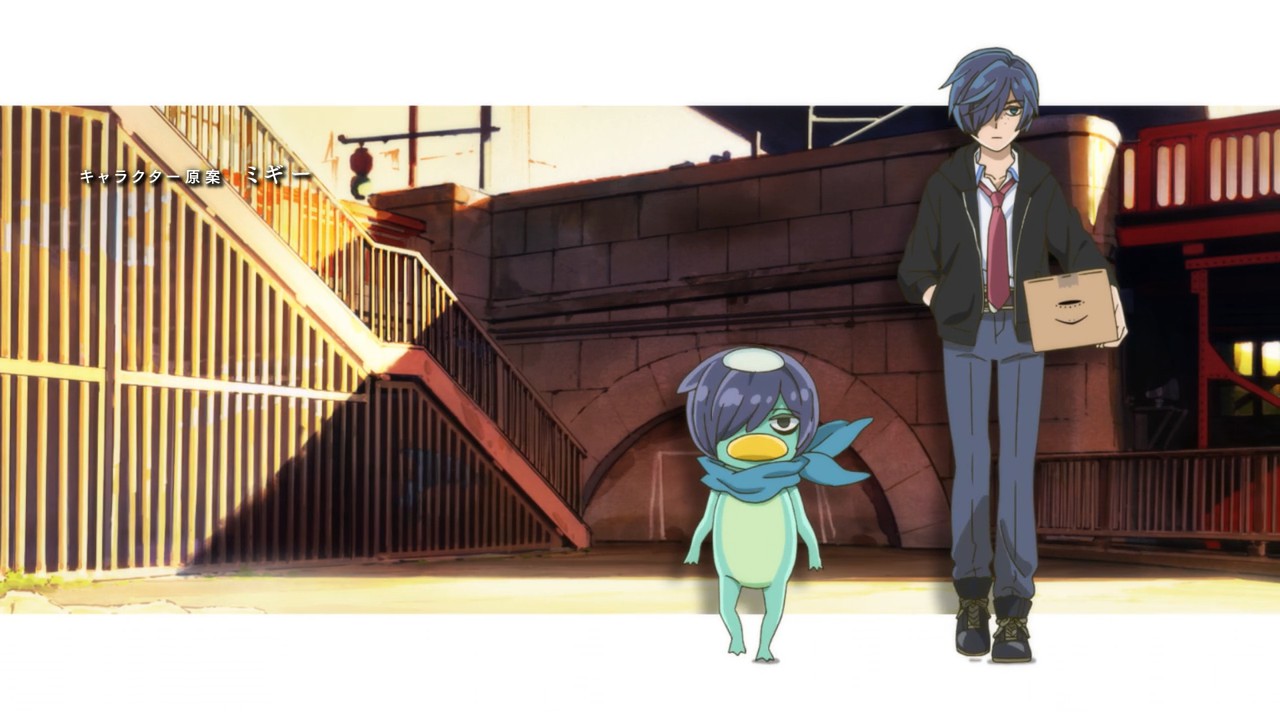
“I want to connect, but I can’t be forgiven.”
Enta Jinnai is the last of the three to be enveloped in Sarazanmai’s story, whose desires are probably the most simplistic of the three, but still a core part of his character. Unlike familial love or friendship, the kind of connection Enta yearns for is romantic love, specifically toward his best friend since childhood, Kazuki. But as much as Enta might try to form that connection, his feelings are not reciprocated. Enta can clearly be seen as cheerful, innocent and the one with the least amount of baggage, but overtime it’s readily apparent how frustrated and fearful he is about Kazuki and his situation, at times even hallucinating about what his ideal romantic relationship would be like. A connection already exists between the two, just not the type he honestly wants most. A solution may seem obvious to us as onlookers, but if it were us, what choice would we make? Abandon this desire for unrequited love with someone who has never registered these emotions? Keep these strong feelings bottled up for fear of losing your closest and possibly only friend? Or end up pursuing them, and risk falling in a cycle of heartache as a result.
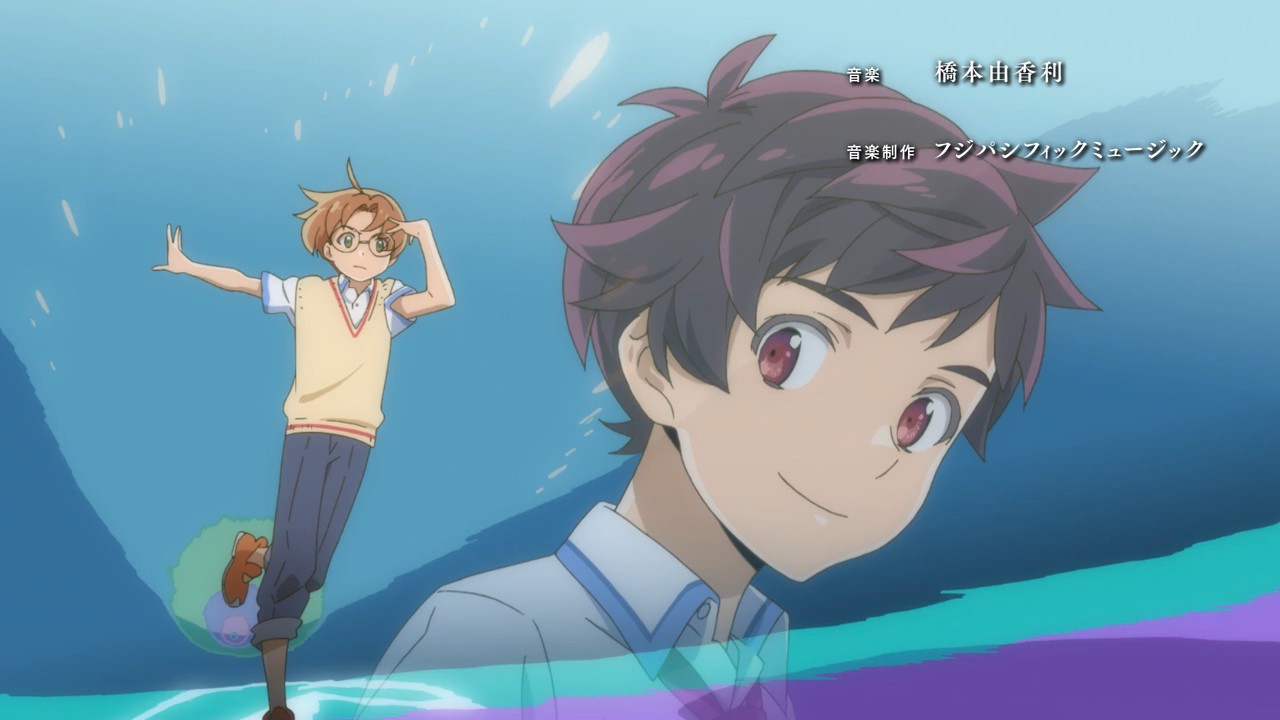
“I want to connect, so I won’t give up.”
Three distinct personalities all different from each other are brought together through the strangest of ways – being transformed into kappa and having their shirikodama removed from the anus, before having to fight zombies and remove their shirikodama in order to become human again, assisting the Kappa kingdom in their ongoing war against the Otter Empire. The premise is certainly original, but the themes are what take centre stage here. How connections between people are forged, strained and how that pain can affect each other being the most overt example, but for as much as the series shoves connections at the audience, the relationships between the cast are formed rather organically. The way each character’s darkest secrets are revealed after each fight is what leads to the natural bonding in the show. There’s a trust created as they rely on one another whilst holding their own goals that would put each other at odds, a dynamic rarely explored in anime and is reinforced through the explicit symbolism. But these bonds may also speak to the level of trust required in a world not accepting of their desires, with the backdoors of society being the one place where people can freely express themselves. Or perhaps the world is not as it seems, and in reality is controlled by an industry feeding and profiting off our desires through corporate means. Or maybe it’s just saying that it’s ok to be gay. This is both the beauty and difficulty of Ikuhara’s works; always shrouded in so many visual metaphors that it presents itself as a puzzle, almost devoid from the typical standards of storytelling but still encapsulating a myriad of ideas and messages, to where viewers are inclined to decipher the dense tale themselves. It’s not a style that everyone will enjoy, or even acknowledge, but for those who do, it’s part of the charm, something that is constantly gleaming off of Sarazanmai
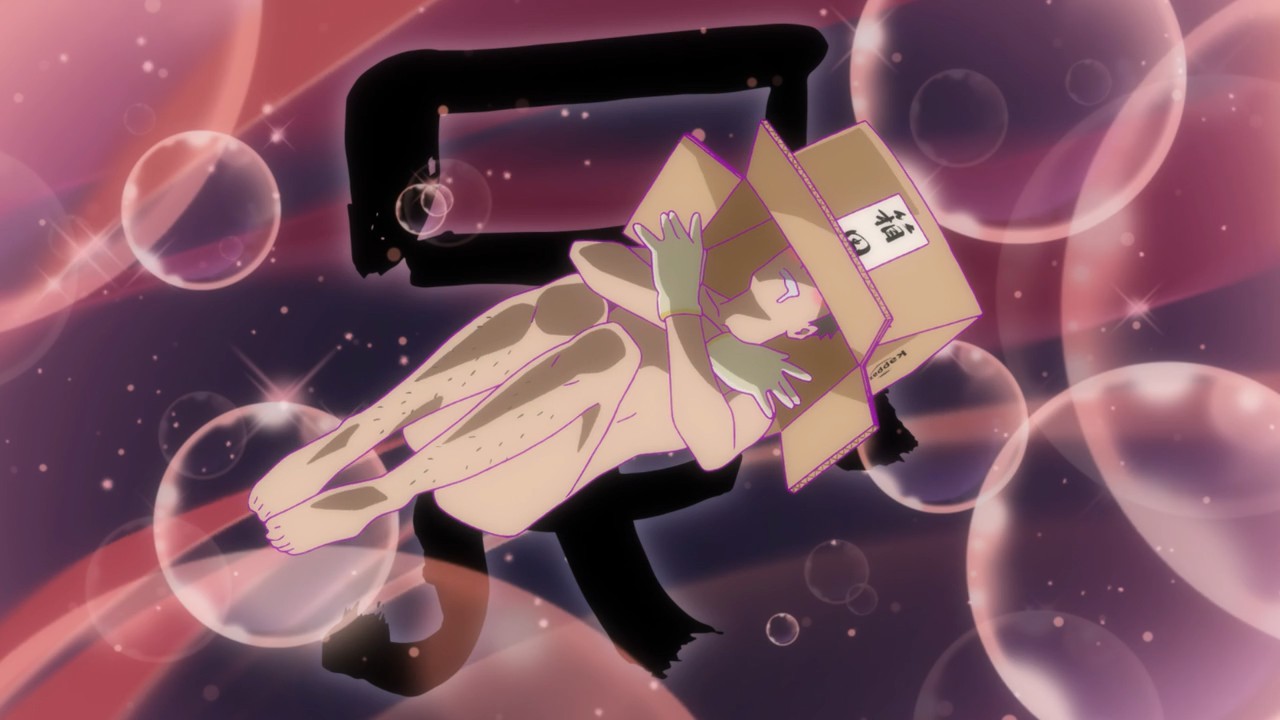
“I want to connect, but I want to betray.”
Now while I am personally a fan of Ikuhara and this series, there are some glaring issues I have with Sarazanmai, most notably due to how this eccentric tale is contained in only 11 episodes. Ikuhara, as beloved as he is by many, is known for his many tropes, from wacky animal hijinks and overly flamboyant poses, to increasingly surreal and almost gratuitous imagery, to the worst of his traits: his re-use of animated scenes. Sarazanmai features all of these quite regularly throughout its broadcast, to a degree where it can be no longer inviting for viewers unfamiliar with Ikuhara’s work. But speaking for myself, watching so many of his trademarks on display leaves very little room for the show to breathe when it needs to. The director’s previous work, Yuri Kuma Arashi, is the worst example of this. To quote a review for the series: “Watching Yuri Kuma Arashi is like trying to memorize the first 100 digits of Pi. Succeeding might technically be considered an accomplishment, but good lord is it meaningless.” Thankfully Sarazanmai does not become this insufferable, staying a joy to follow moment by moment whilst remaining coherent on top. But the quirks do leave their marks on the series. For a show so based around connecting to its characters, the audience is given little incentive to care for the characters in the first place. Factor in the repetitive tropes, a breakneck pace and a script that beats the term “connection” into your skull, and as a result we’re left with inconsistent development and key events not able to fully capitalize on their emotional impact. I truly believe it would have benefited from having more time available to explore the world, the cast, their backstory, etc. in order to tell a more complete story without rushing to the finish line. But alas, we fans get what we are given.
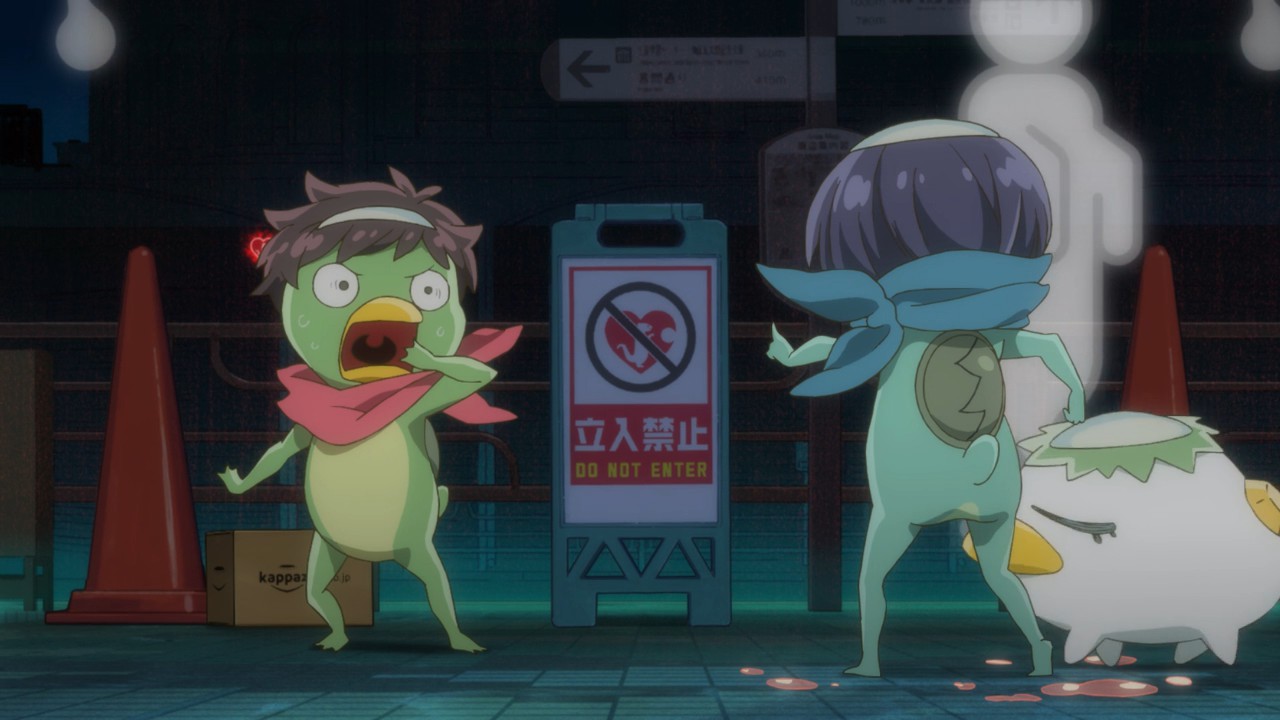
“I want to connect, but we’ll never meet again.”
Ikuhara’s history as a director is riddled with him having to compromise in some way on most of his projects, whether it be the numerous limitations that faced the production team for Yuri Kuma Arashi, or him completely abandoning his position on the Sailor Moon TV series. But with Sarazanmai, it’s hard to tell if there were any issues the crew faced. Very rarely does an anime emerge with the kind of intensity that Sarazanmai brought in the first episode. At face value, the show is visually stunning, using a multitude of vibrant colours and attractive character designs that immediate distinguish it amongst the crowd. The show also has a knowledgeable understanding of colour theory, with red, blue and yellow used to help define the personalities of the main trio. The series features a surprising amount of action that’s animated very well. I find it extremely praiseworthy that despite MAPPA being credited as the main studio, the first 4 episodes were produced by Ikuhara’s small team at Lapin Track and look no different from MAPPA’s work on the project. The show is like an explosion on the screen, bringing Ikuhara's vivid creativity and imagination to life.
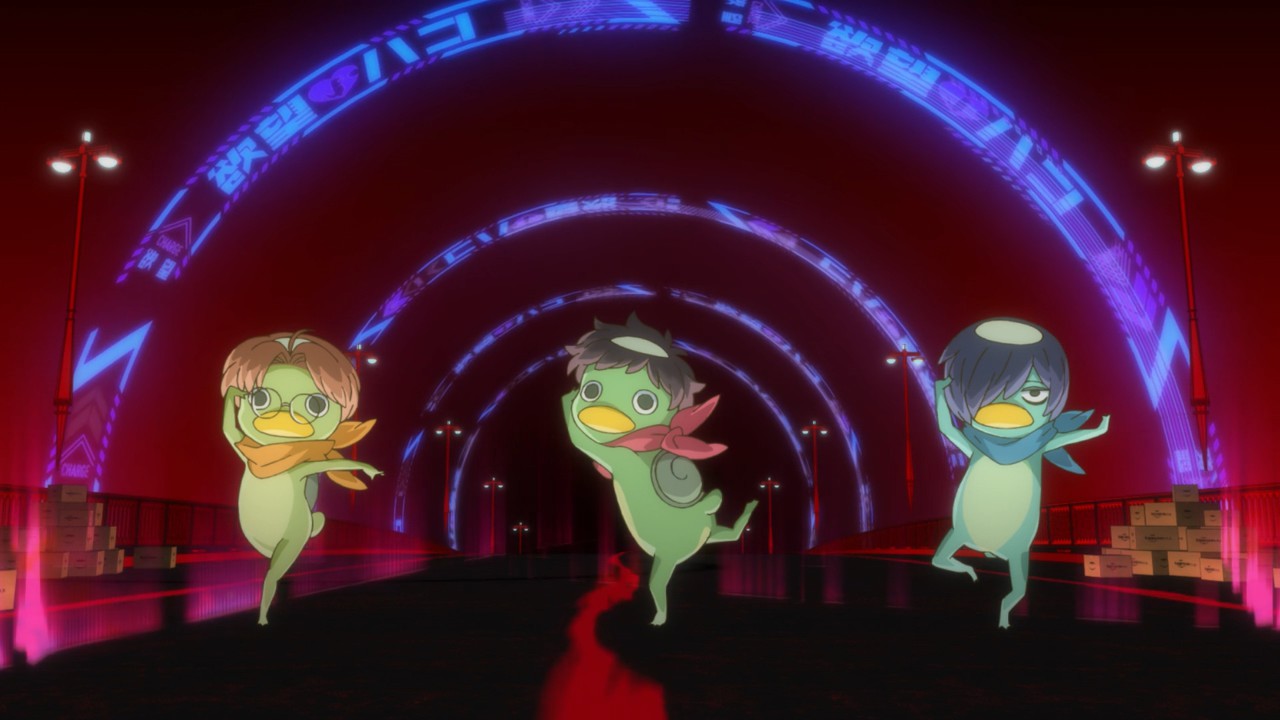
“I want to connect, but I can’t express it.”
The music for Sarazanmai is fantastic and well-voiced even with how repetitive it can be. Each of the fights feature the same tracks over re-used animated footage of the same dance sequence most episodes. The show takes inspiration from musicals with how it uses a mixture of diegetic and non-diegetic songs that help propel plot and character development, another rarity to be found in the medium. The themes of desires and secrets mesh well with the musical format, utilizing the basic structure and common song format to help give the series a theatrical essence in these moments. The voice acting is also excellent in conveying the appropriate tone, clarity and emotions required from each scene, effectively helping to humanize the characters. The soundtrack was composed by Yukari Hashimoto who also worked on the soundtracks for March Comes in Like a Lion, Toradora, Osomatsu-san and one of Ikuhara’s other works, Mawaru Penguindrum. Yukari has a knack for combining traditional Japanese motifs with modern electronic-style music to create a collection of tracks that’re uplifting in their own distinct way. The opening and ending themes are also bangers if that means anything to you.
“I want to connect, but I can’t.”
Sarazanmai, as much as I may like it, is an anime I find difficult to recommend, simply due to how hard it is to describe the kind of experience someone is in for. And in a way, that’s how Ikuhara’s works differ from the norm. There’s a story to be found and characters to move it forward, but they rely on interpretation to the point where my experience could end up completely different to that of the average anime watcher. But what I will say is that Sarazanmai sums up a bit of every original work from Ikuhara: The structure of a battle closing each episode with meaning behind each foe faced from Utena, the comparison of love and desire from Yuri Kuma Arashi, and the way society works with a shredder to destroy what the world doesn’t accept from Mawaru Penguindrum, all while maintaining its own identity. Sarazanmai is a weird show, but the weirdness is not complicated, as it constantly bears two sides of the same coin. Connection is an important part of the show, and our lives, but the show is also about hidden desires – the embarrassing parts of ourselves we don’t wish to share. The truth is we all have weird parts about ourselves, and we’re afraid we won’t be accepted if we admit those things. Yet in Sarazanmai, admitting those desires allows for real human connection to foster, and there’s something worth fighting for in that.
“I want to be connected.”
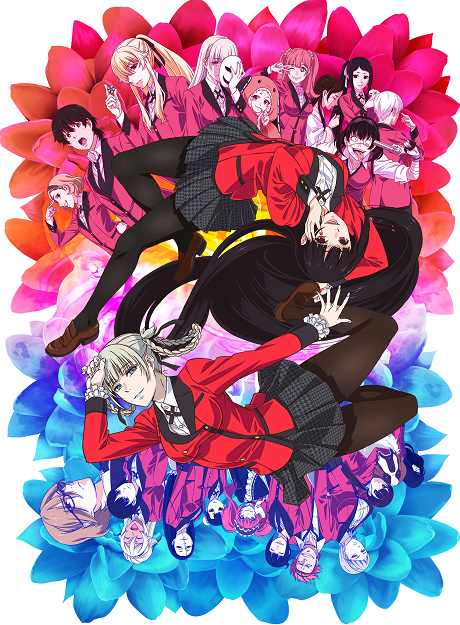
“When it comes to gambling, there’s always a risk involved.” – No one in particular, FACTS and LOGIC speak for themselves here.
Gambling is a concept we should all be able to relate to. Maybe not as the premise of a series or with having ever put one's own money on the line, but wagers are constantly made in our own minds regarding quality when a new show comes around. A mere glance at the seasonal lineup will inevitably lead to first impressions being made despite how little is known about an anime. But make no mistake, this is to our advantage no matter where in the life cycle of anime fandom you lie. Slowly but surely these thoughts act as effective tools to determine whether an anime will be to our liking. However, for this to happen, gambles must be made. From newer fans learning of disappointment for the first time by not ‘dropping shit like it’s hot’, to hardened viewers having learned what garbage lies amongst every season’s dark trenches – we all made bets one time or another, and we all suffered for our ignorance. As Kurt Cobain said: Nobody dies a virgin, life fucks us all.
Kakegurui was one anime that served this purpose for me. I had hopes for the show to be the standout of its time, only for that hope to be taken and buried six feet under its own morally bankrupt excrement, all while the protagonist stared back at me with a smug, crazy-eyed look on her face. Jesus may not have wept when he felt betrayed, but I could not follow his example. I felt the need to release these pent-up emotions; I wanted catharsis and my review on its first season is where you can find it. I detested Kakegurui for the suffering it put me through and have now seen hundreds of anime to have awakened my third eye. So naturally, one may find themselves asking me "hurr durr poohead, if you don’t like, why still watch? And to that, my answer is simple: I am Jesus, or at least I like to believe such. One value Jesus promoted during his time on Earth was forgiveness, and like Jesus providing us the ability to atone for past sins, I approach Kakegurui in the same fashion. This is Kakegurui’s chance at redemption and despite already disappointing with the title clearly missing one more “X”, it deserves at least that much from me.
THIS REVIEW CONTAINS SPOILERS
Following last season’s anticlimactic finale, Kakegurui x(x)x was put in the awkward position to follow a plot and characters left with practically no conclusions nor a clear sense of direction. Instead of establishing clear intentions of how this season would approach the narrative, no time is wasted introducing viewers back to the main appeal of the series: gambles featuring raunchy females and their sadistic facial expressions. The academy still appears to be lacking in faculty members to ever properly function as an academy, although we are welcomed with new faces. After Yumeko single-handedly decimated the Student Council’s stranglehold over most gambling-related affairs, an election looms over the school for main antagonist Kirari Momobami’s position as president. This causes the emergence of a new threat in the form of the “Momobami clan”, all family member related to Kirari with their objective being to banish Kirari from their family. It’s also revealed that Yumeko is related to the family in some way and also becomes a target of the clan, challenged to a series of gambles throughout this season. It’s an admirable attempt to drastically shake things up and deliver on more creative, unpredictable moments to keep fans invested. Unfortunately, the intentions still fall short as Kakegurui x(x)x comes across more like a rehash of the first season than otherwise, unable to move away from issues that plagued the previous season.
Kakegurui x(x)x as a series thrives on its gambles as they are the easiest way for the series to create any sense of thrill and excitement. This season puts a greater emphasis on them specifically by decreasing the number of gambles taking place and in turn increase the amount of time and focus given to each gamble. Most games take two episodes to complete instead of one and do better in allowing more character development and motivations to take centre stage. In theory this should be a more successful way to structure this season compared to last, however these changes manage to come across in practice as a detriment to the show overall from my perspective. Aside from removing the idea of stakes from their gambles almost altogether, using several episodes to explore the inner workings of games is usually effective when the games themselves have a certain level of complexity to them. Here's the problem: barely any games shown in the series thus far have that level of depth purely in their construction, with games like the “Finger Cutting Guillotine” only being effective as a game of chicken. It also does no help for this show that every gamble is extremely predictable in their outcome, with Yumeko only allowing for games to end in her favour, as proven from S1 and is the way of the Mary Sue. For a piece of entertainment, these drawn-out gambles are unable to adequately capitalize on the initial suspense and excitement viewers wish to feel each episode.
Because Kakegurui x(x)x is always following the almighty Yumeko and her deus ex machina abilities, it’s the other characters who are required to do the show’s heavy lifting. She may be the main character, but their perspectives are the ones always shown when standing opposed to Yumeko and end up changing as a result. In the first season they were barely more than obstacles for Yumeko to swiftly overcome but they still contained something about them that defined them as a character besides their design. Yumemi is an idol singer, Itsuki had a fingernail obsession, even edge-queen Midari had her revolver fetish of all things. In Kakegurui x(x)x, we have a clan full of new characters that we know little to nothing about regarding personality or motives aside from the their clan’s objective. Sorry, but simply having a cool-looking design does not make them any more interesting as characters. They just look cool. Although these new characters do break away from the stereotypes birthed from last season; no longer are all the females psychotic or grotesque, and the introduction of new male characters breaks the idea of males in the show being no more than pathetic beta males. But that’s far from a high positive for the season. So far these new antagonists have been relegated to just fulfilling mandatory roles as Yumeko's opponents. There still lies development present here for secondary characters that is noteworthy, but the way Kakegurui x(x)x treats these characters so sparingly in the narrative does it no benefits. I’m not fond of seeing a side character to return for two episodes looking like Ken Kaneki from Tokyo Ghoul before being pushed to the side again for however long the narrative demands.
With how the series handles both its plot and characters with such recklessness, Kakegurui x(x)x is the kind of anime one can find easily detestable. Not to say one cannot find enjoyment anywhere here, but when trying to depict characters created clearly immoral as admirable in a story centred around malevolent aspects of gambling, I’m left asking myself serious questions. Who is this being made for? What is this show trying to say? Clearly the show's focus is on addiction – why else would the anime title be translated to “Compulsive Gambler”? It’s not shocking that the characters with the most plot armour are the ones with the worst cases of addiction. But what has the series done so far in 24 episodes to really delve into this theme? Yumeko has yet to show any signs of distress or psychological torment while the punishment for losing is constantly raised to astronomical proportions. Is she a sociopath? If so, how is anyone supposed to know when it’s not even remotely close to a realistic depiction? Kakegurui x(x)x seems to be the kind of show that likes to have its cake and eat it too. It wishes to be a commentary on the dangers of gambling whilst holding the act up proudly on a pedestal, unabashed in sympathising with those clearly contemptible of such deeds. A show that sets up stakes and never follows through with them. Trying to impress with intellect and logic while simultaneously having the Tower of Doors arc end with the loser jumping out the “correct door” because she’s apparently so smart that she SUBCONSCIOUSLY CALCULATED what door was the one that wouldn’t kill her. The show has so many glaring holes, I could probably order it on the menu at Subway.
Kakegurui x(x)x from a visual standpoint is likely to either make or break the experience for viewers, and it’s almost solely because of the facial expressions. Once again Studio MAPPA tries to bring out as much insanity from these designs as humanly possible. While it does convey the kind of lunacy viewers are in for when watching characters lose themselves in their games, it’s still far from aesthetically pleasing and will no doubt have its fair share of detractors. Although if you’re already this far into the show I’d assume you can tolerate it. The character designs for the main cast are certainly eye-catching especially compared to new characters. Background art is usually typical and unimaginative but fits perfectly fine during games. The visual effects are still a strong part of the series and CGI usage is improved upon from last season. As for the soundtrack used, it never particularly stood out throughout the season but I was pleasantly surprised with the new opening and ending themes used here. Honestly I found myself preferring both themes over those from S1, despite the first from my perspective working as a better introduction to the comical madness this series indulges in. The voice acting also felt like an improvement, not coming across as off-putting when it came to the crazier parts of the script. They all do a great job in their respective roles, with Yumeko Jabami’s performance by Saori Hayami capturing a wide array of emotions in her voice to match the character’s absurd behaviour.
At first, I called Kakegurui pretty awful and feeling like it wasted my time. Now having given the series a second chance my thoughts haven’t changed that much. Making a second season that blatantly imitates key events of its predecessor only to fall victim to its shortcomings is not what I had expected or hoped for, but I still found a silver lining to this season. While Kakegurui initially felt more of an insult in what it set out to be, Kakegurui x(x)x has a clearer identity about it that I can respect. Instead of trying to encapsulate far too much in so little time for its own good and as a result failing in every way, this season is more inclined to take a step back from the intensity in order to bring more detail and focus on something grander. Whether this is a significant improvement remains to be seen, but the potential is there, building to something hopefully greater than anything the series has shown us yet. I still dislike the series, but I cannot say that I haven’t developed more respect for what it sets out to be. And for that, I do not consider Kakegurui x(x)x a complete waste of time.
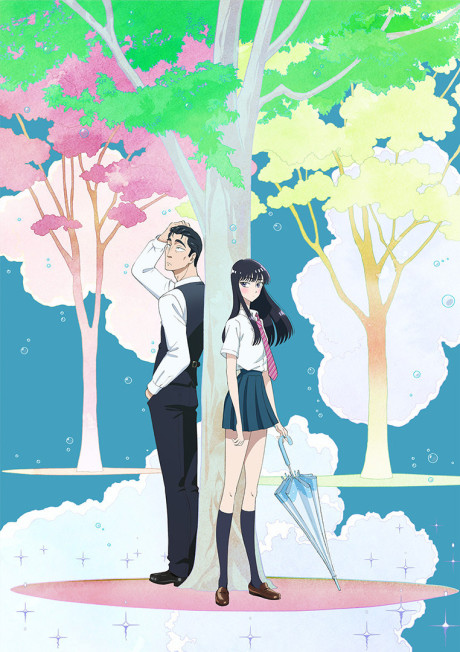
Love is like After the Rain. In the midst of stormy conditions you can either comfortably wait inside until the weather dies down or choose to face it head-on, pressing forward through the torrent and seeing where it takes you. Similarly, passion is like after the rain; once drowned out it can leave you confounded and lost with grey clouds hanging overhead. What once before had consumed one’s lifestyle is suddenly pulled away, no longer part of who they are and now must come to terms with this. In After the Rain we are shown two characters, each on the surface seem completely different to one another but upon closer inspection share a comparable suffering – they are both burdened with the feelings of a lost passion.
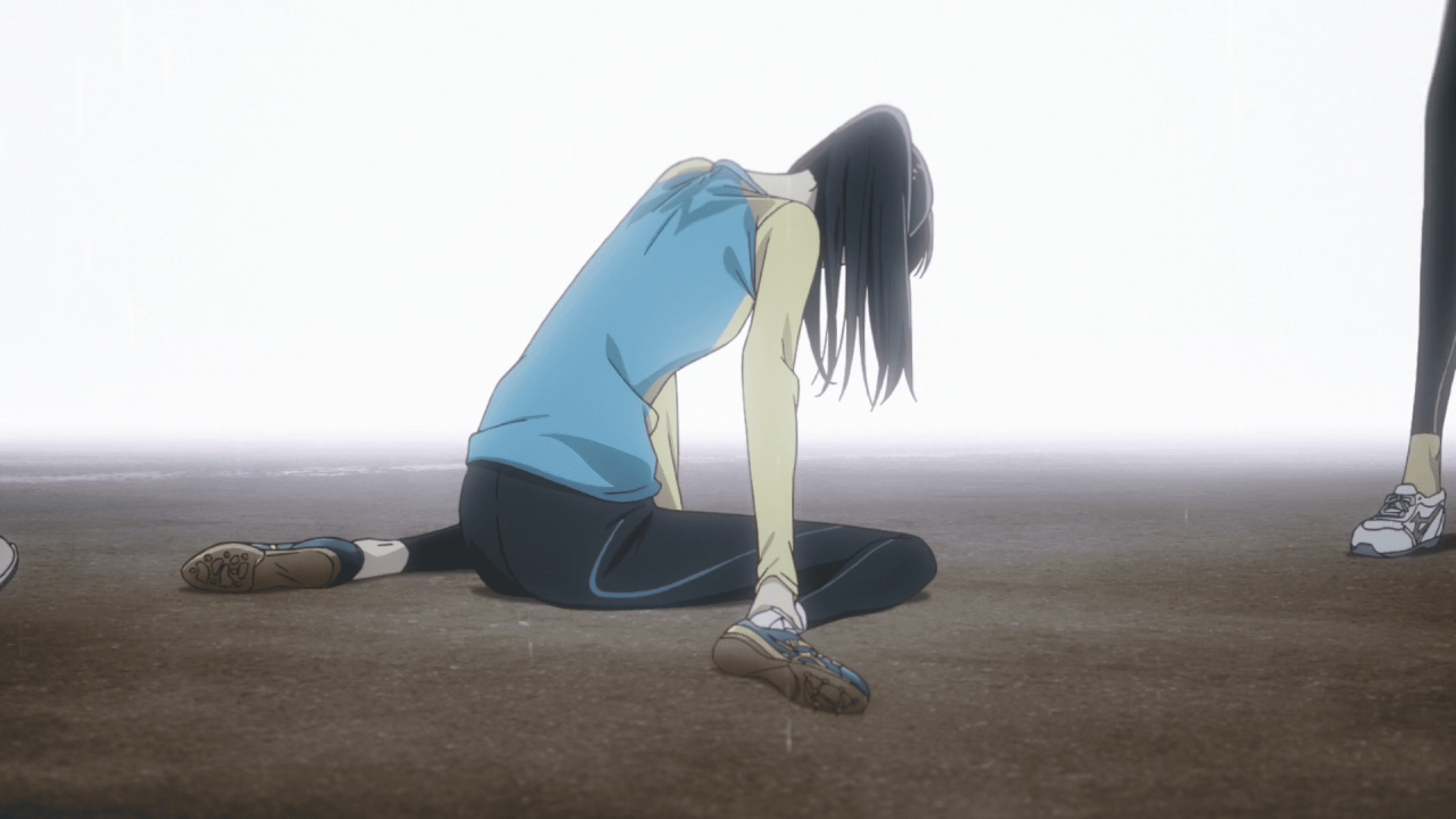
High-school sophomore Akira Tachibana is obliged to give up track-and-field after suffering a torn Achilles tendon. Up until this point, running had been part of her life since her earliest memories, almost becoming an instinctual part of her. Now having been ripped away from her passion she finds herself detached from her past world; stumbling along mere sidewalks by her lonesome self, enveloped in a constant downpour that doesn’t appear to let up anytime soon. Akira as shown on numerous occasions is very emotionally-driven, her feelings never bottled up and always fuelling her actions. Now facing the reality of her situation alone, she is at the lowest she has ever been. But one day, whilst sitting inside a family restaurant staring out at the rain, the manager approaches her with a cup of coffee on the house, performs a cute magic trick before saying to her:
“It’s boring when you’re just waiting for the rain to stop. I’m sure it’ll stop raining soon.”
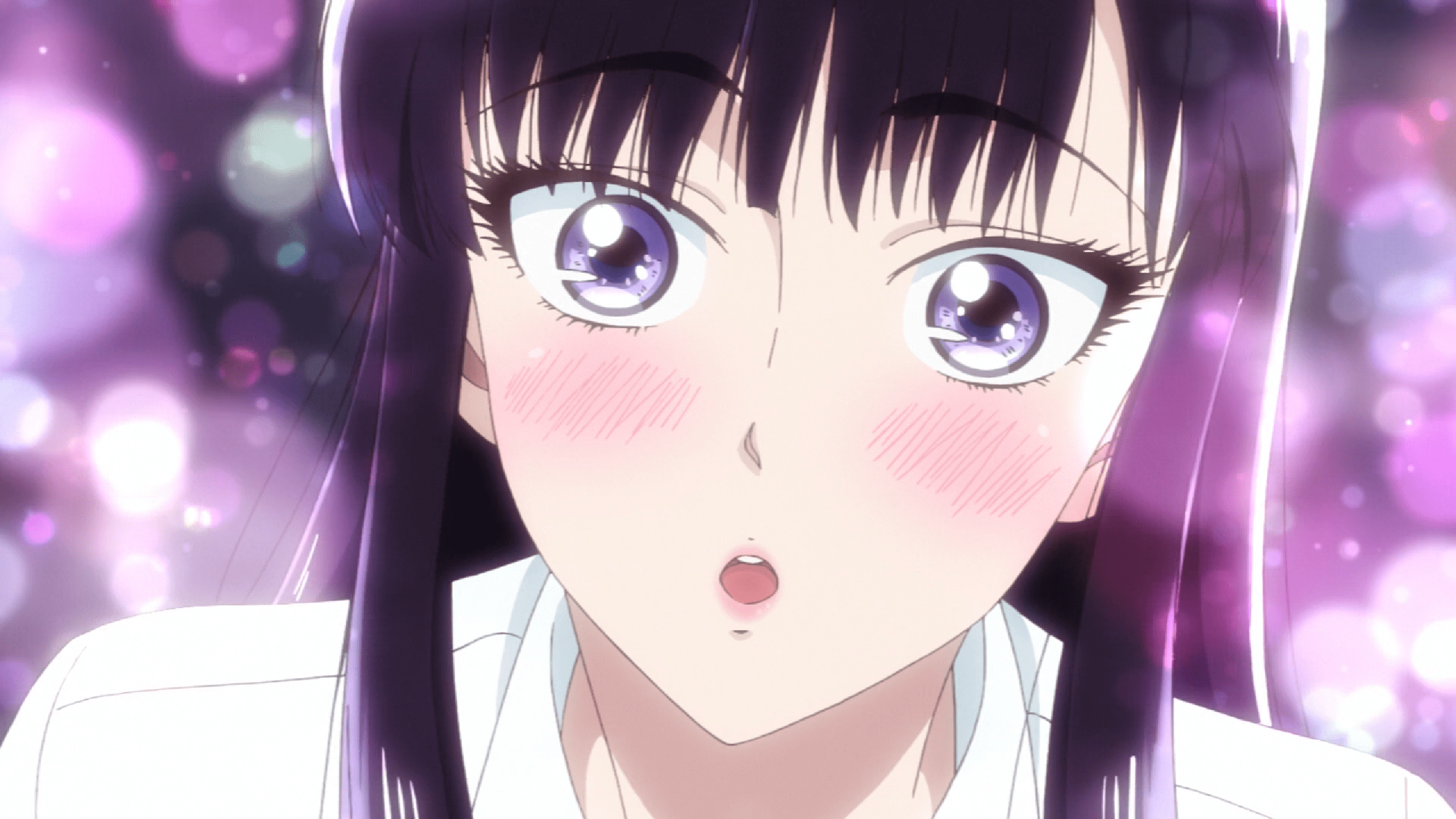
This alongside his act of kindness captures her heart and results in Akira developing a childlike crush on the man, subconsciously filling the void her injury left with an almost unhealthy love for Masami Kondo, the manager over twice her own age. Going so far as working under him at that very restaurant, becoming more and more committed in confessing her feelings to the man. Considering the subject matter, this series walks on very thin ice with focusing on an implied romance between a young girl and a middle-aged man, even testing the waters at times with her confession leading to a date between the two. But where many other series would have faltered, After the Rain handles this relationship with a level of grace and tactfulness rarely found in anime. It evolves from a simple age-gap romance generally considered taboo to deliver on a tale that focuses on the couple as individuals, each having lost something integral to themselves in the past and are both still learning to cope with.
Masami Kondo may seem a typical kind man on first impression but his life up to this point has been far from what he once hoped for. He is constantly burdened by what could have been – an avid writer in his youth whose material unfortunately never gained popularity and coupled with a failed marriage, leaves him with an attitude of complacency. His adoration for writing heavily implied as the driving force behind his divorce and losing custody of their child, a tragic turn of events that left his family broken and eventually caused him to abandon his writing. Now whenever his past career work is challenged, he simply blames it on age and sees any serious attempt to change such is inconsequential. He is content in reminiscing about the love he once had bitter-sweetly, afraid of potentially tainting the memories he still cherishes.

Both our main characters have felt the pain their passions led them to, Akira physically with a severe injury and Kondo emotionally with his family fractured in the process. Both are pushed away from what they lost and have grown fearful of the hole left in their place, afraid of ever returning to them. Kondo is fine reading the words of others and scribbling down notes when working, but at his desk with pen in hand he can only stare at the sheet in front of him, his thoughts never put to paper. Alongside being reminded of his past failings in the form of his highly-successful college friend, he is unable to take that step towards rekindling his passion. Akira is still willing to talk with her friends on the track team, but now doing so is coupled with a feeling of disconnect and angst, stranded alone and forced to watch their practice from the sidelines. Every time she tries to run she’s left injured in the process by her lost love, akin to an abusive relationship she just cannot seem to overcome.
On that day when Kondo offered her coffee they were only strangers, unaware of what has happened in the other person’s life. What Kondo did know however was the look in her eyes; the longing gaze of someone who’s lost and mourning something important to them. He knows it because it’s the look he shows whenever alone. Staring into the rain at night with cigarette in hand, reflecting on what he once had, his position in life and how he ended up there. Despite the difference in age Kondo is able to empathize with Akira, birthing a stronger connection between the pair from the parallels of their situations. A crush from the teenage girl does initially result from this and while there are moments throughout the show that hint towards romantic feelings being returned by Kondo, the overall approach is cautious and thoughtful. Her fondness for Kondo is illustrated as simply infatuation born out of immaturity and never becomes a path to shape her future. Not only are her feelings never taken advantage of by the older man, but what began as a school-girl affection morphs into a deep mutual respect and understanding between two damaged people.

Love is like After the Rain, but not in a romantic sense. Instead it aspires to depict the rekindling of a lost love that has plagued both Akira and Kondo’s lives. Here lies a story of two people with their own problems that are able to help each other work through them. Allusions are a core aspect of the series used to convey the issues each main character faces, both visually and metaphorically. When referring to the short story “Rashomon”, Kondo suggests he is too far gone to try writing once again, claiming he does not possess the energy and determination required for it. In response Akira tells him that his regrets aren’t something to wallow in, instead use them as motivation to return to that love that constantly spurred him on. For Akira, her fears of running again are finally addressed when having a conversation around a swallow that had trouble leaving the nest. Asked if the bird could have been happy staying behind in the nest, Kondo asserts that while there might be happiness found, it would forever look up and long for the skies. These moments end up being the push both needed to take the next step forward in their lives. Both have realised they each have a lot to work on as individuals and neither are ready to give up on the dreams they hold dearly in their hearts yet. And so, they each go their separate ways.
As the end credits roll, a melancholic theme plays set to a race track flooded with rain, only to transform into a bright one as the sun breaks through the clouds whilst the tune meets its climax. It’s a gorgeous representation for how the series closes with both Akira and Kondo coming out of the storm stronger than before, ready to face their passions once more. No matter how long darkness and feelings of uncertainty loom over, there will surely be a light that follows. Amidst the rain seeds of romance were planted, but now that the rain is over do they have the chance to flourish. Whether their relationship still holds romantic love or not remains to be seen. But from a year praised as one of the best for anime, I know there’s at least one show from that year I still hold great fondness for.

Ambition. An earnest desire for achievement or distinction and the willingness to strive for such an attainment is often fundamental in success. It produces action, bringing forth moods of passion, emotion and a yearning love for the endeavour. This is especially so with art, where the skill and craftmanship of creators are beared on display, readily available for consumers to take in and experience for themselves. However, in recent times one could argue that overall such craftmanship seems to have dwindled overtime, instead reverting to complacency in one’s ability to prosper. No longer when writing a story is a high level of skill required when accompanied with breath-taking visuals, nor is impressive production necessary for adapting acclaimed literature. Today, ambition appears no longer appreciated as it once was, and honestly, this does seem rational: why take a chance on something new and bold when settling on success still grants enough in return? It is this mindset that I sincerely believe breeds mediocrity whilst leaving those who dare try otherwise in the dust, but I would hope for the opposite; where originality is valued amongst the familiar crowd and if successful, could very well turn out a classic which stands the test of time.
With that said… Madames and Monsieurs, good evening.
‘High above in the opera box a figure entered. Removing his top hat revealed streaming ripples of hair, his skin ghostly blue. The singer steps forward, hands outstretched as she came closer, her voice lifting higher and higher. He grasped a bouquet of flowers and once reached her climax threw it to her, leaving her audience in wonder; perplexed as well as in awe. He bowed among the applaud of many but to one soul in particular. Of this moment he knew tonight marked a new dawn – this shall be the prelude to vengeance.’
Gankutsuou: The Count of Monte Cristo is one such work of art that seems driven on ambition, exuding a distinct, lavish style unparalleled for its time and ever since has never been replicated to the same magnitude. There always lies a certain level of tension whenever adapting a classic adored by many, yet here lies not only a competent retelling of arguably the greatest lovers revenge piece ever put to paper, but a fantastic re-imagining able to stand on its own merit as a masterclass of storytelling. Rather than simply applying a shiny new aesthetic coat to fit a tried-and-true formula, Gankutsuou takes strides in significant changes to allow core facets from the original narrative to align seamlessly in this new world. The setting: Paris, Rome and other major cities used in the original are replaced by entire planets and sectors of the galaxy, each with their own set customs both suiting the sci-fi setting whilst matching mannerisms flaunted from characters near identic to the source material. Through this, the majority of characters are quintessentially the same for both versions, with their French names, relationship dynamics and mentalities crossing over smoothly. In short, it effectively manages to transfer the culture of 19th century Europe into one’s depiction of the 6th millennium without feeling out of place. The result is a rich world where spaceships, aliens and robotic horses are considered the norm, alongside fashion, architecture and entertainment more befitting of the Renaissance period than anything in the distant future. It’s a change of scenery more appropriate to call anachronistic than futuristic, projecting a sense of familiarity amidst the otherwise alien world that separates Gankutsuou from every other iteration of Dumas’ opus. But there still lies more prominent changes with respect to the novel.
The most obvious point of divergence between the original and this adaptation lies in their point of perspective; the former being an enduring melodrama of a man wrongfully convicted who enacts revenge on those who ruined his previous life. Whereas here the retribution played out is portrayed as a tragedy, fixated with the corrosive effect vengeance may have when framed through the lives of what could be considered as “collateral damage”. The most effective way Gankutsuou achieves this is by beginning halfway into the overarching plot, trimming huge swaths of unnecessary content while focusing primarily on the victims within this tangled web of one man’s vengeance. Most notably is Albert de Morcef, a young partisan who unbeknownst holds a greater grief and anguish than his contemporaries know. Displeased with the confines of his own life and desperate to seek out pleasure while he still can, almost as if by chance he meets and is immediately captivated by a mysterious stranger known only as “The Count of Monte Cristo”. He invites Albert to dine with him and partake in a game of fate, gambling lives under the illusion of choice. An enthralling experience, one the naïve hedonist yearns for more of, offers to be the man’s guide for reintegrating into aristocracy, entirely unsuspecting of the danger he has welcomed into his household.
“There is no such thing as coincidence. Everything happens out of necessity.”
Albert acts as the catalyst that puts the Count’s plan into action. Concomitantly strung within a tangled web of deception, greeting the spider readily descending on its prey. Of course, this web only appears as mere strands barely connecting to one another at first, allowing for the story to unravel in thrilling suspense and ambience. As the narrative continues along its own thread, the supposed “first half” of the story is subtly revealed moments at a time, unveiling the true motives behind the Count’s revenge in parallel to his plan enacted out in real time. The pacing of such is truly sublime: key information slowly leaked across the series’ runtime, letting the viewer tie the knots themselves, coupled with asphyxiating cliff-hangers that do enough to maintain excitement and continually upholds a sense of curiosity for what is to come. It delivers on an engrossing tale specifically to those unfamiliar with the source material, however it still remains immensely enjoyable for those experienced with the classic version also. Despite creating a mystery from the most well-known part, the writing here is astute; clever enough to realise this fact and takes careful steps that eventually peel away from the canon in order to move in its own direction, adding extra layers of mystery and surprises to fit with the original whilst feeling fresh at the same time.
Although this tale is told from Albert’s point of view, the Count himself is without question the star of the show. A master manipulator, using his limitless amount of wealth, charm and guile to play everyone around him like pieces on a chessboard. His ability to shrewdly influence others from even the simplest of conversations is surely admirable to witness, but like a true mastermind he plays on the weaknesses of his adversaries. He creates the circumstances required where they cannot resist exposing their true nature: lust, greed, any immoral act they hold dear are brought to light, and he takes delight in such. An enigma, constantly shrouded in an aura of mystique both frightening and fascinating, his very presence begs one wanting to know more, and sometimes learning more only brings forth more questioning. Just who is the Count of Monte Cristo? Vampiric in appearance and devilish by nature, suave as well as sinister. Controlled chaos… yet also capricious. He embodies that of a man hollowed out by revenge, but at times still appears to have a heart. It’s near impossible to determine all his actions as either manipulations or stemming from true emotion, and this intricacy further makes the man such a beloved character in my eyes, more akin to a compelling anti-hero than the dastardly villain the story portrays him out to be. Regardless of how one views the Count in that regard, he holds an unmistakable charisma setting him apart from every other character. Whenever the Count is present on screen, he demands the full attention of every viewer, all heeding on every word he speaks. His words, often providing the best insight into the creation and complexity that is the Count of Monte Cristo:
“In the darkness, I awaited the dawn. And once dawn came, I cursed my flesh until night fell once more. I even prayed that I would lose my sanity. But those prayers went unheeded. I even strove for death, but the Devil’s cold, pitiless hand held me back.”
The Count and Albert are who ultimately carry this tale; the Count being cause for the mystery and overarching main plotline, with Albert contributing his point of view alongside the struggles attached with being at the centre of it all. Through Albert’s eyes a spotlight is cast upon numerous characters, each with believable characterization and strong chemistry that lends well to the dramatic story playing out. From his arranged fiancé Eugenie who constantly desires for independence, to his best friend Franz, a fellow partisan constantly involved in Albert’s affairs, frequently lending himself as a voice of reason whilst concurrently also directly affected at a similar degree as Albert courtesy of the Count – all are welcome expansions to their development compared to the source material where they barely held any relevance. Even characters who have their roles downgraded in this version are not relegated at the cost of their charm and never feel out of place. Everyone involved in Gankutsuou is complicated, entwined in a complex network of connections with each other and while some eventually fall by the wayside, a great number of them remain integral to the ongoing story.
Albert in many ways represents what the Count is not. Aside from being a very anime typical kind-hearted protagonist too credulous for his own good, from the beginning of the anime he expresses aspirations of breaking free from the confinements of his dull life that soon follows with him demonstrating clear naivete and general fragility. Albert is immature, often showcasing foolishness stemming from his young age and privileged aristocratic lifestyle. All and more play into why he is so easily enamoured by the Count’s mysticism. Albert is the most central character in the show, with his innocent disposition and despair suffered serving as the metric for drama to spring from. He is probably the most criticized part of the series, but as a sheltered 15-year old boy most of his actions can be considered as expected and these faults are what arguably make him oddly relatable. Alongside his friends, they all signify a “changing of the guard” of sorts, with their parents – all important and respected noblemen – representing established customs and traditions of their society, held atop an old, corrupt and overall defective order that forces others to accept it as they hold the power. But this new generation strive for a better tomorrow; one based of personal freedom, love and hope. Simultaneously involved is the Count, bringing about revolution, justice and a destruction for the establishment that wronged him, but also one of sorrow and chaos birthed from retribution. Interestingly enough, the Count does further allow for Albert and others to achieve their ideals, but there eventually lies a crossroad between both parties. This consequent clash also impacting the Count’s own inner conflict, with Albert reminding him of his past trusting nature, yet still driven by a need for revenge. At its climax, viewers bear witness to how far the Count would go through with his vengeance, and how far Albert would reach out to him.
“Everyone has a sword within their hearts; the purer the heart, the sharper the sword.”
The aesthetic choices made for Gankutsuou are what instantly set the series apart from practically every other anime currently in existence and is likely to be what makes or breaks the series for viewers. Personally, I found the artistic direction near impeccable, crafting the best visual definition possible for the term psychedelic. Director Mahiro Maeda had a clear vision for this anime, using Western impressionism and Ukiyo-e as inspiration for an art-style that beautifully blends the designs of classic European and space age to form this spectacular kaleidoscope of textures, with elaborate sets such as the Count’s household appearing more like a dream arthouse than anything remotely realistic. Almost every scene at the beginning of Gankutsuou utilizes various bright textures that immediately grab one’s attention, before slowly reverting to a neutered-down colour palette more welcoming to the eyes. These textures also provide an almost indirect means of characterization with the clothing worn and gorgeous imagery saturated across the series. Its distinct animation uses computer graphics to overlay bright colours and multiple background layers that blends the various animation styles used into scenes rather well. The result was something both complex and minimalistic that adds more value to character gestures and expressions. The staff wanted to create a show that “talked” to viewers, something that from my perspective was a success. The production is not perfect though, as CG still manages to come off jarring in the most climactic scenes. Studio Gonzo was behind the production for this anime, around a time where integrating traditional animation with CG was more often than not the norm for them, repeatedly receiving criticism for many lacklustre attempts. But with an anime so immaculate and extravagant in its design and surreal art-style, it barely amounts to a hindrance that is easily outweighed by the show’s visual strengths.
Much like the artistic endeavours that went into the visual side of Gankutsuou, the music accompanied is also masterful in its own right. The series features a strong soundtrack comprised of various classical tracks that flawlessly set the tone and ambience for each and every scene, lifting the dramatic moments to even greater heights. Ranging from serene and charming melodies to the more haunting and thrilling themes that aid immensely in the narrative conclusion of each episode, leaving viewers on the edge of their seats waiting eagerly for more. Jean-Jacques Burnel both composed and performed the opening and ending themes that were each a delight. The opening “We Were Lovers” involves a simple piano piece, bringing a softer nostalgic sound that draws viewers in, with lyrics vaguely describing lost love that speaks true of the Count’s background. The ending sequence “You Won’t See Me Coming” is a stark contrast to the former, bursting after every cliff-hanger with an energetic number along with distorted visuals that match the series far more as a thrilling drama. The voice acting is incredible across the board for both the dubbed and subbed version, with Jamieson Price and Jouji Nakata both being splendid standouts as the voices behind the Count. Overall it comes down to preference. I was more in favour of the English dub, but you cannot go wrong either way for this series.
Gankutsuou might be one of the closest examples of anime genuinely being considered a work of art. A beautiful series, artistically daring and meticulously plotted, each of its individual facets come together as an overlooked gem that when given the proper attention, shines ever so brightly. Transposing a time-treasured tale from one medium to another will always detract some for fear of ruining the beloved original story. But classics are eternal, and through reimagining old works in a new light they are enriched, able to awaken the love and respect of many generations that follow, staying in our hearts forever.
“All human wisdom is contained in these two words - Wait and Hope.”

I think it is fair to say that no other anime has caused such controversy and overwhelming divide amongst anime fans after a single episode like Goblin Slayer has. The pilot almost effortlessly setting a spark across the community that would act as ignition to countless flame wars lasting for weeks on end. A scene lasting around fifteen seconds receiving more vitriol and condemnation than arguably every other anime airing this year. On the surface, the divide seems clear: on one side lies those vocal to their displeasure of even the sheer existence of this series, labelling it as edgy, repugnant and pornographic. Some going even so far as comparing the anime to Nazi propaganda decades ago. And on the opposing side lies the fandom, constantly upset by criticism their beloved show receives and reverting to insults and name-calling them with popular phrases such as the dreaded “SJW” for example. But these are simply gross generalisations of both the series and its viewers, centring upon a small group of outspoken individuals that unfortunately leads any attempt of discourse astray. Instead my aim here is to hopefully bring a more critical view on Goblin Slayer to the discussion; of the series’ perceived intent, as well as numerous faults and issues prevalent throughout its first season.
“The gods of light, order and fate, and the gods of darkness, chaos and coincidence decided to throw dice in order to determine which side would rule the world. The gods threw the dice over and over and over again, until they began to feel faint.”
Goblin Slayer is a dark fantasy anime adapted from both the manga and light novels of the same name, highly inspired by tabletop role-playing games. Initially the story follows a young woman known as “Priestess” that has recently become an adventurer and joins an upstart party on her first quest. Their naivety and inexperience ultimately lead to their grim demise, ravaged by goblins who commit heinous acts such as rape and dismemberment depicted in much more graphic fashion compared to other fantasy anime of recent years. Before the Priestess can be dispatched however, the actual protagonist appears from the shadows, intent of massacring every goblin in sight. From this point, the series is predominantly focused on this mysterious adventurer commonly referred to as “Goblin Slayer” and his efforts to exterminate the entire goblin species.
The beginning to this story gives what I believe to be a clear sense of what Goblin Slayer strives to be. Simplistic, cheerful dialogue to elucidate fundamentals of the adventurer system, a light-hearted tone able to create a strong optimistic mood, even the visuals and audio utilizing light colours for character designs coupled with an upbeat tune all try and convey a presentation akin to the typical fantasy anime of recent memory. The group of upstart adventurers each can be seen representing archetypes one would expect to be present in such a series: tsundere, loli character, main character for a harem, etc. Numerous times before a goblin appears on screen, subtle signs are revealed about the party’s lack of preparation and expectation to indicate this quest will not be as successful as they hope, and then what follows is a shocking realization of what the world of Goblin Slayer truly entails. Essentially these characters were tools for the series to subvert people’s initial expectations of the story, with the tragic events that entail further emphasizing this point. The sickening portrayal and detail of these actions going to further lengths than most anime fans have probably ever experienced previously in the medium. Disgusting to watch even for the short time shown, and from the reception this anime received, it looks to have garnered the initial reaction staff had intended. From this perspective, while many can find these scenes crass and tactless in their depiction, I find it difficult to call this part of Goblin Slayer lazy writing.
Shortly followed by the introduction of the titular protagonist reveals a change that strongly contrast to events that just transpired earlier. Compared to the almost wilfully ignorant upstart adventurers that end up decimated to the lowest mob type in the world, Goblin Slayer’s approach to killing goblins is much more tactical. Shown to analyse nearly every time he murders a single goblin, often determining the most effective method for slaughtering the mob step-by-step before executing his strategy in cold, calculated fashion. Through this he not only personifies the kind of badass main character one would expect for a darker fantasy story, but also provides a solid understanding of how a high-level adventurer would be expected to act in battle. Armed with various weapons and antidotes whilst always on the lookout for signs, Goblin Slayer has enough tools at his disposal to face any goblin he would come across. A clear juxtaposition to how many inexperienced adventurers would conduct themselves. Him slaughtering the horde also raises an intriguing question of Goblin Slayer’s morality when intending to murder the child goblins. While the protagonist remains steadfast of his opinion on the species, the Priestess brings forth the possibility of a “good goblin”. Despite going through with eliminating them, he does admit there could be one out there. From this, viewers have a grasp on how this tale could further develop this idea with having both character’s ethics challenged as Goblin Slayer’s quest continues. There is potential in this tale to be more than just the fun schlock of the season. Unfortunately, that potential slowly gets squandered every episode following, and personally even loses the series’ initial appeal.
One of the more detrimental choices I find a story can make is following an attempt to create a purposeful, serious tone, and then reverting to what it tried to distance itself from initially. After Goblin Slayer’s shocking start that firmly established the story as a dark fantasy that supposedly takes itself seriously, the anime takes an odd change in tone that is rather baffling to understand. Numerous quests later in the series showcase characters in a way you would never have expected in Goblin Slayer, with an array of playful, trifling scenes one would more commonly associate with a slice-of-life anime than this show. Somehow the series decided to skip on possibly showing some of the effects trauma experienced from death, sexual assault or even just being an adventure can have on a person, instead these scenes barely contribute to the characters on a notable level. The change in tone can lead to breaks in one’s immersion of the story and the protagonist it follows, with transitions feeling awkward and out of place more often than not. A notorious example can be found in episode 2 where the episode cuts to a well-endowed redhead girl waking out of bed and stretching, followed by some of the most prominent jiggle physics to be found this season. I thought this was meant to be a serious tale. For a dark fantasy to work, usually it requires the atmosphere of a series to remain constant enough to a degree where the earnestness and consequences of actions can still be felt through the more cheerful scenes. Berserk, Attack on Titan and Fullmetal Alchemist 2003 are just some examples of dark fantasy anime that constantly have a sombre air about them, constantly felt when witnessing the actions of their characters. Goblin Slayer lacks this air that breezes alongside the narrative and whilst continuing to lack a strong sense of identity in a genre already spoiled by an abundance of generic fantasy, it is more inclined to leave a stale taste in the mouths of those hoping for Goblin Slayer to distance itself further from its contemporaries.
This lack of an identity also permeates the narrative and overarching worldbuilding to a degree that I have to address. When a series attempts to be a subversion or even a deconstruction of a genre, normally this would involve acknowledging tropes typically associated with a genre whilst subverting their intentions. Goblin Slayer, at least in its first season, does not do this. Alongside the series constantly switching the tone between dark and nonchalant, the anime seems to never want to take its world very seriously despite the premise. Goblin Slayer is a man who has an unrelenting obsession to kill goblins as they are a species that lingers on as a problem for innocent people. They are weak creature with childlike intelligence individually, but as a mob are a destructive force which can lead to the devastation of entire towns. An interesting yet believable problem in this world. So then, how is it believable to think that there is only one person that acts in response to this problem? Because the anime has mainly taken place around a small town there is a possibility for other adventurers similar to Goblin Slayer to be primarily hunting goblins in their own areas of the world. But thinking on a large scale, if goblin mobs can and already have been a significant cause of wiping out various towns, would someone not think that their effect to agriculture and the overall economy poses a severe threat on a national scale, to where even adventurers seeking glory and fame would end up losing money? I would have at least expected some form of intervention – here is an idea: have some adventurers hired as a form of security for farmers against a potential goblin attack. Or at least have the guild girl not allow novices to take these jobs when it is made apparent how many novices and kidnapped and killed off by goblin mobs! If so many are dying because of this fact, maybe it would be best to intervene, even if with just a simple warning about how dangerous they are, and how prevalent this is. If only Goblin Slayer had more consistency in its world that more people could admire, instead of trying to subvert common fantasy anime tropes and then as if almost contradictory to itself maintaining a level of unbelievability behind how these aspects work in its story.
It is upsetting how a show essentially fails at fleshing out the more complex issues the world of Goblin Slayer encompasses, especially when most of the defence for this anime in regards to certain actions and events is derived from insular logic. A common complaint for the series initially was based around why goblins rape, and while it certainly is specified that rape is their only option for reproduction, that does not cover details about their creation. Goblins here are force-of-nature villains that embody evil and chaos, thus not requiring distinct personalities and from this the rape shown can be considered a further way of emphasizing that point thus bringing them to where they can be considered irredeemable, but this only works on a narrative level. All works of fiction are made with intentions from their creator/s and by peeling down the layers of in-universe context is one able to search for the purpose and intentions behind specific scenes, actions, etc. Often termed the Thermian Argument, it claims that pointing to a show’s logic in response to criticism of the subject matter is inherently fallacious. It supports a difference between what is being depicted and why such is being depicted at all; a metanarrative point of view. I stated what I believed to be the main intention behind such shocking acts in the first episode as a way for the show to subvert the audience for what kind of anime they were in store for, but after witnessing the series make that idea almost completely irrelevant through poor direction, tonal dissonance and having such actions repeated onscreen later with similarly crude framing for reasons even I am unsure of, it is hard to defend the series for all these creative choices happening numerous times throughout the anime’s duration from a metanarrative point of view.
Characterization is one of Goblin Slayer’s focal points if even only applying to one individual so far. Goblin Slayer is the embodiment of a man who refuses to die before his purpose in life is seen through to the end. Driven by revenge after goblins took away the person most precious to him, he epitomizes the idea of how a badass protagonist should act. His character design is also impressive in certain scenes with a red eye theme glowing in the darkness that oozes a killer instinct rarely found in anime nowadays. Reminder that the in-universe creation of the series was founded on gods rolling dice and playing the game of chance, with all various races and species being birthed purely for their amusement. But with the way Goblin Slayer acts, he can be considered the one character in this world to defy the will and wishes of those who created him. And while there are numerous examples of him conveniently surviving so far due to plot armour, the intent remains – underneath his monotonous voice and implied social awkwardness lies the potential for a metaphorical figure of inspiration. Unfortunately, that is where most of the praise for characters ends at this point in the anime. Every character besides Goblin Slayer receives little attention in the anime, with minimal development bar the Priestess who acts as a rookie slowly growing and learning how to survive as an adventurer in this harsh world, however even this has made little progress this first season. Other characters sprinkled across the story range from other rookies slowly improving and gaining experience to dependable fighters often able to hold their own in battle, which is a striking difference compared to how most typically act away from any battlefield; childish and immature. Honestly, besides Priestess and Goblin Slayer the rest of the cast are easily expendable, but I guess that is to be expected when the supporting cast includes names such as “Dwarf” and “Lizardman”. Hopefully if there is a sequel, they have a better opportunity to leave a lasting impression on the anime.
Much like these forgettable characters the production quality for Goblin Slayer also failed to leave a strong impact. The art is not very detailed, with most character designs and backgrounds often appearing plain and generic for most of the season. A mixture of 2D and 3D animation is used to jarring effect, with most action scenes and the occasional panning shot relying on CGI that look more like an eyesore that anything visually pleasing. In fact, most of the better-looking shots involve scenes lacking any sort of movement. Disappointing as the artwork is commonly seen as a key strength to the manga’s popularity. For a series where the most basic appeal comes from a guy mowing down goblins, the action was underwhelming and that kills a show like this. Wish I could say otherwise for the soundtrack, but that also failed to leave a strong impression on me. Voice acting was solid but effectively crippled with a lacklustre script treating half the characters as dense. The opening theme was melancholic but failed to ever have me personally want to listen to it more than once. The ending theme while I certainly enjoyed it more was accompanied by CGI Goblin Slayer with clunky animation. At least the ending track was fun.
Goblin Slayer is at its core, an anime about one man slaying goblins. Though it can tempt viewers with ideas of something greater at work, it still boils down to a mere schlocky action show with lacklustre presentation that by the end of its first season has its biggest strengths stemming from potential and a hope that a sequel can further flesh out characters and worldbuilding which at this point cannot hold up to scrutiny. But it does have its appealing qualities no matter how superficial they might be. If you are willing to take a chance on a simple action anime trying to break the trend of generic fantasy released this year, this might be worth your investment. My main hope is that now with the most controversial anime of the year finished, the community at large can learn from this experience. As the old saying goes: “That which does not kill us makes us stronger.”
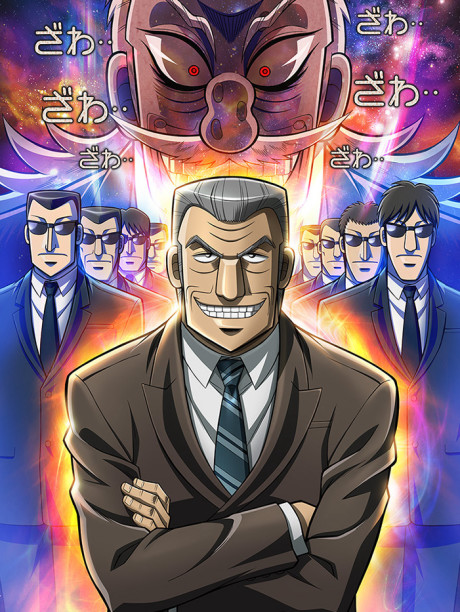
Donning his drab trench coat with a pack of cigarettes in tow is a man constantly at odds. He hunts those who dare test his patience, often poor strays lying about already bleeding for cash. In his eyes the pleas of worthless trash that caused their own misery, a contrast to the hardworking man in front of them. All they could give weighing less than a single bill of currency. He writes in his notebook: “Money matters are life and death matters. Society isn’t your mother.” Words he holds true to heart, using them to push himself further. As in the shadow of glory and legends lies one Yukio Tonegawa, a mere middle manager, suffering and fighting in ways that no one really knows.
Mr. Tonegawa – Middle Management Blues is a peculiar spin-off to the underground classic gambling thriller Kaiji: The Ultimate Survivor in that it is set initially prior to the parent story and follows one of the minor antagonists to the main series. Tonegawa serves as the financial consulting firm Teiai Group’s second in charge and the right-hand man to president Hyoudou Kazutaka, who has a disconcerting fondness for extreme forms of entertainment. The series largely focuses to Tonegawa to meet and satisfy whatever Hyoudou wishes at practically any given time and has been assigned a project team to assist him, pitting Tonegawa in a predicament where he needs to appeal to both parties in order to succeed in his role. Through this premise, Tonegawa is able to bring out laughter from even the darkest of places.
The most important thing to understand about this series is that this is not the suspenseful thrill ride that Kaiji was, instead it seeks to act as a comedy and parody to the Kaiji series. In theory this places the show as a near complete polar opposite to its predecessor and what its intentions were, however this spin-off comes across more as a worthy companion piece to the series as a whole. While villains such as Tonegawa and Hyoudou still remain morally bad and even sinister at times, this new perspective expands upon their ideals and motives, even showing weaknesses in their struggles with life, particularly on Tonegawa’s inability to connect with each of his subordinates. Speaking of, characters that were no more than faceless thugs before are given a breath of fresh air with a more humanistic characterization to each of the men in black working under Tonegawa’s lead. A greater understanding of these characters coupled with a more grounded tone provides viewers with numerous moments tacked on throughout the show’s runtime that can easily be thought of as relatable and oddly endearing. It easily captures authentic parts of life at work and portrays it in a comedic way that might even be more effective for those of us who have already experienced moments like these ourselves. This expansion of the story may not have been needed, but it is surely welcomed for a fan like myself considering what it brings to the table.
Often when criticisms about the show’s use of humour are brought up, while I can respect the differing points of view I feel they ultimately miss the mark for how and why comedy works for Tonegawa. There are several different styles of comedy and even at the time when by this review has been published comedy anime has experienced a kind of resurgence, observational and surreal humour is still rare to find. And this is what I believe really helps make Tonegawa stand apart from its contemporaries; it’s a comedy series that thrives on these comedic styles through exaggerating the importance of seemingly mundane and trivial aspects partnered with a keen eye for detail leading to preposterous leaps of logic. The character Tonegawa is a perfect match for this type of humour, having been a key antagonist in the original series heavily reliant on observation already. The first meeting with the men in black provides a clear example of this: they all look the same and tells them upfront that he cannot tell them apart from one another, and when he tries learning their names he picks up on the similarity between them, making it even more difficult for Tonegawa to differentiate between his henchmen. An absurd line of logic that is executed surprisingly well. Psychological, yet surprisingly relatable events like this are what gives the series its own distinct charm. The show also has its fair share of subtle humour placed throughout each episode that helps to make episodes more memorable in their own way.
Trying to picture how this style of comedy could possibly work so effectively may prove difficult to those of you who have yet to watch anything from the franchise yet, and this leads into another core element of the show: the presentation. The entire franchise does utilize a very atypical art style that can easily act as a deterrent to potential fans, but further helps set the series as a whole apart from every other anime today. What’s more important however are the visual metaphors utilized, borrowing the techniques from the main source material originally used to make scenes more enthralling and using them in parody-style fashion, now creating low-brow jokes to act as literal metaphors and visual representations of such. Some of the more memorable examples include Tonegawa calling all his subordinates gutter balls after finding they are all interested in bowling and Tonegawa hanging on to what appears to be a spider’s thread until soon after is revealed to be drool from the president after he failed Hyoudou. There’s also numerous references made to past works by the original creator of Kaiji that are sure to catch the eyes of seasoned fans for those series’. Major props to Jay Kabira who voiced the narrator of Tonegawa and might have been the best part of the series; his ability to garner genuine hype to even the most monotonous of things is second to none and was splendid to witness. Even the beloved “ZAWA” symbols from Kaiji are able to produce an oddly surreal atmosphere that I’ve never seen before in anime.
Sadly, it cannot all be high praise as Tonegawa does run into some issues along the way. The show teases progression a lot in regard to the relationship between Tonegawa and his employees. The show is certainly episodic but never tries to capitalize with all the sincere moments it creates like it potentially could have. Apart from being partially directionless, the story introduces short stories from the perspective of another antagonist from the original series, Tarou Ootsuki that in my opinion worked as a nice change of pace for a while, until half of every episode was dedicated to him. Tonegawa’s struggles brought forth what I felt was a much greater sense of absurdism and creativity that could carry the show compared to Ootsuki. It’s also perplexin why they would continue with content for Ootsuki considering an anime specifically focused on this character was announced halfway through this series… I don’t really know what to say to that, but honestly it just feels like they wasted TV time that could’ve been spent better.
The production, while emulating a similar style to that of Kaiji also unfortunately lacks the attention to detail in character designs and much of any fluid animation. Not a big issue for a comedy series in my opinion but these features were certainly noticeable. The colour palette used was much more faded and less vibrant in contrast and while I would not call it poor quality, feels a lot cheaper by comparison. Studio Madhouse were behind this series with a different staff, yet still manages to provide us with a successful homage to its parent anime visually. The music is also fairly unmemorable which is a shame as it remains one of the best features from both seasons of Kaiji. But the voice acting was solid from the main cast and the opening, “Sassou to Hashiru Tonegawa-kun” by Gesu no Kiwami Otome, became one of the most enjoyable and upbeat themes to hear an anime begin with. Hell, here’s the link, you can thank me later.
youtube(https://www.youtube.com/watch?v=WkbyJ3unvWQ )
Mr. Tonegawa – Middle Management Blues is a series that at first glance may appear to not know what audience to appeal to; the new or old. But I implore you, especially if you have seen Kaiji to try this spin-off. It is not Kaiji, nor was it seriously trying to be, but what you will find is hopefully one of the most entertaining and downright distinct comedies in a year almost saturated with them, and from my viewpoint the most underrated anime of the year. Zawa Zawa.
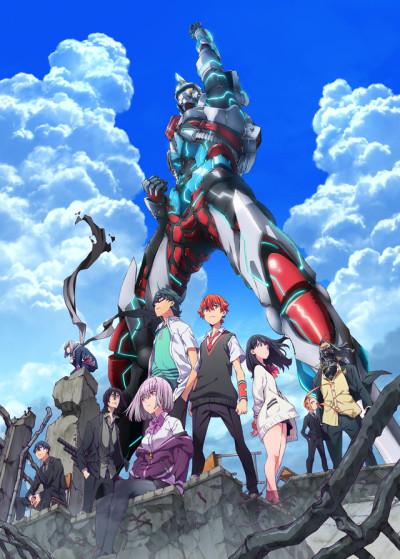
(An Abridged Take Inside TRIGGER Studios)
Director [claps hands]: Okay. Thank you all for coming on such short notice. I just wanted to discuss some further details on the series that I thought appropriate.
[Staff members nod their heads and grunt in agreement]
Director [smiling]: Great! Okay. Masaru [Sakamoto], you are in charge of the character designs, right?
Masaru [nodding]: Yes, that is correct.
Director: Okay. May I see how they look so far?
[Masaru nods and shows him a clipboard containing several designs of the main characters. The director takes his time glancing at each of the female designs.]
Director: Okay. I like what you have here, but I think we can make both of these female characters stand out more.
Masaru [intrigued]: Sure. What would you want to change about them?
Director [pointing at Rikka]: Okay. [leans towards Masaru’s ear and whispers in a serious tone] I want dat ass big and her thighs thicc!
Masaru [choking in absolute shock]: Uhh sir, I mean… are you sure about that?
Director [grabs Masaru by the collar]: Okay listen here bucko, I’ve been in this industry for over a decade. I was an animator for one of the most successful anime from this year, Darling in the FranXX, so I think I know a thing or two about what sells in this business. [Releases his grip on Masaru and returns to a light-hearted tone] And try and make the other girl look cute, but not with thicc thighs. Only one girl gets that.
Masaru [still stunned after what had just transpired]: Wh-what do you mean, “look cute”?
Director [walking away]: Just think what I would look like if I were a high school girl. Okay?
[Masaru has no idea how to respond and decides to ask mechanical designer Shigeto Koyama on his opinion. Koyama sees the designs of both girls and a slick smile forms across his face.]
Shigeto [amused]: Well, when all else fails, you can always make dem titties big!
Masaru: ….
(Inner Masaru [sighing]: What the hell did I sign up for!?)
Regardless of how seriously you take the transcript written above, it’s hard to argue just how much attention to detail went into the creation of SSSS.Gridman. While being heavily inspired by the 1993 live-action series Gridman the Hyper Agent, this version is loaded with visual references to numerous tokusetsu series and mecha anime of the past – Space Runaway Ideon, Getter Robo, Evangelion, several iterations of Gundam and more receive stunning rendition scenes that serve as quick but effective throwbacks appealing to nostalgia for the die-hard fans of yesterday. Whilst on the other side of the community, Gridman had managed to conquer the ever-present “best girl” debate of the season, with each week providing more material and support for why each girl and this series is worth one’s attention. Hell, there was even a theory made halfway into Gridman about whether or not Rikka was secretly pregnant with the protagonist’s child the entire time (there’s actually a fair amount of evidence about it, not gonna lie.) But first impressions are usually not what they seem and this saying holds true for Gridman, as the very first episode comes off as anything but the fun mecha shows its constantly compared to.
SSSS.Gridman introduces its audience with several long shots lasting for uncomfortable periods of time – focusing on rather mundane things like a pile of shoes and dozens of students leaving school for the day, with only the sounds of cicadas being heard. Our protagonist Yuta wakes up in an unfamiliar room, with an unfamiliar female sitting across from him. The unfamiliarity continues as shots continue having characters fail to dominate the frames they are in, often outsized by their environment; constrained into small spaces of scenes. And when characters are allowed to dominate frames, the camera often takes weird perspectives placed either above or below their eyelines, almost intimately close to these characters. There’s a strong, distinct direction present that forces the viewer to rarely ever feel comfortable about what is being presented, coupled by a minimalist-style soundtrack that further emphasizes a quiet, environmental atmosphere rarely ever attributed with mecha shows. Its presentation is one that is more inclined to push anime fans away given just how different the show appears to contrast with the majority of anime airing nowadays. Some may call it a series with striking directing techniques that ultimately lacks proper direction. but I would urge otherwise as Gridman still has a lot of upside that helped make it one of the most popular shows of the season.
The story focuses on amnesiac Yuta Hibike, who after finding himself in the home of fellow classmate Rikka Takarada meets a robot known as Gridman inside of an old computer. This has coincided with a sudden appearance of giant unmoving Kaiji, with one abruptly attacking the city causing Yuta to merge with Gridman to battle the Kaiju. In the aftermath however, the city around them appears rebuilt, with those having died being forgotten and people’s memories being reset around this fact, all bar the main characters. Because of this, Yuta attempts to stop the Kaiji from attacking and uncover the truth behind these disappearances. The mystique behind these events is what ultimately drives the story forward, however majority of the first half of Gridman almost rigidly follows a simple formula akin to tokusetsu monster-of-the-week: slight plot development occurs, monster appears, big hero/monster fight ensues with the heroes coming out on top, maybe some followup and repeat. This is not necessarily a detriment to the show as it works well to further establish most side characters and the setting in general, but once again it’s a tool that can easily alienate more viewers looking to see why Gridman is so well-liked.
Gridman’s cast may not be seriously complex in their characterization nor development but still remain a solid aspect of the series, especially with the chemistry between more characters. The way each of the high school students are able to bounce personalities off each other is impressive and the least someone like myself can ask for of characters barely important to the plot. Although there still are some specific characters worth mentioning: Yuta as an amnesiac portrays a relatable human response in trying to carry on as usual to the best of his ability, reflecting how many of us will often try and find a sense of normalcy, coping to the best of our abilities instead of shutting out entirely despite the desire of sometimes wanting to. Meanwhile on the other side of the spectrum, Akane serves as the main antagonist to Yuta and friends, spending most of her time inside her eerie room, creating Kaiji inspired from daily frustrations and petty grudges. Underneath her outward reputation as a talented student lies a psychologically twisted girl barely able to be kept contained. Thematically, the series dangles along threads of memory and connection and both of these characters are integral to these ideas.
As far as visuals are concerned, this is where Gridman really shows its strengths. Distinct character designs and colour palette that never overwhelms a single scene, detailed backgrounds that give off an ominous sense of uncertainty, subtle edits to further keep the audience away from any settled feeling. Its animation is somewhat limited considering the number of stills used in Gridman but does utilize a significant amount of 3D animation in conjuction with 2D animation, and here is where opinions can get easily divisive. From the time of Gridman’s airing, anime still has a long way to go with improving CG animation to looking anywhere near as appealing as traditional-style animation, and when both styles are used in the same show, the consensus thought is that it comes off clunky, immersion-breaking and overall detrimental to the show visually. But Gridman stands as an exception to this, with the CG-animated fights coming across more reminiscent to that of tokusetsu battles. In this way, these action scenes give off a similar sense of scale of larger-than-life monsters duking it out, destroying vehicles and buildings as if they were mere toys. These moments also encapsulate what I feel are the best parts of SSSS.Gridman.
When a Kaiju attacks and Gridman, the hero and giant ass-kicking robot enters the fray, everything regarding the purposeful directing fades out: the unsettling camera angles, the absence of music, the alienation – all of the uncanniness is annihilated for this moment courtesy of the triumphant emergence of the hero confronting the evil. All of the sudden the cameras move into action, the music blares out, frames are completely dominated by the two behemoths. It doesn’t last very long but for this moment we as viewers finally are at ease and it becomes a glorious release of pent-up emotion. Expert manipulation of the audience that while it may sound simple on paper, could only work under the guise of splendid filmmaking ability. And that, is where SSSS.Gridman truly shines.

“He very definitely told your father there's a chance – a very great chance, he said – that Seymour may completely lose control of himself.” – J.D. Salinger.
A soldier’s life is one of hardships. Seen as the pride of a nation, they are tasked with defending the honour of their motherland with both flesh and blood. A life that requires chivalry, discipline and steadfastness. Their existence serves as a beacon light to the tame and cowardly; a source of inspiration for the youth to grow strong. But underneath all the glory and medallions reveal a darker tale more telling of their lives. Ordinary people before donning a uniform and sent off to war, a life of violence and suffering entails them. A hellish nightmare seeming to never end makes it near impossible to return to their former self. One must be physically and mentally tough to ever hope to survive such a turbulent time, but not everyone is capable of carrying that weight.
J.D. Salinger was one writer who certainly understood the pressures put upon people in severe circumstances such as war, through first-hand experience being drafted into the US army in 1942, even being hospitalized by ‘combat stress reaction’ months after Germany was defeated in World War II. He was clearly affected, going so far as stating “[he] found it impossible to fit into a society that ignored the truth that he now knew.” These events all informed his writing of the short story titled “A Perfect Day for Bananafish”. While numerous interpretations of the story do exist, the common belief is that it symbolizes those soldiers sent off to war and came back traumatized; gorged by the anguish brought on from war and stained of bloodshed. Decades later this short story would be loosely referenced to in the successful shoujo manga series Banana Fish, written and illustrated by Akimi Yoshida that would later be considered highly influential to the BL subgenre. And now over 20 years since the manga’s initial release, Banana Fish received an anime adaptation produced courtesy by Studio MAPPA to run for 24 episodes in the latter half of 2018.
Banana Fish focuses on the relationship between Ash Lynx, a cold ruthless teenage gang leader in New York City, and a naïve assistant photographer from Japan in Eiji Okumura. Both men, despite appearing as polar opposites in personality and upbringing end up being caught in a fallout over an entity known as “Banana Fish”, that also happens to be related to Ash’s brother and what occurred on his stint in Iraq. The pursuit of this mystery further pulls Eiji to the centre of this conflict, thereby leading to Ash pushing against the wishes of his bosses and gang members who put the safety of his newfound friend in jeopardy. It would be easy to summarize the story as simply a developing romance between two men, but the series is more concerned in making the story and overarching weight of it at the forefront of the tale, causing the narrative, despite being heavily reliant on genre tropes, works effectively as a fast-paced charming thriller. The series uses heavy topics regarding drugs, sexual abuse, corruption and other mature themes to craft a careful drama that avoids sensationalizing the sheer brutality inherent with such subject matter. Likewise, these ideas further accentuate the thematic correlation between Salinger’s “A Perfect Day for Bananafish” and this loosely inspired adaptation.
No other character is as carefully crafted nor developed to the same degree as the main protagonist Ash Lynx. His backstory alone would be enough to garner the sympathy of many: a boy who ran away from home at 8 years old only to be taken into custody by the head of the Mafia. Having been kidnapped as a sex slave numerous times later before being granted leadership of a street gang years later, he has seen his fair share of violence and trauma. Part of his likability derives from him never seeing himself as a victim and therefore is able to overcome adversity. However, his meeting of Eiji is what ultimately acts as the cause for Ash to slowly reveal himself emotionally and properly recover from trauma accumulated throughout the years. His character easily parallels that of Salinger’s protagonist, as someone who has been exposed to so much that the idea of recovering from it all is improbable. Both of these characters take a liking to their more innocent counterparts, seeing in them what they once had but now have lost for reasons that were outside of their control. Clinging to that one person in the hope to keep them sane, and in the case of Banana Fish, no matter how the world might see Ash, Eiji will remain by his side. But similarly to Salinger’s short tale, it may not be enough to help Ash change to a more civil lifestyle.
Despite the original manga being set in the 1980’s, Studio MAPPA decided to move the setting to a more modern time and as such caused various changes to the anime that deviate from the original source. Some of the most obvious examples include using character designs typical of the current animation standards rather that the original’s well-defined character models, and the implementation of technology such as smartphones used by the majority of the cast. These changes, whilst they may come off slightly off-putting are fairly harmless in the grand scheme of things. Although when it comes to contemporizing the story and its themes, there are numerous issues that arise. For example, by revising the setting to present day, many of the topics covered can be considered outdated and requires a certain suspension of disbelief not to lose any immersion the viewer has with the world established. This take also renders most of the social commentary the original story had as nearly obsolete, which was one of the aspects that made the manga so important for its time. It’s something that most viewers probably wouldn’t have a problem with, as it still remains a piece of fiction that can be enjoyed without social context. But for those that want to look at this show deeper that the ordinary fan, it’s an issue that can easily cause disappointment amongst certain anime fans.
Another key issue that I personally had throughout watching was how many elements regarding the plot and characters slowly become narrowed as the series continues. Allow me to elaborate; the beginning of this show was really appealing, not only on a visual level with how vibrant the settings were and the distinct designs on display, but with how many different parts there was to the plotline. From the main characters, to the supporting cast gang members, to the numerous villains, to everyone else involved, each of these groups felt like their own intricate parts to the storyline that had the potential to create something truly special. But as the plot continues, it becomes apparent that the storyline is only meant to focus on the relationship between Ash and Eiji. This is not necessarily a bad thing – Banana Fish revolves around this in particular. But I can’t help but feel disappointed when a show with so many moving parts to begin with are funnelled out to prioritize all the screen time on the core plotline. Especially if comparing the anime to the manga, which gave more balanced attention to the large cast of characters intertwined. The villains all had varying degrees of depth but none of which I would honestly call complex, most characters not associated with a gang are shafted halfway through the anime and the gang members that are fleshed out are always given time and focus corresponding to their relationship with Ash. This is not a severe knock against the show, but I can’t help it when I see a series like Banana Fish have so much potential and not seriously capitalize upon it.
The visuals for Banana Fish are a solid outing for Studio MAPPA. While I have my personal preference for character designs, the animation present here is energetic in how it depicts character movements and expressions, as well as providing the audience with some very exciting action scenes. The dynamic colour palette and background art are both visually appealing that while some might consider it detrimental to the tone of the show, I believe do better to initially attract anime fans to the series in general, acting as a pleasant treat for the eyes at first glance. The framing of the most controversial events that took place in Banana Fish was also commendable in giving the series a good sense of artistry.
The audio for Banana Fish is also praiseworthy with strong performances for voice acting overall, really capturing the essence of each main character. The soundtrack also fits most scenes well despite none particularly standing out, except for the OP and ED tracks which is just simply fun to listen to. No matter what your music taste, these tracks are pretty accessible and make for fun openers to each episode. The translations however could definitely act as a detriment to the series as a whole depending on your take of the sensitive topics covered in Banana Fish. Personally I found it funny when Ash calls a separate character a “fag” in the translation considering what the series is about, but some could easily take such as a homophobic slur and the anime as a whole as tone-deaf. Just be careful what you’re getting yourself into, k? :)
Looking back on Banana Fish, I see a series with a lot of upside to it. A carefully handled crime drama, innovative for its time, critically acclaimed source material, etc. And despite having my own criticisms against the series I would still recommend this to anyone interested in the series at all. Despite creative liberties it is at its core a well-made drama with emotionally powerful moments that are likely to entrance you in a tale barely brought to light by anime. There may be homoerotic undertones present, but the series was not made solely for such. Instead it clearly values a strong appreciation for storytelling, for that is how people from all different backgrounds can relate to fiction at a fundamental level.

Five men, all considered some of the most violent and dangerous criminals in the world await death row. Each one locked in high-security prisons across several continents unbeknownst to each other and, as if by sheer coincidence, break out from their penitentiaries and head for Tokyo Japan. Their goal: to challenge the fighting champion of the underground Baki Hanma in the hopes of finally tasting defeat.
Baki is somewhat of an anomaly when talking about the series in depth. On the surface Baki comes across as the stereotypical shounen following a teenage boy training to become the world’s strongest fighter, a label currently held by his father Yujiro Hanma. However, when delving deeper into the story, Baki manages to encapsulate the concept of fighting and the themes that tie with such. The struggles, sacrifices and suffering felt when facing an almost unachievable goal, the unbridled enjoyment of experiencing your passion to the fullest and even the jaded, dreary perception that can set in when constantly at the pinnacle of one’s field of interest – all are just some of the core ideas the series is firmly rooted in and all remain prevalent in this adaptation of Baki.
This version is set shortly after the Maximum Tournament arc, acting as a direct continuation to the past TV adaptations of Baki almost 2 decades ago, but still serves a solid entry point for newcomers of the franchise. The first OP gives enough backstory on its own – Baki wins a fighting tournament and is crowned the world champion, but that title behaves more like a proverbial target on his back, attracting the group of convicts whose unmatched strength had led each to grow bored of life and now seek to challenge the young prodigy. This premise eventually leading to a showdown between the death row inmates and Baki alongside other underground martial artists prominent in past seasons; a 5-on-5 no holds barred match where fights are free to run amok between fighters anytime and anyplace, which would also soon involve various other characters in this battle between discipline and technique against sheer brutality and ability. It’s an arc that easily creates excitement and anticipation as to how such a story will play out, but the execution of this turns out to be a mixed bag depending on your expectations for the anime.
The plot for this arc, while it may seem grand on paper is actually fairly simplistic; progression and development are both dependent on fights between martial artists with at least one character gaining something from each encounter, from a newfound strategy to beat an opponent if they ever fight again to realizing weaknesses that keep themselves from becoming stronger. One would think this approach would make each fight more meaningful and hold more weight, except that when reflecting back most fights in this show came off forgettable and even sporadic, the latter being the result of very poor structure and pacing. Baki has a habit of introducing new characters and flashbacks at random points in the story, with some flashbacks being as long as 10 minutes in the middle of a match. It’s a habit that seriously disengages the viewer from the tension and unpredictability that this arc is founded upon, to an unpardonable extent with how often this is bound to happen. This kind of storyboarding is what constantly brings down my engrossment of the narrative here as it continues onward, meanwhile the eventual outcome of this arc is seriously underwhelming given how each of the five criminals are written off so unevenly. The lack of a succinct structure results in some antagonists being beaten in quick fashion in order to build towards the next arc of Baki and thus required bringing past characters back into the mix to do just that. Narratively, it looked to be full of ideas and potential develop but lacked a clear direction and framework to present the arc in a carefully planned and orderly manner.
The characterization in Baki is also lacklustre to an extent. Characters in Baki can often be considered embodiments of their chosen martial arts style, with the values and overarching philosophy of each forging the minds, bodies and souls of their practitioners. Through this understanding the show probably appears to be stacked with many distinct personalities to play with at the writer’s leisure, yet it remains difficult for many to leave a strong impression on the audience. Partly due to awkward plotting as stated earlier, but also most characters lack in enough focus and development to keep most characters important. The events are often made out as more vital than the characters taking part in such. This leads to not only a declining interest in the fights as the series continues, but also makes the majority of characters used here more likely to be lost in the shuffle and only used when convenient.
Baki as a whole has always been primarily about Baki Hanma, the protagonist, and his father Yujiro, the strongest creature on Earth both feared and respected by all. These two are constantly integral parts to the overall story as they should be, yet to witness so many side characters be treated so sparingly can be disheartening to say the least. However, my biggest problem with this adaptation when it comes to characters is with its handling of the main character Baki Hanma. This is a problem that I feel is more prominent to those who have followed the series from the beginning and have seen Baki grow from the hot-headed impulsive gifted brat to an exceptional fighter worthy of being called a champion. But in this arc, Baki appears…. different. Not only is his personality more laid-back but his train of thought and subsequent actions at times come off somewhat autistic. It’s a take on the character that I had never envisioned or pictured, not only acting as the cause for several awkward moments, but also frankly feeling like a betrayal of the character that I remembered watching and reading. Baki still receives his own development throughout this arc, moving from a reserved anxious style of fight to the spirited, confident attitude that made him such a force to be reckoned with. Except for when you find out this change and increase of strength is solely due to Baki losing his virginity.
I wish I was making that up.
If you were to read Baki in its manga counterpart, one of the first aspects that would catch your eye would be the art-style. There is a keen eye for detail in not only making each technique such a crucial part of the series, but in making the character designs such exaggerated portraits of strength in the human anatomy. A clear expression of weight and power through this absurdist aesthetic creates a strangely beautiful sense of art that further pushes Baki from the standard shounen manga series. However, if one were to watch this version of Baki, the visuals would easily be the first part that grabs your attention. But unfortunately, the visuals here are kind of trash. It is certainly an improvement from previous installments, but comparing it to the quality of its contemporaries, this has so many glaring issues. Designs have a habit of appearing out of perspective on different angles, animation for the most part is cheap and the juxtaposition of 2D and 3D animation is so god awful it is near impossible for viewers to take most fights seriously. It also doesn’t help that the fight choreography makes the battles come across more turn-based than a Pokémon game. For one of the most jarring experiences I have ever had for watching an anime. I’m honestly surprised how I can say a show with so many technical issues can still be tolerable, but here’s the crazy thing: I actually enjoyed the show.
Earlier I called Baki an anomaly, and this entry in the franchise is no different. Baki (2018) is honestly an insane show that should not be so enjoyable to watch, from both faults in production and writing. But here we are, with a series seemingly unbridled in taking action and martial arts to the irrational, all whilst taking itself absolutely seriously. This level of sincerity is almost palpable through every episode and makes it difficult not getting drawn into the bizarre logic of Baki, no matter how grating the lack of fluid animation and coherent writing may get. In this arc, Baki takes the leap of embracing its own ridiculousness to evolve into a genuine spectacle for the eyes that is hard to not take notice of, and with the finale acting as a teaser to a possible continuation of the story, I expect that the best of Baki is still yet to come.
I don’t understand this show.
Not to say that I cannot understand the appeal of this show at all or what it might have been trying to say. Rather, I have barely any grasp on how this series has turned out the way it has. Initially, this show was dubbed by publishing company Kadokawa Shotan as ‘Project D’, an original series centred around time travel. The premise is honestly nothing new as time travel appears a dime a dozen in many anime nowadays. However most of the excitement RErideD was receiving stemmed from the announced staff, specifically Takuya Satou the chief director of Steins;Gate, alongside acclaimed character designer Yoshitoshi Abe. These two are known for bringing their own unique style and unconventional aesthetic to many of their works, and while RErideD is certainly a perplexing show as one would expect, I do not mean that as a positive. Because if one were to watch this show with no knowledge of the crew behind it, neither person’s name would come to mind as RErided appears more middling that any of their previous work suggests in practically every way.
RErideD is set in the near future where artificial intelligence has recently brought forth advancements in society’s living standards. Derrida, one of the engineers behind their creation has discovered a flaw in their programming that his co-worker says could prove fatal if not addressed quickly. After being ignored and reluctantly putting off any further action until later, they are attacked by his own company that results in Derrida being frozen for 10 years, emerging in a world devastated by the technology he helped create. On top of this, the update needed to repair the robots was given to his co-worker’s daughter Mage who’s now missing, leading Derrida on a quest to find her and the device before all hope is lost.
Now, whatever hopes you have for this series based from my general description of the synopsis I want you to cast as far from your mind as possible, because the potential this story had gets crapped on and then some. The entire progression of this narrative is constantly dependent of contrivances, to the point where it no longer seems like a show you can trust on its internal logic to hold up. Time travel stories are often some of the most prone to these plot devices, but the fact that this series manages to fall back on the power of convenience so often without even having involved the concept of time travel for majority of the show is frustrating to say the least. Even the plot progression through Episode 1 just to reach the premise circumstances alone should give enough red flags to warrant concern:
The series only continues with this train of thought while, ironically, lacking such. Now awoken to a war-torn environment he meets Vidaux and Mayuka who offer to help him under the pretence that he will pay for their services. However, the pair soon find out that Derrida is promising their pay based on finding the upgrade he gave to Mage 10 years prior. Derrida does not have anything concrete to offer which makes their choice in continuing to help very odd and frankly unrealistic considering how the world has gone to shambles and helping Derrida this way would most likely result in the party wasting resources and money of their own. On top of that, Vidaux is constantly putting his daughter further in danger from protecting Derrida from everyone wanting to kill him. It’s choices like this that go against the setting and character motivations depicted, and even when/if an explanation is brought to light episodes later, more often than not we’re provided more questions than answers, a cardinal fault of the series. There are many examples throughout the show that similarly plague the plot, even sometimes going as far as breaking the laws of physics; from a character dodging every bullet her way in real time to a grenade going off in the same room as a little girl, only for her to come out of it hanging from the window with no injuries. If you were hoping for a serious, grounded series in RErideD then I think you might have put misguided trust in the wrong show.
It’s kind of remarkable for how many questionable choices and events take place in RErideD, at the end of the day it all comes across uneventful and as if you could care less about what ends up happening to the characters. Part of this falls back on the cast who all fail to properly leave an impact on the viewer. Fact: apart from Derrida I had to check MAL for what the character names were. Of course, the main character has purpose pushed onto him thanks to the plot, but is there anything else we really know about Derrida? Perhaps more importantly, is there anything particularly memorable about Derrida? Most of the other characters also lack in personality and depth, some even acting as a burden to where I was contemplating what purpose do these characters serve if they are constantly shown. The antagonists were also lacking in these aspects also, with the main villain appearing more like a poor man’s caricature of Donald Trump than anyone remotely interesting. There were obviously glimmers of hope throughout, like the hired assassin who appeared to have intriguing motives behind her actions, until her backstory was revealed just before she no longer served any purpose to the story. Revealing important aspects of characterization in the narrative whenever convenient is a very common theme with this series.
RErideD is a hard show to pin down when trying to understand what it wants to be. Looking at the genres it belongs to: action, sci-fi, drama. And yet, RErideD constantly diverges from each of these categories assigned to it. Is there action present in this anime? Yes. But those scenes are few and far between the countless amount of exposition and dialogue viewers are subjected to that make the series less and less enjoyable. One would also think the action scenes would at least deliver for the 1 minute each episode they are shown. Shockingly these are the moments where the series is at its worst visually; poor CGI, significant drop in frame-rate, awkward character physics resulting in laughably dull moments. Yes, “laughably dull”. RErideD tries to come off as a serious science fiction anime, yet the way time travel is executed makes the series feel more supernatural – I’m no scientist, but I would imagine it’s extremely difficult to explain how an astral projection can help Derrida to time-leap by ‘thinking really hard about an intensive memory.’ The fact that time travel for most of the series had turned out inconsequential is also confounding to say the least. All that is left is a drama, one that leaves much to be desired on the emotion end as it regularly treads across separate genres, failing to establish a distinct identity for itself. Well, aside from being a bloated mess of an anime.
Disappointment is the best word I would use to describe this show, most notably regarding its production. Never is the series able to alleviate the overall visual blandness of RErideD; never outright ugly or repulsive, just simply mediocre, run-of-the-mill art design lacking any visual flare. A muddy, insipid colour palette that does little to garner one’s attention, and typical uninspiring character designs that even look off-model in several stills. The art is plain, flavourless and comparing it to the almost avant-garde styles of their past work, feel like an antithesis to the aesthetics of Takuya Satou and Yoshitoshi Abe. I have to question the budget that went into RErideD, seeing as the action present here looks significantly worse than the typical exposition scene. The score is also unimpressive, merely passable OSTs and voice acting that leaves a lot to be desired. It’s honestly a shame that as I stated before: RErideD is an original work that turned out middling in practically every way. I can’t even say I’m mad or frustrated at it, just disappointment.
And so, what we are left with is a series that disappoints from the very start and never rises anywhere close to the expectations seasoned anime fans hoped to see from it. It lacked logic, coherence and any convincing characters to be excited for after the first couple episodes. If you weren’t left scratching your head in confusion at first, you were probably already busy rolling your eyes at the sheer number of illogical happenings unfolding in front of you. Maybe this could have been good. Maybe if there were a few significant changes made at the start, maybe a better script behind it, maybe a clearer vision of what RErideD should have been. Unfortunately, despite what the show would like to believe, time-leaps aren’t possible in this world line. And even if they were, I highly doubt anyone would waste 10 years in a cryostasis chamber to do it.

Every season of anime always has that one show. You know the one. From the start it receives constant praise and love by the masses, unrelenting in their desire to make their short-lived adoration known to any that will hear. For weeks it leads the figurative hype-train that has every seasonal watcher on board in anticipation to see where it will end up. Its the show you stay up late at night each week just to catch the latest episode on Kis-Crunchyroll.com. While every other show with potential may and probably will squander around the half-way point, this show – THIS SHOW – is the only one to matter, for it holds the embodiment of why weeaboos traded their social life to solely watch Japanese cartoons.
Newsflash: This ain’t it.
To be honest, this season as a whole has been remarkably unremarkable given the obvious trends that take place in the anime community. Although it may not be so surprising given that the season prior was coined by many as ‘The Greatest Season of Anime’, even the most popular shows airing currently have made little more than a murmur throughout their runtime. Attack on Titan, Overlord, the “final” season of Gintama, all well-known series that have all fallen silent amongst the public. But when it comes to new series airing, Grand Blue had to have been a main attraction; based on one of the most popular manga serialized today that features Shinji Takamatsu as director – the same director for successful comedies School Rumble and Daily Lives of High School Boys. Yet… something’s seriously off about this show, and since it seems to have slapped the tactfulness out of me, I’m just gonna go ahead and say it: This show fucking blows.
I was planning to say something along the lines of “Let’s dive into this”, but whilst being the most cliché cringe-inducing pun I could have possibly made, there’s not very much at all to “dive” into here. Grand Blue follows 20-year-old Iori Kitahara who has moved to his uncle’s seaside town for college, where he is almost immediately roped into joining a male-dominated diving club. But if you thought this show was about diving, it’s a trap! Instead the club activities more or less revolve around drinking, stripping and getting hammered. Essentially, it is a comedy anime focused on the college life so a basic plot such as this is harmless so long as the comedy hits its mark. However, that simply is not the case. Instead Grand Blue comes off as an American frat house flick turned into a gag anime, except with nearly all the effort sucked out.
Now I understand that comedy in general is heavily subjective so what personally may not land well with me could very well come off as a massive hit to someone else. Nevertheless, I have so many issues with how the show handles humour. One of the first instances of this come from the running joke where every other character tries tricking Iori into getting drunk. Conceptually, this does not strike me as humorous, but the ridiculous ways this is tried alongside dysmorphic character faces utilized certainly add to the punchline and made me laugh the first few times. But a cardinal problem with Grand Blue is that a joke which becomes par runs the risk of growing dull, and while using different scenarios can keep things fresh, Grand Blue instead drives them into the ground as fast as possible. Sure, the joke earned a few chuckles the first couple times, but then they use it once more, and again, and again… and again. Numerous times the overabundance of these quips was akin to beating a dead horse, and if at that point it does not feel overdone then I just do not know what to say. Clearly Grand Blue is a comedy show that lends itself to multiple running gags throughout the 12 episodes, but the way they are used is what inevitably ceases the series to deliver the same results on viewers like myself.
Another issue with the comedy presented here more often than not is the timing. Timing is obviously a key factor for basically any form of comedy, especially with the kind of jokes Grand Blue exploits that rely heavily on the punchline. Yet here poor timing is so apparent that it comes off almost amateurish by the staff. Maybe this is a limitation when adapting the source material. I have not read the manga, but due to anime being… animated, it limits the way one can interpret a scene compared to a series of still pictures; the anime ends up much more restricting on the imagination. The punchlines themselves are also somewhat confusing at first if you had high expectations of Grand Blue without having read the manga. The series seems to treat comedy at a fairly lowbrow level where majority of the time punchlines were aimed between the more innocent characters being coerced or embarrassed by other club members. Sure, lowbrow humour can be funny and even I find it hilarious sometimes, but considering this is also a light-hearted comedy, makes Grand Blue’s task of making someone like myself laugh incredulously difficult. What also works in their disfavour are the more heartfelt moments mainly centred around Iori gaining appreciation for diving as a whole. These moments COULD have been useful as far as getting better invested in his character, except there is one serious problem: he has no character. You should not expect much in the way of development or characterization presented as there are only a handful of character worth remembering just to remember the plot meanwhile everyone else, despite their own “plot” are flat as a pancake. Again, due to Grand Blue being primarily comedy, there is barely any expectations as far as the narrative or characters go, yet the show continues to spread itself thin that I, as a viewer, am left with barely anything to truly grasp onto. Maybe I'm just an old fa[n] :(
Perhaps the key problem I have with Grand Blue is not with the comedy or even the characters, but the subject matter. There has been an increasing amount of anime set in higher education as of late, each with their own take on a core aspect of college life. But before Grand Blue I had never been exposed to one that focuses primarily on the parts where the main characters get blasted off one’s face, and after watching this, it really does makes sense why. As a student myself I can tell you with assurance that there is not much fun getting shit-faced and even then, it does not last long. To those reading this that have experienced a hangover probably understand this most and, perhaps more importantly, the after-effects. Headaches, drowsiness, poor concentration and nausea are just a mere few of the symptoms that coincidentally are also felt when watching these moments every week. One of the most common appraisals about Grand Blue is how relatable the show is. I’m sorry but the main aspects that are relatable to real life here are not things that I would be celebrating as much and like those who have had poor hangovers, is something I would rather forget about. Although when it comes to alcohol in Grand Blue, there is nothing more depressing than seeing each episode open with a disclaimer about legal alcohol usage. Now, they were probably necessary to even have the series airing in the first place but way to present the exact opposite of comedy at the beginning of each episode. Of course nothing is mentioned about the nudity seemingly ever-present here; I see Japan has their priorities straight here.
Speaking of; yes, I am a straight cis-male with no interest in the male nudity displayed in Grand Blue, but holy hell do they have the least creative way of censoring dicks. As aforementioned I have not read the manga, so I do not know how scenes were drawn but it is such a lazy way of going about it, though it does match the effort that arguably went to the overall visuals of Grand Blue. It looks absolutely lacklustre. Below average animation for practically every scene. Poor designs, even for the male supporting cast (no homo). This is not a series to watch for its technical appeal, because there practically is none. However, I find this fact to somehow work in its favour as far as the entertainment goes. Seeing comedic scenes with laughable animation effects certainly has a charm to it; perhaps a “so bad it’s good” quality, but not enough to warrant slogging through it all. Even fanservice for the male demographic was at a minimum. As far as the sound, both the soundtrack and voice acting are very forgettable. The opening and endings, whilst memorable, I personally found cringeworthy. Never will I not skip either if they ever happen to come up on a playlist. Just listen to these lyrics:
♫♫ Be passionate my friend
Shine bright with the sun
Dive into the blue sky
And let summer take it all ♫♫
And that is all there is to say about Grand Blue. It’s clear that not many people will agree with my statements as it appears to be a strong fan-favourite of whatever is left of the community still interested in seasonal anime. If you like it then I’m glad you enjoyed it, but there’s probably better comedies this season. Watch them; I thought this sucked. Grand Blue was the equivalent of a grand disaster in my eyes and stands a reminder that “in every age, in every place, the taste of weeaboos remain the same.” I guess I’m just not a fan of watching something akin to what the Fairy Tail guild would be like when knocked off their rocker. Anyways thank you to everyone who read my review. Be sure to leave a like if you liked-hell even if you disliked I’ll still take a like! Send a message for what I should review next. 99% unlikely to actually do it but who knows. Au revoir.

Steins;Gate is often touted as one of the most complex and engaging time-travel stories in recent memory; a sci-fi thrill ride that holds at its core, a tender tale of love and friendship that touched me. Originally a visual novel highly praised for the attention to detail, branching plot points and masterful utilization for the style of gameplay, the anime adaptation by Studio White Fox carefully blended these aspects from the game into a compelling plot traversing several timelines for a memorable experience unlike no other. Revolving around a makeshift lab group who unexpectedly wound up inventing their own time machine, they explore the idea of “D-Mails”: messages sent back in time with the potential to change the world around them. But curiosity gets the better of them and they delve too far into the realm of time-travel, taking viewers on an enthralling journey filled with intrigue and upset. This journey starts with a more light-hearted approach to introducing characters and concepts that come with some pacing issues, before the series takes a drastic change in tone and stakes, turning into the emotional rollercoaster that makes Steins;Gate a masterpiece in the eyes of many. The consensus is this shift marks the point where the show “getz guud”, but what’s often left unrecognized is how essential the slower, witty earlier episodes were for the weight and tension to have such a profound effect.
Set amidst the sun-beaten city of Akihabara lies one self-proclaimed “mad scientist” Rintaro Okabe, the man with the plan to thwart malevolent strategies of the elite, an underground freedom fighter striving for justice. A seminar on time-travel has caught his eye, but only comes to find out it’s nothing more than plagiarism. After causing a ruckus and leaves he stumbles across something much more alarming – the dead body of a young auburn-haired girl. Disheartened he texts the news to a friend, and with the click of a button, the world around him changes in an instant. At first glance it all appears identical, but soon learns his memories do not quite match with his surroundings, most notably Makise Kurisu, the woman he thought dead appears before him alive and well. What follows is an uncanny chain of events that bring Okabe and Kurisu together as the duo along with the rest of the Future Gadget Laboratory seek to understand how such events came to be; the science behind it all. During this time the entire cast is introduced in some way, with adequate time spent fleshing out characters.
Okabe shines as star of the show, bombarding scenes with several bursts of ridiculous theories and conspiracies of a supposed “Organization”, even referring himself in third-person as “Hououin Kyouma”. The scientist is anything but lucid, coming off an enigma equipped with such comical prose that has all around him in awe. Or bewilderment. Nevertheless he keeps the level of intrigue at constant max. Next to him is fellow scientist Makise Kurisu, except she legitimately warrants the title as a genius neuroscience researcher, famous for many accomplishments at such a young age. She’s a firm believer in order and logical reason, making her a perfect opposite for our protagonist and has no problem pointing out Okabe’s bulls**t. Unfortunately for her, she’s also a tsundere – a trait Okabe often teases her for. The dynamic between the polarizing duo is always creative, playful and especially a treat when attempting to explain technobabble and scientific lingo. Makise acts as the level-headed, analytical shadow to back up Okabe’s imaginative and expressive mind, with the plot being a perfect environment to develop a relationship between the two over the course of the show.
Other members of the Future Gadget Laboratory consist of Mayuri, Okabe’s childhood friend and the most upbeat of the group, with her optimistic and somewhat dim-witted nature has her regulated to keeping team morale high. However, she becomes an essential part of the plot progression in the latter half. Daru, the sarcastic hacker of the group and a colossal pervert, but with a preference to a subtler approach, allowing for more glimpses of his good nature to shine past his vulgar behaviour. Suzuha, a tomboy that started working near the lab and is drawn towards their work, but constantly shows to know more that she should about the group. There’s also a woman that only communicates through text message, a maid with a knack for cat noises, a man with the mannerisms and voice of a woman… yet still a dude, etc. Steins;Gate happens to have a cast full of intriguing, quirky personalities with constant chemistry between them and a distinct script to match that keep the slow parts of the story worth the investment.
Perhaps the most notable aspect of the writing in Steins;Gate comes from its concept of time travel and how it’s integrated in the narrative. Most time travel stories never go in depth with any rules or limitations that come when tampering with time; rather only use the idea as basic plot devices, but this is when Steins;Gate breaks from the crowd – it aims to give viewers a solid understanding of what is and isn’t possible, along with effects that come as a result of hopping through “World Lines”: divergent worlds that one can move to and from through time intervention. This is shown through using D-Mails to change Okabe’s reality; the only one with the ability to carry memories across when the timeline is altered, permitting viewers to witness the phenomena from his perspective; a fresh take on the common butterfly effect. It’s a unique, believable perception on the subject which works coherently with the narrative for the most part, giving the series an edge over other time-related shows. However Steins;Gate never gets bogged down in theories or tries to explain itself to the over-analytical; les not forget the original time machine is basically a phone connected to a microwave. It understands the strengths of being a piece of entertainment, effectively balancing hard science with fun hijinks. What I also find impressive is how the theories presented evolve proportionately as experiments are performed, to where the discoveries made are ground-breaking and immensely sought after by powerful organizations. Grasping the severity of their situation leads them to ponder how and if they should continue research, questioning what’s more important to them as a group – touching on topics I never expected from a show so deceptively comedic.
Sadly, as everyone who’s finished the series knows, this deception was not meant to last. Looking back, there’s a significant amount of foreshadowing sprinkled across this period, that something drastic was bound to happen. Something was coming, and no matter what choices were made, they were not going to stop what is now destiny…
“My watch has stopped.”
This is the point when Steins;Gate shows its hand, moving from the funny, well-written slice of life we knew to a darker, intense thriller that never looks back; as if the series took a shot of adrenaline where the rush of exhilaration is almost palpable. It still has its fair share of humour present, but now the direction of the show is clear; Okabe desperately trying to escape from fate’s clutches after countless time leaps all lead to the same predicament followed with the same result: death. Like the watch and hourglass show, the time for fun and games is over. The conflict of “Man vs Time” conveyed here was excellent, with time serving as an unforgiving, ubiquitous antagonist and a cruel reminder of the dangers that come from meddling with multiple world lines. Tension and stakes are raised to the heavens as Okabe must try and reverse all the effects of past D-Mails sent in order to return to the original timeline in a nail-biting thrill-ride if he ever wishes to reach happiness, whilst doing so allows for a greater understanding behind each character’s motivation for their personally sent D-Mail. Unfortunately some subplots, most notably the romance-driven ones with side characters can come of flat, tedious and even ludicrous, falling victim to common visual novel tropes that do more harm than good here. However Steins;Gate still holds up throughout thanks to Okabe and the tribulations he faces.
It’s easy to get lost in the world of Steins;Gate – the mostly smart plot, eccentric cast, striking visuals, beautiful music, etc. are all great pieces to the series on their own, but what makes the show so incredible in the eyes of many is thanks to Okabe. While originally established as an off-the-wall character whose oddities can come off strange or jarring, his actions and thoughtfulness keep him from becoming a mere walking ball of cringe and more like an actual human. But it’s not until Okabe finds himself in a never-ending cycle of despair where his outlandish persona is revealed to be just a mask; a façade to hide his true feelings. The incredibly wacky mad scientist is still a part of his essence, but that’s all it is, a singular part of the whole Okabe. His moments of compassion beforehand are only glimpses to his true self, and it’s not until his smokescreen is blown away when we are left with a near-painfully kind individual that longs to form bonds with others. At the heart lies a lonely man who finds difficulty in expressing himself, and when push comes to shove he can be deadly serious and sombre. The juxtaposition between his former idiosyncratic self and this broken man now is so brilliantly written that watching it all unfold hits hard, coming across a lot more empathetic and, dare I say relatable than what most people are comfortable coming to terms with. Pushing him so far down a desolate, agonizing state made him realize his disguise and reminded him what he really cares about most, urging him to rise against adversity and be the hero he needs to be, leaving viewers to experience one of the most suspenseful arcs in all of anime.
When looking at the technical side of Steins;Gate, there’s something alluring with the art used: striking character designs with uncanny, intimidating eyes and stark textures comes off expressive and engaging. Coupled with a high contrast, sterile pallet that adds to sci-fi and mystery elements, often giving a grounded, dreary feel that somehow manages to compliment the numerous antics taking place on screen. Speaking of, there’s a clear understanding of camera placement and shot composition present throughout, almost always feeling as though viewers are in Okabe’s head. The cinematography and lighting is used to maximum effect, never relying on animation to keep the story moving forward. The animation used is solid, but not particularly noteworthy and cannot compete with some of the best animation of its year, though this is never a problem as the overall presentation does a splendid job capturing the bleak setting with muted colour schemes and easily transitions between different atmospheres.
Regarding the sound, Steins;Gate always manages to hit the right notes at the right times. The soundtrack composed of piano pieces that when used consistently helped increase the impact of the emotional and powerful moments, with both “Gate of Steiner” and “Believe Me” standout tracks that were always a pleasure to listen to. But nothing compares to the anime’s opening, “Hacking to the Gate”, an iconic theme with some of the best use of concise animation, symbolism and subtle foreshadowing in recent memory, bound to get even the deaf excited for the show. The ED’s used are also very well done in their own right, but nothing is going to come close to matching the sheer hype of the OP. The voice-acting for both subbed and dubbed versions are outstanding, most notably for the main character, matching the witty dialogue with a magnetic tone and range that is rarely found in the medium. The only issue with the English dub is the slight changes in the script that can negatively impact on the immersion, but with a series like this I highly doubt that would be a problem for most.
Steins;Gate is like a puzzle that slowly and methodically comes together over the course of its run, combining pieces of a great time travel tale with gripping drama to bring us something special, doing so with grand flourish. Looking back there certainly are issues and flaws apparent, but they aren’t enough to stop the wonderful ride Steins;Gate takes you on: a journey filled with all sorts of emotions and intrigue that is nearly unmatched. What started as pure innocuous curiosity ultimately came down to Okabe having to choose between the two people he cares about most where he’s left with an impossible decision, making for an incredibly tragic climax. The ending does cheapen this highpoint and is poorly constructed compared to the rest of the runtime, but personally I feel Okabe and the series in general deserved the kind of conclusion it got – the true end emphasizing that getting what you want always comes with a level of sacrifice, but by enduring such, you have the power the overcome any obstacle in your way.
~ Everyone has Reading Steiner. Even if the worldline changes. Even if the past and the future are rewritten. Your memories remain. You've merely forgotten. All it takes is a push, and you can remember. The memories of those lost three weeks. The memories we made together. "Welcome back, my assistant, Makise Kurisu -- no, Christina." I reach into my pocket and take out the last pin. Nobody knows what the future holds. And that is why, just as this reunion demonstrates, the possibilities are endless. I place this pin in Kurisu's hand. I gently close her hand in mine. And, holding back my tears, I tell her... "This is the choice of Steins Gate." ~

Warning: The following is a rewrite of a deleted review from years ago, and contains blacks, rocks, shooters, criticism, profanity and a score below 5/10. Reader discretion is advised.
Black Rock Shooter has had an interesting rise to prominence, beginning with a mere illustration that spawned into a music video by famous vocaloid persona Hatsune Miku, whose attire was inspired from these illustrations. An OVA was released in 2010 based on the music video, much to the pleasure of many vocaloid fans that caused a ridiculous amount of hype surrounding the project that naturally left a lot to be desired. From there the franchise created their own line of figurines and a video game before finally returning to anime two years later, putting small-time animation studios Ordet and SANZIGEN in charge of the project to expand the franchise further than ever before, culminating in a TV series composed of 8 episodes in early 2012. Rarely does an anime come to fruition from a tangled background like this, the majority of anime use manga or light novels as source material to base a show around. Because of such, questions are bound to arise about the narrative, characters, structure and other elements in regard to a show when it has such a vague and almost convoluted history like this. Black Rock Shooter is a prime example for why such questions and concern about similar circumstances are justified, by being one of the most peculiar anime I’ve seen, and not in a good way.
The TV series of Black Rock Shooter focuses primarily on two characters and two worlds. One being the human world where two schoolgirls Mato Kuroi and Yomi Takanashi go about their normal lives and first befriend each other. The alternate world is more of a mystery, coming off as a stylized barren wasteland where the enigmatic fighter known as “Black Rock Shooter” wanders across the land, fighting for seemingly no other purpose than for her own survival. Unlike the OVA, this series does attempt to show that characters between both worlds are connected, with BRS and other fighters acting as the personas of characters in the real world, providing an intriguing, distinct expression into how characters honestly feel about each other. Unfortunately, the show was unable to capitalize on this at all with the 8 episodes they had from the very start. The first episode gives a couple lines of exposition on the relation between both worlds, which is an improvement from the OVA which had no focus on the topic whatsoever, but this is the only time when said link is ever touched upon. Looking back, it’s kind of pathetic how production didn’t bother to do anymore with this concept considering that Black Rock Shooter is a series that relies on relationships and links, but they did the bare minimum when it came to the most important relationship of all; with the self. Constantly characters are shown to have their own inner conflicts that are expressed through battles within the alternate world, yet there is an ongoing disconnect between these settings that has a damaging effect on these parallel stories as each on their own have nowhere near enough content and focus to stand on their own.
The story of Black Rock Shooter is nothing special; Mato Kuroi has just entered middle school and she is looking for friends, eventually befriending Yomi Takanashi, a shy, aloof girl initially through their shared interest in a picture book. Slowly Yomi becomes more open with Mato as the show goes on until, plot twist, Yomi has another best friend, and she isn’t happy with Yomi talking to other girls! Oh my god, what drama! Honestly, it’s just a silly middle school girl drama that takes itself way too seriously and has no real entertainment value that warrants much attention. At least if it stuck with only focusing on the two main characters, then maybe I wouldn’t have such a problem with the plot, but Black Rock Shooter does not care about being a disjointed mess. After the half-way point the show takes a turn off a cliff as more characters are introduced with little screen time, only to never get a mention again. More “plot-twists” and backstories are added to give the story more shock value that no one cares about at this point, and it all bundles together to form this perplexing piece of work that both insults your intelligence with how simplistic it can get, yet confuses one with so many plot points unanswered to the point where viewers are no longer watching for the plot and only for the action. Which brings us to the alternate world of Black Rock Shooter:
This setting is a complete change in presentation, showing a vibrant yet desolate realm that is supposed to represent the mentality of middle-school girls; chaotic, turbulent, dangerous where peace among fellow wanderers is not an option. It’s kill or be killed here. All the focus here is action and it is easily the best part of the show. The directing, use of CGI and choreography were all impressive here and a keen eye for detail was present with every battle. Sadly, I would argue these scenes act as a double-edged sword for Black Rock Shooter. On one side, it’s certainly visually impressive and the only parts of the show I would ever recommend watching, but what these scenes do is take away precious time that should have been used to tell the actual story at hand. As far as I’m concerned, the action is second to the main plotline and if the narrative here is rendered to shit because the staff wanted to add more cool action scenes, I don’t see how that makes the show better. All it does is turn the series into one where you can only enjoy if you “turn your brain off” and what makes that any better than looking at a fucking brick wall? It doesn’t help that most of the action scenes are jumbled together with scenes from the human world and ends up clipping the actual story, with horrendous transitioning that makes it all feel worthless. Maybe if they actually put emphasis on how the two worlds correlate, then maybe people would care about what happens in these scenes, but that seems like an impossible scenario considering the staff couldn’t fucking do it right a second time with 3 hours to work with!
Black Rock Shooter has a very poorly constructed storyline that feels like a case of a show trying to accomplish much more than what time given would allow, but taken to the extreme and doesn’t bother to focus on telling a coherent plot in the process. But as bad as the plot may be, the characters are arguably even worse. These young girls are both simple yet [redacted], let me explain. Both main characters are fairly generic, with Mato being an outgoing girl with a strong sense of loyalty and Yomi being an introvert wary of getting close to anyone due to a “tragic past”. The two easily contrast each other and are in no way memorable until they begin showing signs of stupidity that does not match their personalities. The way these two react to everything around them is unnatural; they exaggerate to any problem they face and never try and think about it rationally. Whether it be Mato constantly yelling at every minor problem in her relationship, or Yomi getting the crazy-eye expression one would compare with an anime character about to commit suicide, these two are atrocious when portraying appropriate feelings. This is why I call them [redacted]; even for teenage girls they come off as incompetent whenever the slightest bit of conflict occurs in either of their lives. The cheesy dialogue does these girls no favours and only further implies that they have mental issues. This is also seen with the underdeveloped characters that are shown for 2 minutes before disappearing from the show, but I found the main leads to be unbearable. For a show that relies on emotions, there was always a feeling of disconnect between what was happening onscreen and what was happening in subtext. And now, after bearing witness to all of their actions, I can easily say that these are two of the most overdramatized lesbian characters I have ever seen; so bad that even the LGBT+ community doesn’t acknowledge them.
For the most part, Black Rock Shooter looks like one of the most bland and uninteresting anime in recent memory if you exclude the alternate world. The characters all look sloppy with a sketchy art-style with no identity of its own and some laughable attempts at highlights. The animation here just looks cheap, as if all of the budget when into the action, which barely took about 1/3rd of the series. The lighting was actually commendable when used in the more “traumatic” scenes, creating a believable aura of uncertainty that helped enhance these moments if only on a technical level, but otherwise it was forgettable and almost absent for the remainder of the show. However, the action scenes are on a whole other level, showcasing some of the best CGI implementation I have seen in an anime and homes some marvellous camerawork and fight composition that makes me wonder why the entire show wasn’t in CGI. When comparing the two diverse art-styles it makes what was hand-drawn look more and more like a piece of shit – one of the rare cases where an anime has crappy hand-drawn animation with stunning CGI animation. Sound-wise it was fine: voice-acting, soundtrack and audio effects were all passable, except for the opening. The opening was sung by supercell featuring everyone’s favourite vocaloid Hatsune Miku, and while some will definitely enjoy the opening, it’s one that feels out of place with this show, and one that I can easily say is “not for me.”
Black Rock Shooter was ultimately another attempt for people to try and make a quick buck off a rising trend, and now that the fad has quietly calmed down I hope that people can see what a pile of utter shit this series it. A successor to a shitty OVA that slightly improves on the material in some ways, only to make the plot even more confusing, characters even more infuriating and an impression on similar works where I expect such to be a complete waste of time. There’s a lot of things I fucking hate about this show, but what really pushes me to the edge is part of the fanbase that find it “d33p” and that if you didn’t like it then you obviously didn’t get it... To anyone who belongs to this group: Trust me, we all got what it was aiming to be, but what actually happened is a different story. We don’t get it? Maybe you don’t get that a show which tries to be an internal character study can also completely fail at it. And with that said, I leave you all with the final verdict.
“♫♫♫ Black Rock Shooter, where have you gone? ♫♫♫”
TO THE HALL OF PAIN BITCH!!! REST….. IN…… PISS!!!!
“Are my father and little brother dead too?”
“What does that matter? We were talking about One Piece.”
I want to take you back to 2004, where an anime called Gantz was released; a gritty, gruesome action show from arguably the most inconsistent anime production studio: Gonzo, and it was a fucking train wreck! The finest example of a poor plot turned bombastic; gore, sex, nudity, profanity, it’s all here and is so nonsensical yet outrageous to the extreme, it can only be compared to shitty OVAs of the 80’s and 90’s that had next-to-no restrictions on what they could do. Unfortunately, due to factors like fluctuating quality in animation, marketing and just being a downright insane show, other anime such as Monster, Paranoia Agent, SAC: 2nd GIG and Elfen Lied found large fanbases and have been fondly remembered whereas Gantz has been somewhat lost in the shuffle over the years. And those who have seen the show, while there might not be much to say about it positively, can certainly agree that Gantz was one of the most enjoyable pieces of schlock they have ever seen.
It’s been a long 13 years.
Inuyashiki is this decade’s Gantz, albeit toned down in sheer crudity yet never eases on being an insane power fantasy romp. It is a sci-fi action series based on the manga of the same name from mangaka Hiroya Oku, and wouldn’t you know it, he’s the same guy behind the manga for Gantz. Coincidence? The story tells of Ichiro Inuyashiki, a middle-aged man that appears almost twice his age who’s down on his luck, being ignored by his own family and finding out he has stomach cancer. Just when all looks bleak, he is killed by a UFO before being rebuilt as an invincible superweapon capable of saving lives and destroying the world. That’s right, aliens pop out of nowhere to turn man into machine with the purpose left in question. But he was not the only person rebuilt as such, and while Ichiro sees this as a way to do more good in his life, Hiro Shishigami is an edgy teen that does what he pleases with his new power, most of which involves slaughtering as many people as he wishes. The plot may seem complex but it’s really just an eccentric take on the “Good v Evil” dynamic commonly used. The premise overall is very intriguing, but what matters more is the execution; how well-handled the show was, and this is where my problems with Inuyashiki begin.
The series focuses on the two main characters, showcasing how they each come to terms with their newly acquired power in their own daily lives, whilst highlighting the contrast in their beliefs and newfound purpose. This contrast is not hard to pick up on, with Ichiro wishing to help those in need and use his power for noble and virtuous reasons, and Hiro…. Well Hiro’s reasons are never really explored – we only see Hiro abuse his abilities how he damn well pleases because he can. Hiro comes off as a child with this mentality, except even a child would have a more distinct personality than what we have here; a mindless psychopath devoid of human emotion – an android in both anatomy and mentality. Unfortunately, there are no flashbacks or scenes of Hiro’s past to show what he was like before the night he was killed, and that provokes one to question if Hiro is simply the character meant to be the villain and nothing more. Compare his situation to Ichiro, an old man that has his problems in life made evident, and when he gains insurmountable power he retains how he thinks and feels about others. Ichiro is no perfect character either; empathy for the man is difficult when personal issues are crammed into the first episode before being practically erased afterward, along with minimal time and focus on the relationship with his family, but at least I can say that Inuyashiki is a proper character that comes across like a real person. Whereas Hiro ends up feeling like the antagonist out of necessity for the plot to move forward, whilst allowing for a small group of fans to self-insert as the suave-looking overpowered badass with the world at his feet.
The points above may seem small when looking at the overall picture, but these minor issues become heavy burdens on the story of Inuyashiki when you look at the structure of the series. The first episode is all about Ichiro and crams a lot of content aimed to put sympathy on his character. At first it seemed an odd choice by staff, but looking back it’s easy to see why considering how most of the following episodes focus on Hiro and how he causes mayhem. It’s hard to not see so much of this cool, calm and crazy teenager murder so many people with Wind Style: Air Bullets and not think that the show only cared about the amount of bloodshed they could animate across the show’s runtime. Initially Hiro also uses his strength for his one friend Andou to stop him from getting bullied, but even when he distances himself from Hiro it does not change Hiro in the slightest. The way the show tries to intertwine both Ichiro’s and Hiro’s separate arcs fails to get viewers to empathise for either main character with one only shown to be on his own one-man rampage from the start, and the other having his arc glossed over as he is thrown into having to be the one to stop the rampage. With the exception of a few times, Ichiro is chasing around Hiro when committing evil acts, stagnating much chance of his character development taking place and putting all the attention on the slaughter. This would not be as big of a problem if Hiro’s character wasn’t built on unexplained motives, coming off so bland and lifeless to the core that both men end up being as one dimensional as the show. The ambiguity was what peaked my interest, but that turned into disdain when you figure out many aspects of the story stays in ambiguity.
The worst parts of Inuyashiki come when they try to take moments of pure schlock seriously and attempt to have viewers empathise with the people in the show. First off, it’s incredibly difficult to feel for a character like Ichiro when parts of his life are brought up at whatever time is convenient for the show. You can’t expect to exploit a character arc so sporadically and have viewers still feel so strongly for him when they themselves are trying to wrap their head around what is even happening with the story. And Hiro, while having more time and attention put on him, is even more laughable to feel bad for when all he does is murder in the most apathetic ways conceivable, from shooting at pedestrians on a whim to asking a girl what manga she likes after killing their family beforehand and her soon after. He is a psychopathic murderer with the most interesting part about him being that he’s a psychopathic murderer. Real sad. As for one-off characters, their screen time is more of a result of poor pacing than anything else, and it’s hard to feel sympathy for what is happening to random people in the show when the show itself is primarily concerned with being a bloody gore fest. Now a show like that is not inherently bad, but it needs to be self-aware enough to not rely on viewers feeling sympathetic for brutal acts on random bystanders, otherwise you come off as shallow. The pacing is also a constant issue – the ratio of chapters to episodes is 85:11, meaning that the show is going to be fast as fuck at potentially skipping key events present in the manga to compensate for the amount to content. This only adds to the already apparent problems in the narrative and characters, giving a show with so much violence almost no breathing room, its audience practically being bombarded with carnage being succeeded with more carnage, only separated by Ichiro attempting to save the day and a god-awful romance subplot that makes no sense even for blind teenage love. The ending also suffers from the pacing, being incredibly rushed that even with how cliché and contrived it was, any emotional impact it had on viewers had the weight of a slight breeze. Inuyashiki was never intended to be an emotional story and here it should have never become one.
It is obvious that Inuyashiki is more concerned with being about senseless fun than a battle of morals between good vs evil represented by two men not even human anymore, but for a show about being entertaining at such a base level, it was a boatload of fun to watch. The ridiculous of it all works to its favour, getting away with some the most shocking yet hilarious moments I’ve seen in a long time. Seeing CGI-animated men fly through the sky at night alone is funny enough, but having a man-child act as if he were holding on to an imaginary assault rifle, before massacring everyone in sight while saying “DADADADADADADADADADADADADADADADADADA” takes the hilarity to a whole new level. Events such as shooting people through their mobile phones, fighting an entire crime syndicate with technique from World Star Hip-Hop and learning to fly from channelling… Astro Boy?? How one cannot laugh out loud when watching this amazes me. Even when the main lead’s cybernetic enhancements are never looked into over the 11-episode duration, I can’t even be mad at this point. This is schlock to the max and is only concerned about being schlock with no thin veil of depth hiding its true intentions. If years later if I forget the show or the characters, at least I’ll remember the moments that made Inuyashiki what it really is.
The animation can be hit-or-miss depending on how you feel on CGI, and while I do think that CGI can be utilized well in anime, it feels out of place for the most part here. Initially this style is used only to show how complex Ichiro and Hiro are when they transform into the primitive mechanical lifeform, but from there its used more and more to where even basic walking will be computer-generated at some point. It becomes incredibly jarring when the show switches from the traditional 2D art style to 3D animation, and can also just look downright hideous, comparable to graphics from a PS1 era game. While it does makes everything look stupid and ergo more entertaining on a superficial level, it’s more of a detriment to the show overall. It’s such a shame that this show had this kind of animation quality behind Studio MAPPA, one that is praised for their high production values for anime the likes of Shingeki no Bahamut and even Garo: Vanishing Line, which came out the same time as Inuyashiki and looks much better despite being a lot less popular. Inuyashiki by no means looks like one of the worst anime ever – that’s asinine to believe, but I expected better. MAPPA, you got to stop letting me down.
As for the sound, it has its own share of problems. The soundtrack is forgettable and won’t affect the experience at all. What is top-tier though are the OP and ED; both are awesome. The OP by Man on a Mission features the most metal theme I’ve heard all year and never skipped. Definitely the most hype openings and one of my favourites for sure. The ED however seems somewhat underappreciated, coming off as sombre and melancholic, envisioning the romance between Hiro and his lover and make it a little more bearable than what we were given in the show. All in all, both are great and one will probably appreciate them both more than the actual show. The voice acting here is very awkward, with some casting choices that have left me scratching my head wondering why were they chosen. Hiro’s voice actor is not good but at least I can say he sounds his age. Ichiro’s voice actor makes it as if his geriatric disease was out of control and he was in his early 20’s the entire time. Maybe an English dub will fix this, but as for now I can only judge it by how I heard it and it wasn’t pretty.
All in all, Inuyashiki is the kind of anime you’ll enjoy on the surface, since there isn’t anything deeper going on than an edgy teen acting like a supervillain with Ichiro nearly always appearing too late to stop him. It’s definitely an experience that most anime fans won’t have seen before, providing the kind of shocks and thrills that will get you easily hooked to the show. Is it poorly written? Yes. Does it have poor characters? Absolutely. Are the production values bad? Well they certainly aren’t great. But was it fun? OH HELL YEAH! Some of the purest schlock I have had the pleasure to come across, and no matter how many problems I can point out with this show, I cannot bring myself to hate it. One could call it so bad it’s good, but terms such as “good” and “bad” do not do the show justice when it comes to expressing how I felt about Inuyashiki. If you’re looking for an anime that you want to enjoy and is unlike everything you have probably ever come across, this might very well be what you’re looking for.