— — — —— — —
×
— —— —
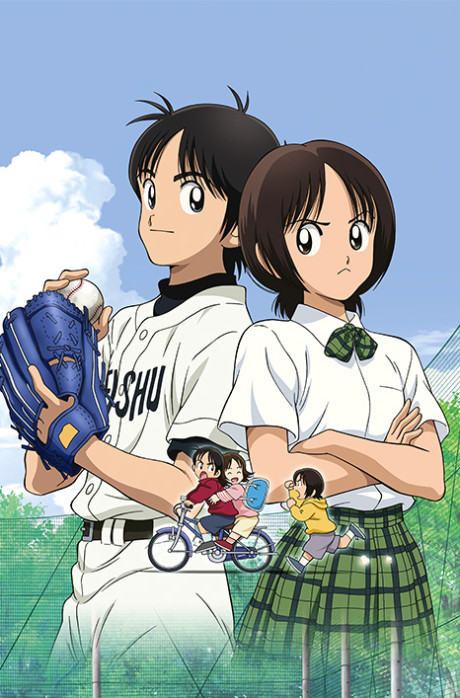
I am always curious whether fans can sell the plot of Cross Game without divulging anything that happens in the first episode. I couldn't do it. As a fan of the show, this is not only a difficult task when somebody asks why this is my top-tier, absolutely juicer sports romance anime of all time, but also a necessary one, since the spoil the emotional investment in the first episode can be an incredibly rewarding viewing experience for the rest of the show.

The show is about an elementary school boy named Kou who hates baseball's experience and... something that makes him want to play... and then he gets good at it. Wow! What a stellar explanation that surely makes this show stand out among thousands. Ok no
Cross Game's first episode happens to be its best, and I can't even give a plot summary, much less a detailed examination, without revealing the show's biggest surprise, so this review carries a major spoiler.

One of the reasons the first episode feels so heavy compared to the rest of the show is because it packs many episodes' worth of information into its first 20 minutes. The events in the first episode stretch across the first 10 chapters of the manga, and considering the rest of the show follows a standard 2 chapters per episode structure, the director could easily have devoted five episodes to the first volume without slowing the narrative. However, when you see that less essential portions of the first volume reappear as flashbacks across episodes 2, 3, 4, and 5, it becomes clear that the creator consciously chose to place the major reveal at the end of the first episode. But why?
Taking Wakaba as one of the central characters and killing her at the end of the first episode in a 50 episode series is not only a bold statement but also a significant risk. The writer risks alienating viewers by removing what the opening episode presents as the most affable character. On top of that, the writer risks not doing the manga justice by accelerating what is meant to be a "slow burning" yet sudden revelation. Most importantly, the writer risks losing viewers' interest by unveiling the biggest plot point barely 2% into the series. Pulling this off requires not only boldness but also the conviction that a reveal like this will ultimately deepen, rather than diminish, audience engagement.

It is easy to see that Wakaba dominates the first episode's focus, which makes her death all the more jarring. There is no foreshadowing, just a sudden cut to a river scene that only makes sense in hindsight. She dies off-screen, mirroring how Kou coldly processes the news. Everything that follows is an unsettling, almost deafening quiet in response to life-altering tragedy, yet we are still able to grasp what is unfolding in the mind of an eleven years old. Wakaba's funeral scene, filled with black suits and silent grief, reinforces this somber tone. Kou, the prince of the series, is caught completely off guard and does not know how to behave or what to feel. The episode ends with him asking his parents to go to the summer festival, not out of excitement, but because it was a promise he made with Wakaba. When he arrives, he does not take in the sights or sounds; he walks with his head down, asking strangers for directions. He passes by someone praying, in that moment, he suddenly realizes what he should do, and what he should feel.

This is the first of 50 episodes, and if that not captures your attention, it is still fair to question whether continuing is worthwhile after losing such a compelling character. I cannot answer that for everyone, but I can say: the first episode is the icing on the cake for me, and the remaining 49 episodes continue to press all the right buttons.
