— — — —— — —
×
— —— —
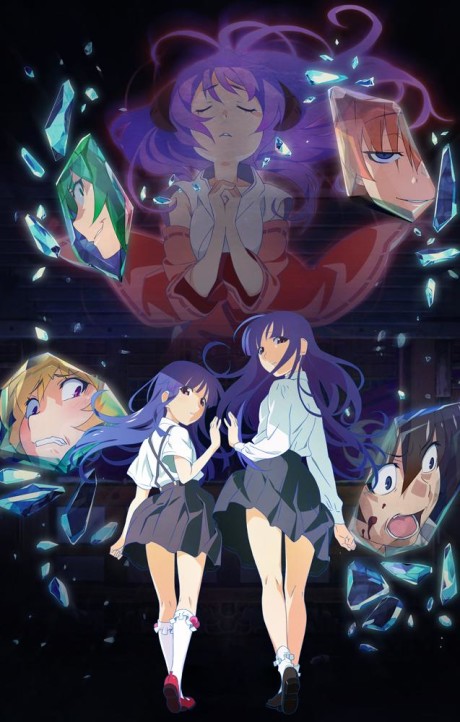
Higurashi is an impressively expansive franchise spanning almost 2 decades with its story brought to life in numerous different types of medium; from VNs, anime, manga, live action, games, novels, audio drama, and even a stage play. I estimate, conservatively, that a fan who exhausted all installments would have invested more than at least 250 hours into the franchise. It has over the years made itself sort of a household name in anime and VN communities alike, which is all the more reason a poor sequel detriments the fictional world to the degree it does. That's where Gou comes into picture, and does precisely that. It, among other things, breaks its characters, trivializes its predecessors, convolutes the extended universe by pseudo-linking it with Umineko—another behemoth that requires a huge investment to get into—effectively barring from entry (or at the very least barring from a profound understanding) anyone who hasn't additional 120 hours to spare, and all around wastes precious runtime with scenes that do not amount to anything meaningful
Gou, onwards from Nekodamashi-hen, skips the answer arcs and, in its haste, decides to expose whodunit and howdunit prematurely, and from that point everything turns south. A new character is introduced, whom I shall call Goutoko. Goutoko appears very similar to a certain character from the original series, but without any expression of genuine humanity, or sanity for that matter. Goutoko is ruthless and extremely tenacious, far more than anyone that remotely resembles a human being is capable of. In stark contrast to the girl whom she's assuming the position of—who was determined but vulnerable and human at nature, she has infinite mental fortitude, and therefore can proceed the plot as conveniently as she wishes to. RNG did not favor her way during her schemes? She'll just kill herself 3 million times until it does! After all, possibility of every non-zero chance event occurring approaches certainty as attempts go to infinity! Never mind one of the biggest plot events of the original being the limitations of one's mind when undergone too much suffering, Rika's concern that her soul will wither away if she does not prevail soon. But make no mistake, Goutoko isn't a snowflake like Rika is, she has the power of being based, which allows her to condemn her best friend to excruciating pains in the hellhole where she was tortured a whole lifetime and stay mentally unscathed. The motivation? "She's kind of a meanie and I don't really like studying lol" Right...
A good transition from there would be the clear undoing of Satoko's character progression as well as a prevalent theme that existed in the original: "That seeking help is something to be celebrated, enduring alone not to be proud of." From Tatarigoroshi to Minagoroshi, Satoko manages to grow as a person and reach out her hand for a miracle to occur. This is a really touching moment and goes to show that, through cooperation, most hopeless of predicaments can be overcome. Yeah... that idea is now scrapped. Satoko becomes a little baby who cannot ask for aid. She instead wallows in self-misery, gets very spiteful, and loses her humanity somehow?? It's a blatant departure from the strong girl who steels her resolve and gets ahold of her future in the beautiful culmination that is Minagoroshi-hen. As someone who really appreciated Satoko's character, this utter disregard for pre-established characterization is intolerable to me; ergo, my choice of wording: "Goutoko".
Since it's Goutoko's time to shine, the main villain of all the previous installment, Miyo Takano, is to naturally be stepped down. But this poses a difficult problem: Takano, whose sheer iron will and lifelong efforts has precluded Rika from besting her for countless attempts in which her conviction stayed consistent, will need to be removed from the proactive role in a sufficiently understandable manner. That... doesn't happen. She just conveniently happens to remember her demise in a previous fragment, finds a letter that she apparently hasn't came across by chance in any of those possibilities, and has a change of heart, preventing a nigh-certain occurrence. This is a gross minimization of the combined efforts of everyone we rooted for, of the flesh and blood sacrifices that've been made across multiple timelines, all to ruin another character.
The last of my complaints would be the many instances of scenes that seemingly don't contribute much to this new tale the show is trying to tell, eating away precious time. These can either be Gou-original scenes like a reformed Teppei going on with his life, or scenes we're all too familiar with like petitioning the child welfare services for redress, debating the Onigafuchi Defense Alliance to request their aid with Satoko's situation, or Miyo's defeat and the subsequent happenstances. While it's not the worst thing in the world to see them unfold yet again in different art-style, when you have a brand new story to tell, I can't help but feel there's a mismatch of priorities to divulge a lot of time to parts the viewer will be intimately familiar with, leaving the real meat of the discussion unbaked. Sotsu may have a better shot in that respect, but the damage is incurred.
'Higurashi: When They Cry - Gou' is a clear blemish in the franchise, throwing the hard-earned lessons of the past to trash and resetting its characters to build them from scratch, it does a disservice to the fans of the original who'd rather keep their fan favorites intact, and their stories not trampled upon.

The streets of Tokyo have been rid of weaponized conflicts. Spearheaded by the Party of Words, a coup d'etat has radically transformed the way of living for the Japanese populace, springing up a matriarchal society where women alone are in positions of power and men are segregated to regions called "divisions" where they have to settle disputes by lyrical battles through the use of state-issued augmented microphones and with it either gain or lose territory; naturally, any other form of violence is strictly prohibited, including non-state issues mics. Through this mechanism, women have taken the lead where men has failed since time immemorial, to construct a society wherein peace and order are upheld in the truest sense, curbing of freedoms but a small price to pay for that worthy endeavor, surely. And thus would be the premise to our title. All of this may have sounded very enticing, and Hypnosis Mic too, is quite enticing in some respects. But you might puzzled as to why I'm phrasing it like my description and the show are two separate entities. And that's because, well, they are. The show could not possibly be more dissimilar than its premise would have you believe. I'm sure you the reader can attest to this, while reading the start of this paragraph, have you honestly thought, even for a second, that I was talking about a different show? Because see, HypMic ARB is hopelessly ordinary, and don't get me wrong, some of my favorite shows deal with the mundanities of life, but in a world that is supposed to feel extraordinary, it sticks like a sore thumb. I want the characters to feel the weight of the system under which they live, to have the fangs of tyranny seeping into their corner of the world, and seeing their opposition forming the baseline of their character. Unfortunately, vast majority of the show goes on like nothing abnormal is happening at all, and the last 2 episodes a last ditch effort to get things back on track to what the pilot episode promised, but too little too late...
The characters are your usual diverse ensemble cast who share roughly equal screen-time as is the case for idol or idol-like shows. Normally this will result in the cast ending up being tropey and weak, and while I can't entirely deny this in the case of HypMic, I argue that it does more than most of its kin. There is some genuine attempt to individualize each character beyond just superficial elements like verbal tics and hair colors, during its runtime all 4 of our division will be facing certain turbulences—some serious and some more light-hearted—that communicate parts of their identity to the viewer in a surprisingly apt manner. Jakurai-sensei's comatose patient for whom he blames himself and suspects foul play, the brief moments where Samatoki seems to have concern for his teammates like not wanting to involve them to his familial issues, Rio's loyalty to his former Navy general, and yet him opposing his fellow comrades in their Machiavellianistic ways to rescue him... these sadly do not tie up to some grand narrative, likely due to time limitations, but it shows that it's not just about pretty boys dissing each other. A good litmus test for well-put-together characters is, in my view, to read a random part of the script and attempt to identify the speaker, and I believe HypMic fulfills that criterion relatively well.
Art and animation are largely inoffensive, but staticity of frames is noticeable in certain parts. The CGI for rap portions are not jarring in the slightest, impressive even, when it's at its peak. The tracks are obviously not on par with the franchise's discography, but nothing to scoff at all the same. The character design has been a strong point of the franchise since it's very inception, and this adaptation is no different. All in all, it's an amusing "pick your favorite boy" kind of show that is bogged down by not having much to do with what you'd expect a show with concepts of such caliber to have.
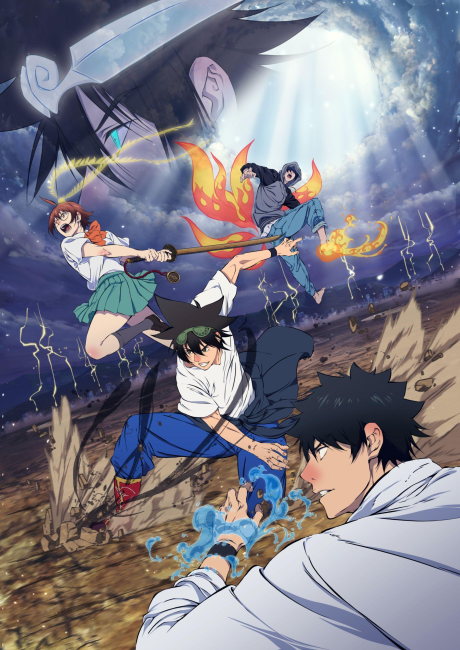
If I were to attempt to encapsulate the idea of GoHS within few words, as the brevity the digital age would have you require, I'd simply say: Battle Shounen on steroids. The more I ruminate on it, the more comfortable I feel at the phraseology of my likening. For indeed, the show exhibits nothing but a gross accentuation of the attributes idiosyncratic to the genre, while consistently outright ignoring the literary conventions for forming and maintaining an engaging narrative, much to the dismay of everyone who has the ridiculously unreasonable bar of expecting more in a story than mere mindless clash of swords/fists. The rule of cool permeates the very fabric of this adaptation; it is comparable to allocating one's skill points solely to one attribute. What should be a mere experience enhancer is mistaken for the main dish and is thence expected for one to stomach a plate filled with naught but condiments and spices. Needless to say it doesn't make for a particularly hearty (nor tasty for that matter) meal. Vague conceptions and aphorisms aside, I shall get on with the meat of the discussion.
As far as any work that features action compounding with fantastical elements go, what is paramount above all else is establishing what exactly those elements ARE, how it ties into the world and its mechanics, as well as the capabilities of the characters relevant to the story. And GoH has NOTHING, and by that I mean not even a SEMBLANCE of this very rudimentary understanding of how stories work in its arsenal. Gigantic swords are conjured from the sky, otherworldly creatures resembling Stands are summoned, anything ranging from elemental magic, cathode ray guns, regeneration, and even teleporting whole cities goes in this story with no apparent explanation to what even is the source of this arbitrary and inconsistent litany of distinct skillsets. Eventually, in episode 7, they chalk all of it up to a mystical power that transcends human knowledge borrowed from the Gods. This helps absolutely nothing; it's still impossible to gauge what our heroes/heroine are capable of, thereby obscuring the level of danger they face at any particular time. It's unimmersive as it is anticlimactic, why should you care about a battle that you cannot make anything out of? Anyone can survive anything, some random god can decide on a whim to bestow you powers. It successfully kills off any excitement one can have over analysing how the tides of battle can potentially change in either combatant's favour. Shows that aren't too keen on building the combat system from scratch tend to instead use internal monologues to give us a sense of the state of battle. This, while not being nearly as satisfying as deducing so yourself by extrapolating from visual cues, works absolutely fine. Too bad they decided not to do that either. As audience, you're but a detached onlooker, witnessing an alien occurrence play out, furrowing your eyebrows at the inexplicability of it all.
The cast is a reskin of the stock characters you've seen a couple hundred times by now. You got the hot-headed and bubbly mc who just loves fighting for the sake of fighting, the stoic and taciturn kick-ass going at great lengths for the people he values, and lastly the uptight and more ordinary tritagonist who mostly assumes the role of the Straight Man in the comical scenes that ensue. On the supporting cast too, the trends naturally follow, but with the added handicap of not being explored at all, unlike the mc's, whose motivations we at least were allowed some minimal disclosure of. There's the enigmatic rich businessman whom we have as much insight on in the end of episode 13 as we do in the beginning of episode 1, some deranged cult leader who just wants to see the world burn, an antagonist who wants to crush people and have as much power as possible because... uhh, you know what forget it, they're stock characters, perhaps better suited for theatre. Though it should be mentioned, my remarks here oughtn't be construed as claiming a uniquely realized cast is a prerequisite for a successful anime, that is not necessarily the case. If the narrative is gripping by itself, inoffensive and simplistic surrogates may very well suffice. But when it's already nothing to be proud of on those respects, this could only be seen as an aggravating factor in inducing head scratches.
There are two subplots seemingly interconnected with the motivations behind the tournament and the fate of the heroes of our story, but it is too unbaked to the point where even addressing it feels like giving it more than its due. "There is a cult-like organization discontent with the usage of charyeok?" Okay... "Mori's grandpa is constantly moving because baddies want him, also he has something to do with NK?" Sure... "Park Meijin and the commissioners have a plan involving the GoH to awaken the key?" What it is, what it is for, how GoH helps it manifest, why everyone and their mother is vying for it, these are all great questions; but well, how about more flashy animation instead? It's all a bunch of vagueries in an attempt to hold in place a series of action sequences, they could be more accurately described as passing remarks than plot points, given that they're mentioned once and never elaborated on again until they're literally at your doorstep. In the unlikely instance where you do get some expository direction, it'll be by means of brief info dumps that are unrelated to the scene in question. I legitimately had to look up the episode synopses in order to remind myself of these plot elements, not because the storytelling is too dense to take in, to the contrary, because there is so little info to go on when interpreting what the hell just transpired that it isn't a feasible nor a worthwhile endeavour.
In short, this is a well-animated fighting compilation that would work perfectly fine as a long-winded trailer for a fighting game. As a full-fledged narrative building up on itself it is an absolute joke.
Edit (1 Oct 2020): The final score of the review has been edited from 3.2 to 2.5 to better reflect the content of the critique. Additionally, some typos are amended.