NOTE: This review is kind of a weird one to start on because It's kind of an extension to a letterboxd review a few days ago, as such some of it's content has been awkwardly Frankensteined together but hopefully the seams aren't super noticeable. On top of this I'm playing around with a lot of concepts I admittedly probably don't have an in-depth understanding of yet. Don't take any of this too seriously. I'm just LARPING.
SPOILERS
i
"Was it my soul splintering into dust?"
This short film is not quite hetrofatalist but a patriarchal approximation of it. An expression of platonic ideal of the Father, represented by a cruel fairy hidden away deep in the woods removed entirely by the banality of civilised society, that is infinitely referred and deferred becomes the reference point of a never ending yearning for the initial moment of “true” adolescent sexual awakening.
ii
“After that, I did not smile or sing and I had but little to say to anyone.”
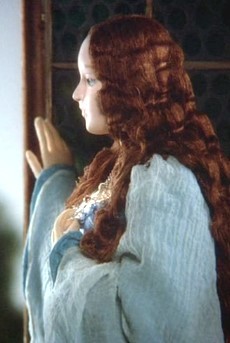
Briar Rose or the Sleeping Beauty is a 1990 stop motion short directed by Kihachirou Kawamoto.
Subverting the traditional Sleeping Beauty narrative for something more sexually charged and, decidedly, more cynical. The story follows Briar Rose, a princess cursed in early infancy by a vengeful and malevolent fairy, who on her fifteenth birthday she stumbles across her mother’s old diary. She discovers that the one who had cursed her as a child was her mother’s first love, who she had believed died during the war. The man, in fact, having survived, Briar Rose set’s off into the foggy woods on a journey to find him. When she tracks the man down to a nearby cottage she consummates with him, the threading needle interposing over the act as a clear phallic representation. The next time she returns, she finds the cottage completely abandoned. Time flows on, Rose’s father calls forth a series of princes who all find themselves broken hearted. Eventually, her mother passes. Rose resigns herself to marriage – taking her mothers place on the throne.
On a technical level the film is stunning. _Briar Rose's world seems so tactile; puppet irises move from behind their sculpted eyelids, their chests can expand and decompress to simulate the act of breathing, every texture is finely detailed and wonderfully decadent. Kyôko Kishida offers a stella performance without which the emotional resonance of the prose could not be felt. The cozy charms of this production cannot be overstated. I’d recommend the experience to practically anyone even remotely interested in the art of stop-motion. It’s a must see.
iii
“I returned to the palace, bleeding in body and soul. And that was all.”
I’ve been tossing and turning Biar Rose as a CSA narrative in my head, to be honest I’m still not entirely sure what my full thoughts are. As far as we can take it, we can say the act of violence here is a disruption that completely distorts how Briar Rose is able to interface with the world around her. Similarly, when returning through the forest you can clearly sense the intense misery radiating from her – the narration mentioning a bleeding of body and soul as if something has been ripped out of her. Even as I’m writing this I find myself more and more swayed by this way of understanding the short. Still, if you’ll indulge me, I feel as if we’re still missing something by succumbing to that framework completely.
There’s something more symbolic going on here. I fear that we’re at risk of losing out on a lot of key content if we take everything at surface value. I’m against literalisation in film criticism as general rule, but especially here as the text is itself harkening back to fable.
iv
“Pale and pensive as she was, her beauty outshone the fairest flowers. I loved my mother dearly.”
I found the symmetry of the film very appealing. Rose who's drawn into the orbit of the Queens long lost object of lust only to become inheritor of her burden, that being a never ending malaise of "ought to". What starts of merely as the drive of curiosity towards a kind of spiritual genealogy, transforms itself over the course of a night to a complete transcendental merging of the mother-daughter roles. Indeed, the film itself seems to regard daughterhood as carrying within itself the obligation to fulfil the unfulfilled debts of the mother.
v
"And I am here to take her place!"
Princess becoming self-same-but-different with Queen through the act of intimacy with their shared love-object; you can imagine both of them occupying the same position in the same place, only separated by time. The film cares little to differentiate between the economic and romantic aspects of this affair, they are after all inextricable from one another. What I'm interested in is whether we can even say Rose is acting upon her own desire, or if she's merely another body repeating the exact same circular movements of every generation before and after?
vi
“Any other reply would seem discourteous. Would it not?”
To return to the very first paragraph of this review, I want to clarify what I mean by “Father”. What struck me about the text very early on was the way you could almost construe the relationship between Rose and The Fairy to be pseudo-incestuous, what I mean by this is that The Fairy can be understood as the lost true Father. The Father that could/should have been if fate hadn’t delivered the Queen to the monotonous jaws of the interpersonal politics of marriage within the ruling class, mediated of course by the symbolic codes and structures that govern these interactions - which is why I think this short has a strong sense of hetrofatalism even if the narrative itself deifies a certain kind of fleeting but perfect type of male/female relationship.
vii
“The man was gone.”
I think the relationship between Rose and The Fairy can be understood then as a longing for a truer more archaic patriarchal ideal of The Man. An identity that the film maintains as a romantic ideal object that is always distant, always fleeting, never quite within the heroines grasp – nor, crucially, her mother’s before her. In this sense The Father and The Lover archetypes become one and the same through the super imposition of the eternal reoccurrence; the same effect is achieved with the collapsing of the Mother and Daughter archetypes which we have previously discussed.
Could we call this an Oedipal existentialism? If we’re going to move in that direction I want to urge that this a process of which the Oedipal complex get’s written in large as a structure that codifies relations – not the inverse. Key here is that Rose takes on her relations with The Fairy not out of her own desires but out of an obligation to pick up where her mother left off. It is not just the true Father but also the desire for Him that is infinitely referred and deferred through both past and future generations. Reproducing abstract forms through the material repetition of the movement of bodies, kind of like how computer screens burn images into their surface without the protections of a screensaver.
I’m suspicious of what I’ve written but I’m unsure of why just yet. Regardless I want to jump off this train of thought for the time being until I’ve done enough reading to assess the ideas outlined here as properly as I can.
vii
“Was my heart asleep? No.. rather, it was dead and buried in a forest of thorns”
In conclusion, Briar Rose (1990) is a short well worth your time and attention. The profound level of craftsmanship on display combined with the rich tapestry of prose that, like all good fables, takes a simplistic narrative and reveals the complex layer’s that are interwoven under it.