— — — —— — —
×
— —— —
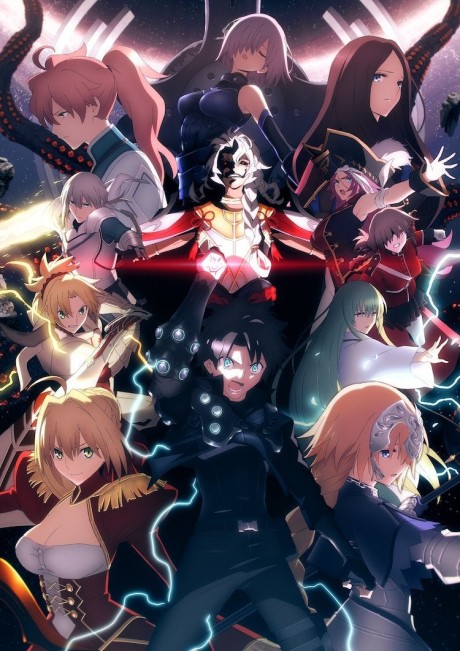
There's a cold, crushing type of hopelessness to the gacha anime adaptation - the type to eschew all cohesive tenants of the form in the name of a singular end product that can be marketed towards fans of said franchise in the pursuit of more profit. So it is that again and again, we see mediocre products churned out in anime to satisfy that core audience. Kantai Collection, a barely tangible story smashed up by subpar animation, needless convolution, excess of characters without any motivation to highlight more than the handful of main boats, and weak battle scenes to prop up the rest. Azur Lane, more of the same but four years later. Girls' Frontline, more of the same but two years later and with gun girls. Between the Sky and Sea, absolute nonsense in every sense. Granblue Fantasy? Granwho?
Even the handful of exceptions to this are in their own weird spot. Princess Connect! Re:Dive makes no illusions about being a contentless show to simply get lost in its food and comedy-related shenanigans, and the animation is on-point, but it only gathers deep enjoyment from its premise by the second season. Umamusume: Pretty Derby also only evolves in its second season, with the first being more of the same generic gacha adapation staleness. And how to forget the tragedy of Magia Record: Puella Magi Madoka Magica Side Story, brilliantly adapting a weird, dense, inexplicable gacha game story into a surrealist anime plotline for its first season that hilariously derails itself by the second season in a production that could only be kindly stated as "troubled"? And of course, you can like, even love gacha game anime adaptations. But there's a cynicism and coldness to nearly any of them that makes it impossible to see as anything but calculated.
And so we get to Fate/Grand Order. Fate, a franchise already impenetrable enough with its numerous storylines and subfranchises (many set in the same universe, all sharing the same general lore), now has a gacha game thrown into the mix, one arguably surpassing the popularity of all other Fate properties to where it's perhaps what a number of people may default to thinking of when thinking of Fate. It is also no less impenetrable, and due to both its status as a gacha game and the poorness of being adapted throughout its history, is maybe even moreso. If you're an anime-only person, you've already lost with Fate/Grand Order. The first arc of the first part of F/GO's story received a very poor adaptation. Six arcs later, you have a two-part movie deal, both of which are very poor with questionable adaptation choices. But wait, the arc after that actually got adapted before that, and is a TV show (it was mediocre). And now the final arc of the first part has a movie adaptation. There's also an anime-original special that takes place between Part 1.5 and Part 2, mildly interesting on account of it being 30 minutes of nothing but talking heads. What about arcs 2 - 6 of Part 1, or anything else? No, don't worry about it.
So let's forget the notion entirely that this is meant to appeal to anyone who is not already submerged into F/GO's story. It has everything a fan of Fate/Grand Order could love and dream of. Impressive animation, with cool CG to highlight the monstrosity of the demon pillars (itself easier to look at than the PS2-esque CG animation of Babylonia). Fight scene after fight scene. Lots of cameos! A number of those cameos even get to use their cool Noble Phantasms! Huge, emotional climatic moment after huge, emotional climatic moment! All (nearly, at least) of the plot beats in the game are matched here! It's everything that anyone could have ever asked for.
Everything delivered in such a calculated, cynical way that it struggles to get any enjoyment out of me. Where to start? The animation is very good, but the technicality of it loses an emotional resonance that can't be achieved otherwise; compare this to even a technical masterpiece in the same franchise like the Fate/Stay Night: Heaven Feel's movies, all beyond impressive-looking but using those visuals as a driving emotional and subtextual force for its themes. The entire second half of the movie feels like one big ending scene, which is very exhausting and draining (fine for the game, terrible for this). Fight scene after fight scene might sound cool, but there's a reason very few media is able to pull it off: you need some kind of levity at some point, which this movie never offers. This leads into a broader pacing issue, something every single Fate/Grand Order movie has had, but this one suffers from especially badly, even compared to the terribly-paced Camelot movies. Most of the cameos aren't voice acted, which is a logistical issue that can't be solved realistically, but still is noticeable (leading to an unintentionally comedic moment where none of them respond to Goetia as he yells questions at everyone in anger). (Also, for being on the poster, Enkidu sure does less than literally anyone else on there.) Special mention to the audio in this film; it is somehow worse than the Babylonia TV adaptation, which itself was somehow worse than the notorious Fate/Apocrypha TV adaptation.
The huge emotional moment after huge emotional moment aspect is particularly terrible. It works in the game, coming off of multiple arcs told through a visual novel format with increasing stakes, odds, and tension, with deep character bonds formed throughout. Without most of that, what else is in this movie but 90 moments of poorly-conveyed emotion? It's not that it's done bad, but it's so incomplete that it doesn't even matter. And when I said nearly all of the plot beats get covered? Special thanks to the atrocious way Mash's resurrection gets handled. What's done in a slightly trippy, dreamy sequence as a very brief break in the action of the story by the end is instead shoved to an awfully-done sequence in the credits, no voice acting, just text and static imagery that flashes by super quickly, thus burying one of the most confusing moments in the whole film (which itself feels like cheap writing inherent from the game, if necessarily done to keep Mash around).
In the end though, it'll certainly appeal to many F/GO fans, perhaps even former F/GO fans, perhaps even some other Fate fans or general consumers of action films. It has done its purpose as a way to adapt an arc in the story to bring more attention to its franchise and convince more to play it, especially if you've never played the game before yet are watching all of the F/GO anime for some reason. It really doesn't matter how cynical the product is, even with the labor of love put into it. Even badly-made gacha game adaptations can still succeed in its intentions. F/GO has especially got it made, the Solomon movie succeeding in its goal of continuing to propel the cash cow franchise for years to come. As a piece of media among many to watch, nod my head along, and go "Oh huh, that was cool that they showed off Sanson's La Mort Espoir even though he's just a two-star", it is certainly among one of many pieces of media I have consumed. But is it too much to ask for these gacha adaptations to at least be better, aim for higher, be more than just Trojan horses for their franchises? Surely, if they have to exist, it must be reasonable to ask for that bare minimum.

One of the most poignant, emotionally-complex films of all time, from a series full of poignancy and complex emotions.
What, you want more explanation? I dunno, go like, watch the movie with an actual eye for film analysis and thematic appreciation instead of crying about how much you hate Mari and how you think Hideaki Anno should have adhered to nothing but Lore and Cool Mecha Fights and how Shinji should have fucked [insert your favorite girl here] or whatever. People calling this creatively bankrupt are rich; when Anno rehashed the first arc of Evangelion wholesale in the first Rebuild movie and only diverged from it entirely in the final act of the second, no one thought he was just trying to sell figures or whatever, but given actual comprehensive writing and building upon the series' themes for an entirely new story with the third, and he gets accused of not caring about Evangelion. It's almost like these people didn't care about anything in Evangelion except for the cool fights and girls or something...
I'll at least give you a push in the right direction to view this film through though. When presented with a complete overhaul of not just his life, but the entire world and how it operates as he knows and understands it, down to the very internal logic upon which the world acts, Shinji has to grapple with the stark reality as he knows it and find greater meaning beyond his own internal, closed-off universe. This differs from the television show, where Shinji is only able to confront a shifting of moral values after being passively thrust into an inescapable situation, or End of Evangelion, where Shinji is only able to confront his own personal failings after choosing to forego changing himself in favor of taking the easy way out. You might notice the slight but incredible differences in each of these situations; as Shinji's problems morph from entry to entry, mirroring Anno's internal struggles as a human being and a creator, so too do his responses, and so too do his consequences and ultimately how he chooses to resolve them for himself.
This is not an abstract situation that he finds himself in here. There is no sinking into surreal thought experiments and self-reflection. There is no loss of the self in favor of melding with everyone else. There is nothing but the cold, hard truth; the world has ended, everyone wants nothing to do with you, and the only one who can bear the weight of your mistakes and sins is yourself. In this light, watching this movie is honestly a drag. There's no beating around the bush; this is an hour and a half of Shinji reckoning with his own faults and figuring out how to make sense of everything and still find light where there is nothing but darkness. The film is almost entirely set-up, and so resolution rarely arrives, and when it does, it is entirely born out of the characters' drives to see something change in this world, lest tragedy happen again and again. You have to be okay with the fact that you're watching a movie about struggling, knowing that the outcome of your struggle isn't entirely clear (and for nine years, audiences did not get this closure as well).
And so it is that this is a top-tier film in every regard. Not because the lack of resolution or decisiveness makes it such, but because it accurately reflects the very real and ongoing fight for happiness, for making sense of the world around you, for living. For such a lethargic, sombre film, it really can't make its point any clearer than it tries to. The constant questioning by Shinji of his own (and everyone else's) motives, what it means to exist in a world that rejects you entirely and ultimately only wants to use you, and how to ultimately still believe in something no matter how unlikely it may be... doesn't it strike you as hopeful? There is a clear intent here on Anno's part to detail escaping the pitfalls of depression and nihilism, despite how prominent they are and how they can always strike. This makes every scene between Shinji and Kaworu hit all the stronger compared to the television show. It is not just simply love born out of deception, or love born out of holiness; it is love born out of existing, surviving what the world throws at you, knowing that even if that love may one day end, what matters is how it impacts and shapes you.
Of particular note is the difference between WILLE and NERV's goals in this film. While the Eva units were obstinately a tool by NERV to fight Angels and prevent the apocalypse in the show and End of Evangelion, but ultimately designed to bring about a melding of all consciousness (thus bringing about a particular kind of apocalypse), in the Rebuild series, the intentions of Gendo Ikari can't be made any clearer and more direct. So long as you desire something wholeheartedly, you should throw away the world for it. Led by Misato, WILLE wants to prevent the total end of humanity, at the expense of all other living and desire. For Shinji to see both sides himself singlehandedly, and ultimately reject both in favor of trying (and failing) to find another solution, is a clear sign of character development on his part. Though he may not be consciously aware of it, and though he is still dragged down by the world's overwhelming desire to force him into the role he must play, there is still room for another option, to escape beyond destiny, no matter how much it dictates a particular desire.
And so it is by the end of the film, as Asuka lectures and puts down Shinji and drags him through the wasteland of their final battle with Rei blankly following them, that we come to see what the film states, what Shinji figured out deep inside but still has trouble fully accepting until directly and immediately faced with the consequences of his actions (as opposed to only seeing them in retrospect): there is still hope to be found. If only you realize that running away from your problems creates more issues than it does solve them, you can just break free of the cycle. And as Shinji learns this cold, hard truth in the aftermath of total destruction, so too does Asuka and Rei, so too does Anno, so too does the audience. No matter how pitch-dark the world is, there is always light to be found and use to navigate the darkness. You just have to reach out for yourself to find it.

Reiketsu-hen was always going to be the toughest film in the Kizumonogatari trilogy to talk about. It does many things that are tough to analyze from a critical perspective, most of which are due to the way the adaptation has prioritized character development across its three parts. While Monogatari as a whole has many dark parts, I would easily call this the second darkest part in the entire series. Character motivations are either not made entirely understandable or otherwise vague. The grand, powerful final fight has a mix of different tones and emotions that are tough to sort through the first watch or two. And despite being the final film for a series obviously intended to be watched as a whole, it arguably feels the most like a full stand-alone film, putting it in an awkward position get a hold of, also resulting in some weird pacing. On top of all that, it has two polarizing scenes to drive home its theme of misery. One is the scene right after the long-awaited fight.
The other is that scene.
You know. That scene.
It's my belief that talking about and sorting through that scene helps make it easier as a whole to decide how to feel about this movie. Or in other words; why one likes/doesn't like the scene influences how one feels about this movie (and Kizu as a whole, really). I believe it's that important to the film, and even if it isn't, it's inspired me heavily enough to critically analyze and write about it, so spoiling it to some degree feels like a must. Having watched anime the past ten years and coming from a nearly-unwaverable "ecchi is bad for an anime" viewpoint, Monogatari has always been a tough series to fully immerse myself in, but each of the Kizu films has their own specific moments of ecchi fitting for the films they're in, and the moment in this film is intense, to say the least.
Before getting to that however, it's important to stress how fucking fantastic this film is with its commitment to its themes and lessons. Of the three films, characters feel the most complex and explored here. Even though Shaft's approach to the Monogatari series has always been artsy and indulgent, this feels the most artsy of the Kizu trilogy (or even the series) by stripping away the flashy layers and getting right into the ugly nature of the characters' predicaments and motivations. Vampires are cruel, possibly not worth saving, and people can easily be just as cruel. In the most dire of situations, there's no way for everyone to be happy; only misery. Wounds run deep. The consequences of your mistakes can be eternal, born entirely from personal flaws. No matter how you look at it, the entire story of Kizumonogatari has no firm uplifting outlook for nearly anyone. They can only go uphill, in other words.
So about that scene. The exact nature of how the ecchi/fanservice plays out in this movie takes on a different context from either the previous films or the rest of the series. Such moments are usually intended to be comedic and played for laughs, regardless of how far they go, and are generally surrounded by either light-hearted or neutral moments of the show. But in this case, total darkness and despair surround it.
Araragi can't bear the thought of living if it means his family dying to Kiss-Shot, or even eating people himself. Hanekawa, his savior, goes far and beyond his (and our) expectations by boldly allowing herself to be eaten by him. Not only would she selfishly throw away her life for Araragi, she would gladly do it for anyone she considers her friend, putting her actions in the three movies and in the rest of the series in such stark context. The degree to which she considers him to be her friend (and the not-so-subtle text of her being in love with him) is such that she's fine with enduring the consternation of her underwear in full view of him, or the vastly uncomfortable buildup of Araragi wanting to touch her breasts, even anticipating it resulting in more. It's Koyomi Araragi, so she will gladly put up with it all. And as she states afterwards; she definitely has to put up with it.
Meanwhile, the entire scene was initiated by Araragi, for the first time since becoming a vampire, indulging in his hormonal desires of "want touch boob, must touch boob". His excuse for it is so flimsy, ridiculous, and desperate that Hanekawa sees through it immediately, but still acquiesces to him. After hearing from her that she won't get mad, his approach to the situation changes almost immediately and he acts in a way that's easy to see as cruel. Even as Hanekawa accepts and is ready for things to go much further, he still acts dominant, almost using her promises and feelings for him against her just for him to touch her boobs. The entire scene plays out in an almost pornographic manner, so of course he never goes that far. He snaps him out of it and the situation gives him an incredibly silly reason, yet 100% fitting to his character, for continuing to live on and fight.
He got to hear a girl, in-person, to him, talk about the sluttiness of her boobs. His whole life lived up to this singular, incredibly human moment.
It's this kind of incredibly complex mess of emotions that makes this scene feel so vital. I have to admit that I would have liked this whole series a lot better (or a lot more readily) if it wasn't so open to ecchi and fanservice, sometimes pretty intensely. But with what the series has given us, this is maybe the most they justify it beyond "Araragi is perverted" and also the most enjoyable (besides, even if the series had way less ecchi they probably could have justified this still). This moment is hugely important for both Araragi and Hanekawa and defines aspects of their relationship and interactions down the road, and does so as wonderfully directed as it is. And because it goes intentionally over-the-top, it manages to paradoxically feel way less gross. The classical piano right when Araragi has his realization is not only perfectly timed and fitting, but combined with his face manages to make it incredibly funny.
But as much as I talk about one scene, so much about this movie is eloquently done. The absolute one-two sucker punch of Araragi and Shinobu's (now fully Kiss-Shot) conversation followed by the very next scene is so beautifully done and cruel to the viewer that I can't think of how much better it can be done. The tense escalation in the first scene with Oshino and Araragi, culminating in the reveal of the full extent of his involvement in everything, is brilliantly done and sets the stakes well, especially with the foreshadowing. The final two scenes crushes the viewer's hopes that this story has a positive ending so swiftly and quickly, as if the movie never gives it a second pause, works fantastically in placing them along with the characters. The bittersweet monologue from Araragi at the very end. Each scene itself could warrant paragraphs of analysis and praise.
I only have two complaints about the movie. Despite the fight ultimately making itself worth the payoff, I can't help but feel Shaft may have gone too overboard. At points it feels like slapstick harshly interrupting the action so unnaturally, and threatens to spoil the mood the movie worked for. Perhaps there was a different way to handle the humorous aspects or make it flow better into the action.
My second complaint, a bit oddly, is with the story itself. Characters in the series can end up being real inscrutable and thus makes everything nonsensical. Given how the show's universe works, this ends up in its favor. However, some revelations that get unearthed end up making things super convoluted and hard to hold up to scrutiny, or are otherwise just total headscratchers. It's maybe one of the most convoluted plot points of the entire show, if not one of the most convoluted parts in the entire series, which definitely says a lot. Thinking too hard about it could probably lessen the impact it has for you, but even then it's not such a big deal; it almost makes what happens even more tragic for those involved.
Somehow, even with its faults, even with its incredibly polarizing moments, it pulls it off. It pulls it off in such style that I can forgive the second part for feeling a little bit like a drag. I end up crying during moments of this, and feeling so engrossed in the action. No other part of the series has made me like (or at least sympathize with) Araragi nearly as much as this does, and it manages to do so much and be successful. But this part really pulls out all the stops in making itself worth the watch, garnering respect without even trying. While the first part is more easily watchable whenever one wants and by itself, as well as feeling more loose and benefiting from it, the third part is how everything ties together and tries to answer all the questions remaining by it. It makes Kizumonogatari my favorite part of the entire series.
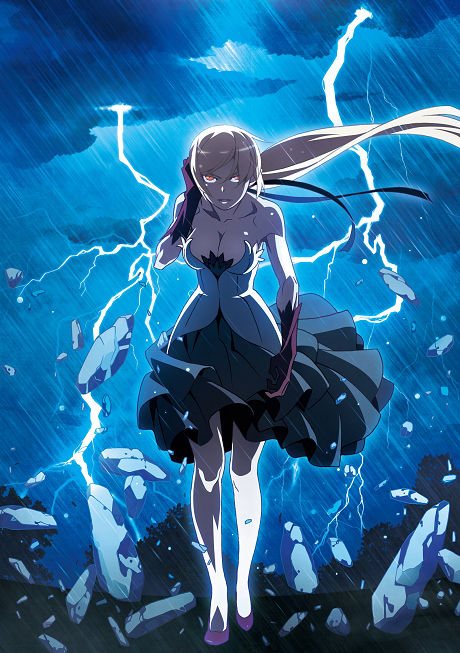
As you enter Nekketsu-hen, the point in the story finally building upon the concepts of humanity and selflessness, where we finally get to the real fight scenes of the movies, it's a little bit hard to shake the feeling that it's constantly, if subtly, off. It's easy to miss the first watch, and if you can brush this feeling aside and enjoy it you'll totally and fully love it anyway. But it feels a bit barebones and skimping on key moments that result in a wobbly progression throughout.
The mark of a good adaptation is being able to change source content or adapt it oddly to fit the medium, but in a way that feels not only natural but easy to immediately love it. Even if it sticks out, you still love it anyway. (See; the constant flash card cut-ins and outs.) In the first movie, there were moments that felt like they were handled in a noticeably different way. But because it fit in with the overall tone of the movie and its relaxed flow, it felt natural to enjoy or even like. This movie does it at points, but even then, because of the weird and uneven flow and story beats, it just feels way off.
Dramaturgy is perhaps the most noticeable example. It's hard to get a clear sense of what his character is, since he's noble and rational even if it's not seen much. You get the sense that there's something critical missing that ties in the themes together (and indeed, there are some stuff missing that some may call critical). After he is defeated, there is no more ruminating about him. He was merely an obstacle.
This wouldn't be a problem if the story was trying to make clear parallels and conflicts for each fight. Koyomi Araragi, a human turned vampire, facing off against a vampire, a half-vampire, and a human, all hunting vampires. The way it is all set up to test Araragi's humanity and his conviction (the Guillotinecutter fight is where all the conflicts get tested in an amazingly-done scene). It falls flat because each time, we miss some context that explains the hunters' goals and motivations. As great as the last battle is, we only get a hint of what Guillotinecutter is capable of, how much of a monster he is. The end result makes it not feel so satisfying, even if the fights are good.
The switch-off to scenes with Tsubasa Hanekawa before each fight doesn't make it any better. In the first ten minutes of the film, Araragi tries to brutally end his friendship with Hanekawa because... he wanted to feel human. With how sudden this sequence happens, everything happens too quickly and it's hard for me to understand the point. Were we supposed to think Araragi is an absolute idiot and asshole? He sort of is both but not to the extent that the scene portrays him as. Luckily, the next two Hanekawa scenes are not as bad in this department, and it feels more natural even for the kind of movie it's in.
This is why I still think this film is really good. There are moments where everything just shines and feels bright and vivid! Hanekawa admiring Araragi shirtless and making excuses to feel his abs. Hanekawa slowly roasting Araragi after finding the adult magazines Shinobu brought back. Hanekawa taking charge and shocking Araragi in the fields in her third scene. Even in the fights there's fantastic moments. Episode's cheesy yet hearty laughter interjecting itself visually during the first half of the fight sells him for me. The baby noises during the moments where Araragi figures out his body parts can regenerate. Guillotinecutter's cold, sadistic laughing when he believes he's already won. It saves what's otherwise an uneven and therefore so-so film.
Special mention to the soundtrack and animation here. The animation gets more adapted to portray fights well, so even in the most gloomy unexciting moments (like Araragi attempting to throw baseballs into Dramaturgy's face, or during sections of Araragi avoiding Episode's cross weapon) it manages to feel fresh. Meanwhile, with the soundtrack, there are climaxes of songs and even brief moments of stuff like intros and bridges, the action or visuals sync up to the music. Even in the calmer scenes with Hanekawa, it manages to hit each mark and strengthen the bond these characters have. It can capture moments better than any monologue can. The absolute best moment musically is when Araragi succumbs to his vampire powers against Guillotinecutter, the Drum and Bass music pounding away as he loses control. The visuals of him tearing up the streets sell it; it's as over-the-top as it needs to be.
This movie really did need to be longer, maybe one to three minutes in each scene setting up context and explaining things the film only alludes to. But for what it is (an underdog fighting to become human again in the most intense ways), it's a very serviceable and fine film. The way the fights get more and more serious as they go on is a perfect lead-up to the final film. So if you watched the first one and you're wondering whether you want to watch a bunch of fight scenes, my answer will always be the same: yes. Don't skip out on this, even with its issues.

For those who have stuck with the Monogatari series for the long haul (in particular the anime, as that is what I have the most experience with), it's no surprise that one of its biggest strengths is the atmosphere it creates. A broad concept, yet fulfilled in many different ways. The dialog-heavy conversations between characters (the point where entire episodes have consisted of only two distinct conversations), soundscapes underpinning moments of both comedy and drama, slightly-heavy faces with odd animation that admittedly got better as the series went on, setpieces and places emphasizing tension and characterization... take your pick. Each season creates its own atmosphere in a variety of ways, giving every single one its own style and character.
Each of the Kizumonogatari movies have their own character to them culminating in an overall tremendous experience, but I can't help but be so drawn towards the first of the three, Tekketsu. I'll be upfront about it; this movie is almost entirely setup for the next two, with the main attractions (that being the fights and Araragi's struggle with his humanity versus living as a vampire) only teased here. It's hard to really be into something that spends an hour primarily building its foundation, but Tekketsu saves itself from being plodding by making sure to have every scene matter, feeling like it means something.
From the start, it leaves an absolutely strong and notable impression. After all, it's not until a little over eight minutes in that characters start speaking. Gone are our main character's (Koyomi Araragi here) inner monologue and narration, and the silences during conversations normally taken up by inner interjections is instead taken up by... just that. Silences. Throughout the movie, there are only three sizable conversations that make up the meat of the movie, and only two feel like conversations from the television seasons; with Tsubasa Hanekawa at the beginning of the movie and with Kiss-Shot Acerola-Orion Heart-Under-Blade (hereforth referred to as Shinobu for ease) during the cram school scene.
Even then, small bits of quiet break up the conversations in awkward ways, hijinks are practically nonexistent, and familiar conversational beats rarely happen. Instead, characters talk at their own pace, topics drift in the air caring little about getting to their destination, and everything happens at their own pace. It feels less like story happening and more like people talking, which is great! It makes the setup feel more natural, despite this movie being able to be summarized in only a single paragraph (and probably not even that much is needed).
As far as other movie elements that feel loosely defined, the pacing is also definitely in that category. All events happen at their own pace, which is better for a character-focused movie that's primarily setup than what is supposed to be a tightly-packed story-first series. While the movie doesn't have to do this, it often works for its advantage. The best example is 20 minutes in, with the build-up of Araragi following the trail of blood in the subway taking three minutes before reaching its conclusion. At various points the camera wil linger on small details or angles to focus the tension closing in, emphasizing Araragi's face at the most claustrophobic bits as the gravity of the situation truly sinks in. During scenes like these, as the film creates absolutely memorable moments, it'll do so on more relaxed and humanizing terms. It really does make characters feel more like real people, despite the absurdity and/or gravity of the situation, moreso than almost any other parts of the Monogatari series.
This is why when we have absurd bits like Araragi and Hanekawa's meeting, it feels less typical, less gross, and more funny than other anime that don't commit to how absurd they hammer home the bit and really emphasize how the characters feel. (The car crash right when that bit ends is perfect; catch the wreckage of the car later on in the scene.) Here, the comedic timing of the situation, the flow of the music, the incredibly gorgeous and expressive animation highlighting it, all work to serve the moment. Parts like this in all the movies, but this one especially, help it feel so engaging where any other treatments would probably lead to a collapse.
This kind of over-the-top absurdity is also highlighted with other elements of the film as well. The gorgeous, breathtaking 2D animation is contrasted against what seems to be oddly rendered 3D environments, making Araragi's adventure feel all the more bizarre. How about the cram school? In the television seasons, it's framed as a tight, claustrophobic building that ultimately ends up as many characters' salvation. In this film, it has the appearance and size of being a castle, a giant lonely place for Araragi and Shinobu. The scene where they walk around in it talking to each other takes ages as they explore different parts of the school (also having a loose flow to it), and it's captivating as a result. Or the pained, shocked face Araragi makes; it borders on ridiculousness but the film is self-aware enough not to make it too funny or attention-grabbing the entire time he makes it. And so on and so on.
At moments it gets to be too much. There was never any need to have Araragi and Hanekawa's meeting happen like that, but that ties into personal taste for how I do not enjoy Araragi whenever he's a part of the series (despite liking him more in the Kizu movies). With this being wholly setup, there's going to be times where this won't do it for me as much as the second or third parts would. Some parts of scenes feel a bit too vague or cryptic, as if stuff is passed over from the novels and we're left to infer more than we should. Oshino who is a bigger part of the next films, does not do too much here, despite him being introduced in the final third.
But even with the above, I ultimately think that the best aspects carry this for me and cater to my personal tastes the most. Plus, given its position both chronologically in and out-of-universe, it feels like a good place to let people new to the series to start (all they'd have to get over are the art and slight dialog barriers). Try and ride with it being a film almost all about setup; the payoff will be super worth it.
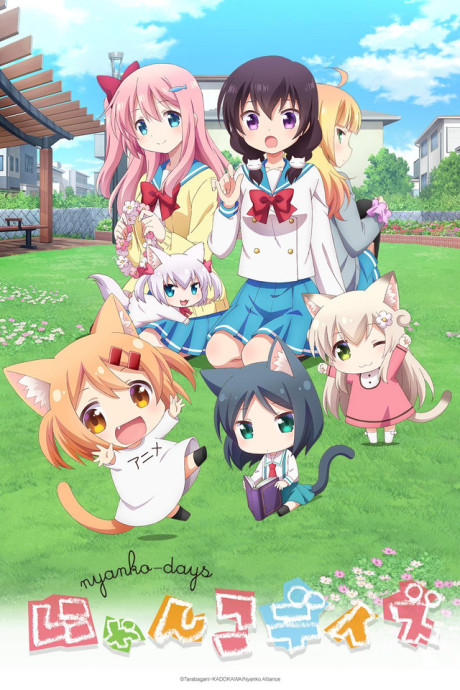
Lasting the length of a single standard episode, Nyanko Days is cute and fluffy, and gets by entirely on being cute and fluffy. In fact, there's so little substance that it's a struggle to even talk about the show beyond its substance.
It's not really that it's bad per se. It's mindless and cute stuff to turn your brain off to for about a half-hour, so it's perfectly serviceable in that regards and serves its function in that way. It's also incredibly cute which no one can deny. It's hard to criticize because it effectively serves its function and arguing against that function just feels like it comes off as weird and nitpicky. But one can afford to be nitpicky over a series that is, effectively, nothing.
When you really get down to it, Nyanko Days is the most anime thing an anime is. Anthropomorphized cats, big eyes and cute faces with characters fitting nicely into archetypes, constant sugary cuteness, loner girl starts to hang out with non-loner girl... it manages to be incredibly exhausting in the very short time it runs, because it feels so much like other similar anime. I don't need originality, but I need something that's derivative with something to offer, and there's nothing here. Not even the cats are cats I can care about. Basically the visual equivalent of "in one ear and out the other".
Part of this is definitely due to the fact that every episode is two minutes long, with only about 70% of it being actual content due to a five-second long opening slate and a 30-second long ED (approximately). There's almost literally no time to even absorb anything is happening, because everything is so rapid-fire that it washes over incredibly easy. Even multi-part episodes suffer from this. It would have honestly been better to split it up into four-minute episodes, or even eight-minute episodes, because at least then you can realize an episode is happening. Even poor slife-of-life anime get by with so-so paced 24-minute episodes; two-minute episodes where a thing happens is beyond the pale.
It does some things serviceable at least, in a way that doesn't make this anime feel like an actual waste of time. Yuuko Konagai and Azumi Shiratori may not be great characters, but they're done fine enough with at least a bit of interest that it's fine (and also have cute interactions together, more cute than anything else in the show). The, uh, arc with Ran Iketani, the girl who's scared of cats, is amusing while it lasts. The ED should be annoying but it ends up being catchy (I still have it stuck in my head even now) and at least has serviceable visuals for it. Aurally, it has a bouncy and bubbly sound design (but especially when the cats are the focus) that it makes up for the lackluster art. Two of the four cats are distinctive. The anime is so short that even if you find it dreadful, you won't have even spent half-an-hour on it. The voice acting was okay.
Really it's hard to name what I like about it when there's so little to care about that I have to stretch myself to name positive aspects. But it's enough to not make it a bad anime, just really mediocre. A lot of it comes down to its awful pacing of two-minute episodes, but even if that were fixed, it'd still be really unmemorable and nothing more than a blip in my memory to remember to possibly check out the manga, if I could ever find the time to do so. So it has some benefits, just not many. If you're that into slice-of-life that you need to watch as much as you can from the genre, or have a spare half-hour you can't spend starting/continuing another anime, then you at least have this. Otherwise, there's too little of value to even passingly recommend. But hey, cats.