— — — —— — —
×
— —— —
THE FOLLOWING REVIEW CONTAINS MAJOR SPOILERS FOR FREESIA
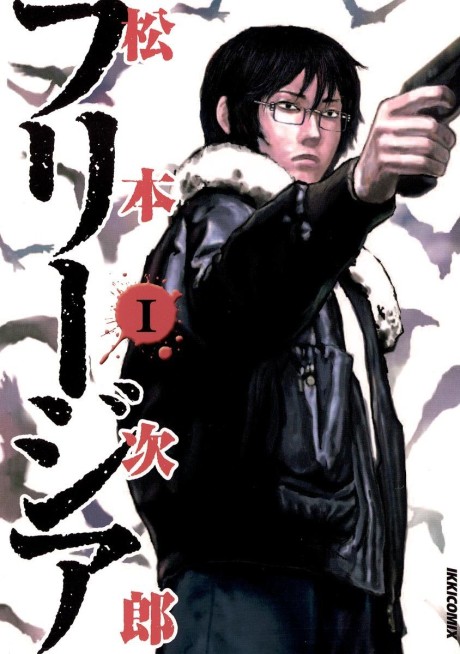
Freesia, created by Jiro Matsumoto, began serialization in 2001, and although it never quite got successful enough to get an official translation, it has certainly become one of the most fascinating series to come out of the 2000s. Its downright repulsive art coupled with an equally revolting story sets a unique vibe that will probably turn most sane minded people off, but looking past it and jumping headfirst into it will allow you to go through the most thought provoking experience you can possibly have with manga.
So, what is it that makes such a seemingly excessive and edgy series so special? The best comparison I can make may seem a little strange at first, but it is ultimately incredibly fitting. Think of The Matrix. Think about how that franchise sort of lured a general audience in with its bombastic action and unique world building to then hit them with a one-two of the most thought provoking philosophy in blockbuster history. Freesia similarly starts off with a very tempting premise. It sets up a gritty, violence ridden world similar to something like Psycho Pass. It is confident about its tone from the get go and pushes its hyper interesting ideas to their very limits before completely breaking them down in the finale.
This aforementioned tone may very well be what has enticed so many readers to actually get through some of the stranger elements. It is a wonderfully sadistic concoction of disturbing, violent thriller and some truly messed up dark humor. Despite what some of the more pseudo intellectual fans will have you think, this series is really just one big comedy. Kano’s constant strange behavior constantly got a laugh out of me before it uplifted me. The series is definitely playing a juggling act, balancing all the elements I’ve mentioned together, but I feel as though it works wonders and is a huge part of the reason why this series speaks to me so much.
Enough about the technicalities of the series, though; it’s time to sink our teeth into its meaty meal. In the broadest sense, Freesia is about how our worlds distinctly affect our psychologies and what happens when those ideals or morals snap in front of us. It is almost an exhibition of flawed and sometimes twisted people trying to get by in a cruel world, lying to themselves with codes and rules to try to ease the pain, only to see it all crash down. Instead of facing the terror of reality, we hide ourselves under heavy coats of denial and hallucination until we simply go crazy. It is not a story of happy endings, in fact, most parables here end with either death or complete psychotic breaks, but to really understand it, we must simply dig in.
One of the simplest displays of the series’ main idea comes from the minor character of Hisae Iwao. Her past with her father was assumed to have changed her in a way that she never recovered from. Her built up anger and trauma caused her to indulge in a downward spiral of violence and murder, trying to let all of it out despite only encouraging it. Through all of this destruction, she convinces herself she does it purely out of interest, and when this explanation is refuted, she has her father to blame. Just as Ide tells her, her dad isn’t the one making her do all this, she is. When the job fails and she’s forced to confront this head on, she completely breaks, figuratively and literally. She destroys her entire office, and she imagines the ground itself turning to sky under her feet. What can she do now?
Her character sets a nice basis for what the rest of the manga is really trying to say, but she’s just off to the side for the most part. When we’re looking at the three main characters, they each exhibit these core ideas in independently unique ways. We will first look at arguably the most psychotic, demented, violent, loathable, and nauseating person in the entire series: Masaki Mizoguchi.
Mizoguchi has a unique arc among the series, as his world view doesn’t just get broken but completely flipped on its head. He bases his entire life around the concept of the hunter and the prey. He got hurt once, and he mustn’t let it happen again. He must rise above those he views as weak. He is stronger, better. He is the lion among the zebras. That is what he must be. Even if it means he has to kill and hurt whoever happens to be even the most minor of inconveniences to him. What really shakes up this ideology for him is the presence of Kano. His mere presence questions the reality that Mizoguchi has built for himself. He is simultaneously the culmination of all dull, blent in zebras while simultaneously being the apex predator. To Mizoguchi, he is nothing but a threat to his view of life, and it eventually drives him insane. He needs to murder him because this confirms his “difference” from the crowd. In the process, he ironically has the exact same effect to placebo as everyone else who took it. He is not different. He is just another prey, and he falls like prey. Under the knife of a teenage girl.
Going in a completely different, although eerily similar direction, we have Ichiro Yamada. Instead of guarding himself from reality with violence, he does so with morals. A strict set of rules that will keep him grounded in humanity as long as they remain unbroken. However, these laws he set in place for himself are constantly clashing with his own personal hatred towards the cruelty of the world. He constantly has to stop himself from executing corrupt bodyguards simply because the rules dictate so. It all comes to a head when he accidentally kills an innocent civilian, putting him in a moral rock bottom of sorts, which breaks his will completely. He chooses to ignore his responsibility as a proxy agent and puts the entire job behind him to try to move on from the painful truth of his failure, but it will never truly go away.
So what’s the point at the end? Is Freesia just a collection of overly cruel sob stories meant to show how fucked up the world is without any rhyme or reason, or can you learn something within its dark, grimy confines? Can you really dig through all the filth and find... “something?” What is “something?” Is finding “something” the central journey of the entire series? After each character suffers that traumatic moment, they desperately search for “something” to ease it, but the only person who really seems to find it is Toshio, who dies soon after. This mortal encounter with Toshio puzzles Kano into really, truly undergoing change.
Before looking at Kano’s journey of self-growth, though, we should examine Keita Tanaka, the closest thing Freesia has to a main antagonist and the polar antithesis of Kano’s conclusion. They start off at the exact same spot, having undergone a wildly scarring series of events that led them to practically break completely. They suffer partial memory loss, having replaced memories with something completely different to soothe the trauma. They are both unhealthily obsessed with the past and paralyzingly afraid of the future. They have to take initiative for the responsibility of the present, but they can never act for themselves to do so. In the end, Tanaka can’t let go of the past. He can’t drop that bracelet. He can’t build his own character. He is haunted by the ghosts of the past.
This leads us to the protagonist of our story, Hiroshi Kano. After enlisting in the war and being an uncaring spectator to many unsavory things, he too is haunted by ghosts of the past. These hallucinations cause him to practically go insane, hyper-simplifying things in a sort of checklist for him to achieve a “normal life.” This normal life is all he seeks to attain. He wishes to conform to all of society’s expectations and blend in with the environment. But his normal life is flawed. His mom is a senile old woman who is deathly afraid of him, his girlfriend constantly cheats on him in the same room his mother sleeps in, his job is practically that of a hired assassin. Through all of this, however, he unquestioningly listens to others’ requests of him. If he follows his job, a normal life may very well await him. Life isn’t this simple. You can’t keep pretending it is forever. You can’t take comfort in the past when the present is performing a barrel roll right into your nose. You have to pick up the phone when reality calls and think for yourself. You have to accept your ultimate responsibility as a human being and head towards it, even if it means going against an army. Even if it means you have to come back and finish the job as a haunting specter. Through the phantasm, you can accept the utmost reality through simple communication. Reject the fantasy in favor of the simple connection between humans. Through this, Kano ascends to our literal, real world reality and talks right to you. It doesn’t matter what the conversation is about, he just wants to. And that is certainly “something.”
10/10
