— — — —— — —
×
— —— —
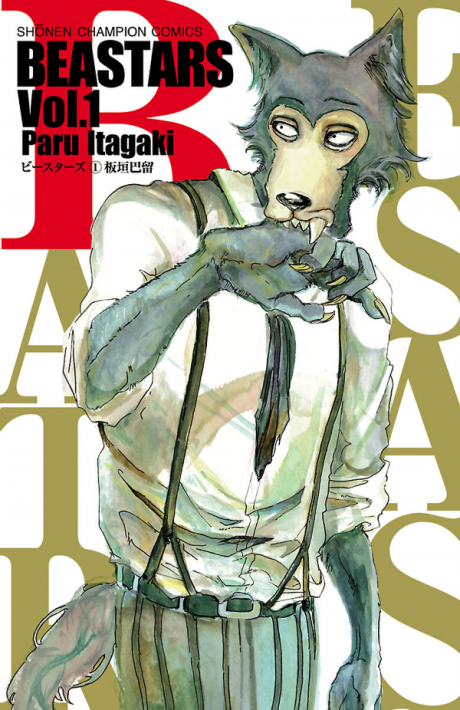
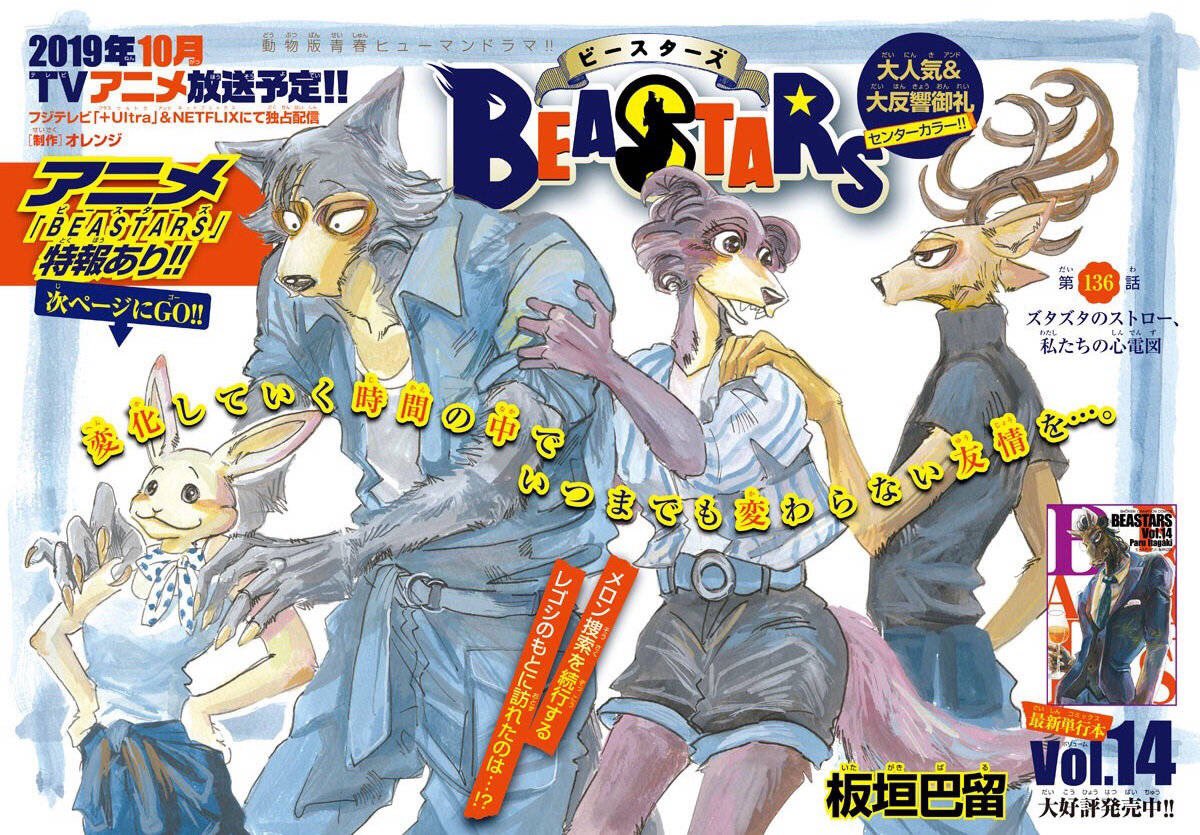
Beastars is a series that needs no introduction, having a colored history of controversy within the larger anime fandom, usually in the form of petty discourse about furries in pop-culture– but that’s neither here nor there. The silly arguments waged between cringeworthy teens may have tainted this franchise in the eyes of some, including my own as a young child, but I think there is a lot to garner from this series beyond what little impact on pop culture it had. Beastars, at its core, is a tumultuous story about human connection with some of the most interesting ideas I’ve had the pleasure of reading in quite a long time. Despite being a manga about anthropomorphic characters forced to abide by animalistic instincts, Paru Itagaki’s Beastars paints a beautiful if not rough-around-the-edges portrait about human experience.
This review will contain some spoilers, but they’ll be marked. For those unfamiliar, I’ll give a basic plot synopsis before getting into the thick of it. Beastars follows a young anthropomorphic grey wolf named Legosi (known as Legosi in scans, but Legoshi in Viz translations) as he comes of age. The manga details the dichotomy of carnivores and herbivores in a society of animals that are called by savage, innate instincts but forced to suppress them due to social order. It uses various character’s interpersonal relationships to explore its unique setting, talk about humanistic themes about the complexity of sociality, and illustrate the convolutedness of love.
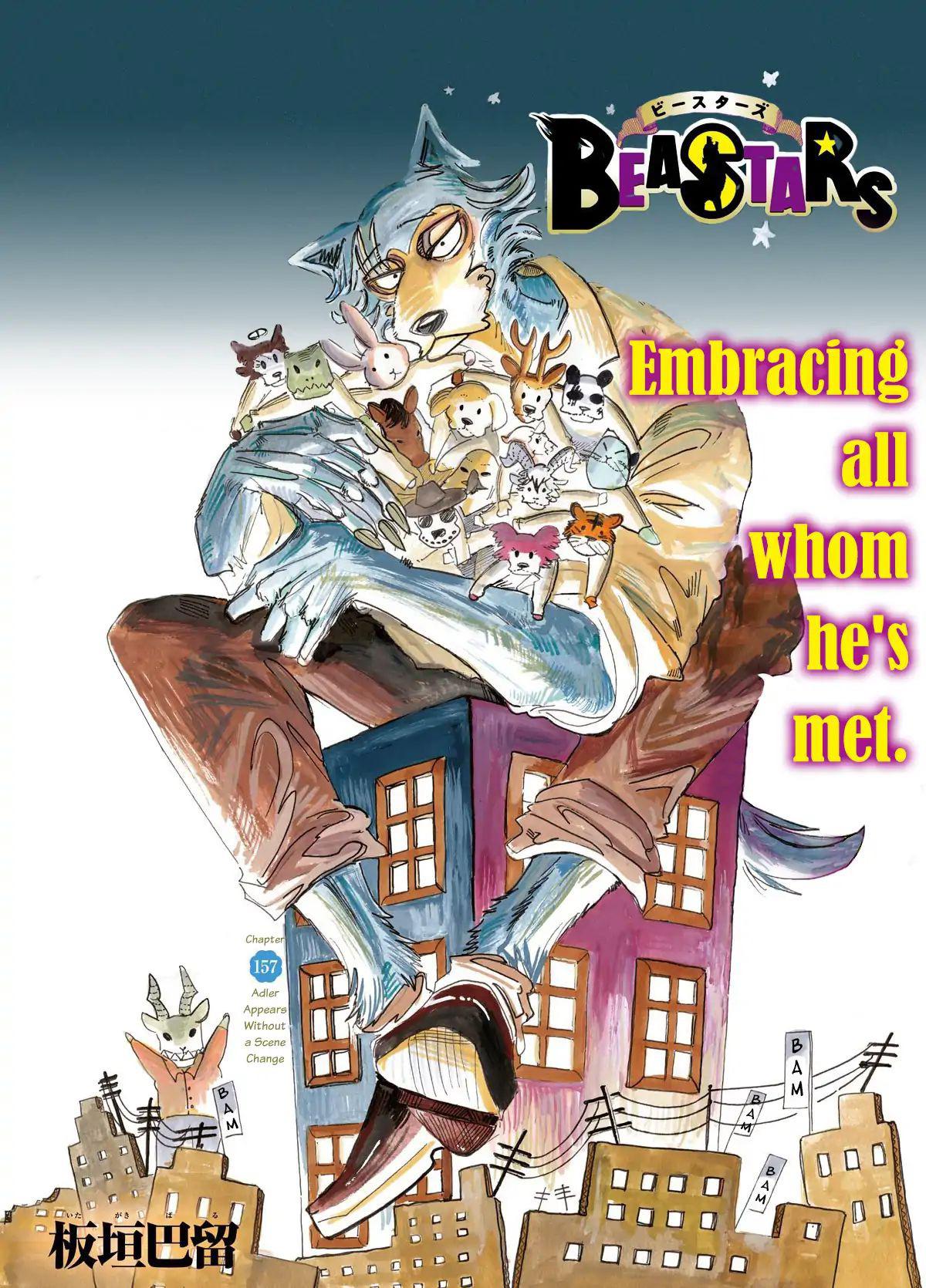
My personal favorite aspect of Beastars is the various compelling characters we follow throughout the story and their turbulent, ever-evolving relationships. I think this is primarily because of how distinct the way Paru wrote these characters is– it’s unlike anything I’ve ever read. Due to their complex societal structure our cast makes aberrant decisions that are wholly devoid of traditional human logic, but make total sense in context of the series. This only works because of Paru’s very natural method for worldbuilding, as she often introduces unique characteristics of the world and animal’s biology using Legosi, and then expands the scope to show us how it affects the world on a greater level. The prime example of this is the centrifugal force that drives the basic plot of this entire manga– the relationship of prey and predator. The members of this world being animals is not merely superficial and instead permeates the entire story in ways you would never expect, beyond being a simple metaphor for discrimination or the like that you will see in works like Zootopia. Instead, we see ALL of our young male carnivores that come of age struggle with their individual animalistic instincts– sort of like puberty but far more life-changing and social hierarchy defining– and later, we see how this metamorphosis for our characters affects adult society. Little bits of worldbuilding are dropped bit by bit until we have a societal structure entirely incomparable to that of humanity’s, with a clear social stratum not separated by financial nor racial means, but instead divided by natural instincts and taxonomic differences. Humanity has issues not persecuting people who have different skin colors as savages, you can only imagine the adverse effect certain races being born with more strength and the innate urge to kill causes. Conversely, however, the carnivores’ beast-like nature puts them on a pedestal and they are the ruling class of society. Rather smartly on Paru’s part, however, it’s not so one-sided; they’re still forced to keep up certain fronts and suppress their meat eating instincts, at least in public. This all cascades into a multi-layered society with herbivores and carnivores in a stalemate for power, with carnivores forced to bottle up their carnivorous desires to the point where they snap and kill someone– or go obtain meat and drugs through illegal means to sate this desire– meanwhile herbivores are constantly in fear of their own lives even if they outnumber carnivores. I explained all of this to illustrate one thing: these characters are not human and make decisions no human would make in certain contexts. Legosi is in constant fear he might accidentally murder the one he loves in a blood-frenzied haze, murder is treated lightly (in comparison to human society, it's treated as juvenile delinquency often in Beastars) and people avert their eyes to their classmates literally being eaten alive, herbivores have a sort of call of the abyss-esque instinct that calls for them to die, and segregation is almost a reasonable argument in this universe.
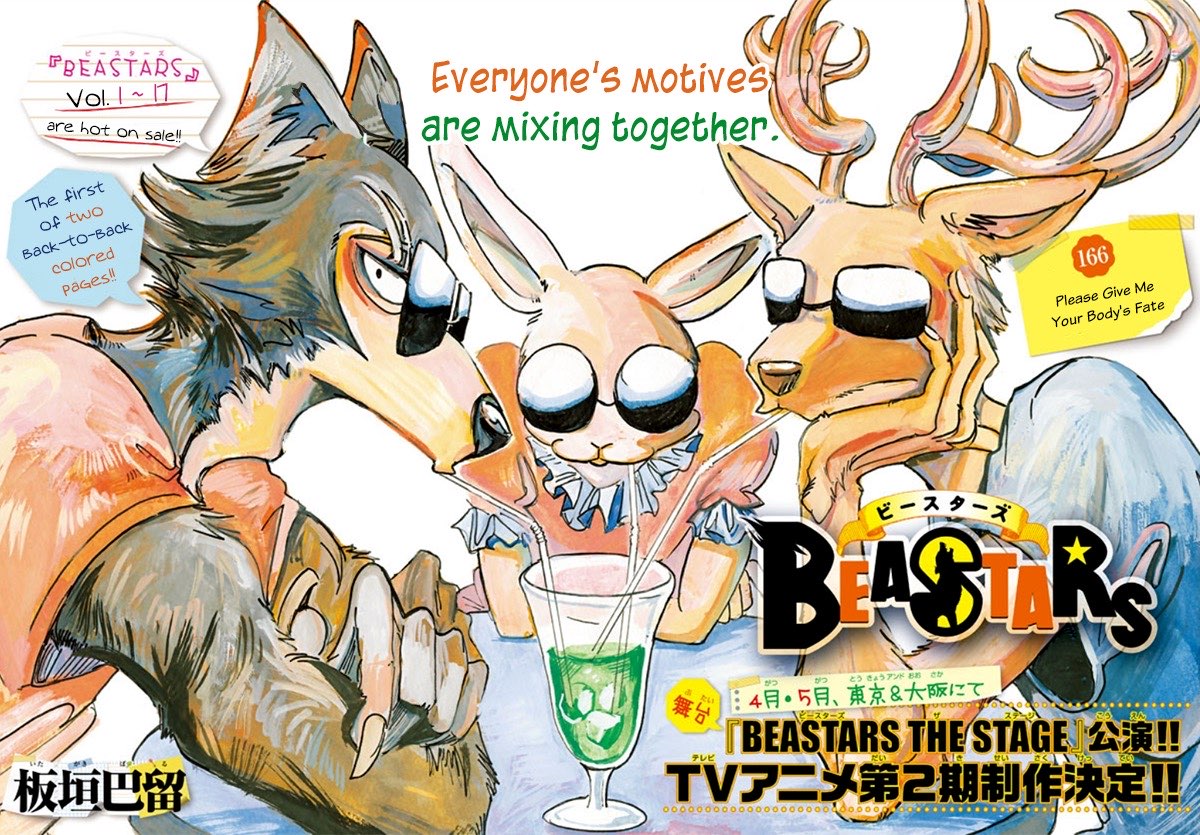
With this bit of background cleared, I’d like to discuss how these societal conditions affect our characters and their relationships on a somewhat deeper level. Legosi is a young male wolf who falls in love with a rabbit named Haru, a strict social taboo for the world of Beastars. He’s forced to grapple with an inner yearning to devour Haru alive, and we see how he uses his personal philosophy to carve a way of life he can be proud of and coexist with Haru in. Meanwhile, Haru, as one of the small herbivore species, is socially conditioned to see herself as just another dwarf rabbit. An already naturally low self esteem confounded by her species specific traits force her to seek self-worth and value through physical connection, as she feels it’s the only thing that gives her life weight and puts her on any plain of equality with other animals. Legosi’s complex blooming emotions develop into a sort of herbivore fetish and dog-like love for Haru, while Legosi’s attention towards Haru makes her feel recognized and valued despite that being hard to accept for her at times. Their complex natural personalities coupled with their bestial condition creates for a relationship like no other; it truly is something totally unparalleled by any other manga series I’ve read. The insane thing is this principle applies to every single Beastars character, and can be seen in most developments throughout the series. The only issue is this requires Paru’s writing to be airtight and unilaterally consistent, but unfortunately, it’s not. Whenever a character acts a little awkwardly considering their nature, it sticks out like a sore thumb. That being said, sometimes, a character can do something ridiculous like Louis’ actions during Legosi’s final showdown with Tem’s killer, but it feels totally realistic under its layers of context.
The best part is, despite being so aberrant when compared to human social norms, all of these animalistic social norms are used as a catalyst to comment on human relationships and feelings. This is clear from volume one with Paru’s closing quote for the volume: “This is an animal manga that is a human drama, and I didn’t just blurt out this contradiction because I’m nervous.” While said somewhat in jest, I believe this line sets a tone and highlights the philosophy Paru had while penning this story. Of course, this is further accentuated by things like the goodbye message in the final volume likening interspecies relationships to human ones in their messiness, and naturally the manga itself. The series exhibits love in adverse situations and the power it can hold, the turbulence of one’s early adult years and the importance of personal development and accountability within that time, the undeniable existence of moral greys that allow our society to function, and countless of other examples of very human concepts explored through the lens of animals. Beastars being able to create a species of creature totally alien to humanity while simultaneously perfectly encapsulating so many human problems is a pure stroke of genius that culminates in an eccentric experience that leaves a distinct impression, regardless of whether you think the synthesis of these factors make for a good manga or not. Personally, perhaps the things I appreciate in art the most is its ability to elicit emotion and how each individual work is something unique to its creators and their psyche. Beastars’ web of interpersonal relationships not only excited me, scared me, and made me cry– but it did it in a way that’s unlike anything else I’ve ever experienced. Paru passed with flying colors with the character writing here, even if there’s the occasional rough patch.
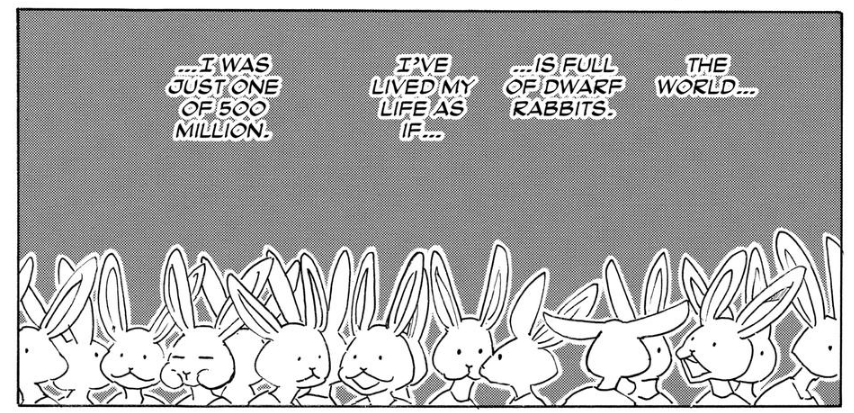
While Beastars nearly perfectly stuck the landing on characters in part due to its worldbuilding, that isn’t to say the world of Beastars is a flawless gem. The very basic social structure of carnivores and herbivores that I’ve already accentuated is done very well, but the details are unfortunately a little messier, which unfortunately unravels the seams that bind our story together at times– particularly in the final arc. In chapter 53 a council of 12 different high schools are introduced to select Beastars that will lead the entire world. It’s not stated whether or not these 12 schools are the only schools that occupy the world of Beastars are the only high schools, but it can be assumed these 12 are the zenith of high schools in Beastars society. However, I am forced to believe these 12 are the only high schools, as there is only one back alley market; the back alley market is a pseudo-necessary organ of animal society that functions as a vital stress reliever for adult animals. According to Louis, the majority of adult animals frequent the market. Additionally, according to Yahya's words at the end of the series, he believes more black alley markets will pop up after the events of the ending. This implies there is only one, which severely limits the scale of our world; we also never see outside of this one big city and the ocean. That would naturally leave one to believe the world is just one city, which simply doesn’t make sense with some other parts of the manga. For instance, in chapter 166, Haru claims she is one of 500 million dwarf rabbits in existence. Which, looking at the scale of our established world as one constrained to a city with only 12 high schools, makes zero sense. While this may seem like nitpicking, it’s confounded by other bits of conflicting information. If the world was large the Yahya shouldn’t have as powerful an impact from mere vigilante acts of justice; if it were big, the shutdown of the back alley market wouldn’t mean anything as there would be hundreds of others. Since Paru never clearly establishes the scope of this world it just feels muddled and confusing, which really sucks because– as established– the world is integral to the characters.
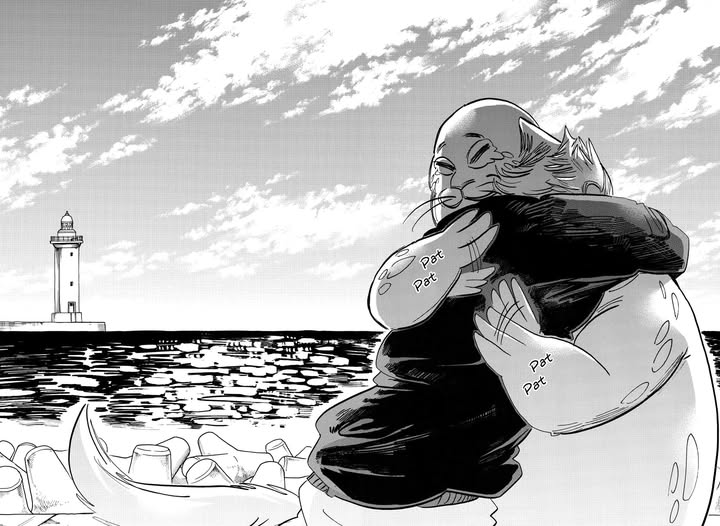
That being said, despite some minor hiccups, I still feel very positively about the world of Beastars. It still allows for a very dynamic and interesting narrative regardless of any surface level inconsistencies, and there are aspects of it I would even say are masterfully executed. The epitome of this for me is how the introduction of oceanic society is balanced with the main story. While it may seem barely relevant from a plot perspective, Zaguan the seal’s explanations of how things function in the big great blue add more than flavor text to our story. It shows a sort of parallel concept to land and air animal society that subtly accentuates and contrasts a lot of prominent struggles in our story. Their acceptance of natural order and laissez faire attitude towards predator-prey relationships is in sharp contrast to anything on the land, and shows us what society could be like were things slightly different for the animals. It contextualizes Legosi’s struggle throughout the story and provides an alternate morality that isn’t necessarily correct nor incorrect, but forces the reader to think and engage with the Beastars world at large. Is the sacrifice of the weight of life worth serenity and peace, or should every life be valued the same? From human logic the answer would be very clear, but the manga asks you to understand things from an entirely separate perspective and empathize with both ways of life. Little stuff like this douses the world of Beastars in oodles of depth in smart, and sometimes subtle ways. I'd also like to highlight the exploration of hybrids as a concept as a strong point in the world building as a concept for me, tragic abominations born out of pure love is just such a fascinating idea to explore.
The last thing for this section that I would like to highlight is the occasional side chapters that depict the life of a non-essential character to the plot, like chapter 20 which shows an example of how herbivore-carnivore relationships (and human relationships on a larger scale) can often subtly intertwine. Legosi is barely conscious of Legom but their connection is deep and rich in meaning in a lot of ways; on top of this, the chapter establishes a lot about the world by exploring these dynamics. Every one-off chapter is super fun and adds a lot to the world in this manner, great stuff.
This segment contains spoilers.
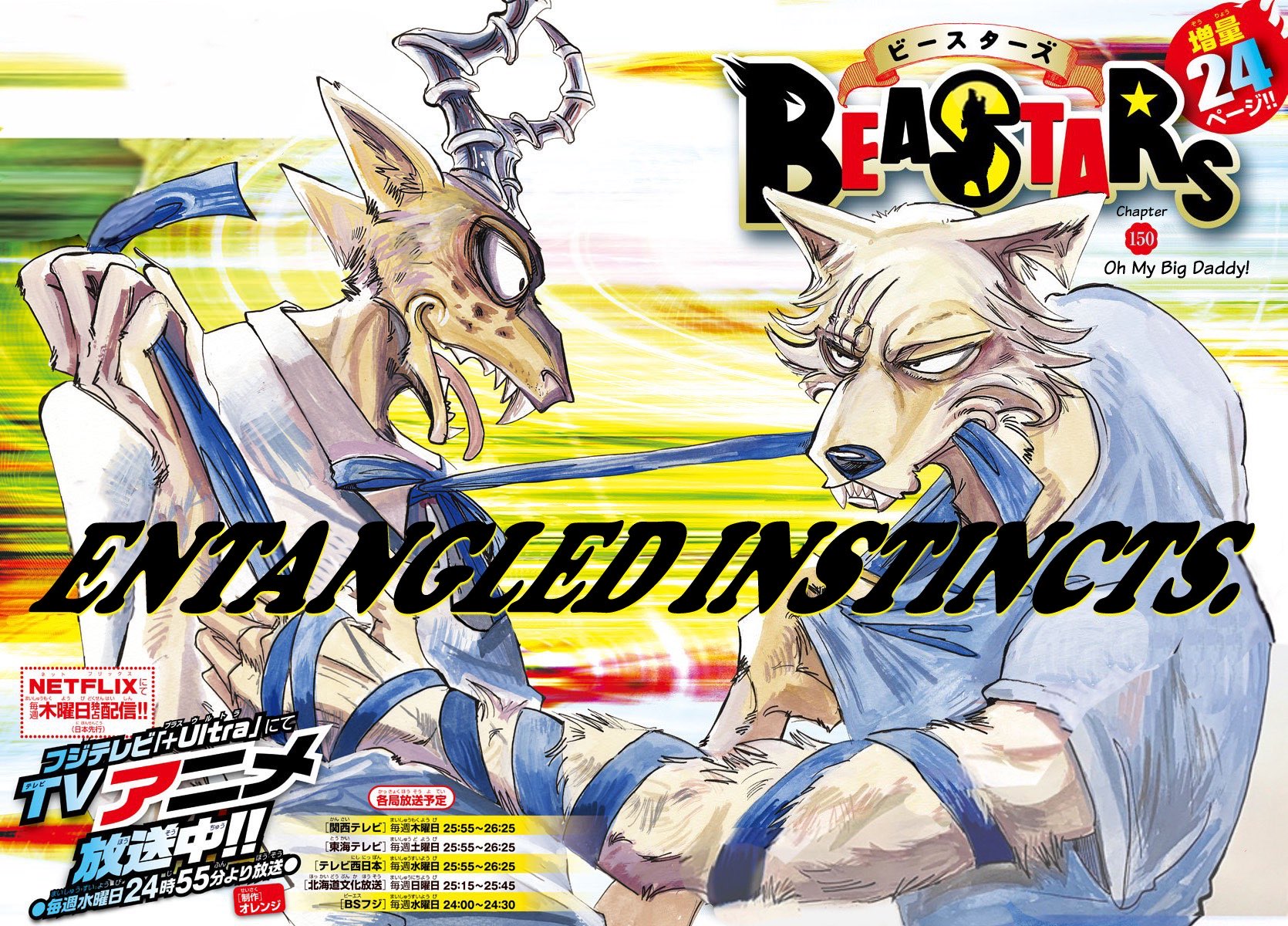
Now, let’s talk about the elephant in the room– err, maybe I should say the “elephant killer” Melon and the entire final stretch of the manga. Online discourse paints this as one of the worst final arcs to ever taint the pages of manga, but to be frank, I heavily disagree. That’s not to say I think the finale is without its mistakes, but I am overall very happy with how things concluded. Firstly, however, I think it’s important to discuss where the finale tripped up. For the sake of brevity I’ll omit my issues with the worldbuilding as I’ve already covered my general thoughts on that in the paragraphs preceding this, but outside of that a plethora of other issues remain. The big one everyone likes to point out is the weird, obtrusive shaft that ravages the entire plot structure up until the points introduced– chimeras. Why would Paru introduce a weird power system that is brought up for one volume and never again? I don’t know, let’s take it for what it is– slightly weird and annoying but ultimately irrelevant. With the generous interpretation that the chimera forms were metaphorical, it suddenly doesn’t become so bad other than just having dropped a plot point; I mean look at Jojo’s Bizarre Adventures, they drop plot points like Forneverworld drops bars in that manga. Hell, it was kinda cute to see Legosi envision his hybrid child and the problems they’ll inevitably face from a character writing angle. Frankly, the entire last arc is riddled with minor issues like this or Dolph’s fakeout death, and I very much understand if you can’t forgive the manga for that. Understanding this, however, I still quite like Revenge of the Love Failure for its great character writing– which is what I liked so much about Beastars in the first place.
While I know some of the character decisions were controversial, I personally think it was executed very gracefully. Louis’ strict sense of justice and duty forcing him to give up Juno makes perfect sense to me; it runs directly parallel to Yahya, as he chooses to pursue his personal life goals as a social representative rather than settle for a content but “selfish” life of interspecies marriage like Gosha or Legosi. Legosi returning to the shadows was also just the only way for a guy like him, and I was personally very happy for both him and Haru. I think it’s very interesting we’ll never know how their mixed child would turnout, however. I adore how the series doesn’t really make a right or wrong in interspecies children when they could easily be equated to something like an incest baby, and instead lets both the reader and Legosi dwell on the risk and weigh it personally. The only slightly perplexing character conclusion would be Riz’s and Pina’s strange relationship. While Pina is a fucking weirdo, and death is generally undervalued in animal society, choosing to associate with a murderer like Riz is a hard decision to grasp; the animal logic doesn’t really fill in the holes to make this decision justified. Perhaps with more development it could have been better.
Ultimately, the final arc is very rushed and messy, but still has shining moments of goods that do justice to what was established before it. I believe the bad parts happen to be the least important parts of the story as well, and Paru’s passion in writing Beastars overall shines triumphant. I’ve heard the anime adaptation will be cleaning up the more jagged edges of the story which is nice, but I wholly believe the manga is still worth experiencing regardless.
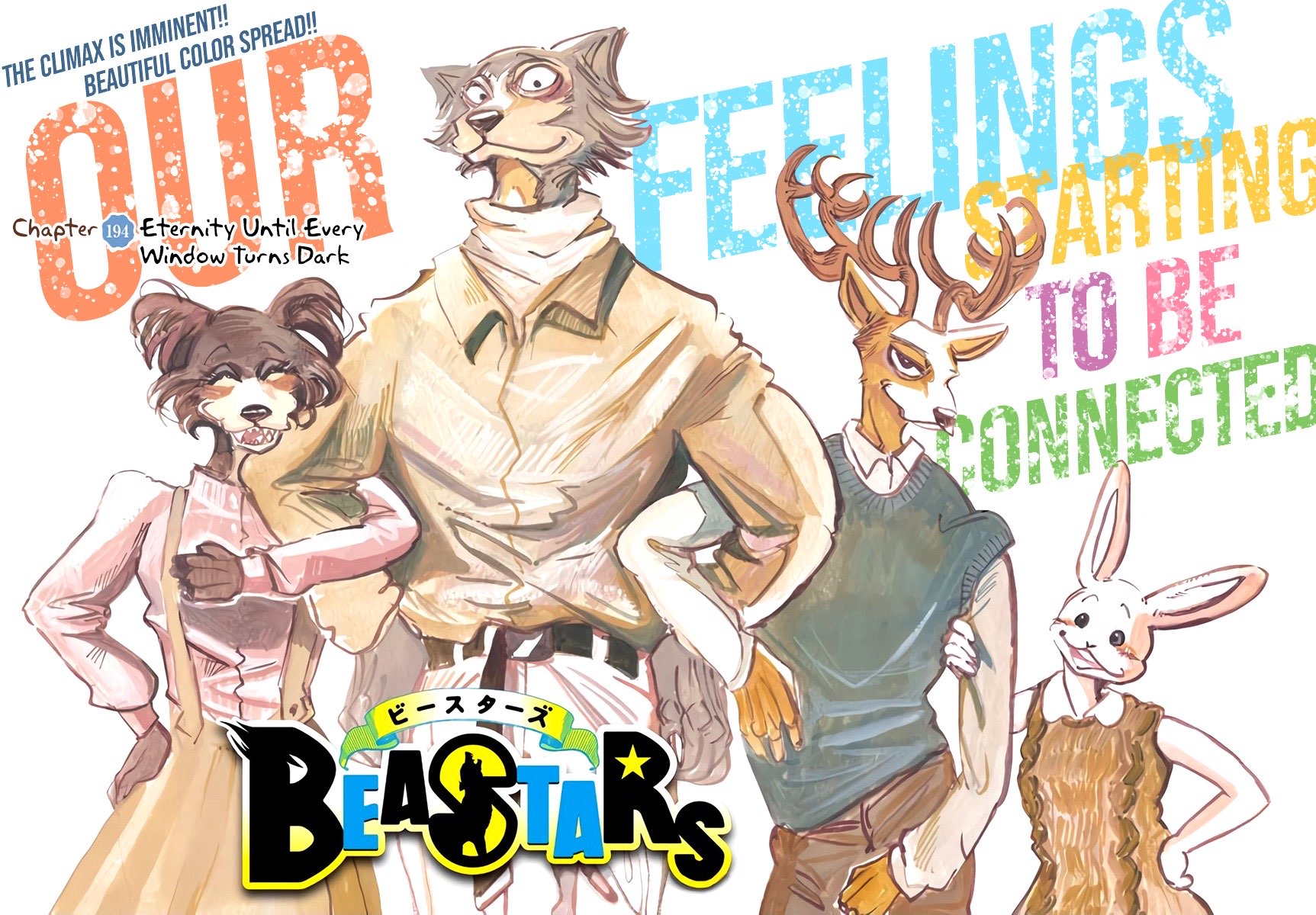
There’s a lot more I could say about each individual character and certain plot decisions, but I don’t want to drive you guys up the wall with boredom. Overall, Beastars is a triumphant success of a manga with beautiful art, zany and entertaining writing, compelling characters, a unique world, and heaps of passion put into every page. I got emotional reading Paru Itagaki’s lament over saying goodbye to Legosi and Beastars, and if by chance you haven’t read it, I hope you get to experience the same saccharine joy I felt while reading Beastars. Incredible stuff, see you all next review ★
This review contains full spoilers.

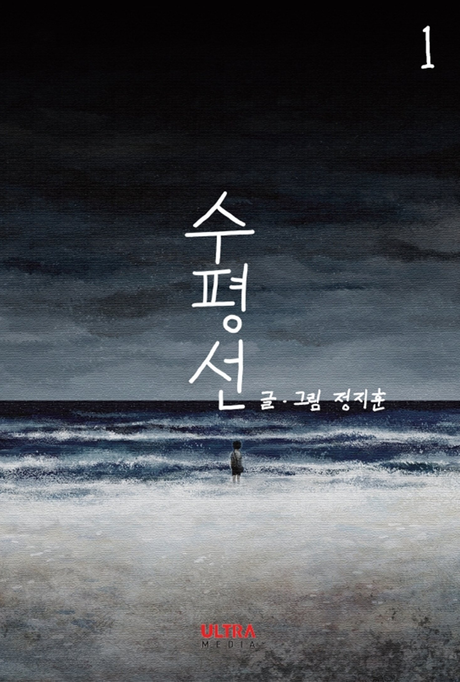
Various stories tackle the meaning of life— from Berserk’s message on finding yourself to Onani Master Kurosawa’s value of human connection. Fiction is a means to deliver a message; what’s more pertinent than living in itself? So, with the suffocating influx of series telling us about our own existence, how does Ji-Hun Jeong’s The Horizon fair?

The world of The Horizon is a bleak, desolate place. We’re introduced to death, suffering, and hatred from the first few pages alone. Nothing highlights this better than the sporadic uses of color that delicately move the tone. From a muddied, burning red-orange that suffocates the skyline of a forgone city, to the vivid and passionate glowing rays of yellow and green in the heart of nature— color is integral to The Horizon’s formula. Moments that initially seem simple are accentuated and breathed new life by a slight palette change; it’s genius. A cliche betrayal can be turned emotional and dramatic by emphasizing the blood from a stabbing. A flower field reprieving our tired protagonists can feel all that much happier with vibrant gold. From dramatic highs of pure joy to the tragic lows of despair, The Horizon fine tunes and incorporates them into the plot and art seamlessly.

The Horizon is about two children simply moving forward. As such, it’s full of pit stops where we explore various lives of those trekking a similar journey. Each one of these attempts to balance an emotional concept to various degrees of success.

Appearances aren’t everything, so says the girl. Upon being followed by a strange man, the two children contemplate various routes of escape, before sympathy begins to well within them. The more rational, logical boy wants to leave him— while the girl’s naivety slowly pulls him elsewhere. They gradually come to accept him and care for him despite his weird nature, and thus gain an important lesson on life. Which is why it’s so dramatic and striking when an abrupt betrayal happens. With a pan in on the boy holding the girl’s hand, it’s implied the man is a pedophile, which is funny— but also seriously depressing. His depraved attack is disgusting and revolting, and destroys the hard earned trust the series attempted to establish. Just as the reader and boy warms up to this creepy aberration, it takes it all away. The boy’s innocence is betrayed; he will feel these ripples throughout the entire rest of the story. Bright red blood seals his fate, as he continues down the winding path.

Killing is wrong, says the murderer. The suited man is a vessel of hypocrisy, but a necessary one. Day by day, he picks off assumed murderers, cleansing the dredges of society— all while becoming part of the problem himself. The story never acknowledges his clear philosophical pietism; it never needs to. You can sense that under the depressed droop of his long-tired eyes, the man knows what he’s done. Yet, for the sake of a greater ideal, he trudges on anyway. The girl can sense this, and steps away. The boy, perhaps spurred by the want to prevent situations like with the strange man, follows in his footsteps— but ultimately fails. The young boy and the young girl could never hope to fall into such depravity; the suited man is relieved to see it. He lives on with countless regrets, and guides the new generation down the correct path. Saying goodbye to them, and his bloodstained life, for one last time.

Everyone dies eventually, right? Then why, as humans, can we not come to terms with it? We can put on fronts and fool ourselves into thinking we are ready, but we can never truly be prepared. Nothing reflects this better than a long, winding voyage towards death. The first to go hides his sorrow, disease-riddled and in agony. It’s only when he gets off the bus that he shows his internal suffering. The second to go is a writer. As a romanticist, he openly explores his feelings, questioning the point of it all if he simply returns to dust. The third is a cynicist. Unable to take it silently like the first, or scream into the void like the second, she ends it early. The fourth and fifth are in love. It gives them strength to move past their grievances, but deepens their pain as they watch each other slowly fall. The sixth is a father. He places emphasis on love and responsibility, and finds his resolve in a deep well of such. Despite his emotional nature, he comes to terms with his departure, questioning existence to himself but holding it in. All of those who leave the bus grasp death in different lights, fighting to deny or accept it. No matter the defense mechanism employed, however, they all return to dust. With such, the girl marches forward, determined to avoid such a fate.

The boy and the girl are in love. It’s given them their conviction, strength, and sorrow. Every step of the way is paved by human connection; as lights guiding each other through the darkness, they forged forwards. However, all roads must end. Passing someone simply waiting for death sets an ominous precedent for the two travelers attempting to escape such a fate; it wouldn’t be long before the boy and girl whittled down to just a boy. With an abrupt, chaotic, and striking draw of guns between two similar groups— the depravity and desperation of humanity is highlighted for a brief second. Then it’s all over, and none are left standing but one. So, just like those on the bus, he is faced with a choice. In the face of it all, he trudges forward. Finding solace in the words and memories of a girl who would have wanted him to move forward.

Reaching a shoreline muddied the dark, quiet greys and blues of a foreboding horizon, the boy stops. Then he waits, and he contemplates, floating among the foam of an ocean— almost to be swallowed whole. Yet something, whether it be the memories of a long gone girl or an internal desire to live, prompts him to cling onto life. So he does. He lives, with ample time to think about and accept the nuances of life. Peacefully and without trouble on a lonely shoreline, he reflects, growing old. Eventually, his world begins to brighten. From bleak greys to baby blues, colors breathes life into his pained life. A comfortable green and yellow invite him towards a camping tent in the wilderness. Only to find loving, compassionate individuals who enjoy life together— and soon, he too, is sucked in. After all the loneliness and despair of his years staring longingly into the horizon, he finds hope and joy in human connection. Meaning in interaction, a happiness buried underneath the muddy sky. Yet, that too, must come to an end. As is his nature, he struggles against such a fate— yet this time, he succeeds. A crown of Biblical thorns coronates his victory, protecting the happiness he so wished to keep. So, coming to peace with his long life, he marches forward one last time: into the horizon.


The singular consistent thread throughout each story segment was “love”. Love for a stranger, romantic love, familial love, love despite cultural barriers, love from Christ— all of it motivates each individual character to do what they do. Those without this ephemeral human connection simply fade into dust. Time and time again, we see our characters persevere through the most hopeless situations. With the end ultimately sending a permeating message, as our protagonist saved and dies happy by love. He sees the bleak world in a new light; he takes Christ’s hand overflowing with the emotion. Some people say this represented him regaining faith, as many believe you can only gain salvation by believing, but I prefer not to follow that ticket. I just see it as his reward for remaining true to his values and seeking happiness for the entire journey; a closing note on the power of love, and human connection by proxy.
While some moments of The Horizon were cliched and muddled in execution, it’s ultimately an incredibly raw and emotional story. It’s depiction of grief, finding meaning and life, and human connection are second to none. Subtle details like the circular wound on Jesus’ hand as he takes the man into heaven add depth to the story, and the simplicity of the plot keeps it easy enough for anyone to understand. While it had many flaws and shortcomings I omitted, I’d recommend this story to absolutely anyone and everyone. Let me know what you guys think about the review— it’s short form and not super in-depth like my other ones. Any thoughts on the style as opposed to others would be appreciated; I’ll see you peeps next time.
The Biblical stuff at the end is seriously so cool. It’s easy enough for anyone to understand while being a very relevant allusion.


(Note: Most non-criticism on this show in the review is a joke— explicitly stated for the mods. Also, this is a bit less comprehensive than my usual reviews, and way different in tone. Let me know what you think. This review will also contain no spoilers.)
I am a Weeaboo. I am an Otaku. I am an incel. Most of all, I have no standards. So, if when presented with some dumb bullshit, even I recoil at a show’s blatant pandering— then one has to take a step back, and enter a state of postmodern self reflection.

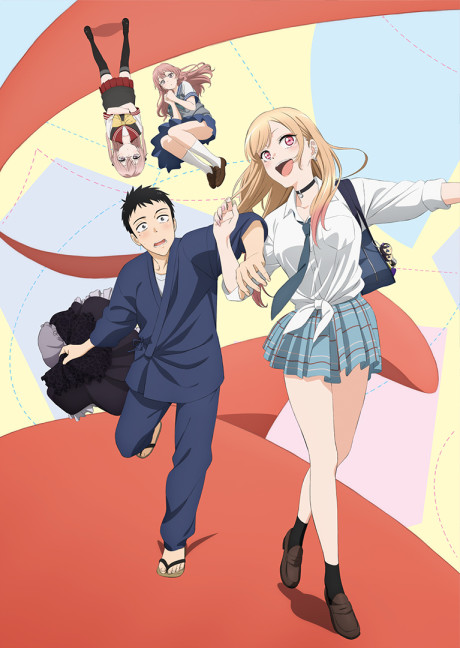
My Dress-Up Darling ticks the right boxes. On a surface level, the tried and true hot anime girl paired with brilliant production is enough— but, as we will see, the egregious lifeblood of Dress-Up’s formula runs much deeper.

Since the dawn of humanity, society has outcast those deemed to be “sad little virgins”. Ostracized from society, these individuals slowly began their retaliation— but it was for naught. The normies and their wicked ways, to this day, remain supreme. Us modern losers, Otakus, gamers, weeaboos, doll makers— the big 4— still remain in the shadow of the eternal pyramid scheme. With shows such as Dress-Up, which depict our struggles in such a valiant light, we may yet arise against this, however.
Okay, enough dicking around. Point in case: the Dress-Up themes pander to an incel-like demographic, that’s frankly cringeworthy. The very first idea introduced is a common note in anime: “your hobbies don’t matter, it’s okay to be weird: it’s what makes you you. Never judge people” Marin’s entire personal philosophy consists of this throughout the show, as she watches hentai and is proud to share it with the world. Which, of course, draws the shy main character out of his ever-so built-up shell of reclusiveness. This particular hobby of his being doll making, which isn’t even remotely weird, as it’s a respectable profession— but we can get past that. Let’s say in this society, people shun cringers born into families that produce antique commodities. The entire point of this is to appeal to me, and you, and your favorite E-Girl— as it is our “struggle”. Many, many otakus around the world feel outcast due to their hobbies. So when Marin, a hot girl, says it’s okay, we go: “Wow, so true! This appeals to my sensibilities!” Exactly like that, I may add. So, you may say: “what’s so bad about that?” Oh, nothing inherently. However, as a man with shame, I hate being pandered to. At least Oreimo has the decency to come out and put it flat, not touting some sense of moral complexity, acknowledging its own shallowness. When it comes to conveying themes that are simple, there are two ways: subtle, or outright. Repeating the same concept, drawing the direction to add a sense of impact, and basing entirely unnecessary character revelations around this is unfortunately Dress-Up’s method. Which, for obvious reasons, comes off as obnoxious to anyone who’s been taught that weird doesn’t equal bad before.

Okay, okay— I get it. Dress-Up Darling never promised to be a thematic masterpiece, but that doesn’t mean it isn’t a significant part of the show. I would have entirely omitted this section had it not been given such a sense of importance, and portrayed as powerful. It’s like Avengers: End Game, with the scene of all the women going all girl boss mode at once. The fact that it thinks it’s a powerful message is the most infuriating aspect of it, and a dose of subtlety would have done wonders. Subtlety isn’t really a concept I expect most anime to bother with, sadly, though. So, in conclusion: thank you Marin for telling me jerking off to children is okay because I like it, you’ve changed my life.

Marin Kitagawa is a female. As I am a raging homosexual, this is a red flag. However, I am a man of culture, and decided to objectify her to make it work. However, despite my benevolent attempts, I was overwhelmingly shut down. As I am an incredible critic with many talents, I have discerned more flaws than just her feminine nature, fortunately. Escaping the bottleneck view of Marin’s thematic purpose, she is built to appeal to the average basement-dweller. A proactive personality, a love of Loli hentai, a curvaceous body, a modern sense of humor, and a cute back-and-forth relationship create the ideal fantasy girl. Her obnoxiousness is attractive to most, and typically, it would make her full of life; as I jerk off to episode eleven, contrarily, I begin to feel she’s robotic. Despite the rock-solid animation breathing life into a stilted character, it’s not quite enough to save her humanity. Due to her factory default setting personality, and perfected archetype, I can’t help but sense a hollowness behind her eyes.They’ve somehow white-washed the edges that animated her, transforming an average character type into a vacant shell. There’s only so much you can push for a certain demographic until the product becomes a revolting mess, and loses its personality.

At first, when Gojo was introduced, I was all hyped up like “they got the famous anime Jujutsu Kaisen in this show?!”. Then I realized that I wasn’t as funny as I think I am, and promptly shut up. That’s the most interesting thing I have to say about Gojo, as he’s yet another stale bread archetype. I argued on Twitter for a little, gauging the community’s defense of him— and to my utter bewilderment, their counter points were my exact points! He’s kind, gentle, somewhat shy, reactionary, good at cooking, and a loner— insane! When I heard that “good at cooking” was a characteristic thought to be unique, I fell over. I don’t know what it is about anime and dudes who like to cook, but it’s perhaps the most common motif among the “nice guy” archetype. Ryuji from Toradora being the obvious classic, but even Fuutaro and the gentleman Toriko are easy examples. The fact that he knows about dolls and cosplay does not make him a compelling character, as they don’t explore that thoroughly enough to be meaningful in any capacity. However, if I had one thing to say, he IS an outlier from other protagonists in this field. His sheer inconsistency is what astounds me the most. Episode ten being the most atrocious example. Gojo is sexually shy, of course, but he often gets so engrossed in his hobby he forgets this fact. That doesn’t make a lot of sense, but we can get over it— it’s for comedic set-up. The issue comes into play when Gojo suddenly breaks this established rule. To connect it back, episode ten entails Gojo struggling to talk to Marin due to his inability to suppress his raging boner. At first, I was like: “Wow, he developed some. This means his relationship is more meaningful, as he sees her in a romantic and sexual light.”. Then I was like: “Am I bloody fucking mad?”. Aptly so, for Gojo ALWAYS viewed Marin in a sexual light. Episode two was about him dramatically collapsing at the sight of Marin’s bikini. Nonetheless, he pulled himself together for her hobby and carressed her tits a little. In episode ten, he’s suddenly keenly aware of his libido at all times, and refuses to see Marin for it. You’ve already seen her practically naked, you wanker! You can handle a risqué outfit for the sake of cosplay, as the show has established this lame concept fifty four fucking times now. I can’t help but feel like they decided to forget his prevalent character traits to create a romantic beat at the end. Genius character writing, bravo.
Finally, I’d like to address character chemistry and vicariously, romance. I nearly forgot to include this section in the review; partly because it’s not comprehensive, and partly because it’s so inoffensive. If you want to enjoy Dress-Up as a purely romance show, you could do much better— but I’m not gonna cry about it. They have the typical proactive and shy guy dynamic, with a modern slant with stuff like the girl getting embarrassed and being relatable. Gojo is the same as every other character within his archetype, landing somewhere in the middle of the “fuck, I’m afraid of pussy” meter. Even the climax is so bland and okay that I can’t harp on it much. I mean, a fireworks scene is about the most cliche thing to implement, but the dialogue wasn’t horrible so it’s almost not worth mentioning. I can’t even really get into analyzing their relationship too much, as it would just bore you to death— they are exactly like you would expect, and are then same from episode one. The only bits of development that happen I’ve already addressed, and same goes for the inconsistencies.

Also, fact: this is a middle-schooler. I don’t care, but I think it’s hilarious.
Second bonus: While I didn’t clip enough to dedicate an entire section to this, the dialogue was fucking atrocious, and funny more often than not. Especially in the dub.

Cosplaying is a fascinating hobby— from the production of the outfit, to the composition of techniques a cosplayer must employ to pull it off. As most hobbies do, it has a rich history of depth and intrigue that pulls many individuals in like a black hole. Storytellers have sought to chronicle art forms such as this for a long time; occasionally, someone will attempt to capture the novelty in a fictional work. From Shinjuko Rakugo’s depiction of its own rapidly changing art form, to Breaking Bad’s loving depiction of how to make meth— a wide range of stories like this exist. So, as many of the more devout fans would claim, Dress-Up falls amongst this category. It thoroughly depicts cosplay as an art form, one might say. Obviously, as this is a discourse, I don’t believe it holds up— but why?
It’s simply too shallow. Not necessarily incorrect, like some would claim, as I found more evidence supporting the opposite. Such as Shinichi Fukuda, the mangaka for Dress-Up, having gone on record saying they interviewed cosplayers about the hobby. However, the cosplayer they talked about must have simply told him: “at times it gets hot lol, keep that in mind. Don’t forget about titties and stuff, my big chest is always getting in the way of my tight dress!”, for this depiction is a fucking nothing burger. The compression bands are wildly exaggerated; masking tape is a basic technique you could Google in seconds. Nothing here is near educational, and rarely does it depict the art form in a compelling manner. Occasionally an idea will spark that applies to real life, such as females cosplaying masculine characters, or how stuffy outfits can get. Most of this potential is squandered, however, by a lack of exploration beyond surface level knowledge. If this is a in-depth depiction of cosplay, then Food Wars is an accurate representation of the culinary arts.

It’s safe to say I am a fan of comedy series— six out of ten of my reviews have been on them. So, I’ve garnered an eye for comedic timing and the art that goes into perfecting a joke. If only I could replicate that by being funny myself, but oh well, saying “boner” here is sure to make some people laugh regardless. Dress-Up— hooray— seems to be of the same laissez-faire attitude. There are two types of jokes to be found: haha sex, and reactionary face jokes. The first one is typical of any show harboring ecchi so heavily, and is honestly inoffensive. The jokes are mostly lazy, sure, but it’s whatever— they rarely play them to be obnoxious. Bar the occasional tit grab or I accidentally slipped my penis into your vagina moment, where it’ll lead directly into a reactionary joke. Creating an obnoxious combination of the former and latter type of joke, but I suppose I should actually cover the latter before delving so heavily into this concept. Have you ever heard something weird then abruptly stopped a conversation to make an over-dramatic reaction? I hope not, because if so, I hate you. You’re ruining my review. While they rarely scream “NANI????!!”, there’s still plenty of GIF-able and pandering facial expressions to gauge in any particular scene. I’m not gonna pretend like it’s a show-stopper, but it certainly does interrupt the more interesting and subtle dialogue. Dress-Up can’t seem to portray a non-romantic idea without tagging in some shitty facial reaction and “witty” straight man remark. Lots of shows do this, but the lack of alternate comedy here makes it particularly unbearable.
Needless to say, this wraps right back around into appealing to incels with the sexual comedy. So, it’s sexy fun times— to many, that fact is epic. However, is the sex appeal even good?
CloverWorks has mastered the art of lighting in anime. It feels fresh, smooth, natural— it adds spades to the tone and visual style. However, Marin is a fucking harpy, and Gojo is a bumbling giant with down syndrome. I mean, look at this vixen’s pointed smirk:


Bonuses:


Doesn’t really seem natural, does it? Her facial expressions can often seem jagged, inhuman, and bizarre. I would not have mentioned this were I the only one who noticed this, but I’m not. Every cringer under the sun has noticed a facial expression going awry occasionally. Were I to place this, it would point solely at the direction. Whoever decided to overproduce the animation, framing, and lighting here is simply insane. For a slow, “wholesome”, slice-of-life burn one should have a tone that reciprocates that. However, the directors thought it seemed pertinent to put every character on fucking crack. While it does well to capture Marin’s boisterous energy, it creates for awkward looking frames that don’t mesh well with the art style at all. The direction is impressive— but for an easy example, I wouldn’t want One Piece directed like The Monogatari Series. It’s at times tonally abrasive, aberrantly uncanny, and strikingly inhuman. Which is where we begin to connect back to Marin feeling so fake, which ruins the effort put into her seeming so much more proactive.
Naturally, this overproduced direction is obnoxious, which cascades into the point of it’s comedy being blatantly annoying. Which leads to:

My Dress-Up Darling is an incel-pandering, obnoxious, mess of a product that harbors ape-brained messages and ideals. It’s irredeemable garbage among the lowest common denominator of media, crafted with the undeserving love of a production team that did not understand the show they were making. I would rather have my testicles nailed to the wall than watch another singular episode of this god-forsaken garbage fire. Anyway, see you peeps next season, as I am going to go watch a good show: like To Love-Ru.
Source:
This review is spoiler free unless stated otherwise.

Gambling is an unexplored art with boundless potential for thriller media— I mean, it pushes people to their most raw, unadulterated forms. Those who triumph are usually those who can keep a clear and rational state of mind; nothing exemplifies more than Gambling Emperor Legend Zero. I’m going to avoid mentioning Fukumoto’s other works throughout this review as I feel it would be cheap, but yes, it’s similar to Kaiji. It’s a bunch of high stakes gambling death games that force the psychology of the players into uncomfortable positions, ultimately creating an intense battle where you’re not sure as to where the outcome will lie. Well, even if you are sure, you won’t know how it’s going to happen.
Gambling Emperor Legend Zero has a rather on-the-nose, but ultimately strong premise. Some smart guy and his gang of suicidal lackies are invited to a death game for a trillion yen— I mean, boom, bucket loads of fun pretty much guranteed. For a quick comparison, the structure isn’t all that dissimilar to Yu-Gi-Oh. Players are forced onto this secular location where they visit various locations of their choosing, competing with or against other players to win the prize. For the specifics, however, we begin to vary. Within Dream Kingdom— where they choose to gamble— there are some very intentional set rules. To win the game, one must collect three rings. There are four total types of challenges: J or “Junior”, Safe, Mild, and Hard. If you lose any competition that isn’t Junior rank, you are automatically disqualified from the game. In mild games, you may win bigger rewards, but you’re almost guaranteed injury. In hard difficulty, it’s near certain death. Naturally, this leads to many ways different players tackle the challenge set in front of them; I won’t spoil it, but it’s pretty interesting.

The greatest problem many thrillers face is the natural element of plot armor. At the end of the day, your protagonist has to come out alive for the story to continue. This seems like it would make most high-stakes gambling boring and pointless, as you’ll always know the outcome— but there are many methods Gambling Emperor Legend Zero employs to get around this. The most immediately notable being in the puzzle format. If you turn your gamble into more of a mystery as you're forced to guess how the protagonist will solve the problem, that’s automatic curiosity and engagement. Even without stakes, the gamble will be satisfying as long as the answer subverts the viewer’s expectations. Zero does this in spades; though that’s not the core gimmick for those gambles, because it adds another layer. Exploring the psychology of characters in such a perilous situation is inherently intriguing, and the manga takes advantage of this. The character’s reactions and thought trains are fun to follow; in their own way, they add stakes by seeing how secondary characters will develop and fare. Which is another thing most of Fukumoto’s works know how to do: kill off secondary characters, and ruin the main character. If the gamble is life or death, it’s entirely possible for well developed side characters to get the axe— as is it possible for the protagonist to lose limbs or all of their progress. This unpredictability adds a sense of importance and thrill to every game, confounding upon the satisfaction of the conclusion.
However, a core, perforating issue remains with this strategy: the characters. If the writing isn’t strong enough to get you invested in the characters, then of course you won’t care about what happens to them or how they think.

Fukumoto isn’t known for his incredibly nuanced and memorable characters, but most would agree his protagonists are always striking— so how does Zero hold up? Well, he’s damn entertaining. He’s a calm and rational genius who reigns over most in the battlefield, but he isn’t perfect to the point where he makes no mistakes, and he has a kind and self-sacrificial side to bolster his likability. Not to mention carry the theme of camaraderie. In a setting like this, you would expect a lot of betrayal, but they shockingly opt for more friendship-based endeavors. Fortunately, it isn’t beaten into the ground like your average battle Shounen, so it’s actually a nice and quaint addition to the themes. So, basically, Zero serves his purpose at both being compelling to watch and being a thematic vessel.
Escaping the narrow view of the protagonist, many would argue Fukumoto’s works begin to falter— but I would argue that isn’t the case here. The secondary cast all have their own traits that make them unique and compelling. Zero’s friends may at first seem one-note, and in many ways they are, but they provide for good commentary. They latch on to Zero and support him, even if they can’t ultimately do much for him, which is really pleasant. Hiroshi has his own arc separate to Zero, and Yuuki ends up proving his worth in ways. This way each character has their individual story purpose, making the writing more cohesive as a whole. However, I would be remiss not to mention the most striking characters: Zenzou, Mr.Kotarou, and Suezaki. The antagonist being a batshit crazy, egotistical, near pointlessly rich, and sadistic old bastard is great. Not only does it serve as some fun semi-commentary on how the rich abuse and exploit the poor, but his senile behavior has a rich presence to it. He’s a pretty fucking scary dude— this leads to natural character intrigue. Mr.Kotarou, the antagonist for the quiz show game, has a different appeal. While he is not necessarily threatening, his wild design and wacky personality harbors a unique charisma you can only see in characters like that. His dialogue is perfectly constructed to accentuate a live-show tone, doubling his characterization. Finally, Suezaki isn’t an antagonist, but fuck is he cool. He’s just a slimy sort of snake that somehow keeps finding himself in Zero-related positions, which is inherently epic. I can’t really say much as to his writing, but you’ll see what I mean when reading.
Finally, the tertiary cast can be pretty great. Characters like Itakura, Shirube, and Gotou have moments of their own which add to the character drama. Even if you likely won’t remember them long after reading the manga, they add much needed flavor to Dream Kingdom. I would go over their individual feats, but I’m not here to waste your time— so I’ll go over the more interesting shit individually instead. Obviously being the games.
Each gamble is pretty unique, with every single one presenting some sort of mysterious tribulation to overcome for our protagonist— and at times the viewer. This segment will analyze each game with spoilers, so feel free to skip below.

As a starter gamble, this is rather simple, but it’s the perfect lesson in critical thinking and sets the tone for what’s to come. Not only is the gamble threatening and actually effective and weeding out half-hearted losers, but it hoists the theme of logic and rationality being the key to solving problems. The solution is simple, but no one blinded by fear or greed would think of such a thing. Which is also a nice sheet to introduce Shirube as a genius, while retaining the mystery he had for earlier chapters. Finally, the closing statement of the game was quite nice. Mitsuru’s death provided ample motivation for Zero to move forward, while setting up how dangerous this world can be. Pretty much a perfect intro gamble, though the latter half of the series doesn’t bring up Mitsuru, which spoils this slightly in retrospect. Hopefully we will get a mention in part two.

This gamble pulls back the stakes and risks only Zero’s fingers, which makes a real threat present for our protagonist as opposed to later ones which only offer death. This also further established how dangerous a place Dream Kingdom is, using the guy who played before as an indicator. Speaking of indicators, the signs for the gamble were laid out pretty cleverly. Peppering enough clues for the viewer to have an idea themselves, while leaving it obscure enough to not be easily findable is ideal— and they delivered. I never would have even thought about the fridge, even if Zero’s earlier dialogue lines aroused suspicion around the finger-cutter’s face. Having him shy away from the face confounds upon his niceness as well, subtly building upon his character. On top of this, it also showed that the game runners are not above cheating, which will come into play later. Fantastic game for establishing Dream Kingdom as a setting.
Calling upon basic mathematics is something Zero does often, and fuck, does it make me feel stupid. I mean, c’mon— I would never even think to calculate the angle of a triangular room, much less be able to calculate it accurately. Despite my own ineptitude, this is what makes games like this fun. The solutions are incredibly creative and out there, but logical and simple when you get down to it. It’s just within the situation you’re clouded by your own perception, which is what most of these games test you for. Can you get past your own emotions and bias to think critically? Though it takes him a while to figure things out, Zero usually can— which is just fun to see. The last-minute factor can be a bit repetitive, but is still ultimately satisfying for each outcome. I think the other teams added a fair amount of interesting completion to the gamble as well, so yeah. Pretty great follow-up to the last two.
Out of pure curiosity, Zenzo pit Zero against Shirube; fuck does this set up Zenzo’s wild card element well, which will be perfected by the ending. Bar the awesome introduction, the gamble itself is incredibly unique and creative. A blindfolded battle where the player is forced to choose between four voices calling him to each side. That’s just an awesome premise, as it provides for some psychological leeway as each person does their best to tempt Zero over. As a viewer of the game, we hold an omniscient perspective and get to see the behind the scenes of the tricks employed as well, which I believe was the right call. It’s just interesting to see how Zero dismantles each and every possible answer systematically, and within the time limit. From Goudo’s temptation to the antics with the mirror, every conclusion Zero comes to makes perfect logical sense and avoids relying on intuition. It was a battle hard fought; Shirube clearing it in under a minute sets him up as a real threat, even more so than before. Not to mention it bolsters Zero’s trait of kindness, as he gives Shirube a hint beforehand. Overall, though there’s not much to analyze, the game was pretty thrilling and had a variety of interesting strategies to unveil while supporting the character’s core traits. Likely my favorite game overall.
This one purely exists to exemplify mob mentality and how fear in one person can bring an entire group of people down. While this can be seen in plenty of shows that entail a group of normal people fighting a larger entity, it’s done really well here. Zero’s deepens mistrust and makes you think some of them may actually be killed, as the stakes of what exactly will happen are unsure. The games themselves weren’t super interesting as they were just mathematics, but it was easily made up for by the reactions of the crowd around them. Itakura and Suezaki get to show off their guile by wheeling the crowds within this round as well. So, yet another thrilling ride with some unexpected twists and turns that will keep you wanting more.

As a game, some view this as rather lacking— which is somewhat justified. Though the concept of the main questions putting points into either raising or lowering and having anchor questions decide whether it gets lowered or raised is cool, some of the questions are simply inane and pointless. Sometimes that’s the point, like with Kotarou’s hair— but why the hell does Zero know about a ramen bowl? I ultimately can’t complain however, for as discussed earlier, damn does Kotarou steal the show. His pathetic jabs and jibes are hilarious to see, along with watching Zero slowly dismantle his sadistic nature. I mean, he literally psychoanalyzes the fact that he was bullied in the fight. Zero fucking destroyed Kotarou’s ego, which provided for good comedy while making a compelling dynamic, especially considering Kotarou held power in the situation. Another thing they bothered expanding upon here was how every individual mind helps in some way, highlighting Zero’s naive but commendable philosophy of helping people if possible. Suezaki and Yuuki may not have been great, but they ultimately did their best and helped the team in some way. While not as dark and grim as it could have been, I think this somewhat more optimistic message is pleasant.
Ending on a rather weak competition, the solution for this one was a bit gimmicky and intuition-based. The stuff surrounding it makes up for it, however. Zero’s self-sacrificial strategy to get into the challenge was rather smart, while once again showing how kind he can be. Not to mention his triumphant exit with the three ringlets in tow was incredibly gratifying to see after all that happened- for, once again, he had won at the last minute. That kind of wraps it up nicely in its own way.
While Zero is a more Shounen-esque approach to Fukumoto’s usual Seinen formula, it still explored gambling as an art in plenty of nuanced ways. Mostly showing the danger of mob mentality and true genius lying in one’s ability to stay calm, not letting your emotions cloud your judgment— you can see what I mean if you read the gambles above. While Zero doesn’t abandon a logical thinking path, he also cares deeply about the people around him and retains his sense of morale. That’s pretty cute as a theme, and manages to give off friendship in a non-hamfisted way. I wish they would have leaned a little bit harder into the rich abusing the poor and what that implicated, however. There’s plenty of ways to explore that, but I suppose that’s for Fukumoto’s other works.
As for the ending, yeah, it was a massive fucking cliffhanger— but it was nice. It’s a good set-up for the next part, and it really cements Zenzo’s character to be as bat shit crazy as he is. Cool shit.
While not every gamble was perfect, each one had its own unique idea to put on the table, ultimately creating for an entertaining thrill-ride that will keep viewers on the edge of their seats. The characters were developed well for their short amount of time, and I could not be happier with the product overall. This is an easy recommendation from me, so make sure to check it out. See you guys in the next review.
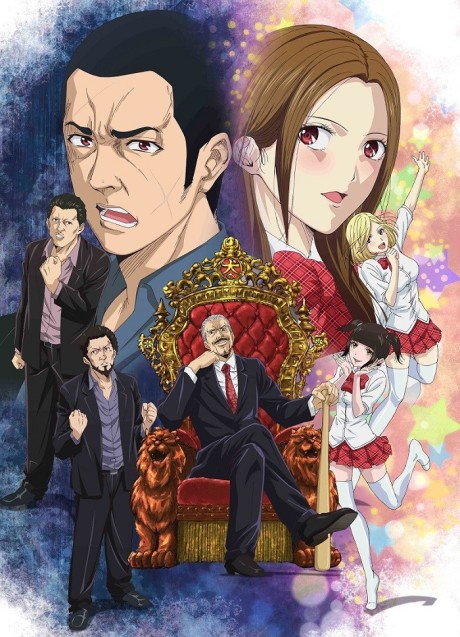

Comedy as a genre is inherently interesting to me— I mean, what people find funny is so flippant and subjective between each individual. It seems like a Herculean task to even formulate any gag string; when writing comedy, it’s hard to know if what you’re doing will hit. Sure there’s conventions to comedy writing, but playing it too safe will lead to making an average SitCom. So we enter one of the various approaches— absurdism. You throw shit at the wall, and see what sticks. This is very much what Gokudols entails, as one can see from the premise and cover alone. There’s always a perforating issue that plagues and attempted absurdist comedy, however. How far is too far? When does the wackiness devolve into mere nonsense and random equals funny gags? Shows like One Punch Man straddle this line near perfectly, but where does Gokudols fall? This is the core question I will tackle with this review; without further ado, let’s analyze Back Street Girls: Gokudols.

Upon failing a mission, three low-rank Yakuza are given two choices: die, or become a pop idol. Naturally, abandoning their Gokudo (Yakuza Path), they fly to Thailand and get the surgery. Unfortunately, it goes over incredibly successfully, and they spend the rest of the show coming to terms with their new lives. Exploring the various things a stoic Yakuza would be upset about within a cutesy girl’s body, they run with this premise. Of course, more elements like new members and even a Gokudols— their group— Hate Club appear, but it generally sticks to the core premise. Personally, while not all of the skits hit, I find this to be hilarious. Whether it being the girls forced to go through random and hellish training, or deal with a rival idol group on the radio show. It always pushes the limits of the premise and creates for entertainingly awkward situations as they put their literal lives on the line as idols.
Structure wise, the comedy is not all that dissimilar to something like The Disastrous Life of Saiki K. Short, comedic bursts focusing on singular premises and evolving one joke. This works for a myriad of reasons, but the most prominent one is the pacing. If one segment doesn’t land, there will be a new one within a few minutes. This way it’s always fresh; I believe this to be a general advantage over shows that spend an entire episode on one premise. Of course, the gag strings aren’t entirely detached. While I’ve heard plenty claim Gokudols doesn’t have a plot, they are simply objectively wrong. There are recurring characters and things that confound upon previous events, showing their progression as idols and even their hate group’s progression as… haters. So, no— you aren’t in for a 4-Coma or anything like that.

So let’s get to the elephant in the room: the production value. I can’t believe I’ve gone this far without even mentioning it, but many will automatically hate this show for the animation quality alone. It’s, put bluntly, horrendous. Characters are commonly drawn off model; the faces simply don’t even align half of the time. Everyone is incredibly ugly, and it’s rare to see people actually move. However, I would argue this almost works in favor of the show. While nowhere near the levels of Cromartie Highschool, the poor animation adds to the tone and comedy. The rough aesthetic generally meshes with the bizarre premise, creating for an incredibly unique experience. It won’t be for everyone, but I find the low budget to be hilarious— and sometimes I believe that’s intentional. I’ve never been one to cry about animation anyways, however. From a critical perspective, it’s most certainly bad; if you can’t handle that, avoid this one.

So, evidently, I dig this show— but let’s destroy that perception as we get into where the series falls on its head. Characters are the key to most stories, and for comedy this especially holds true. That’s nothing lamer than a disconnected knock knock joke; comedy in fiction, around at least 70% of the time, is funny because it comes from the characters. Gintoki, Saiki, Kazuma and most other comedy-based protagonists are vital to what makes their shows so memorable. Unfortunately, we don’t really have that here. They try to establish the characters well by panning over them several times, establishing names, and directly stating personality traits— but nothing about their designs or actions are particularly compelling or unique. They just mesh, which works for the comedy most of the time, but is rather lacking. By the end you can say a few things about each character that has been directly shown as opposed to told, like Mari’s hemorrhoids, but I think most will agree the impression is weak. Naturally, that has its own reason— inconsistency. In episode two, Mari is established to be jealous of Airi and Chika receiving so many nice gifts from fans. The joke here is that she’s slowly seeped into the psychology of an idol and abandoned her Yakuza roots, but it does establish a good bit about her character. Later, Mari is shown to have destroyed an entire marriage because she has so many dedicated fans. Of course, it’s possible she just grew in that one episode time span, but it wasn’t directly shown so it fails to deliver in what the initial skit set up. If you can’t keep your character traits homogeneous, then your characters will come off as muddled and unmemorable.
On that note, however, I believe the lack of personality bar their Yakuza archetypes from our main trio makes Boss Inugane stand out all the more. Being the leader of the Yakuza, he automatically holds comedic potential due to his sheer power. The shit he puts the girls through never fails to deliver as well; his tacit threats and demon-like demeanor provide a palpable presence. If the rest of the cast had stand-out character traits like this, I believe the reception would be far better as a whole.
(As a bonus note, their producer was great. His naivety on the situation created for some great and naturally following humor.)

What ultimately determines if the premise is purely a gimmick and remains one-note is how they evolve the joke within the show, however. How far can you take something like this and run with it? One Punch Man is applauded for how it deftly handles its gimmicky premise, and modern day Isekai are lambasted for their shallow attempts at grabbing attention. On this line, Gokudols falls more towards the One Punch Man side. Instead of beating the premise into the ground with the most predictable copy-paste gender swap gags, they use the Yakuza and idol settings dichotomy to their advantage. Some of the funniest shit comes up because we have these husky-ass men in these cutesy girls idols being asked to act like women. I mean, think about the early 2000’s perception around idol culture and how men— especially Yakuza— could misconceive that. Comedic goldmine, and I can’t say I saw it all coming. This isn’t to say there aren’t bad jokes, but you’ll see what I mean when you watch it. They do things like putting the girls on talk shows, making them fail for acting like cute idols, but then fail even harder when they’re told to answer the questions honestly as that’s what’s popular in the modern idol movement. Of course, they employ a lot of misunderstanding comedy— which may be tiring for a lot of people, as it’s so commonplace in AniManga, but it’s done pretty well here.
By the end, there are enough new concepts introduced into the show to make it feel like the joke evolved at least a little. Inugane’s wife, the hate-club, the other girls who join— all of these push it past its base archetype and keep the formula from getting stale. So, yeah. Gokudols is pretty great in this aspect.

While not perfect by any means, Gokudols was a fresh absurdist comedy that’s a nice reprieve from most of the schlock put out nowadays. Some will fucking despise this show, while others will love it— as it’s generally polarizing. If you want something similar but far better, check out Prison School. I know this review was rather short, but that’s all I have to say. Pretty fun, but nothing stand-out. I definitely recommend you check it out; see you peeps next review.

This review will contain no spoilers unless further warned. I will also be calling the rival guy Blue, and the rival girl Green— as to follow their localized names.

The hype surrounding Yellow is rather immense, with many citing it to be a blossom into a more serious venture than originally implied— with plenty of heartfelt moments and great battles along the way. Expectations held in check, once again, I entered the series with one question in mind— what is the goal of Pokémon Adventures: Yellow? Having established the series isn’t merely for nostalgia-driven people— even if it panders— in my previous review, I’ll mostly be disregarding those elements bar some touch-up in later sections. So make sure to check that one out if you want to hear some generally less specific and retaining flaws with the series.
To set the stage, Yellow begins two years after the events of Red, Green, and Blue. Our previous protagonist, Red, has mysteriously gone missing upon receiving a strange challenge from a mysterious challenge. His Pikachu, Pika, returns to Professor Oak’s lab injured and near death; upon seeing this, Professor Oak entrusts Pika to Red’s friend, Yellow. Naturally, Yellow is our protagonist for the part, as we follow his many misadventures looking for Red. Also, yes, if you’ve read Red— Yellow is the kid Red gave the Ratata to. Kind of cool they set it up, I suppose.

Yellow’s first thirty-or-so chapters attempt to mirror Red’s structure, establishing our main character and the world through various disconnected escapades. Does it succeed at this? Initially, I was going to say no— but upon further thought, there’s a lot to love. They really don’t waste time throwing you into the world; nor do they waste time chucking familiar characters at you. Seriously, I don’t know if they didn’t want to come up with characters not from the games or something, but damn is there a drought of originality here. It’s cool to see Yellow meet each person and form their own dynamic separate to Red, though. I’ll get into how this actually plays out during the characters. If you’re looking for some fun adventure elements you’ll probably find this aspect weaker than Red’s portrayal, but if you’re fine with just seeing Yellow’s perspective on these places, you’ll probably enjoy it.

The exemplary chapter here is one not one many will remember, but it takes the spot of my favorite chapter in the series thus far. Pidgeotto Pick-Me-Up follows Yellow’s Caterpie and Pidgeotto getting into wacky shenanigans as Yellow is off gathering food. It’s so simple, yet brilliant. We get to see the bumbling Caterpie stumble into one hazardous situation after the next, with Pidgeotto saving him from the crux of danger each and every time. You can feel their bond genuinely grow and evolve, fleshing out the needed subtext in their characters, all without dialogue. The pacing draws back for this singular chapter, and bothers to establish things. Even if the rest of the manga rushes off at breakneck speed and hastily bandages over genuine character building, I very much appreciate this isolated moment. It really shows how much better the story could be if they took time building and establishing things. It’s whatever, though, and the Pokémon were woefully underdeveloped anyways.

Picking up from where our last section left off— how do our characters mesh? Well, it’s a pretty mixed bag. Yellow is rather weak as a protagonist, at the very least upon an initial viewing. They have none of the charm or unique characteristics that Red has, and end up feeling like a hollow shell because of it. Their only majorly established character trait is that they love Pokémon, which they harp on— which is sometimes fun, mind you— but Red has the same trait, so it comes off as redundant. At least it contributes thematically I suppose, which I’ll get into in the spoiler section.
Blue is surprisingly used to great effect here, honestly. I expected them to pull him back and out of the story considering Red is out of the equation, but they went ahead and tried to play him off of Yellow— which was great. Him being a mentor figure makes him a perfect straight man and creates decent conflict with Yellow’s love for Pokémon being so extreme. Their conversations were generally witty, so it’s a shame we didn’t get to see more of them here. I don’t even have anything to say about Green, though. She really didn’t do much bar some plot-related things, and some fun dialogue with Bill.
Our main antagonistic group, the Elite Four, is a very mixed bag; I could not be more baffled with the character archetypes they chose to put here. Strong but kind-hearted fighting guy? Okay, makes sense. Mysterious and imposing powerful guy? Checks out. Ice cold secretary? Uhhhh….? Old woman with a grudge? Fucking hell lmfao. I don’t think they turned out too poorly, but the character archetypes they chose are incredibly basic and uncharismatic bar Bruno— who’s automatically likable to most due to his jovial and chaotic tone. I couldn’t imagine any of these guys have any chemistry together, either. They don’t really get scenes where they’re all together, so I couldn’t really say, but it’s by far the opposite of compelling. Lorelei is just cold, that’s it. Agatha is just a hateful and evil old woman, with some past thrown in that establishes more about Professor Oak than anything. I will admit Lance, the dragon and serious type, has a bit more put on him, though. The issue is, it doesn’t make any fucking sense! He hates people for polluting the environment which hurts Pokémon? Yeah, that’s a great motivation. That’s a pretty complicated issue, though, I wonder what he’s gonna do to fix such a nuanced problem.

God damn it, Lance. He doesn’t think humans and Pokémon can coexist, so his first solution is to attempt to literally eradicate the entirety of humanity bar an elite few. This guy is presented as a smart political leader lmfao. It’s really needless to elaborate upon why this is utterly idiotic and crass, but point in case the entire crux of their plan will collapse upon completing it. Not only is it logistically impossible, but there will be no one to manufacture or produce what people in modern society need to survive. Not even Pokéballs or Pokémon healing stations. Also, if you only leave your friends who are strong trainers, what’s the point? There’s nothing to be gained from any of this. You could say “Oh, it’s a kid’s manga, it doesn’t have to make sense”— but that doesn’t cut it for me. If other kid’s manga can make sense, Pokémon can too. Obviously leaving the good will for the premise of Pokémon, if the antagonists are so cartoonishly evil and villainistic to superficially inflate the stakes, maybe they should just consider toning it down a bit or justifying their villainous tendencies. Sorry, Lance, but any leeway your philosophy had was eradicated by a sloppily introduced motive. Though, I would like to add the obvious implication that Lance’s viewset diametrically opposes Yellow’s, which leads to a satisfying conclusion.
Getting back on track, Bruno was by far my favorite member of the Elite Four— he was just so god damn charming. He’s most certainly a walking stereotype, so I see why you wouldn’t like him, but his interactions and battles are simply too fun to ignore. Battling above a pit of acid on an Onyx bridge? That’s fucking brilliant, what a lad.
I would be remiss to not mention the Team Rocket leaders from the previous part, and I gotta say— they were okay. Angry girl is just angry girl, and poison guy is just poison guy. Koga— poison guy— did have some relative personality added in his surprising reliability, I suppose, but it’s really nothing that will wow anyone. Lt. Surge made a great return, though. Spinning his militant personality into one slightly more jovial and abrasive was a smart move, as it really accentuates Bill’s cowardness, elevating them both as characters. They got paired against Bruno as well, with everyone within that fight managing to elevate each other.
I feel I may have gone overboard with this section, but finally, it ends at last— with one final caveat. Connecting back the circle, we once again arrive on the main topic of the series: Pokémon. I previously stated, in my last review, that the Pokémon remained woefully underdeveloped for the duration of the series— does that remain true here? Well, yes, but to a slightly lesser extent. For example, cite the Pidgeotto and Caterpie chapter I mentioned earlier. Each Pokémon had their own, unique sense of personality; they really needed that. Especially considering how one-note and bland their names are. I mean, c’mon. Graveller is Gravvy? Pikachu is Pika? Venusaur is Saur? I mean, could they get more uncreative? I wonder what they named Caterpie—

Fuck.
To touch up on spoilers, I think juxtaposing Yellow and Lance worked fine enough. It really complimented the themes of the series, plus brought new ideas into play. Pollution was a rather smart undercurrent to bring in the forest with this, as it developed the Pokémon world to end far more grounded than it previously seemed. Plus, it makes the villains' motives feel somewhat reasonable. Of course, this culminates in a bombastic and epic final battle— which was alright. We got to see Yellow move past her insistence on not evolving her Pokémon, as she would love all of them anyways. What a phenomenal way of showing her growth over the series, as her superior ideology crushes Lance’s flawed and hypocritical one.
For other things regarding the final battle, the twist of Yellow being a girl was odd. I had known it all along; I don’t see how it changes the plot in any manner. Blaine was just like “okay” and moved on, though Red not knowing is pretty funny. Giovanni coming back was neat to see as well, and him running away revealed aspects of his character that we haven’t explored before.
Other than that, Red’s return was cool, but he ultimately didn’t do much. He was best in the arc with his fight against Bruno; also as a mystery element.

The premise for this part is alluring; I couldn’t help but be intrigued as to where they would take this whole “Red is missing” plot line. As a hook it’s strong, but the true worth lies in how it’s executed. To be concise and curt, it was done pretty well. Red’s whereabouts gave genuine stakes to the plot and pushed it with a sense of urgency, even if that’s somewhat ruined by Yellow’s bumbling around as they travel through a forest of Exeggutor or whatever. Overall the conclusion is satisfying, if a little anticlimactic, and it leads to a brilliant fight scene. On the polar end of the scale, I can’t really say the same for a certain “mystery” revolving Yellow. I won’t say what it is for spoilers sake, but it added nothing to the plot; it was obvious, I literally knew it was that way the whole time. I’m sure people who’ve read it will know what I’m on about here, and I must apologize to those of you who haven’t— but it’s just too strange not to mention.
Surprisingly, I went through the entirety of the last review without discussing the fights once. Even though the climactic battle for Red, Green, and Blue was phenomenal, I didn’t find it worth touching up on here— but for Yellow, I feel it’s an entirely different story. The emphasis is placed far heavier on battles to convey story and character drama, with the entire last stretch of 30 chapters being purely centered around fighting. At its best, Pokémon Adventures can have nuanced fights that involve a great level of strategy and cleverness; at its worst, Pokémon Adventures is inconsistent and simple. Unfortunately, this volley of stories was really a mixed bag; so, let’s break those of the Elite Four Arc down, one by one. If you consider fight match-ups spoilers, feel free to skip the next four paragraphs.
Beginning at a high point, fuck was Lt. Surge and Bill vs Bruno good. I briefly talked about this earlier, but all of the characters compliment each other incredibly well. Lt. Surge’s jovial militancy directly mirrors Bruno’s fight-loving attitude, with these traits making them both extremely charismatic. Bill is a nice addition to Lt. Surge’s side as well, as he adds even more comedic relief to the battle. It’s funny to see him so out of his element, considering he’s a scientist. Once again, the Onyx rock bridge setting was brilliant. It was so wildly creative, and showed off a great amount of flare from Bruno’s side— which is part of why I love him. He was even kind enough to not cheat, though he easily could have. The actual fight itself was a lot of fun, if not short-lived. It was cool to see Bill strategize and Lt. Surge put his plan into action; it really felt like they were a team.
One battle I reflect far less happily upon is Green and Sabrina vs Lorelei, however. I’m sorry, but the whole rivalry between Sabrina and Green is disjointed and forced. What reason do they even have to hate each other? Is it because they’re both petty, or both girls? They may have fought in the past, but even before that they had a peculiar and unjustified rivalry. It’s not a big deal, but it makes one care less about their match-up when their dynamic is neither compelling nor sensible. The opponent they are put up against is rather lame as well. Out of the Elite Four, she perhaps gets the least development. For the most part, her personality consists of being evil and ice-cold— which is ironically reflected by her Pokémon all being ice types. Ultimately, that minor strike of characterization only goes so far, however. So, the characters aren’t exactly up to snuff here— but what about the actual fight? I mean, it was fine. The concept of shackling the two rivals together to create conflict is really fun, despite their lack of chemistry. The events end up being rather short and one-note, however. I won’t complain considering it was a weak match-up, but the fight was ultimately just near meaningless and disappointing.
Koga and Blue vs Agatha is a strange duel; it was executed better than the Loralee fight, at least. They bother establishing connections and history between Blue and Agatha, which adds some tension and nuance to the fight at play, no matter how strong it is. Agatha is ultimately a lame archetype with little for her beyond a past grudge, but I can at the very least appreciate what they did here. Koga shockingly wasn’t too bad, either. Unlike Sabrina, he’s not a fucking pussy, and decided to work with Blue and even be nice for their shared interests. It really gave me a newfound respect for the guy. The fight itself was perhaps the best of these first three, as well. The strategy employed was clever at times, and it’s interesting to see people try and beat an enemy that literally lives in their shadows. Overall, the match-up was shockingly enjoyable.

Lastly, for the climax of the manga, we have Lance vs Yellow. This is the thematic ziptie of the arc, as it closes everything up well. I’ll get to that in the thematic section, however. Otherwise, the structure of the fight is rather well put together. There are two major dramatic twists during the fight— one being the return of a character, and one involving Yellow’s development. It’s ultimately engaging; I dug the contrast and chemistry between the two as they brawled it out. Sorry for being vague as opposed to analytical here, but I really can’t spoil. Either way, this fight was practically the perfect conclusion to what they set up earlier in this part.

Pokémon isn’t exactly known for thematic complexities or nuanced subtleties, but in this case, I think it warrants its own section. Not that I think there’s a lot to analyze here, but I would be remiss not to mention what they explored here. Obviously, the most baseline and simple theme of Pokémon is friendship. This reflected through not only the premise itself, but the main characters as well. Never have I seen it emphasized to such an extent as with Yellow, however— with their love for Pokémon sometimes being a detriment to their character. It really does grind the pacing to a halt at times, with many characters acting shocked that they care about their Pokémon so much, but it ultimately pays off in the finale. As discussed earlier, they directly contrast Lance and Yellow’s philosophies. One full of hatred due to the conditions around him, while the other has a similar understanding of how horrible things can be, but changes things the right way anyways. The touch on pollution was pretty cool as well. They set it up in earlier chapters via having Yellow train in an industrialized wasteland, and they pay it off by having the main antagonist's direct motivation being this destruction that humans breed. For an adult, this is simple— but I think it’s nice for younger kids to consider pollution more. Especially in the way it’s presented, as opposed to something corporate and superficial.

Pokémon Adventures: Yellow was once again a hit and miss, but it’s attempt at a more serious and structured narrative was a lot of fun to experience. The thematics were fun more often than not, and it wrapped itself up neatly. Not without its flaws, of course— especially with ones that I left out due to the coverage of the last review, such as how the world building is rushed and often pandering. In the end, though, my experience was resoundingly positive. Here’s to Pokémon Adventures: Gold, Silver, and Crystal!
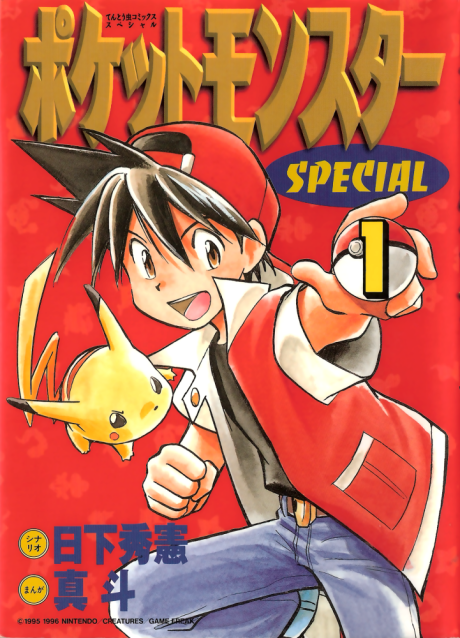
This review will contain no spoilers. Also, I will be calling Green and Blue by their localized names. Therefore the rival is Blue, and the girl is Green.

Pokémon, as a franchise, has always found its stride in miscellaneous and meandering adventures. A charmander lost in the rain, hidden ancient Pokémon buried deep underground, a hamlet full of eerie ghosts, or a mysterious and looming figure beyond the lighthouse over the ocean— so many atmospheric and adventurous moments that have been imprinted into many children's minds, including mine. There’s a certain magic to it that seriously leaves an impression on people; there’s a level of fun and escapism, a whole wonderous world with new things to see awaiting you. So, does the manga capture this magic— well, yes and no, but I’ll get into that. For now, I should clarify I went into this series with one question: is this going to be genuinely good, or is it gonna be a self-masturbatory fan-service circle jerk for nostalgia filled junkies? Fortunately, for the most part, I was pleasantly surprised— so let’s get right into it.
For some background, Pokémon Adventures takes place in the Kanto region— so generation one, for those of you familiar with the franchise. We follow our protagonist, Red, as he adventures across the country, battling and capturing many Pokémon along the way. The A-Plot involves our protagonist and his rival, Blue, battling gym leaders and filling out their Pokédex. Team Rocket— an evil organization— is trying to capture a Pokémon called Mew, which Red has to put a stop to; that’s the B-plot. It’s hard to sum up simply, but I’ve taken the liberty that the readers here at least know what a Pokémon is.

Pokémon Adventure is in no way atypical for a Pokémon installment. You have all of the usual set-ups— a strong and somewhat callous rival, a wacky professor, a naive but good-hearted protagonist, and a goofily evil team of bad guys. Being based off of the first generation of Pokémon, it’s the usual crew of familiar faces as well. Something that doesn’t shoot in the manga’s favor is that along with it they bring cliches as well, which aren’t really evolved from their previous incarnations. There are very few instances where they evolve these tropes past their most archetypal forms, so be prepared to experience some eye-rollingly lazy writing on the plot’s front— this effect is only confounded upon if you’ve played or seen any previous Pokémon work. However, I do think there are real nuggets of gold sprinkled into the crevices of every arc; I can really see this story blooming to be something special in further installments. For one, since it’s a manga aimed toward children, it’s easy to forgive the cliches as long as they do something interesting with them. I’m happy to say there’s some fun stuff here. By the end of the manga, even if Professor Oak points it out in an exposition dump, you can see how both Red and Blue have changed. Rubbing off on eachother, which is a nice dichotomy even if they are the stock and standard rival duo, honestly. Of course, not everything is done incredibly well. Take this for example:

Bad dialogue really perforates the chapters of this manga. Not only do they constantly use trope-y and overused lines, but sometimes it doesn’t even make sense in context of the characters— especially exposition wise. In the example above, not only is “let me show you the cruelty of adults” a cliche, it’s just stupid. He has no reason to be so evil, and it just comes off as corny despite trying to strike a serious tone.
Beyond the occasionally lazy writing, however, Pokémon find it’s stride in being simple. It takes these stock characters and gives them likable dynamics that are fun to see in action, given the dialogue isn’t particularly bad in said scene. You root for our naive protagonist as he adventures towards his dream— and that’s kind of the point. It’s supposed to be a fun-filled adventure about friendship and teamwork, and that’s totally fine. At times it really does this perfectly; I couldn’t be happier with those moments of pure, unadulterated entertainment. So, yeah, it can own it’s cliches. One of the best examples of this would be Red as a character. His one-note naive and kind personality makes him incredibly likable and charming, not to mention captures a childlike innocence most of us have long lost. Even if he does develop to be a bit more cool-headed by the end of the manga’s run, Red is a trope done near perfectly. Sometimes you don’t need to innovate too much, given the setting and context.

Finally, the themes are about as stock and standard as they get. Which in this case, is no way a bad thing. A sense of camaraderie and friendship really works in a story like this. Not only is it good for teaching children the basic moral of compassion for others, but it’s heartwarming as an adult. It’s pleasant, simple, and to the point. Nothing wrong with talking about friendship as the crux of your show depending on what you’re trying to do, or what tone you’re trying to convey. Hell, even the setting contributes to this— it’s literally just about adventuring and making friends. I’d be shocked if they made the main thematic purpose anything else.

Harkening back to the hook statement for this review, Pokémon is a series about adventure first and foremost. In the sense of random, fun, and episodic encounters that are memorable and inspire a feeling of childlike wonder— Pokémon Adventures succeeds. There are plenty of enjoyable one-offs that Red stumbled into, and damn were those chapters good: finding a Pokémon race on the way to the next city, joining Team Rocket to catch a badge thief, stumbling upon a bizarre Pokémon fan club, entering a hollowed city of ghosts— the list goes on and on here. It really captures the appeal of the early Pokémon episodes, and also in early Pokémon’s likeness, it captures very mixed pacing. Chapters constantly flash by, hardly bothering to set up the next event. Hell, never setting up the next event. The manga has no clear direction for most of its run, and it makes the whole adventure feel aimless and meandering. It would have benefited the story to include a map or outline the route Red will be traveling to get his badges at some point. This may seem minor, but it really ruined the whole adventure schtick. Without a baseline for travel, it’s hard to get invested or excited.

What’s this? There’s already an adventure map? Oh… well, uh— it’s still bullshit. I really like the illustrations and route details provided in these maps, but they’re not given in the story, so much as end-of-the-volume extras. The context and timing is completely off here, making the maps more of an insult to injury than anything. This whole thing ties into the nostalgia-based circlejerk, anyway. People who loved these locations and played the games as a kid won’t be near as bothered with the lack of outline, and will just be happy to see these places reimagined in manga format. I really hope the writers didn’t write this with the express intent that most would have pre-knowledge.

The characters in Pokémon Adventures are all cardboard cutouts— but in no way is that a bad thing. As touched upon earlier, Red is an extremely likable protagonist who touts the adventurous themes of the series. His opposing personality to Blue is fun to see in action, and often leads to humorous moments. They’re simple enough for kids to understand, while being charming enough for adults to have fun with. I talked about this earlier, but the way they develop each other is quite apt as well. Red becomes more of a critical thinker; Blue becomes more compassionate for his Pokémon, and generally less self-centered. My favorite from the primary cast is definitely Green, however. She’s a genuinely witty and charming character; her manipulative tendencies play off of Red’s naiveness very well. Don’t expect a lot from any of these characters, and there’s nothing to really analyze, but it’s a fun cast that certainly serves its purpose well.
On the other hand, I cannot say the same about the tertiary cast. Some characters feel like they’re just shoved into importance due to being popular in the anime or games. Brock is the easiest example I can think of. He’s barely in the story at all, and serves his purpose as a gym leader— but then they make a big deal of him and Red being friends, having him travel to a city during the climax to save him. Not only does him knowing Red is in trouble not make sense, but they had a singular Pokémon battle. It’s such a pointless turn of events, and I can’t help but think it was done for fan service.

Know what character also randomly showed up during the penultimate finale? That’s right, Misty— and god damn does she vex me. She’s the perfect example of how the pacing in the manga can screw over both the plot and characters. Her character struggle is introduced and concluded in the span of three chapters, so I can’t help but feel it’s rushed. She somehow starts liking Red in a semi-romantic tsundere type of way, and evolves to genuinely care about him from one battle where she was knocked out for the entire chapter. Then, when Red is ready to rush back into combat, she gets mad and stops him— declaring they’re friends who care about each other so he shouldn’t be reckless, noting that she thought he already understood that. For one, they don’t have a bond. They’ve been together for one day and she acts like they should understand each other perfectly. This sort of plot line is a cliche you see in a lot of stories, but without the proper time to breath and develop it feels anticlimactic and brushed over. It doesn’t help that she randomly shows up twice on later occasions just because it’s convenient for the plot. Hopefully her character will improve in further installments.

Another thing I should mention is that the Pokémon are oddly decentralized here. They don’t have distinctive personalities and hardly get scenes to themselves for the most part. Hell, the manga is oddly selective with the Pokémon it wants to become part of the main cast as well. Red will catch a Pokémon and then it will never show up again, but sometimes he just randomly catches a Krabby and it sticks around. What happened to all of those Pokémon he caught in the forest and the Safari Zone? It’s not a big deal, but it’s a bit weird. Especially when compared to stuff like the Pokémon anime, which creates characters as memorable as Charizard despite Pokémon only being able to say their names.

For Pokémon to work, you have to hold your suspension of disbelief. You have to simply accept the idea that an 11-year-old child can travel across the country and fight evil criminals organizations by himself. It’s part of the fun; I’m not so petty as to nitpick what’s necessary to make the story work. However, there are plenty of issues present outside of this. For example:

On the surface level, stuff like this is fine— but I’m concerned the writers will write themselves into holes sooner or later. In later generations, we get introduced into many more Eevee forms. How does one introduce Umbreon or Leafeon when it’s already been established that there’s only three types of Eevee? The same thing goes for Pokémon count. They’ve already established a set limit in the entire world, so how do they explain future generations? Hopefully they’ll have a way around this, but it’s hard to take the world-building seriously when it’ll just betray itself in the next installment.

On top of this, the manga is filled to the brim with inconsistencies. They had a low-level Pikachu one-shot a high level Onyx, despite their type difference. In Pokémon, an electric type is supposed to be weakened against a rock type. Fucking hell, in the anime, Ash had to put Pikachu on a whole-ass electric power mill to beat Onyx in the first place. Here he just does it. What’s worse is that they establish water attacks don’t work on grass Pokémon the chapter after. Which isn’t how it works exactly, for the grass Pokémon should still take some reduced damage— but that’s besides the point. The authors just bend the rules of the world towards whatever’s convenient for the plot.

Perhaps my biggest issue with the manga, which permeates every single section I’ve talked about so far, is how often they base writing off of pre-contextualized knowledge. They don’t really bother explaining gyms, Pokémon types, the Pokémon league, locations, or legendaries. They just throw you in and assume you know; it’s so incredibly lazy. I’m sure they would have just delivered it in exposition dumps anyways, though. You can really feel this aspect as we travel around unknown locations with no clear direction; as we get into strategic battles with no knowledge as to how types work. Rushing the set-up always muddles the execution, and fuck is it crippling here. Even outside of assuming you have pre-knowledge of some things, they base some character appearances and events off of nostalgia. As previously stated, Brock had absolutely no reason to come back into the story. Misty was rather shoehorned in as well. Fuck it, here’s another example:

No, Pokémon Adventures, I don’t know Articuno— you didn’t bother introducing the concept of legendaries until this very chapter. I don’t know if they simply forgot or didn’t have the foresight, but the introduction of Articuno would be so much more impactful had they established legendary Pokémon before this event. It doesn’t hold any weight or impact the story at all due to this. It feels like it was just aimed at fanboys who would already be hyped to see legendaries.
So, in the end— is it a pure nostalgia trip? No, not really, but it certainly has pandering elements which ultimately bog it down.

Pokémon Adventures was a very flawed, but overall enjoyable ride; I can easily recommend it, and I’m excited for more. Despite its tropes, cliches, and pandering, there are genuine nuggets of gold within the character interactions and exploration elements. If you’re a fan of Pokémon as a franchise, definitely check this out. Otherwise, maybe give it a shot, but it’ll be harder to get into. If you have any criticisms or other thoughts, please leave a message on my profile. I’m always down to discuss series.
Next Review- Pokémon Adventures: Yellow
Extra, Random Thoughts


Disney and Mark Twain are now canon to the Pokémon universe. So cool.

They gave Mewtwo the King Bach comically large spoonful LMFAO.

They really did their best to make Pikachu look SpEd.

This kid is like a 11 lmao, he does not know what ornery means.

This fight was actually rather great. Plenty of fun strategy that isn’t incredibly surface level as opposed to the fights beforehand.
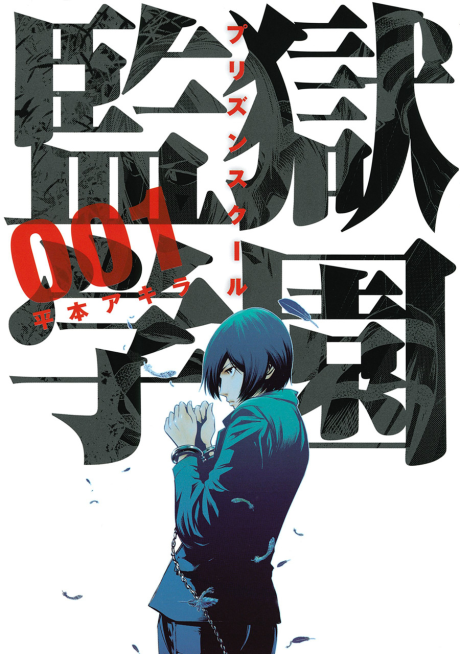
This review will contain no spoilers unless further warned.

Prison School was a series that was bound to have mixed reception from it’s very conception— I mean, it’s basically about a comedic sexually-toned highschool slave camp— but the criticism and modern perception runs a little bit deeper than that. To non-fans, Prison School is an overly sexual clusterfuck of cringeworthy content; to fans, the series past the anime remains in an ambiguous light. Though they obviously find the anime gut-bustingly hilarious, many supporters of the series remark on it in a negative manner. This core issue, if you’re unaware, stems from the last 100 or so chapters of the manga— and the bizarre direction the ending takes. I’m not here to defend or attack the series, but I’d like to chronicle my thoughts and opinions. So without further ado, let’s get into the meat and bones.
For those of you unfamiliar with the premise, it basically revolves around 5 boys— Kiyoshi, Joe, Gakuto, Shingo, and Andre— as they embark upon increasingly degenerative adventures in an all-girls highschool. So, yes, the archetypal Ecchi setting; however, this time with a twist theme— prison. Our lads immediately get comically caught attempting to peep on girls while changing, and are subsequently locked up inside an in-school prison system. Naturally, the female guards are abusive; I have to say, this is a perfect set-up for comedic potential. Limiting our characters' actions gives birth to increasingly creative yet awkward scenes, but I proceed myself. Either way, this is the basic premise, but the manga goes quite past this narrow scope. We get to see each of our characters leave prison and individually develop in intriguing ways, though the prison is still there, I can’t get into its purpose without spoilers. So for now, I’ll leave it at that.

First and foremost, Prison School is very much a comedy. I’ve heard some say it relies on shock and gross-out humor, and though it can be there, I believe that’s a great disservice to the humor in play for most of the series. I get it, though, for the style can certainly be jarring at times. It takes sexuality and pumps it up to eleven, constantly formulating clever and ever-expanding gag strings that permeate through the entirety of the chapter— and most of the time beyond that. It establishes things about characters like Joe loving his ants and Andre being a masochist early on, and continues to run with that, building again and again upon the original joke until the characters have developed past their original states. Well, for the most part. Characters like Shingo honestly stay underdeveloped throughout the series, which is a glaring flaw, but he has his moments and doesn’t feel entirely useless to the cast. Lots of the more stand-alone jokes rely on getting our protagonists into the most inexplicably awkward situations conceivable, however. They just continuously get more absurd, confounding onto the bizarre tone of the series— and there’s a ton of examples of this type of humor within the show. Like Hana needing Kiyoshi to piss in front of her to satisfy her twisted, naive, and misguided revenge; even Gakuto heroically shitting his pants in the middle of class to get an audio file for his dear comrade Kiyoshi.

This is where the issues begin to arise, however— how absurd is too absurd? Entering the Sports Festival Arc, we travel into the realm of the completely ludicrous, and this was a turn off for many. It somewhat broke the internal, grounded logic of the series. Andre becomes a giant dog thing? Why not? Kiyoshi fucking dies from a boner? Why not? The principle crashes a fucking helicopter into the school building? Why the hell not? Some of these things are relatively clever and hit, but others miss— and when they miss, they miss hard. That’s key issue number one, anyways, for there’s another feature that makes many hate the latter half of the manga: bloat. Bloat is a word I see constantly thrown around in reference to the Sports Festival and Calvary Battle Arc, as many feel like jokes somewhat stagnated and didn’t evolve fast enough for the pacing. While I don’t necessarily agree, there is certainly credence to the idea. Put together, it lasts 75 whole chapters; you get a similar feeling to Dressrosa fatigue. It’s set in this one, bland location and general concept. I believe, no matter how much they evolved the jokes within the arc, being confined to that one space and premise would have pissed most off anyways. It does not help that absurdism began to truly bloom here.

I likely came off as very critical in that last paragraph, but honestly— I love even the more controversial parts of the story. The clever writing remains; I think the absurdism is fine for the most part. Andre’s descent into madness feels like a hyperbolization of his masochism, and it leads to genuine development for characters like Risa. I do admit that the joke dragged on for far too long, though. I feel slightly dishonest to have talked of the Sports Festival and Calvary Battle arc and have omitted the Chairman Side Story Arc, however. For this arc is perhaps the greatest single thing to have graced the pages of Prison School’s run despite it’s awkward juxtaposition to the concurrent chapters. The Chairman is a serious guy who does serious things— but he’s also an ass man. He loves ass; upon seeing a fine piece of ass, he picks her up and takes her to her destination. Unfortunately, he ends up crashing and getting amnesia, making for a mystery where he believes he’s an action hero running from an evil organization— it’s fucking brilliant. Genuinely the peak of absurd premises. His sort of action hero demeanor is in stark contrast to the very normal events that happen around him, as he ends up cheating on some man’s wife and even getting into a fight with a bear due to a misunderstanding. They keep bringing unexpected things from earlier in the arc in to play, such as his crashed car and a dog. Sadly, I can’t spoil how, but damn does this arc craft comedic structure well.
So, we’ve established that the series mostly uses absurdist and blue comedy to deliver it’s punchlines— blue meaning comedy that’s sexual in nature. However, it would be unfair to mention the key issue that would turn people off from the manga: gross-out humor. While there’s almost always an actual joke to go along with it, it stands to reason that scenes like Vice Principal Meiko pouring buckets of sweat sexually or punishing prisoners with a riding crop would turn many off. Sadly, this issue is only exacerbated by the anime, which in all regards is an incredible adaptation— which only makes the realistically-drawn cringe worthy scenes all the more painful. I never personally thought the series was hard to read for its more repulsive content, but I would be remiss to not write about it, as it is a key part of the series.

Another commonality one may find within many jokes is a sense of camaraderie or at times, lack thereof. Prison School is a very “the boys” type story, as we watch our main five indulge in ridiculous farces constantly. Of course their relationship is petty and shallow, as they get mad and envious of each other just for interacting with women. This gap that builds in their relationship is usually rectified, however, as they are forced to give up pettiness to overcome their issues. The connotation “the boys” brings along may seem cringeworthy at times, but it’s executed fantastically here. It gives them a real sense of chemistry as they sacrifice things for one another, and even betray each other. Seeing Gakuto give up things in his own, personal interest for what he believes is the best for his friend ultimately is touching and feels genuine. You can feel the real bond beneath them, even if some things drive wedges in it— which I think is rather realistic. Real life long-time friends fight over stupid bullshit all the time, after all.
Finally, there’s a sort of psychological aspect to certain arcs of the story. We get to see characters play constant mind games and outsmart each other, usually leading into some ridiculously sexualized mishap— and it’s fun. It’s entertaining to see these five, munted boys attempt to escape a prison while under constant surveillance of brutal guards. I wouldn't say this is a main appeal of the comedy, but it’s certainly there; I think people who like psychological mind games would love the comedic romps here. It’s similar to Kaguya Sama: Love Is War, except far more clever in building up to the most ridiculous outcomes possible.

One of the core themes of Prison School is, evidently from the comedy, sex. Considering the raunchy and crude nature of Prison School’s subject matter, one might assume it to lack nuance or just not attempt to do anything outside of comedy— but I’d like to beg to differ. There’s actually some interesting nuance covered under the guise under the comedy, which isn’t present enough to mean a lot for many, but I really appreciated the message the story tried to convey. It adequately explored sexual relationships between minors and how that can scar one’s development, especially with relationships such as Hana and Kiyoshi. They became so twisted up in each other that it devolved into sexual degeneracy that neither would ever return from, or that’s at least what they thought at the time. They actually develop as people, though, and learn to move on past that and try to form healthy relationships. This is one of the many ways Prison School explored sexuality and relationships; it was shockingly adequate as commentary while being comedic.

To venture down another avenue or sexuality— how about fetishes? With a quick dismissal of Hana’s piss obsession, I’d like to hone in on Risa and Andre’s dichotomy. For those of you unaware— Andre is a brutal masochist. He gets his greatest pleasure in life from being mistreated and abused by women, which is often drawn to a comically exaggerated extent. Then, there’s Vice President Meiko; she’s a boorish but hot bitch who constantly abuses Andre in prison. Naturally, Andre takes a liking to her and her whippings; through a series of psychological tribulations, she breaks Andre down into a husk that needs “punishment”. However, she disappears due to a certain story development— and this is where Risa comes in. Feeling bad for the big, dumb, and kind Andre, she gradually warms up to him. Eventually, she takes on the mantle of trying to become his “Queen”. This is a phenomenal gateway into the relationship between a sadist and a masochist, as we begin to sympathize with her attempts to capture the magic the Vice President once had. Andre continuously puts her off for his one true Queen, for he can feel her reluctance and care for him; but eventually, due to her neglect of him, she finally clicks for him. We get to see the effort Risa put in to be his Queen, and how specifically she did it. Of course, most sadist-masochist relationships in real life are more grounded, but the core concepts remain. We really get to see Risa bloom for someone she cares about, and I think that’s underappreciated.

Expanding the field of fetishes and sexuality, we see Hana get obsessed with seeing male piss due to her own morbid curiosity. This is presented in a comedic light, of course— but it’s a genuine exploration of her own psychology as she develops a piss fetish. However, when she gets to the point where she’ll finally see it, something beautiful happens. She’s hit with a truck of instant regret, coming to the epiphany that her morbid curiosity was just that— a curiosity. She was so hellbent in her own, perfect fantasy that she didn’t realize the realistic repercussions of such a thing actually happening. This happens a lot in real life with fetishes such as wax play or cock and ball torture; people begin to realize a fantasy should remain within its own fictional confines. Of course, this isn’t always true, but I’m glad it was addressed here. Hana realizes that such a thing would ruin her own innocence and that she wants to form genuine, romantic connections with others. What a nice stroke for her character.
Another resounding theme of Prison School is its characters' constant selfishness and perversion. The boys especially act purely in self-interest, often for lust, and sometimes for social gain. Everyone’s willing to betray each other despite their supposed camaraderie; in the end, selfishness is their downfall.

Lastly, perhaps the most permeating relationship-based theme in Prison School involves the very foundation of a relationship. Partnership is based on one’s own maturity and willingness to love and trust their partner— a relationship built upon a lie will never last. Our boys get caught up in frivolous and self-concerned connections that make them lie for their own game, and they get punished for it. I'll get into this in my spoiler section, but the main point of the ending of the manga was to prove this point. One who isn’t mature enough to be honest with their partner isn’t mature enough to hold a real connection. We see people fail time and time again from their own selfish actions, and we see people giving into their own lust get continuously beat across the head— yet they never learn. Well, they might at the end, but I’ll save it.

I’m gonna go over each character and their arcs in this section, with both a spoiler and non-spoiler section for each. That way I can analyze their development thoroughly, while providing general and baseline thoughts for those unfamiliar with the material.
Kiyoshi, at first, appears to be your typical ecchi protagonist. He’s a bit of a perv who’s only encouraged by his friends, but he’s a good guy at heart— debatably. He can be selfish and lie to get what he wants, but he has a lingering sense of guilt and shame. Though this is archetypal, it sets a good stage for the themes of the story; by the end, he’s developed in such a uniquely bizarre way that I’m astounded. I can’t say everyone will like this character, but seeing him struggle with morals and hornyness is entertaining. This all changes and pays off brilliantly at the end, however.
Obviously, perhaps the most hated and controversial thing in Prison School is it’s ending— and I get why. It had many, many issues; I don’t think Kiyoshi’s arc was one of them. Seeing him lie about Hana’s panties shows his immaturity and selfishness which he has acted upon for the majority of the series, and proves we were conceited to think he had changed at all. When he’s nice, it’s usually in self interest, other than basic moral principles. This was his due— along with his entire relationship being founded on a lie. He started it in the first place by lying to Hana about liking sumo to make her happy, and this time it comes back around to him. He didn’t learn or develop his own morals and selfishness, and remained an immature boy for the story. Something about that is brilliant to me, and definitely a bold move from the author. Despite its seriousness and thematic interest, the decision is so ballsy it comes off as oddly comedic.
If I had to peg Gakuto as anything, I would say the primary comedic relief— or at the very least the funniest. He’s a perverted nerd who has an odd obsession with The Three Kingdoms, and at the beginning of the story he’s as self-concerned as the rest of them, but he changes. He learns there’s more important things than his own gain and becomes a martyr at certain points in the story; his development makes sense and feels genuine, even if the latter half takes it in a different direction. He’s always put into awkward situations, and seeing his nerdy reactions and speech patterns is always refreshingly funny. He’s the sort of fan favorite I hope everyone would like; he genuinely ranks among some of my favorite comedic reliefs. That’s not all, though— he has very real character issues beyond his perversion. He constantly struggles with his own selfish desires while trying to balance what’s right and his social relationships, which is cool to see. Beyond him struggling with his selfishness, he battles indecisiveness; especially in love. The manga uses this to show how being passive and indecisive in a relationship can hurt one’s partner, or conversely, potential partners.
We’ve already established Gakuto constantly battles selfish decisions over the story— but realistically, that only plays into his indecisiveness. He has a flippant attitude towards morality; this is most evident when plays with Slut-Chan. His nerdy, awkward, and passive personality gets him into a sexual endeavor despite his current relationship with Mitsuko. Later, in their relationship’s climax, he can’t decide who he loves the most. Evidently, his inability to pick pushes them down a perilous path of pointless games— proving his love is peripheral. Meaning his love is secondary, superficial, and corrupted. Justly, he gets punished for this; the girls move on from such a shallowly indecisive man. Putting aside his character flaws, his comedic exploration of sexuality was really fun; I’ll get more into that with Joe.
Perhaps the strangest character in the entire manga, Hana is a somewhat crude and delusional chick who gets infatuated with seeing Kiyoshi’s piss after he accidentally sees her peeing, leading to many comedic moments and some interesting thematic development. She’s one of the better girls in the manga, and she tackles themes such as fetishes, naivety in love, jealousy, and pettiness.
As touched on in the thematic section earlier, her naivety and regret being unveiled once she actually gets to the point where Kiyoshi will pee on her is a nice stroke for her development. However, after that, her character becomes a little more polarizing for many— she becomes a love interest. Her chemistry works surprisingly well with Kiyoshi as she attempts to steal him from Chiyo, and the love triangle creates good drama on occasion. However, as we all know, this falls apart at the end. Her pettiness unveils Kiyoshi’s own flaws, and they both end with the worst ending possible due to their own moral bankruptcy. In that way, they are perfect for each other. Both are selfish, immature children who ruin the relationships of those around them due to their own shitty character flaws— which I think was a very intriguing direction to take the character.
Joe is unfortunately an underdeveloped character, for he had a lot of potential to bloom. His character design with the hoodie which alway stays on is rather funny for a background gag, and his love for ants was stupid and quirky enough to work. It also tied into the recurring theme of being self-absorbed, as his care for his hobby impedes his social life on many occasions. He does get some pretty interesting exploration later on sexuality— but I don’t really have much to say there, honestly. It was just cool seeing him find himself.
Chiyo has an archetypal baseline that pervades her character for many, but in my opinion, she has some interesting notions outside of this. The archetype is of course your average nice, playful, and funny basic girl who seems to like the protagonist because they have the commonality of being nice. Well, at least nice on paper— because Kiyoshi’s toxicity eventually becomes apparent, dragging down Chiyo with him. She also regularly serves as a good plot device to set up wacky and increasingly more degenerative events, as Kiyoshi does anything to try and appear perfect to her. She drives the plot and forces Kiyoshi to do things like sneaking out of the prison, and also lying— which develops the themes of Prison School. Sometimes her naivety leads to fantastic comedy as well, like when she thought PBR-Sama was her birthday gift and continued through the Sports Festival Arc under that assumption.
FInally, at the end of the manga, she breaks. All of the perversion and selfishness of the boys pushes her over the edge, and she develops to parallel her sister— Mari. Of course, Kiyoshi lying was the final straw that broke her faith in men entirely. This is naturally a controversial way to take her character, but I think it’s honestly fun and interesting. There’s a certain sense of playfulness and irony to it; I just wish it was less rushed.
Mari is originally our antagonist, as she’s driven from a strict hatred of men. She believes all men are no-good perverts, and she despises her father for this— him being a big part of the reason she thinks that, as he’s not good at hiding his porn. She’s presented as serious and cold-hearted, and the deconstruction of this later creates not only good drama, but hilarious comedy. We see a gradual perspective shift in her philosophy when she’s bereaved of her prison head position and is forced to hang out with the boys. Not only is this arc of gradually less-severe sexism satisfying, but it creates good conflict with other characters. For instance, her initial hatred of men drives a wedge between Chiyo, her sister, and Kiyoshi’s relationship. It also creates awkward moments and solid banter when Mari is forced to work together with one of the boys; she’s pretty fun as a character. Another important notion for her character is her dichotomy with Kate, the antagonist that proceeds her— and their troubled past. I’ll get to that later, though. Of course, her respect and friendship with Meiko is also interesting to see; their relationship feels genuine and complex, as there are many moving parts. Despite how it may seem at times, you can really see their bond through Mari’s backstory.
By the end of the series, Mari has moved on from her sexist ways; she flew away to discover herself more. This is an interesting direction for her to take, as it’s directly leaving Meiko behind— but her needing to do it made sense, and she knew it would be good for Meiko to become independent anyways. So, she gradually became less sexist and left on a journey of discovery by the end of the series. I wish her departure was less rushed, but this was nice. Also, as a fun side note, Mari might be lesbian considering her scene with Kate.
Since Kate is our second antagonist in the series, it’s hard to cover her arc without spoilers— so just know it explores envy and perhaps sexuality, which I’ll cover in spoilers.
Kate being incredibly cruel is a fun way to set up humorous scenarios; this is accentuated by Mari and Kiyoshi being put in prison together. She’s manipulative, sadistic, and a bitch all around— which makes her fun to watch. As we learn about her past, we begin to understand her grudge as well. Mari’s constant one-uppance of her feats caused her to form an inferiority complex, and most importantly an infatuation with Mari, who seems perfect. She was jealous, and Mari saw right through her. Her infatuation quickly turned sexual as her twisted mind created this perfect version of Mari, even though she wasn’t that; their final battle and sex scene was a great conclusion to this. Mari left her with Meiko in the end, and she’s forced to move on, defeated. Cool enough.
Honestly, I’ve been dreading writing about Meiko, for she’s one of the most peculiar characters in the manga— and it’s hard to even say in a good way. She’s a real mixed bag— especially in the spoiler section— so let’s dive right in. At the beginning of the show, she serves as a second-hand lackey to Mari, but serves as the general antagonistic force since she’s around the most. She’s strict and mean, having no problem beating prisoners with riding crops; perhaps most pertinently, she’s a sexy beast. Well, kinda. I personally find her the opposite of hot, and her constant sweating grosses me out, but my ultimate point is she’s incredibly sexualized. Lots of her humor derives from either beating the boys or being in a sexual position, which can get very gratuitous. However, Prison School usually carries some level of wit; it knows how to construct clever jokes off of this. They play Andre’s masochism off of Meiko’s sadism, Gakuto gets to be a punching bag, and for a while her chemistry just works. You can feel the sort of camaraderie she’s formed with the boys from spending so much time as their prison guard, and it’s pretty sweet in a way. However, throw all this out of the window, because guess what— amnesia. I can’t get into exactly what happens, but her character has a major perspective shift; I’ll get into this below.
Meiko beyond the first arc turns into an entirely different beast, and it’s perplexing. Amnesia was a strange trope to bring into the mix in the first place, but it reverting her character to meek and shy really shook up the dynamic among characters in the story. Hell, it sent Andre on a spiral of insanity. Using this as a segway to reveal her previous flaws of being so meek really highlighted how Mari and Meiko developed each other time. Her current self is truly in juxtaposition to her previous self, which leads to great comedy. It’s kind of the same sort of appeal you see fandoms go rabid for (Particularly noting on Undertale’s many personality-flipped alternate universes.) I can’t complain ultimately, though. The direction was fine, even if the cure being soda seemed a bit too random to be funny. Developing her dependence on Mari with the backstory was the right choice, as it segwayed into her ending nicely. My only major complaint there is she didn’t get a resolution with most of the boys, especially Andre.
Shingo, in a similar happenstance to Joe, is woefully underdeveloped. He contributes to the themes by being selfish and horny, but beyond that he has little notable personality. He’s a somewhat-cool, slimy backstabber who will do anything for personal pleasures. Particularly a lay. It’s hard to sympathize with him, even if what he does is understandable. It’s nice to see him make amends and attempt to change himself, but as for most of the characters in Prison School, it’s mostly for naught. His selfishness is at the core of his character, and he foolishly reverts back to it. Other than that, he gets some neat romantic development with Anzu— even if he fucks it up comically on multiple occasions.
Near the beginning of the manga, Andre is a very one-note character. However, in a similar fashion to Meiko, he has some of the most varied and controversial developments in the manga— truly pushing the reins of absurdism. Hia whole schtick is masochism; they use this for great comedy whenever it’s appropriate, and it doesn’t feel particularly explored or focused on. As the first arc ends, however, we shift the focus onto Andre far more. His character develops into something else entirely, and we begin to go into a gradual exploration of the dynamic between a masochist and a sadist. Said exploration can sometimes be disjointed and bloated, but it’s a genuine covering of a topic you won’t learn about in many other manga, so it’s interesting.
Past the first arc, and since I already covered the thematics of Risa and Andre’s relationship, past that— Andre truly dives off the deep end. His character is turned into a beast-like entity to parody his hyper masochism and need for constant masochistic stimulation. On paper, this is pretty funny— but the joke gets old. Every once and a while they revitalize it by innovating on it, but overall it stagnates. It’s one of those evolutions that happens so fast and in such a bizarre way you miss the original character as well, the easiest comparison I can draw here is Mr.Garrison from South Park. Even if the evolution made sense and had its moments, you just want your original funny-guy back.

Finally addressing the elephant in the room, the ending is by far the most controversial element of the story among those who have read it. It takes such an incredibly bizarre turn for all of the characters in the story, and it’s honestly kind of fascinating Hiramoto had the balls to pull this one off. So, without further ado, let’s get into the analysis.
Rushed. Rushed is the immediate word that comes to mind when someone brings up the flaws of the Prison School ending, for we get to see many plot-lines remain unresolved or come to a premature end. For the people who despise it for this aspect— I honestly can’t blame you. Things like Mari’s conclusion don’t even early capture what her arc had set-up, and it feels like they just slapped a band-aid for a quick fix as an afterthought. Hell, they literally did forget about the wet T-Shirt concept, and were forced to finish that plot-thread in a short point-five chapter.
So, the first branch I would like to cover is Meiko, Kate, and Mari’s conclusion. I think Mari leaving to search for herself and get away from the others is a very novel concept, but fuck, man— the execution. It was poorly explained and came out with little apparent build-up, as they only hinted at this notion towards the finale. On the bright side, however, I think this was a rock solid conclusion for Meiko and Mari’s character dynamic. Meiko blossoming into independence is a powerful notion, and made the bullshit of the amnesia worthwhile. I also like the implied chemistry with Kate and Meiko as they search for Mari, but unfortunately still, this entire sequence of events comes off as very rushed.

Moving onto the penultimate finale, Gakuto, Shingo, Joe, Anzu, Mayumi, and MItsuko’s ending was polarizing. On one hand, it’s incredibly dumb; it’s hardly even an ending. They float off on PBR sama and are forced to come to terms with their drifting fate, missing Chiyo’s party. On its own, this is just horrible as an ending, but a funny sequence of events. However, I’d like to give it the benefit of the doubt. I see this as a fucking hilarious joke, even if it was a bit cheap. Near their final moments floating away on PBR-Sama, Gakuto states that everything is a matter of perspective; instead of a castaway situation, this is a 2 years vacation. Fortunately, we get to see our B-cast one more time— and they’ve finally managed to stop PBR-Sama. So what do the boys do? They board back on the ship, continuing down the river. The implication being that they took a whole 2 years vacation, and that’s fucking hilarious. It makes sense as the boys had been obsessed with PRB-Sama for the past 100 or so chapters as well, so I’m fine with this ending, honestly. Most of them already had their romantic conclusions— Shingo being the obvious outlier— and they were usually relegated to comedy, anyways. It just feels like a massive shit post, and you can say I’m in bad taste, but I dig it lmfao.

Touching on perhaps the most controversial segment, let’s talk about Hana, Kiyoshi, and Chiyo’s ending. There’s really a lot to cover here, holy fuck. This is perhaps the most bizarre string of chapters I’ve ever had the pleasure of experiencing, and I absolutely understand why people hate it. I like some things about it, though. For instance, everything that happens feels perfectly in character. Kiyoshi was an immature teenage boy; he remained that through the entire series. His character flaws ended up biting him the ass, even if he tried to cover them up— as they did for most other characters in the series. He never grew up, changed, or developed past some instances like learning how to take an emotional hit. That idea is beautiful. Where most series have their asshole or flawed protagonist grow and change, Prison School shows us a character who never escapes his own flaws as a person, but simply reverts to them— and that’s incredibly realistic for some people out there. For many, change doesn’t ever come, and they exhibit the same mistakes for the rest of their lives. Of course, in a story this makes the conclusion unsatisfying for many; I think that’s a valid complaint. I, personally, thought it was really cool, though. The other character’s actions make sense as well, as they fall right in line with previously exhibited behavior. Hana’s pettiness and jealousy are at full display here, as she ruins Chiyo and Kiyoshi’s relationship. Ironically, with their flaws, they might be perfect matches for each other. While Chiyo was a diamond in the mud, who’s naiveness was her only flaw, she would have never worked with Kiyoshi. They didn’t even have anything in common beyond Kiyoshi being kind-hearted. Their shittiness breaks and corrupts her, however, as her perspective shifts to a more cynical one. Feeling betrayed by the only person she could trust and love— Kiyoshi— she shifts her perspective towards hating all men, mirroring Mari. It’s not perfect and could have been more fleshed out, but I really like this direction. It’s really unique and thematically poignant. Ultimately really cool stuff, even if they could have pulled the pacing and rushed it less.
So, yeah. Despite some left-off plot lines and rushed conclusions, I really liked the Prison School ending. It was unique, impactful, and thematically appropriate. I get people that hate it, but I do think modern perception is a bit hyperbolized. Feel free to message me your personal thoughts on the ending, as I’m pretty interested to hear all of the unique reactions to this.

In the end, Prison School is one of the funniest experiences I’ve ever had watching television. I consistently laughed; there was even some interesting character development and thematic nuance in the background to keep things fresh. It’s latter half has its flaws, but I’ll always remember it as a resoundingly positive experience. The raunchy, blue comedy may not be for everyone— but if this looks appealing at all to you, go for it. Signing out, message me your thoughts, and have a good day, everyone.
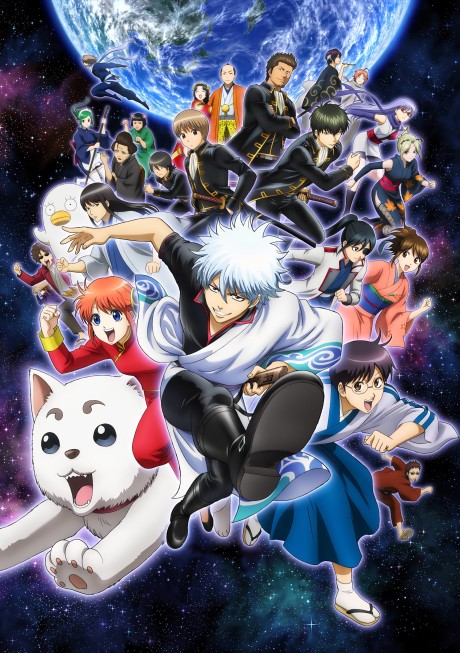
This review will contain spoilers for season 4 and analyze the events within it, but nothing after. If you want a more general review covering Gintama’s writing, go read my season 1 review. This will just over the arcs as my last 2 reviews have, so thanks; have a good day.

Gintama season 4 is perhaps one of the most hyped up seasons in anime, and for good reason. It’s the mark of a pivotal change in Gintama’s story structure, as we begin to shift from comedy-filled episodic escapades to serious arcs cascading over the rest of the show. So much comes to a head and develops; it was hard to write about, honestly. Even the production value significantly improved along with the season. You’re 4 reviews in at this point, though, so there’s no point dicking around— I’ll just get right into it.

The Reaper Arc I had no prior expectations going into, and I would like to say I was pleasantly surprised. It had a neat moral baseline that fit right in with the core thematic motifs of the series; I loved every bit of it. Asaemon learns to protect what she wants to protect like a samurai, as opposed to following the rigidness of law. The idea of humans being the only ones able to redeem each other is a beautiful thought as well, and it ties nicely into the executioner gimmick. Our characters all reflected different ideas and were very poignant for the arc. The former Yaemon lived like a samurai, for his own values, and Asaemon’s arc had her learn to live like that. Meanwhile, the 18th Yaemon killed to protect the family name, but only sullied the ideals behind it. I feel like the development of characters and themes was well done, and the character design reflected that. The skull Asaemon had ended up serving as neat symbolism as she shed her reaper identity and lived by her own merits. She executed herself to be born anew, and that was the perfect ending.
The death of the 18th Yaemon was also nice in multiple ways. His character development in saving Asaemon was a bit drastic and sudden, sure, but I can accept the philosophical shift despite its jarringness. On the flip end of the scale, Yaemon’s death turned into the perfect introduction for Nobunobu as a character. It set him up to be super intimidating as a figure and was just generally shocking. Not to mention it set up his motivation and personal philosophy super well, with lines like “I’m going to cut the head off of this antiquated country.” On top of all this, it was somehow made even more impactful by immediately tying him to the Kiheitai.
This arc has many moving elements to cover, and god damn are they all interesting. I’ll be segmenting them to cover it, and this way it should be easy to skip around to the parts you care about if you would like.

Who would have guessed Gintama would go from a goofy comedy Shounen to a political thriller? Well, hopefully everyone, because this has been building up for a long time coming. 300 episodes of forces moving in the background of the show come to a major head here, and damn is it beautiful. We immediately begin with an assassination attempt on the Shogun’s head, setting a precedent for this arc like we’ve never seen before. Of course, in this scene, the Shogun explains to his sister Shoyo that he wishes he could stay under the moon in moments like this forever. Of course, this sets up a nice emotional impact for later, and the final scene which I’ll get to. As for the beginning of the Oniwabanshu, we get to develop Zenzo and Sachan’s philosophy a solid bit— which in my opinion was heavily needed for their characters. We learn of Sachan’s devout loyalty and sense of duty and then are given the red herring of Zenzo aiding the side he finds more fun, which is later subverted into the idea that Zenzo is betraying the Shogun to protect the country. This sets an interesting conflict for the viewer by framing a decently liked character as a villain, which I would like to say is excellently done. Sachan’s disappointment with him feels guttural, and the lighting and framing of the fake Shogun assassination scene make a shocking and imposing moment. Naturally, though, all of this is reversed by the twist that Zenzo actually assassinated his friend in the Shogun’s stead— which felt kind of bullshit at first, but it was decently executed, as the person’s sacrifice for the Shogun holds genuine weight. The Shogun as a character holds the philosophy of protecting his nation with his own life, which is of course reflected through the dialogue “The duty of the Oniwabanshu is not to protect the Shogun. It is to protect the Shogun's duty. And a Shogun's duty is to protect his people and his country even if he must risk his life to do it.”
I think this quote is well implemented into the Shogun’s backstory, and we get to see not only his connection with the Oniwabanshu, but his deep-rooted kindness and respect for others. The Shogun idolizes the life of the Samurai and their ideologies, so I think it makes perfect sense for him to come to the naive conclusion of disbanding the Shogunate. He does not feel fit as a ruler for such people, and he realizes the only people worthy are the people themselves. This also generally creates a good twist as we see him tell this directly to the Tendoshu and Nobunobu in the darkest hour of the show, which is honestly beautiful. It was the perfect setting; it made it hold great levity.
If we backtrack back to Zenzo for a second, his willingness to sacrifice himself for the Shogun accentuates their relationship and reliever for each other. He will sully his name to save his dearest friend; I think that was a nice stroke of development for Zenzo. It shows that a ninja and a samurai don’t have to be so different after all, as they can both protect what they value. The entire Oniwanbanshu faction going to war with the Kiheitai also gives some life and meaning to their faction as a whole. My only complaint is that it kind of came out of nowhere, and I wish we had at least been introduced to the village of ninja properly beforehand. Usually, Gintama has the sense to subtly implement these things through one-off comedy episodes.
Finally, I think the Shogun’s internal strife of having to run away instead of fighting directly for his nation is awesome. He wants to protect as many people as possible, but jeopardizing his own life would make all of that sacrifice pointless. He does what he can and even demonstrates his kunai technique, eventually, of course— but in the end, he has to run away from even Edo itself. He has to mature and run away to ever have a chance of facing anything in the first place, which I think is awesome. Then, unfortunately, we enter the final scenes of this arc. The Shogun, or now Shigeshige, is assassinated. The way it happens is near poetic, and it perfectly concludes his characters and adds nuance to the themes of the arc. We see him abandon his heavy guard in favor of making connections with people as Shigeshige, as a fellow samurai, as opposed to “The Shogun”. It’s a picturesque notion that perfectly falls in line with his character, but alas it’s fatally naive. Gintama pulls back on its ideal of the samurai and kills him— with no silver lining in the concept. It’s a tragic end to a hero; it gets the message that ideals don’t win a war alone across. It went far darker than I expected it to, and I appreciate it. Most similar Shounen would end up hoisting the themes of the story over the realism of the arc, but Gintama lets the idea of the correct ideals not always winning in the end flow. Really cool shit.

Shogun Assassination is truly an arc of build-ups, for perhaps the most tantalizing mystery in the entire series has been Gintoki’s past. It’s been parodied and joked about constantly through the course of the show, and we even got a little tease in Courtesan of a Nation— but the truth comes out here; it’s pretty great. The mystery was incredibly well-executed, and the answer was satisfying. I suppose I proceed myself, though. I think it would probably be important to note Takasugi's presence in the arc in general first. Him and Kamui teaming up with Nobunobu was imposing as hell, and it set the stage for the most chaotic political storm possible. His and Gintoki’s confrontation was slowly built up in the arc, and Gintoki’s charge down the mountain to face him was incredibly hype. As was the battle in general, as they really let the animation budget go for this arc. The direction of the fight is generally superb; its structure, too. It’s tied in with bits of Takasugi, Gintoki, and Katsura’s past with Shoyo, which gives us a greater understanding of the characters fighting. Then the build-up to the twist of Gintoki executing Shoyo himself was super well-executed, making us simultaneously be shocked and understand Takasugi’s hate of Gintoki. Takasugi despising the government and wanting to destroy the government makes sense because of what they did, and Takasugi hating Gintoki while not understanding his actions is perfect— and of course for not rebelling against the Bakufu. Gintoki killed Shoyo to protect Shoyo’s will and ideals, on top of saving his comrades. He tried to protect Shoyo and Takasugi but ended up sending Takasugi down the wrong path, and as we learn in Farewell Shinsengumi— killing Shoyo was for naught. How ironic.
Anyway, Takasugi develops in this fight, as he understands Gintoki’s intentions more. He understands why he saved them instead of Shoyo, and his conviction only goes stronger for it. They’re both samurai with things they value and need to protect, and these ideals are highlighted by their convictions only being strengthened here. Where most Shounen would redeem a villain and have him flip perspective, they simply have Takasugi understand but disagree here— which I think is pretty fucking epic. Gintoki continues living in the present for his ideals, and Takasugi continues fighting and grieving over the past. There was a lot of nuance for a segment that only stretched over 2 or so episodes.

Hijikata, Kondo, and Okita all get solid amounts of development in this arc. We see them defend their ideals like true samurai, and just generally generate hype. The parting between the Odd Jobs and Kondo’s group on the bridge was pretty impactful, drawing on things like the Shinsengumi never requesting the Odd Jobs up until this point. On top of this, Matsudaira developed phenomenally in this arc by establishing his motivations. Sure, we knew he was assigned to protect the Shogun previously, but it fleshed out why and how much he respects him. He even respected him so much as a friend he let him meet with no guards, which tragically ended up being the Shogun’s death. That’s just depressing, honestly. Then, finally, I would like to note how imposing Nobunobu ended up being. He used the main villains built up for the entire show as his puppets, killed the fucking Shogun, and got the approval of the Tendoshu. What a villain. He feels slimy, childish, and despicable— he is one of the most hateable villains in anime for sure. I don’t want to proceed myself, though, so we’ll wait until Farewell Shinsengumi.
In conclusion, this was the single best Gintama arc up until this point. Some insane developments accompanied by the most hype political thriller I’ve seen since Code Geass, and god damn did everything pay off. Episode 305 isn’t considered the best episode in Gintama for something, and I’m sure it’s etched into the hearts of most who watch it. Super fucking cool.
Directly following Shogun Assassination, I’ve hit another mega arc I’ll have to split into segments— so here we go.

Farewell Shinsengumi begins with bombastic music, showing every rippling effect of the Shogun’s death— and this is perhaps my favorite start to an arc in fiction. There is an insurmountable amount of development for many characters in such a short amount of time. We see Zenzo grieve over having killed his friend and fought a war for naught, we see Katsura promise to change the nation in his deceased rival’s stead, we see Yorozuya hit their lows after failing to save someone for the first time, we see the Shinsengumi split up under Nobunobu’s iron fist— and the individual fragmentations of that. Kondo takes the role of a martyr to let his men live on, as Hijikata tries to accept this. Eventually, however, the Shinsengumi conclude that there is no point in living if they can’t protect their values and their chief— which falls into the motif of samurai. Gintoki also gets nice development on this stroke as he gives Hijikata advice on what to do, having made a mistake in a similar situation— referring to Shoyo. Otae learns how important Kondo was to her all of this time, calling back on old gags to turn them into serious emotional beats, mostly with the stalker stuff. Anyways, this brooding tone cascades over our main cast as Nobunobu takes over the shogunate, and damn is it impactful. In the scene where he antagonizes Otae and others with his newfound power it’s extra cathartic to see Gintoki deck him because of our hero’s recent loss. Everything about this is just incredibly well executed, and Isaburo even taking the piss on him was a nice touch. Of course, this isn’t all, for there’s more development in these first two episodes than most one-cour shows. We get to see Matsudaira hit his all time low, even contemplating assassinating Nobunobu to avenge his dear friend. This emphasizes Matsudaira’s relationship with Shigeshige better than anything until this point has. Finally, to cap off this section, we get to see the Shinsengumi and Joi Rebels abandon their previous grudges and statuses to join as samurai with common values. It had been a long time coming, and this really accentuates the idea of positions pitting pretty like-minded people against each other. The core idea differentiating them before the Shinsengumi disbanded was a lawful attempt to protect their values as opposed to a rebellious one, obviously.

Nobume and Isaburo were incredibly underdeveloped as characters before this arc, so I’m glad they got what they sorely needed; it was great. The backstory was well interwoven with the fights raging at the time; Isaburo’s fight against the Shinsengumi was hype and climactic for the long-time feud. I think the general direction and color palettes of the backstory scenes were done super well. The actual plot itself was well constructed mostly due to the story structure, like with the timing of the reveal of Nobume’s name being what Isaburo was going to name his daughter. The depiction was just neat in all fields, and it really helped us understand Isaburo as a character— as a father, and as a samurai. His suicidal, hopeless notions of wanting to end such an era of violence and made sense for his character and was unexpected. Nobume’s love for Isaburo being explained by his fatherly relationship with him, as well as her duty of guilt to kill him worked away my previous problems with her character expeditiously.
Directly after the entire backstory scenes they drew parallels between Kondo and Isaburo as leaders— which was to great effect. They were both samurai with their own things to protect in life, and Isaburo respected Kondo for that. Kondo’s advice had once helped him after all, even if it had backfired and he lost his wife and daughter anyways. It was a nice way to wrap up their relationship before Isaburo’s death; on that note, it was a great conclusion to his character. He knew he would never be able to change a thing about the world in the end, but he got to raise and love Nobume. He sacrificed himself for her in the end, which is the perfect conclusion for him. Then, the send-off the Shinsengumi, Mimawarigumi, and Nobume give off with the salute was really emotionally poignant. They saw their chief off; Nobume sent off her father. The cell phone being thrown over the edge was a nice touch too. Pretty impressive development for one arc, I would say— and yet again there were plenty of twists that made events worthwhile.
As a little bonus and afterthought for Thorny, I was surprised to see Tetsu get great development at the end of this arc. Even if they never got along, he wanted to impress his brother, and I think that was gratifying to see. I’m glad his character wasn’t entirely abandoned post-Thorny.

In one of the most hype introductions I’ve ever seen, Utsuro enters the final quarter of the battle, tearing our protagonists to shreds. He eviscerates Gintoki with his ship, pummels Kagura, breaks Okita’s arm, and severely injures several people on the playing field— all while this menacing OST is blaring in the background. His presence is given weight for being one of the Tendoshu heads, and obviously just how powerful he’s shown to be. This is confounded upon when he’s revealed to be Shoyo, which not only sets up a solid mystery, but makes him all the more imposing and impactful. You can see the ripples of emotion this sends through Gintoki as he tries to process what he’s seeing— and it’s pretty fucking cool. The OST, the framing, the lighting, and the animation all make Utsuro seem next-level as a villain. He wipes the floor with some of the strongest people in the show up until this point, and is only another threat to stockpile on top of Nobunobu. This certainly promises to affect Gintoki’s character tons later, which I look forward to. My only potential issue is how cliche it is to bring back a dear friend who’s been taken over or is being controlled by something else entirely, so I really hope they take this in the correct direction. This section was shorter, but it was an important development, so I figured I’d cover it.

To touch up on some things I missed talking about during the arc, I would like to start with Kondo. I think he and Katsura both developed phenomenally as they dropped the pretext of being a rebel or cop, and joined forces as samurai. We also got to see how much Kondo’s men truly love and respect him, attempting to save him and even abandoning themselves in such a dire situation. Hijikata’s depression upon Kondo’s death accentuated their dichotomy, and Gintoki incurring him to rage and fight also showed a lot. The scene was really cool, even if we got baited on Kondo’s death. Then, for the Shinsengumi’s actual conclusion, god damn was it beautiful. Otae and Kondo’s farewell used previous comedy to create emotional beats; it was to great success. The Shinsengumi left Edo, officially disbanding— though their ideals as samurai would still live on, which is what made them Shinsengumi in the first place. Odd Jobs taking over the protection of Edo in their stead was also superb in concept.
So, finally, Farewell Shinsengumi was perhaps the most emotional saga in Gintama so far. It has events which will be felt later into the story, and had conclusions that capped off characters well. I can see why this arc is praised so highly; damn, it was a good time.

I know it seems a little brief to only cover 3 arcs, and only serious ones at that— but I genuinely don’t think any comedy arc in this season is worth noting. Some were really funny and some were duds, sure, but I don’t feel there’s anything I need to analyze that I haven’t covered a similar thing on before. I’d just like to say that some characters like Kyubei and Saitou got great development, and that’s really all. So sorry if you guys wanted to see something on Feigned Illness. It would really just be me saying how they took a cliche formula and subverted it for great comedy, which I’ve already talked about Gintama doing before. Anyways, this season was one of the best, and damn, it gets me hyped for more. Signing out, and always feel free to message me your thoughts— they’re very much appreciated.
This review will once again be a general arc breakdown, and a follow up to the first and second. Of course, full spoilers in this review. If you want a non-spoiler review, go read Gintama season 1’s.

3 reviews in, I’m sure you get how this works. I’ll start with a little touch up, and dedicate most of the review to breaking down each arc.
This one will be relatively short with only 13 episodes of content to cover, but bear with me, because this season was jam packed. It was an entourage of serious arc after serious arc— which for some reason seemingly had a way increased budget from previous seasons. I don’t have anything to note beyond this precursor, so into the meat and bones we go!

The Kintama arc has a pretty wacky premise; I love it. Waking up to find yourself replaced by a superior version of you is genius, and it leads to a lot of good drama. It ends up tackling some neat existential ideas like “Should I even want to go back if they’re happier with the other me around”. Of course, the moral of the story here was that Gintoki’s dim luster made him him, and no replacement would be apt. It was a predictable moral point for a Shounen, but it was relatively impactful either way. It drives home the point of everyone being special and irreplaceable in their own way, and also shows the bond Gintoki and the rest of the cast share. The other thematic strokes were good as well, as all of Kintoki’s friends revolting against him exemplified the idea of true friendship being correcting each other’s path when they go astray.
I thought the comedy was super solid as well, making creative jokes off of the doppelgänger situation. Like Gintoki always finding a way to bash him in the head out of anger was hilarious, and somehow unexpected almost every time. Not to mention the Tama and Sadaharu Yorozuya team was just neat to see. Also, one can’t forget the opening being solely Kintoki for the gag; replacing Gintoki in the previous episodes with Kintoki.
Of course, the main attraction would be Kintoki himself; I thought his character arc was sublime. He strived for his own ideal life of being a protagonist as he was created to be one, and felt threatened by Gintoki coming back to replace him. This is a large part of why they sympathized with him in the end, as he was created by them and had no say in his role in life. Also, the idea of our main antagonist just wanting to be a harem protagonist is fucking hilarious.
I also thought the structure of the plot was nice. There were several neat twists that were shocking to various degrees. They really strengthened Tama’s relationship with Gintoki during this arc as well, I really appreciated them showing the bolt hair-pin Gintoki gave her. Though, when she “died” and came back it just felt hollow. Character revivals are just generally not fun, and it seems to be a recurring thing in Gintama.
So, in conclusion, Kintama was an incredibly fun arc with a lot of things to offer— even the ending was super satisfying. It was a blast all the way through, and it got me hyped for later ones.

Courtesan of a Nation was a very satisfying conclusion to the Yoshiwara trilogy, and perhaps the best serious arc in the series up to this point. There’s a LOT of branching plot threads to cover, though, so I suppose I’ll cover them individually.
Suzuran, the famous courtesan of Yoshiwara, had a solid introduction. It grounded her character with some funny jokes, and established her connection to Gintoki well. It also semi-subtly began building up towards a phenomenal emotional pay-off. I wish I could say the same for Maizo, however. He wasn’t bad in his introduction, but the whole wanting to be stepped on by a child thing was strange and a bit off putting. I wasn’t initially sure how his character would largely play into things, but the reveal of him being Suzuran’s beloved was super well done. It helped paint the Shogun Sada Sada in a villainous light, and established him as a threat on the levels of pettiness he would go into. The idea of Maizo suffering, wanting to return to Suzuru under the moon was beautiful; it naturally set up for a good emotional pay-off when they met up. The actual meeting scene was done near perfectly, as we see Suzuran finally achieve her wish on her deathbed. This was amplified by the idea that it just barely happened, and some smart direction flashing them from the past to the present with the motif of Sakura petals. Also, if you didn’t know, the lyrics of opening 13 tell their story— which is the opening that plays over this arc, obviously. This was probably the emotional point in Gintama, and it was super well set up. Something about their love enduring over such a period of time is just special; I understand if you don’t find such a concept appealing, but the direction and way it’s conveyed should be enough to get most invested.
As mentioned in my 4 Devas review, Gintama is quickly turning into political warfare— and it’s incredibly hype while being thematically poignant. The arc accentuates the idea of samurai being beings that live for their own ideals, and how their lifestyle should be protected. We see samurai revolt against an entire governmental system for the sake of principles, almost outlawing them as terrorists. Of course, the Shogun comes in to usurp his predecessor as one of the most hype twists in the series. Not only was it unexpected, but it perfectly played this comedic character into a serious arc, and gave him a good bit of development. The Shogun has always been connected to his people and always cared about the citizens of Edo, so it makes sense to have him resign from his position and want to leave the political power struggle— believing he isn’t worthy of ruling such samurai. On the other end of the spectrum, it’s awesome to see opposing forces like the Mimawarigumi and the Shinsengumi band together for the sake of a common foe— and the others to protect the samurai ideal.
This also continues to build upon the world, introducing and developing factions like the world leaders Tendoshu. Not to mention the political faction vying for control, the Hitotsubashi. You can feel the political power struggles boiling up in the background, and tell this is just the beginning. They even casually name dropped “Nobunobu”, who I’m sure will be important later. Then, as a closing note, Takasugi’s appearance politically assassinating Sada Sada once against drives in his relevance and potential threat.
This plotline finally gives some reprieve to long and not-subtly foreshadowed events. The mystery of Gintoki’s past has been built up for 100’s of episodes, as we only get nibbles of bits of information as to what transpired back in the Joi War. Our built up intrigue is immediately peaked by linking Oboro to Gintoki in some way, and the bits of his past that they reveal get you wanting more. Not to mention, his seeming connection with Nobume sets up a new mystery to be satisfied. Then, the actual fight with Oboro and Gintoki is beautifully animated and directed; it has levity due to Gintoki willingly attempting to kill someone. We don’t get much of their plot line here, but what we do see is impactful and memorable.
For other things I’d like to note, I feel like Tsukuyo had her character developed well here. Hinowa directly pointed out her parallels to Gintoki, and it really shows how she’s been subtly influenced by him. On top of this, I think the comedy was super strong. The cliffhanger ending of the Shogun getting knocked out by a can was super funny; it’s an attestament to the Shogun’s comedic power. He’s an important, powerful political figure but he always ends up in the most unfortunate of situations. Of course, this is sometimes subverted for comedic effect like in the pool episode, but the idea generally remains— and it’s on full display here. I’d also like to note Princess Soyo and Kagura’s relationship coming back into play was a nest touch, and was totally unexpected. It felt like the political connections the crew had gained over the series had really paid off. If I had one complaint, the political exposition was perhaps a bit too much for the pacing at certain times— but that’s minor.

For sure the most troubling arc of season 3, I still really like Beam Saber in spite of its flaws. Though, I would be remiss to not mention them.
The most glaring thing for many people are in line with Renho’s flaws— the abundance of Star Wars references. Of course, the references in themselves are not the issue, but the way they are delivered is problematic. They constantly rely on using Star Wars jokes for humor, with no back-up punchline or subtly in play. It’s a parody, sure, but it’s practically just saying “laugh because of popular things”. Which, obviously, is incredibly lazy writing. Though, outside of this, I found Hajime to be a fun and well-developed character. Even if the theme of laughing instead of crying is overdone and cliche, it was poignant here due to the presentation towards the end. Had they not concluded Hajime’s character arc by killing him, which conversely teaches Otae and Shinpachi, I would have been pissed. That truly would have been cliche Shounen. Hajime’s struggle of wanting to see his childhood friends off for one last time selfishly is endearing, and pretty sympathetic. Gintoki wanting to save him from his fate is perfectly fitting of his character, as well as him making himself the villain for it. Everything fell properly in line for the character’s action, and it’s honestly rare to see such potent characterization. Shinpachi’s initial rage at Gintoki was heartbreaking as well, and the same goes for Otae’s solemn silence. In the end, Hajime was an awesome character who taught us the importance of laughter, as cliche as that may be.
The comedy beats in this arc outside of the Star Wars stuff we’re super solid as well. Drawing on Otae forgetting her original goal as a character was genius, and it’s the exact kind of smart and self-aware writing I expect from Gintama. I’m so glad they addressed it instead of having it become an actual plot hole or major issue. The conclusion of them opening the dojo with Hajime credited as an eternal founder was incredibly sweet as well. Not to mention Otae and Shinpachi just moving on from his death, learning to laugh and live from him. Super awesome stuff.

To finish off, since I don’t have enough to say for a whole section— I though Sadaharu’s arc of growth in episode 266 was very sweet.
Anyways, I’m wrapping it up on this note— damn, that exceeded my expectations. It was hype, funny, and emotional. Incredibly jam packed for a season, and definitely the best one for now. So onto season 4! Also, if you have any thoughts, feel free to message me of course— or hit me up on Discord.

This review will be directly tied to my Gintama season 1 review, so make sure you read that before reading this. Considering I’ve already covered all of the bases for Gintama, I’ll just go over them in my overview here, and then write about characters and episodes I like.

Gintama Season 2 is more Gintama, to put it simply. A refined Gintama, but more of it nonetheless. They removed the persistent, nagging flaws of the more awful episodes and generally created a more rounded product with the second season. Bar some arcs that had major issues, this was far neater as a show; I’ll get into short specifics as to why.
On an animation note, I feel like leaving the 3:4 aspect ratio was symbolic for the quality shooting up. There were far less animation errors and weird frames in the second season, making the original style lose a little charm, but certainly being a welcome change.
As for the comedy, I feel like the formula was perfected here. They did everything season 1 did but better, and cut the fluff. Everything was super concise bar a bit of redundant filler; I had some of the greatest laughs from the series so far in this season. I’ll go into specific examples to prove my point later.
One thing I felt was very unique to season two, is the Four Devas arc. Never has the series had a moment with such political development, and I’m incredibly excited for more— as I’m sure we’ll get in later seasons. The culmination of two-hundred episodes subtly building Kabukicho made for a satisfying political struggle. It felt like a playground for Sorachi to test the water before he enters the serious world-wide political struggles.
With that in mind, let’s get into the specifics!

Four Devas was interesting for me. We get immediately introduced into the arc with a comedy episode following a girl named Pirako, who seems to be a murderous psychopath out for revenge. The episode is pretty fun, as several stupid antics ensue— but we can feel a storm brewing in the background the entire time. There is unrest in the town of Kabukicho, and soon it’ll boil over into war. Which is, exactly as you would guess, what happens. Now, perhaps the most initially impressive thing about this stretch of the story is the pay-off to 200 episodes of subtle political world-building coming to fruition. I’ve already talked about this before, but I can’t press enough how fun it was to see the 4 Devas of Kabukicho in action.
Now before moving onto plot lines and their messages, it’s time to cover the biggest folly of this arc— tonal whiplash and Otose’s death. We see Otose get brutally “murdered” by Jirocho, Gintoki blooming into a furious rage in response; this hits hard, not only to lose a lovable character like Otose, but to see our main character lose his goofy demeanor and devolve into a monster. More appropriately a devil, I suppose. The scene that proceeds this literally shows all of the main cast mourning over her as she dies in the hospital bedroom, creating a somber scene and an incredibly serious tone. However, this is trampled upon by the revival of Otose, leading to a far more comedic escapade than what was initially set up. So, while I don’t think what they ended up doing was bad, it was tonally jarring to go from mourning and revenge to laughing and friendship. As a side note, Otose literally comes back as an old woman who has been hospitalized and somehow fights.
Getting into the things I found more impressive about the arc, let’s get into the character of Jirocho. Jirocho’s mystery was well set up, as we try to understand his motivations for what he does— and the conclusion is very understandable and satisfying. The idea of taking responsibility for a broken promise and Jirocho filling the role of diseased friend was great. He wanted to protect the people he loved, and in this we see a lot of parallels to Gintoki. This is well set by some of the framing forcing them to fight against the Harusame in a parallel position, really driving the idea home. Their philosophies are similar, but they just go about things differently. This sets up Jirocho to feel like an older Gintoki, naturally making us sympathize and rationalize with him. Finally, his character conclusion is very sweet. Making up with Otose was good to see; Pirako finally getting the family she so longed for was heartwarming. A great ending to a great character.
The other major thematic point of 4 Devas would be the unification of Kabukicho. We see the concept of the entire town banding together to mourn the death of a dear friend, creating an inspiring moment of the cliche but still potent idea of doing good will always come back to you. The people the Odd Jobs helped paid back the favor and got over their differences in an attempt to save the friends and town they love; I think it was nice to see. My only complaints would be them reviving Otose for this reason, and some cliche dialogue. I feel like this arc would benefit from giving weight and levity to Kabukicho’s battle, having the characters genuinely fight for a lost friend. It wouldn’t really thematically detract from the arc, either, considering the unification could still be pulled off.
So, in summary, 4 Devas was a great installment in the series despite its flaws; I can’t wait for later serious arcs.

The Renho arc is in a weird position that isn’t quite serious nor quite comedic, but most cement it as comedic due to the ending. I don’t know if I particularly agree with this notion, but I suppose it doesn’t really matter. The arc had an awful start, as they introduced our female lead for Renho-- Fumiko. They drove sex joke and her being a slut super hard, which just didn’t work. The jokes were simple, uninspired, and just mood killers. Then, on top of this, they introduce the Elizabeth clan of Renho to be a Star Wars rip-off-- which was fun, but got a little too much focus as a joke. I think the reference was subtle and cleverly implemented enough to not detract from the story, but the episodes already lacked jokes in the first place, and relying on references made it feel cheap. The things that ensued were of relative fun, though. The concept of a society of Elizabeth’s is hilarious; it’s only made better by them just eating SNES cartridges. Antics like the game of Uno were used to great comedic effect while also serving the dual purpose of furthering emotional beats, reflecting upon the times Katsura and Elizabeth played Uno together. I also loved how we got to see Sakamoto’s peaceful philosophy of trade and business-- his philosophy of looking into the future come into play. As for the ending, Fumiko’s orgasmic conclusion was a bit strange but not that bad all in all. The villain being the planet was a decent twist, and the battle was fun. Though, as you likely know, that is not the true ending. The after credits scene unveils the fact that the entire goodbye Elizabeth sequence was focusing on Monday Elizabeth, a temp-Elizabeth that filled in for normal Elizabeth upon Elizabeth’s Monday absences. Fucking genius.

Perhaps one of the funniest arcs in Gintama, the Scandal arc has a genius premise. Gintoki wakes up after a party with a huge hangover, forgetting the events of last night only to find out he supposedly laid all of his friends-- even Madao who’s male. The natural conclusion is to date every single one of them to take responsibility, living in the same apartment rows with each one of them, attempting to balance their daily schedules. As a parody of ecchi, this is funny as fuck; it’s one of the best concepts I’ve ever heard for an arc. It ended up delivering upon the idea as well. The gags that ensued were absurd and surreal, as we Gintoki gets into a moral dilemma attempting to live with everyone-- culminating into a chaotic ending that I smiled all the way through. The ending twists were well set up and hilarious, even if I predicted both it being a prank and the Madao one being real. I don’t have much to say, and it’s not as clever or smartly written as Popularity Poll-- but god damn this was funny as hell.

Thorny was a fun serious arc focusing on the Shinsengumi that I don’t have too much to get into, but would like to note on. To start, Tetsu was super cool. He has a funny introduction, and his arc of completely changing himself bottom-up was neat. It was simple, but well conveyed, and makes Tetsu a grounded and somewhat inspiring character. The rapping thing was fun as well, especially when put with a serious character like Hijikata. Good chemistry; it got better when they made parallels with them both being “Thorny”. The whole thorny thing was a fun gimmick, and it led to some epic dialogue lines— like pushing through the thorns or being a thorn in one’s side lmfao. Kinda cheesy, but it was used to effect in the show. Hijikata’s backstory on being “thorny” was fine. It led to a nice, simple conclusion that was pretty wholesome. I don’t know how to feel about Tetsu’s conclusion in comparison to Hijikata for this arc, though. He was basically just forced to move on lmfao. His brother wanted him dead; that was never resolved, and I guess it couldn’t have been. It was just ironic looking at how Hijikata’s brother’s wife was talking about the bond of family. I guess one can take Tetsu finding a place and family in the Shinsengumi as he tries to change as the replacement, and put Hijikata in the role of his true older brother character guiding him along life— but he’s irrelevant after Thorny so I’ve heard, which is just a bruh moment,
Isaburo himself was alright. He was a typical elitist villain, with a good contrast to the more rough-around-the-edges Shinsengumi squad. He didn’t learn anything this arc aside from the formidability of the Shinsengumi, though. I hope we see him blossom with an arc of his own later, as I’m sure he has potential. Nobume was cool as well; I liked her dialogue and relationship with Sogo. She was interesting and entertaining on screen, if not a little ridiculous with cutting up buildings and whatnot. That’s hardly an issue considering the world establishes people can be that powerful beforehand. What I did feel like was a bit of an issue was the goofiness of the serious scenes in the arc. For example, Hijikata got shot 5-6 fucking times and stabbed through like twice— and then went through an entire fight scene and battle unhindered. He moved perfectly fine; no, adrenaline would not biologically allow that. Then he conveniently collapsed after the arc was done lmfao. I wish they would have pushed a bit more into the idea of it being an ideological motivation keeping him up, but nah.
Also, the arc is so cliche it almost looks like a parody lmao. I mean cliche with the action, like I just described. Then there was the joke with Hijikata eating from his hotdog while the helicopter crashed behind him, which is what made me want to note this. I don’t know, it just lacks self-awareness for a Gintama arc. It would have been so much nicer had they called out some of the bullshit.
As a closing note, I loved the color palette having overtones of red for part of this arc— it set atmosphere super well.

I’d like to briefly go over this considering it’s my favorite episode and general part of season 2. It’s not quite as good as 188 from S1, but it’s in a similar vein and is honestly phenomenal. It uses Madao trying to remember the answers to questions on a gameshow to bring up Madao’s lost memories, which all connect to tell a coherent story. This is an incredibly funny, creative, and effective way of conveying a story-- and god damn do I have to give Sorachi props for coming up with this shit. Of course, also similar to 188, the story is surprisingly emotional and relies on dark humor for a lot of the comedic beats. As to which it’s almost hilarious. Of course, the ending lets us see Madao’s samurai soul shine through, as he wins the game show and forks the money that could save him to a family in need-- making for a initially inspiring and emotional moment that quickly turns into laughter, as they reveal that the debt the family needed to get out of tripled that of the prize money. It was seriously one of the most effective uses of 20 minutes I’ve ever seen; I look forward to episodes similar to this.

For sure the most disappointing arc of the season, the jokes here were incredibly redundant and uninspired. While it wasn’t horrible, they often relied on saying “Jugem-Jugem Shit Throwing Machine Shin-chan’s Day Before Yesterday Underwear Shinpachi’s Life Balmunk Fezarion Isaac Schneider One Thirds Pure Feeling Two Thirds Worried-Over-A-Hangnail Feeling Though Betrayal Knows My Name Or Does It? I Know The Unknown The Cuttlefish Tastes Kind Of Different Than It Did Last Time Because It Was Caught Near The Pond And Served With Oil From A Hoofed Mammal, Pepepepepe Pepepepepe Runny Diarrhea.” as a punchline, with slightly different variations on the name. They even made a rendition of the joke into a song. Overall, it just felt like Family Guy repeating the same phrase for a few minutes level humor. It was lazy and repetitive, even if they introduced some funny jokes occasionally-- like when Madao started slinging shit. This arc seems to just have bloat and pacing issues in general; It;s even reflected in jokes like the Isaac Schneider segment. The arc wasn’t awful, but it’s a huge let down compared to the rest of season 2. (Also, yes, I included the full name to get my point across-- you probably skipped over reading it.)

Before I wrap this up, I should clarify I didn’t cover everything I loved-- just what I thought needed a write-up. In fact, I didn’t even talk about the second best episode of the season, the Hedoro bath episode. It’s not a big deal, though, and if you have any thoughts or questions hit me up. Gintama season 2 was Gintama season 1 minus the rough edges; I loved it. Can’t wait to take the plunge into later seasons, and I suppose I’ll sign out.

This review will contain no spoilers unless further warned, and only cover season 1 of the show.

Gintama was a series I had incredibly high expectations going into, anticipating battles and victories to rival the other Shounen greats-- which wasn’t quite what I got. Yet somehow, it was equally beautiful. To set the stage, Gintama is a comedy at its most core element, with the occasional emotional moment or even more sparse battle Shounen arc. The labels here don’t really matter, though, because what Gintama has in spades is soul; which is ironically a recurrent thematic motif of the series. Through some of the cleverest comedy I’ve seen in anime, and some fantastically melancholic to heartwarming plotlines, Gintama manages to catch a balance no other show quite can. This gives the show a sense of heart and soul like no other, making for an incredibly memorable experience beloved by millions. Of course, charm and comedy isn’t the only thing the show has, there’s plenty of serious arcs and amazing character development sprinkled throughout. However, the only issue is people go in expecting the show to frequently be this, or this to be the main appeal-- and it’s simply not. Perhaps in later seasons that ramps up, but the first season is a gag-driven comedic bombshell, and should only be viewed with that intent. Otherwise you will be sorely disappointed, as expectations often make a show like this for many. Before I get into the meat and bones of this review, I’d like to note Gintama is a show of gradual appeal. If you’re like me, you’ll probably hate it at first, but it’s truly worth sticking. You’ll slowly see your complaints evaporate over time, as the author improves and confounds upon his writing ability.
For a little background on the setting, Gintama takes place in Edo, Japan, the land of the samurai. Well, what was once the land of the samurai, as a new-age Amanto(alien) government takes over and integrates far more futuristic technology into society, winning their war against samurai and banning the way of the sword. So, we follow a post-war veteran bum who refuses to pay rent and uses kids to make money doing odd jobs-- Gintoki Sakata. Despite Gintoki appearing to be such a worthless person, he makes many friends and earns a large amount of respect for his character-- mostly due to a shining samurai soul that guides him in life. That’s neither here nor there, however, as the basic point is we follow a samurai in a world evolving out of such times. This creates for interesting conflicts between samurais of the old age and the new age, naturally leading to political intrigue for the viewer, even if our main character usually takes a passive stance on this matter.

Gintama comedy is a wide array of things depending on the episode, though it is usually character-driven. It dabbles in many things such as absurdism/surrealism, meta humor, black comedy, sentimental comedy, romantic comedy(kinda), word-play, spoofs, blue comedy, deadpan comedy, and gag-based comedy. This wide array of comedic styles keeps the humor from getting stale across 201 episodes, as they constantly evolve the formula and mix styles. The show’s ability to construct creative situations for the characters to interact in never fails to impress me, as it's fun to watch an episode’s core recurrent gag evolve to get funnier and funnier every time. On this note, most episodes have a satisfying comedic punchline to subvert the expectations of the viewer at the very end. Now that I’ve explained why I generally like the comedy, I’ll get into the specifics that I think are notable.

One of the most memorable things about the show is its wide array of vivid and unique characters, each subverting their own molds or evolving their formula throughout the run of the show. This strong, lasting characterization is part of what makes the show have such an abundance of heart and sentimental appeal. I would be a liar if I didn’t say the cast captivated me, and the execution of each of their arcs is sublime-- noting the fact they are mostly un-concluded by the end of season 1, however. Now, for a more thorough analysis, let’s look at one of my favorite characters in the show-- Yamazaki Sagaru. He is an incredibly minor character without much relevance in the grand scheme of things, but characters like him are the roots of the show’s success. His contributions to the show are of an indescribable flavor, as he meshes in with the rest of the supporting cast to make a phenomenal experience. For the character himself, he plays the role of straight-man for the Shinsengumi which is sort of its own sub-cast within the show, with the occasional subvertation of this expected role. He gets into various bizarre situations throughout the show, and as a straight man, he usually reacts and calls out what is happening-- which is generally entertaining, and fortunately not patronizing to the viewer with this character. We see him form relationships with the other characters adding to his chemistry, as he forms a kinship with Shinpachi(another straight-man) and is constantly the punching bag of the Shinsengumi. Each individual episode focusing on him expands upon this existing dichotomy with other characters, gradually developing not only Yamazaki himself, but the comedy over time. In arcs like the Popularity Poll arc, we get to see his character expand from just another straight man balancing the cast to a vivid and memorable character of his own. It's hard to get into specifics without spoilers, though.
Now take this basic concept of development through comedy and apply that to every minor and grand character of the show, as they all begin to flourish in the latter half of the 201 episodes. I mean it when I say almost every character experiences this in some way as well. Along with comedic growth however, there is a single baseline for every character-- the recurrent gag, or in more primary characters several of these. Yamazaki plays tennis; Hijikata likes Mayo and cigarettes; Gintoki likes sweets and has curly hair; Kondo is a stalker gorilla; Shinpachi is nothing but glasses; Madao is nothing but glasses and also homeless, and ect. My point in case there was to highlight each character has a central motif that separates them from the rest of the cast, bar the overlap of Shinpachi and Madao. Even that is used to great effect though, which I’ll get into later. Anyways, these gags get more complex over the runtime and are boosted by creative situational writing. They shockingly almost never get stale bar a few episodes, and are constantly innovated upon-- and when a joke has thoroughly run its course, it's replaced with something better. So, in essence, the development through comedic evolution and the constantly recurring gags are what make the cast truly special-- plus the consistency of such development to even the lower levels of the cast.
Creativity is a forte of Gintama, which is fortunate considering how mind numbingly awful meta humor can be when delivered incorrectly. A parody or reference to one’s self can feel pandering or too self-pleasing at times, I mean, look at most modern-day Isekai as they flounder around attempting to look smart by stating “Whaaat? A demon-lord?! This sounds familiar”. Fortunately, Gintama meta humor does not fall into this category, but falls more along the lines of something like Hot Fuzz. It manages to have incredibly solid and original storylines, while making fun of stuff it does or tropes it occasionally harbors. Stuff you wouldn’t even expect is called out, like in a certain Madao’s cited reason for trying to take out Shinpachi is because they both have glasses-related gags, and it's often shown Shinpachi and Yamazaki have a kinship since they’re both straight men for another example. This kind of smart, subtle-ish integration into the plot allows for naturally flowing and unobnoxious meta humor. It’s truly impressive what they do here compared to mass-produced Isekai or modern day Hollywood schlock; they’ve truly mastered the formula of satirizing one’s self. It really shows that Sorachi, the mangaka, has a solid grasp on the fundamentals of comedy and can twist them to his benefit. On another note, Sorachi himself is a character portrayed by a lazy gorilla, which is within itself a very fun concept. No arc exemplifies this aspect of the show better than the Popularity Poll arc, which is perhaps the peak of the show. I won’t spoil this, however-- just know it perfectly uses meta humor to add to the characterization of already well established characters, and blends together absurdist humor with meta humor to create something truly beautiful.
For absurdist humor, it’s just another testament to Sorachi’s creativity in his art. The bizarreness of some of the comedy within itself is general enough to make one laugh, but this is fortunately not over-used and is constantly compounded upon by other forms of humor. Usually the punchline of a joke, or the evolution of a joke over an episode, is what breeds Gintama’s absurdism however. For example, we go from a simple episode where the gang catches colds to a character absorbing all of the colds and becoming the being known as “Ill Smith”. We get to see the gang get abducted by aliens and turn into screwdriver people, having to force themselves to accept it and take up driver-related jobs with melancholic music playing for the better half of an episode. The constant influx of borderline ludicrous ideas at play never ceased to shock me, and I was thoroughly entertained every time the show tackled this sort of comedy. On this note, however, it made it even more disappointing when Gintama did eventually fail. Like the episode where Hijikata and Gintoki get handcuffed together falls into the most cliche, boring comedy a show like this could ever produce. Anyways, the video above is another example of this-- yes, the MS Paint OP is official. What a beautiful idea.

Gintama has mastered the art of parody and reference, being a celebration of anime culture while simultaneously being an integral part of it. It constantly makes fun of tropes you would see in a different genre of show, deconstructing them while executing them perfectly. To bring up Hot Fuzz again, it manages to parody shows while managing to be a good version of said shows within itself. If Gintama parodies a romance, it will not only thoroughly make fun of and subvert things within said genre, but it will also be a convincing romance within itself. That is the key to the parody in my opinion. The goal is not to point and laugh, but hold hands and laugh, it just creates for a better product all around. As for the referential aspect of this, Gintama manages to go as far as referencing semi-niche things like classic ecchi such as To Love Ru, while making jokes everyone can understand and appreciate. This is essential for proper and non-pandering reference humor, I believe. It's a general principle the show follows as well, with some episodes such as Hijikata’s tobacco-filled adventure to a DBZ universe parody being a fan favorite, even for those who haven’t watched DBZ. If a joke is made that involves outside knowledge of a franchise, there will almost always be a secondary joke to make up for some viewer's information gap, or at the very least it will be brief. I would also like to note the wide range of parodies Gintama performs, I think it’s great.

“Whether I go or not, I’ll die anyway. I have an organ more important than my heart. Although you can’t see it, I feel it going through my head down to my feet, and I know it exists within me. It lets me stand on my feet, it lets me walk forward without trembling. If I stop here, I feel like it would break… My soul will break.”- Gintoki Sakata.
Gintama, at its core, is about standing up for your own personal values and protecting what matters most in life, whatever that may be to you. Usually for the characters in the show, in a semi-cliche way, this is their friends and family. This is simple in concept, but it is portrayed beautifully on multiple occasions throughout the many episodes Gintama harbors. A common motif is that the soul is what a samurai consists of, depicting samurai as devout beings who take up swords to protect what’s important-- usually being their country, friends, or moral code. Those who are truly beautiful and said to shine brighter than any other are those of our main cast, who exhibit traits of compassion and empathy on multiple occasions. My favorite example of this would be in episode 188, where we see Madao throw away his own chance to get out of the hellhole his life is for the sake of reconciling a broken family. I won’t spoil it, but that episode is a comedic and emotional masterpiece that perfectly conveys this theme. Anyway, though this is the core theme, Gintama manages to use its many storylines to convey other purposes depending on the episode. It tackles stuff like growing old, secular devotion, loss of self being cowardice, and the new generation overtaking the old. All of which is delivered to various degrees of impact and success, across various characters. I look forward to seeing how this is compounded upon in later seasons especially.
I touched on how samurai’s souls “shine” in the paragraph above, however, I didn’t go into specifics-- which I would like to do here. For example, our main character Gintoki Sakata shines because he represents the present. He lives by his own rules; he doesn’t conform to society, nor does he fight it unless it hurts what he needs to protect. This is in stark contrast to a character like Takasugi who remains constantly caught up in the past, never moving forward and constantly fighting for a battle long lost. Then, for another layer, Katsura’s philosophy of change without violence directly contrasts Takasugi’s more volatile methods as well-- which I really like. I enjoy how every character has their own justified life view and philosophy, employing various methods to cope with or change the world they live in. Of course, to complete the set, I would be remiss to not mention Sakamoto who looks toward the future and accepts change. So, in essence, that is what makes the concept of samurai in Gintama special.

The production of Gintama is slightly befuddling; it is quite different from any other show I have seen. The budget is low, the animation is cheap-- but this often enhances and accentuates the show, leading to fantastic visual gags or meta humor. Not quite to the level of something like Cromartie Highschool, though. The show will constantly reference its own production and things surrounding that field, making fun of things like the show remaining in 4:3 ratio despite that method being outdated. The show even deliberately admits to stalling for time with skits like Gintoki being paralyzed and unable to move, mostly so they don’t have to animate it and can just use voice acting-- which really exhibits how limiting what one can do can lead to creative solutions. On this note, it would be good to transition into the voice actors, which fit their characters perfectly. Every cast member has a decent range of emotion and sounds like you imagine their characters would, which is a huge plus. You’ll have likely memorized some of the voices by the end of the show. This is referring to the sub of course, considering the dub is incomplete. The OST bangs as well, incrementally getting more memorable as you hear certain tracks play during certain scenes. They usually fit the tone of a scene, and generally bolster the atmosphere-- I have nothing bad to say on this front.
The Achilles heel of most battle Shounen of that era is the filler episode, as I’m sure we’re all familiar with. To my shock, though, Sunrise somehow pulls filler episodes off with finesse. One of the most memorable episodes is a filler episode going through various ways on how to end the show; which was absurd and fucking hilarious. I was very much pleasantly surprised by how often the filler was quality— bar the first 2 episodes, though. Seriously, skip the first 2 episodes.

A vital part of Gintama’s soul that I’ve spoken of previously is it’s heartwarming to bittersweet plot lines sporadically placed around the episode catalogue. Many of these are unexpected, and placed in between random comedy episodes, while others take form in “serious arcs”. One of the most memorable episodes of the show is completely unexpected, being episode 188. Anyways, Gintama manages to ground the show with strong showing of various emotions through various plot lines, generally each with their own moral point. The show doesn’t hold back too much, either, with characters permanently dying and some episode conclusions being downright depressing-- even if it never quite loses the tone of a fun Shounen. I don’t have much to say here beyond that it does it very well, though, and there’s plenty to look forward to.
As previously mentioned, Gintama bolsters an array of arcs that follow a more traditional battle Shounen formula-- with a main antagonist, a final battle, a low-point for our protagonist, and just about everything you would expect. For lack of a better term, these have just been dubbed “serious arcs”. As I’m sure most of this review has highlighted, I believe the strongest aspect of Gintama season 1 is the comedy. However, most believe the benchmark staples of Gintama to be these arcs that punctuate the story-- so I figured why not discuss them? The spoiler marking will include short reviews for Benizakura, Shinsengumi Crisis, Yoshiwara In Flames, and Red Spider.
There will be spoiler reviews for Benizakura, Shinsengumi Crisis, Yoshiwara In Flames, and Red Spider below.

This arc is constantly hyped up for new viewers as the first serious arc, which sets a sort of special precedent and expectation for new viewers-- unfortunately for me, it didn’t quite meet such a standard. However, the arc still banged in various ways. Assuming people have already seen this if they’re reading this, I won’t bother with a recap. The core themes of Benizakura consist of these: moving on from one’s past, and senseless violence and greed leading to destruction. We obviously see Nizou’s self-destruction, but the thing that hit me the hardest in Benizakura was Gintoki’s final line. Katsura pulls out a journal from their past, remarking he’s surprised he still has it, so he asks Gintoki where his is-- as to which Gintoki replies “Oh, that? I spilled a cup of ramen on it and threw it away.” This is incredibly encompassing of Gintoki’s personal philosophy in my opinion, as he focuses on the present in front of him as opposed to the past that can’t be changed. Obviously, as I mentioned in the thematic section, this is put in opposition to Takasugi’s methods as we see him resort to terrorism for past grudges, never moving on. For another note, the second strongest moment of Benizakura would be when Otae leaves Gintoki her umbrella, knowing he would go to save his friends despite himself and despite what she wished. The “shining soul of a samurai” really permeates in this scene, showing Gintoki’s personal resolve. It also highlights the trusting yet understanding relationship between Otae and Gintoki in a semi-subtle way, which adds a lot to their characterization. My only complaint is that Nizou isn’t too memorable a villain, and nor was the blacksmith chick. I think Kagura and Shinpachi got very good characterization by going out on their own without Gintoki as well, which is something we see persist in later arcs. Very good arc overall.

Shinsengumi’s first half is some of the best referential humor I’ve seen in anime, directly tying To Love Ru into the plot for hilarious effect. Obviously, the implication of Hijikata being a weeb in the first place is funny due to the usual stoicness of his character, but this is confounded upon by the show referencing anime pop culture such as “2D vs 3D”. I think bringing Shinpachi’s idol faction was a nice touch as well, being a nice example of recurrent character gags. As for the themes, though, I think they were executed perfectly in the final episode of the arc. The main theme being the bond between comrades and the loneliness of shutting them out. We see the Shinsengumi stand up and protect each other throughout the course of the act, really accentuating the bond between all of the men-- which I think was really nice, as it played directly into Ito’s character arc. Ito was a pretty great character, and I appreciated the idea of his cruel actions stemming from a childhood of high expectations. Though it seemed cliche at first, the superiority complex really blossomed into something else, mostly due to the concept of his real issue being loneliness. His high expectations from others and himself set him up to be distanced from other people, and he never learned how to truly bind and make friends with others. This is why its fucking beautiful to see the figurative threads connect him to the rest of the SC in his final moments, allowing to feel accepted and gain what he was missing for the first time in his life. Being slain by a friend for a samurai’s death is really poetic as well, I enjoyed everything about this scene. It makes for one of the most memorable episodes in Shounen, and it's really got me looking forward to future arcs. So, for now, this arc sits as my favorite “serious” arc.

For Yoshiwara In Flames, the Night King Hossen was a really cool character, and I liked all of the thematic relevance of the sun- literally making his death by thematic combustion lmao. But the issue with that is it was kinda beat into the ground, and made some parts feel very slow and predictable. The arc of his character obviously being creating a paradise to run from reality, a message on escapism-- I think you can generally apply this theme to alcohol in real life. A big issue with the arc was the sheer amount of bullshit, though. Like the Tsukoyo convincing the Kunoichi’s to turn to her side felt really forced in the moment, even if her being the underground moon that lit and inspired the hopeful flames of Yoshiwara was cool. Like, they had already riddled her with kunai, and after two dialogue lines they’re standing over her treating her wounds. Still a powerful moment, but it felt eh. Same for when Hossen almost killed Gintoki, and head smoke covered his face. The fact that the show acted like we didn’t know he was alive was really annoying. Sieta was cool and was necessary for the arc-- certainly nothing great-- but good. I just can’t see him being too great later in the series, unless they introduce a new arc for him. Especially since he’s just kind of bland as a character outside of his thematic relevance in Yoshiwara. Also, Kamui had a cool introduction. Nothing to really complain about, I feel like him targeting Gintoki adds much needed stakes and plot direction for the series. Plus, his relationship with Kagura is pretty good. The two core two messages were pretty strong, and conveyed well aside from a few hiccups and overplays. The whole sun metaphor worked really well, and made The Night King’s death a lot more powerful. Plus, the thing about family was well explored(mostly Sieta and Prostitute.), and makes you think more about other familial relationships- obviously mostly Kagura.
Other flaws that particularly drag it down for me is the pacing, with there being 1-2 episodes too many. They really dragged on the arc, which only added to the thematic redundancy-- but this a nitpick at the end of the day, and I’ll certainly remember the arc for the good it did as opposed to these nagging and inconsistent flaws.

Red Spider was very self-contained and quaint plot wise, without a lot of branching plot threads compared to something like Yoshiwara In Flames. First of all, the comedy was pretty solid. Wasn’t anything special and probably below the average Gintama arc, but it still wasn’t bad— the Red Spiders stealing fish cakes or whatever was funny as fuck lmao. Then the joke about Gintoki touching Tsukuyo‘s boobs was kinda shit. Part of it was good, but it ended with the expected and typical sort of punchline of “You touched my boobs?! Now I’m embarrassed and will hit you!.” Too bad the last 3 episodes didn’t have that much comedy at all, when generally Gintama manages to find a nice balance in its serious arcs. As for the plot itself, I dug it. Jiraia’s motivation and character was fun to decipher— and it had a satisfying conclusion. The idea of losing your sense of shelf to block yourself from pain actually being cowardice isn’t exactly original, but it was nicely executed here. He was just generally a good character. I also like that we got some expansion on Zenzo’s character, who sorely needed it to be honest. Plus, we really got to see Tsukuyo finally grow up, a satisfying conclusion that seeds were set for in Yoshiwara In Flames. On the note of characters, Shinpachi and Kagura were just there. The moment where they cut threads was kinda cool, however, there was a minute or so in episode 2 where they tried to sleuth information on Jiraia from thugs. That was entirely useless, and felt like it was only put in because they had to have Shinpachi and Kagura do something in the arc. They just forgot it even happened and got no information. The fight itself was very cool; I liked the effects they chose to use and animate it. The production definitely increased, and it was generally a very guttural fight. Very quality stuff. So, yeah. It wasn’t anything mind-blowing and I don’t have a lot to say, but it was a hella good time. I’d like to point out that Red Spider is more consistent than any arc, though.

For the most part, I have doted on the genius of Sorachi’s writing throughout this review, which I feel is a bit inaccurate from a critical perspective. Gintama has many, many flaws that constantly nag it down, though one of its core strengths is ironing out said flaws over time. For example, though I often give love to Gintama’s creativity, about one out of every 15 episodes is incredibly uninspired and trite. The most pertinent case of this in my mind would be episode 166, which follows all the typical cliche conventions you would imagine with an episode about “Me and my rival got handcuffed together!” When Gintama fails in this field, it fails hard, with no amount of recurring character gags being able to save the predictability and eventual monotony of the episode. That is an ailment to all comedy shows, however, and I would like to note Gintama has a relatively solid ratio of good to bad. Just don’t go in expecting to be enthralled and entertained with every episode, especially ones earlier in the series.
Lots of issues pop up in individual arcs involving cliche writing decisions, particularly in emotional ones. It’s really hard to muster up the care for a plotline when you can already see what’s coming a mile away, or have already seen it before. It’s also a detriment to the experience with how Gintama uses the battle Shounen cliche of obscuring your ability to see if a character is actually dead or not with smoke or a screen cut, then acting like the viewer should be shocked when said character turns out to be alive. That kind of cliche just insults the intelligence of the viewer and bogs down the pacing of an episode, unlike the cliche writing conventions of some one-off emotional episodes which are far more forgivable. In the field of predictability, jokes can often fall flat for calling back to a character gag without innovating upon the original formula. The idea of Hijikata liking mayo isn’t funny within itself, but it naturally blooms to being funny when the joke evolves over time-- which is why it's in stark, negative contrast to the occasion Gintama falls back on a gag with no originality.
(If you’re wondering what the image represents here lmao, I just think that was a really unfunny joke in the show. They made him grope a chick’s boobs on accident without subverting the cliche at all, it just fed into it by her hitting him.)

All in all, Gintama season 1 was a wonderful ride filled with dizzying comedic peaks and an incredibly solid emotional background. The various samurai inhabiting the futuristic land of Edo, Japan and their tribulations will likely stick with me for a long while, especially characters like Madao and Katsura. So, overall, I thoroughly enjoyed my time with the series, and I am definitely looking forward to seeing how the show develops in the second season. If you are interested in getting into it, skip the first 2 episodes and hop right in-- preferably taking your time with the show, as episodic comedy is best enjoyed in my opinion. If you’ve already seen the show, feel free to message me your thoughts on the review or the show itself, I’m always down for discussion. Peace!
This review will contain no spoilers unless later warned.
(Edit 6 reviews later: Give me some leeway since this is my first review. I've unprivated it so people can see my growth over time, but this one isn't great.)

Emotional, yet frustrating. To Your Eternity is a flawed gem— a diamond in the rough— that is simultaneously masterful in its premise, while being mixed in its execution. It depicts the struggles of a being named Fushi, a being that experiences psychological and physiological stimulation to grow, or “evolve”. Sent to earth for mysterious reasons, we watch as Fushi obtains emotions and rational thought, developing from a blank orb to a kid searching for his place in life. I very much like this aspect of the story; I think the concept is beautiful. It’s a wonderful way of presenting character development in a more physical, present way— even if it throws a bit of subtlety out of the window. Plus, it’s just a fantastic way to convey the themes of death and memories being all we have.

The characters, at least to me, are what make this story great. How they affect and change Fushi, helping him to experience shocking and new things, is very well done. Sometimes, especially in the case of Gugu and Pioran, they experience a nice arc of their own. A sister growing to protect her siblings, a romantic coming of age, a child coming to terms with her parent’s actions, an old woman fulfilled in life— there’s really a lot to like in the characters, even if they only exist to springboard Fushi’s own development. My main, permeating issue with these are the tertiary cast, though. There’s a good few characters, particularly in the Janada Island Arc, that feel a bit underdeveloped which makes emotional beats feel a little hollow. Overall, pretty premier stuff, though— just don’t expect to have your mind blown. While good thematic depth is present, it’s still a fun Shounen at the end of the day.
(Spoilers for character death.)

SPOILER ALERT— I appreciated how each character’s deaths contributed to Fushi in different ways, and taught him different things. It didn’t really feel like typical cry-bait thanks to the care they put into each arc thematically meaning something different. The highlight for me has to be Pioran’s death, though. Somehow a fulfilled life is more tragic than an early death— and generally, I appreciated how it highlights that we all have to die eventually, and the best thing we can do is remember our loved ones.

As for the antagonist on this note, it’s pretty interesting. There are three total characters you could say take up the mantle of this for the series, but none of them feel quite apt. If you care about VERY minor spoilers, skip past this paragraph, because I will expand a bit upon the premise here. First of all, The Man In Black is definitely the least traditionally antagonistic. He’s fine enough as a character, though— he’ll just need more fleshing out as a character, given we get a second season. His best parts are definitely when his opposition to Fushi’s ideals are highlighted, and Fushi is forced to play directly into his hands— but this isn’t anything super phenomenal as of yet. Now, as for the Nokkers— I mean, they’re okay. I really like how they take Fushi’s memories, really accentuating the importance of how someone is reflected upon post-death. In the end they’re just a typical, mysterious alien force, however. They didn’t add much beyond their strategies to kill Fushi being cool, and adding intrigue into what Fushi’s purpose is. I really hope to see them being given some sort of leader with an actual personality, or something to ground them as the antagonistic force opposing Fushi. Nameless, individually uncharacteristic creatures don’t really work as antagonists unless it’s horror. As for our final antagonist, Hayase, I thought she was good but had major issues. Read the spoiler paragraph below to see why.
(Spoilers for Hayase’s arc.)

Lastly, Hayase is our final “antagonist” to look at. I actually will get into spoilers for her arc, so please skip past this paragraph if you plan on watching. Overall, she was pretty lackluster. I enjoyed her and Fushi’s cat and mouse dynamic in the earlier parts of the story, but as it developed she returned to be incredibly imposing— but this was almost immediately ruined. She began to make irrational and unexplained decisions, even when we began to comprehend her twisted mindset. She really didn’t have any reason to attribute sexual or loving feelings to Fushi, even if she was infatuated with his immortality. I’m simply not willing to believe such events could break her sanity down to such a suicidal level, though it did make for some cool scenes. I liked the final scene with her, and I hope to see it spiral into something greater later— but for now she’s VERY flawed.

The production value of To Your Eternity is lackluster to say the least, I really hope to see this improved in the second season. The OST was alright, though amazingly un-noteworthy— but that’s not my main issue. The animation really took a dive the further the series went on, driving down the quality of life for the show. It may appear arbitrary, but it became increasingly frustrating to see an unfitting color palette and poorly drawn backgrounds in certain scenes. Worst of all, however, the direction became a detriment to the plot at times. For example, Hayase had a Nokker enter her arm to grow to the size of a balloon, bursting to leave almost no wound. Most of her skin was fine— and it doesn’t even make sense her skin could stretch so high in the first place. Also, one time they knocked out someone by sending an owl to attack them. Little details like this drastically affect the experience of the show, in my opinion, making the quality of the story get drowned by lack of care. This may be something the manga will fix, though.
To be fair, there were some scenes I thought looked REALLY good. It’s just unfair to pick a biased sample, when most of it falls into a below average adaptation. It’s certainly not insufferable, just don’t expect anything phenomenal.

Overall, I very much look forward to seeing more from this story; experiencing the beauty of Fushi’s arc bloom. I just hope they can really fix the nagging, persistent issues bogging the show down— from production to the useless characters. I would also like to see the thematic prevalence here compounded upon, and turned into something greater. Not that it was bad here— it was great— it’s just nothing truly special YET. Anyway, I really enjoyed this story, and I definitely recommend it to those of you interested. Thank all of you for reading, and enjoy the story!