— — — —— — —
×
— —— —
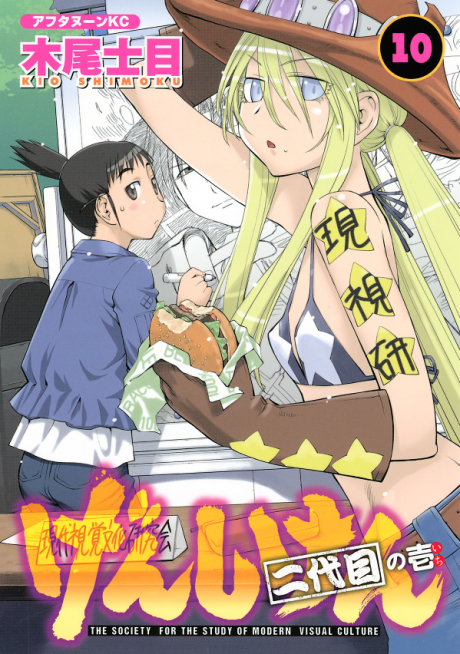
Before anything else, a note: I will often be referring to the work subject to this review (Genshiken Nidaime) as just 'Nidaime', while referring to it's previous incarnation (Genshiken) as 'Shodaime' for the sake of avoiding confusing descriptors.
Genshiken Shodaime might at some point become a work that i dare put in my favorites. It's a really interesting work for me to read, as i feel like it speaks to none of my own experiences as an otaku. I began my consumption of anime and it's sibling mediums roughly around 2016, which is closely reaching the mark of "a decade ago" in terms of descriptors. Yet Genshiken takes place in the 2000s. It takes place in a time when i was nothing more than a little kid, when most of my favorite pieces of media had either not released yet or were considered recent, a time when the internet had yet to become a mainstay of modern visual culture. It also takes place in a country that's as far away from my own as possible, with a culture and language that I am learning but will never truly live in. Genshiken Shodaime exists in complete separation from my own identity as an otaku, and yet I still felt myself reflected in it's pages. So much has changed in the 20-odd years since Genshiken was written and yet I can sit here and read it, feeling like it was made for me. I have never once set foot in a comiket event, and yet i felt a sense of closeness to the characters as if they were living my own experiences.
Part of what made the characters of Genshiken Shodaime stick with me had to do with the fact that they didn't limit themselves to any single medium. They will sit down to discuss a currently on-going manga they are all reading, then they will talk about a eroge and which heroine they preferred. They will talk about the TV adaptation of a manga while playing fighting games and then they will go out to buy erotic doujinshi. It speaks to me a lot in how I, too, do not limit myself to a single medium, instead opting for enjoying many of them. Later additions to the genshiken include things like cosplay and BL, both subcultures that I do not engage in and yet ones that I do appreciate as a part of the vast landscape that is and should be otaku culture.
Genshiken Nidaime lacks such landscape.
It became really underwhelming to me that I went into this work, a direct sequel to Shodaime which featured so many facets of Otaku culture, and found myself in one which featured none of them. Genshiken Nidaime features a cast which is almost exclusively female, and those females are almost exclusively fujoshi with an interest in BL. This is not a flaw of Nidaime, as I do not think that a work about fujoshi is without it's worth, but it was ultimately one of the features that made it stand out less to me. My problem with Nidaime is not the fact that the cast is mostly girls (though i shall admit that the lack of male characters made it harder for me, a male reader, to feel myself at home), instead my problem is that the girls in Genshiken lack variety. Ogiue and Ohno were already a Fujoshi/Otaku hybrid both, but with the arrival of Yoshitake, Yajima and Hato, the club became overwhelmingly fujoshi-centric. The only characters within the story who weren't fujoshi were Kuchiki, Madarame and Sue, all of which often fell to the sidelines when it came to the story.
But it would also be a lie to call Genshiken Nidaime a story about Fujoshi. Though it explores the topic a bit, and it made me understand their side of otaku culture a lot more than i did prior, Genshiken Nidaime is ultimately not a story about Fujoshi either. At first it's a story about Hato's struggle with cross-dressing, and later it becomes a romantic comedy about Madarame's complicated love life. Both of those story-lines were interesting to read, and both deserve their spot in the light, but it was strange to have that be the continuation of a work like Shodaime, which would be best described as "otaku slice of life".
This makes Nidaime a hard work to judge. It's not that it fails at maintaining the tone and focus of it's parent series, but instead it does a completely different thing. It explores a completely different focus, with a different type of story and overall different genre than what it's predecessor was aiming for. I do not blame Nidaime for it's choice of topics, I instead blame it for it's choice of being a sequel. This story could have been told on it's own, and it feels like gaining the role of "genshiken sequel" only serves as a detriment to my opinion of it.
Still, I cannot truly encompass my feelings on Genshiken Nidaime in a way that sticks to the wall of my brain. I cannot truly claim that it is a bad sequel through it's story alone, so instead I will say the best real criticism I can give it;
I have said in the past, and I will say it in the future, that a work is defined by it's ending. A story that starts great and ends poorly is a story that I can never in good faith recommend. A story that begins poorly and ends in a great way is a story that I will insist you give a try. A bad ending to a story will be a stain that no amount of fanfiction can ever truly undo, and a good ending to a bad story can work as a redemption-through-death for my opinion of it. Some of my most hated pieces of media come as a result of being bad sequels to works i hold dear, and some of my favorites were shitty games that managed to win me over in their final stretch.
How did Genshiken Nidaime fare when it came to reaching the finish line? it's... mixed to say the least.
It's final moments when it came to Madarame's romantic comedy were possibly the best I could have ever expected. I don't think I can ever write or read a line better than what Madarame said in that phone call. If you've read it, maybe you agree with me or maybe you think I'm stupid. But I am the stupidest of idiots and I will forever be in love with genshiken's final volume because of it.
It's true final moments were disappointing. Even if we do not include the final extra chapter (which completely kills the vibe), Nidaime's final chapter feels like it's promising another sequel. I feel like there exists a secret 13th volume of Genshiken Nidaime which i am being deprived of. It feels like I was being promised an epilogue and they didn't give it to me. I would perhaps let this slide, because it is often said (and I agree), that it's better for a story to end leaving you wanting more than making you feel like it should have ended earlier.
But that's the thing. It did end earlier.
Five years before the publication of Genshiken Nidaime started, Genshiken Shodaime was having it's final chapter. And Shodaime's final chapter is amazing. All of it's characters, all the ones that were there when the series began, had graduated. With Saki, Kousaka and Sasahara all leaving the club, the story felt like it could truly come to a close. The one open thread of Genshiken Shodaime, the one point that could truly be said to have never been left to end, was Madarame. His love for Saki had gone unresolved by the end of the story, and even then it felt like it was enough of an ending. It would remind many, myself included, of the way one sometimes has to just deal with unrequited love and just walk forward in life. Even in it's lack of a conclusion, Genshiken Shodaime gave Madarame an ending that made sense for him, sad as it were.
That is the true gripe i hold with Genshiken Nidaime. It's a sequel to a work that didn't need one, and while i adore what it does both with it's new and old characters, I can't help but feel like it re-opened an old wound and forgot to close it. Perhaps in a few years we will get the real Genshiken Sandaime that we deserve, but i fear it might be too late for that now. After all, Genshiken Nidaime ended back in 2016, and that year is closely reaching the mark of "a decade ago" in terms of descriptors.
Is Genshiken Nidaime good? I would say so. It does many interesting things and it's a work I enjoyed reading.
But is it a good sequel? that is something I'm not sure i can answer with a yes.

"No otaku worth their salt would ever shame someone for the things they love"
This quote, which i'm probably mangling together from a handful of different translations due to poor memory, is one of my favorite quotes of all time by now. It's source, as you should know, comes from episode one of the show that you'll see me ramble about, and the topic of this review; 2.5 Dimentional Seduction.
The story, as you'd figure from that quote, is one about otaku. it's about people who are passionate about things they love and engage with those things with their entire heart and soul, unapologetically so. However, by virtue of being a story about otaku, it also addresses the main problem that anyone willing to assign that label to themselves has to bear: being judged for the things you like.
This is more notable in the manga, which features some of the more otaku-centric arcs within the whole story, but you can also see it within this adaptation in the characters of Kisaki-sensei, Nagomi, and particularly Nonoa.
To many of us in the english-speaking side of things, the term 'otaku' mostly just refers to those who watch anime and read manga. If you are a bit more informed about the otaku culture of japan however, you probably know that the term extends far outside the realms of anime and manga. The term, while often being self-assigned by otaku themselves, can be taken to be a pejorative term, mostly equivalent to calling someone "obsessed". Being an Otaku, of any kind, is to devote yourself to something to a point most people would deem unreasonable. You will only ever be obsessed with something to this degree if you love it, and 2.5 Dimensional Seduction is a story about expressing this love, and enjoying it as much as humanly possible.
There is a weakness to this enjoyment, however. One which you probably know just as much as I do. When you love something that much, and when you try to share that love with the world, you will get mocked by those that don't understand it.
That mockery, that shame, has driven many of us to hide the things we love. After all, It's only natural that you'd rather shut up than be laughed at. And so you shut up. You stop bringing up your hobbies for fear of ridicule. you stop expressing your love because it makes you vulnerable.
Thus, "No otaku worth their salt would ever shame someone for the things they love" becomes my mantra, because the last thing i want is to deprive someone of a chance to express their love. It does not matter what things you like, whether they are good or bad, whether I myself like them, or whether you watch it for the intriguing story or the sexy anime women. What matters to me is the sparkles in people's eyes when they talk about the things they enjoy most, and that's all that should matter to them too. Thus, in my eyes, 2.5 Dimensional Seduction presents an ideal of the otaku pride. If you love this thing, then you won't ever care about what other people say about it. Yes, people will look at you weird, they will mock you and you probably won't have as many people to talk about it as you'd hope, but you should never feel ashamed for the things you love.
This is why 2.5D Seduction is a manga that I hold in such high regard, and one which I dare say I love.
But I don't just love it's themes of being an Otaku, which I hope i've proven here. I also love it's portrayal of cosplaying and how it affected the way I look at the people that partake in it, gaining a new perspective on a hobby I never thought much about. I love it's romance plotline about learning to trust people again, and how i saw myself reflected on those themes. I love how so many of it's characters speak to me personally about the experiences I've had when being an otaku and being a teenager.
But before I loved any of those things, before the manga turned into the cosplay-as-a-sport romcom narrative that it did, and before I realized just how much I related to these characters, I had also loved to read what once was a generic ecchi manga about a girl wearing a sexy costume. And those ecchi elements, while not as heavily present as they once were, are still there even 150+ chapters later. 2.5 Dimensional Seduction's manga is, among a myriad of other things, an ecchi manga.
It is in this, despite it's great work at portraying every other part of the story, that this anime adaptation fails to fully encapsulate all of what I loved about it's source material. No matter how you want to look at it, the show is ashamed of the fact that it's source material is ecchi. You can see it in the changes to the outfits, you can see it in the scenes that are cut, the ones that change angles to avoid showing much skin, and the ones where the camera looks away. To take those elements, which are a part of the original material, and remove them to this degree, feels like nothing short of an insult to those of us who liked them. It's telling me that those elements were not good, that I shouldn't have liked them in the first place. It's telling me that the show is better without them, as if they have no worth.
And the worst part of all this? I am here, complaining to you, instead of talking about the many things I love about the show. Its unfortunate, because the show is great adaptation. I loved watching every episode week after week, getting to see the early arcs of the manga getting animated. I loved hearing the voice actors perform their roles, especially Mikarin's seiyuu. I loved seeing the opening and ending themes, my favorite being the first ED theme. I particularly loved seeing the in-universe anime of Ashford Wars, which was barely ever seen in the manga, getting animated scenes which were clearly crafted with love for the medium (the 4:3 ratio!!). I loved reading the author's own commentary as he spoke about the experience of first writing the manga every week on twitter. In general, I just really really loved seeing the adaptation of a manga which i had deeply enjoyed before.
But in all of this, I could never truly get rid of the awful feeling that came with seeing the scenes altered to tone down the original material. I couldn't get rid of the idea that the show would have been more popular and enjoyed by more people if it had dared to keep the pantyshots. And I very much couldn't get rid of all the people talking about how the ecchi was removed, which really ruined my enjoyment of the show when it came to discussing it online, and pretty much forcing me to enjoy it on my own rather than have people to share my passion with.
Ultimately, if I were to give it a score without taking this whole thing into account, I'd probably give it a 7. It's not a particularly stellar adaptation, but it does have it's moments of beauty, and it's a really fun thing to watch for anyone who likes the source material. I'd argue the manga is more visually stimulating and the pacing works better in that format, but that's probably up to you.
But I can't review this without taking the changes into account.
Because it's adapting a story that tells you to not be ashamed of who you are, while being ashamed of what it is. And that's probably the greatest sin it could have made as far as I care.
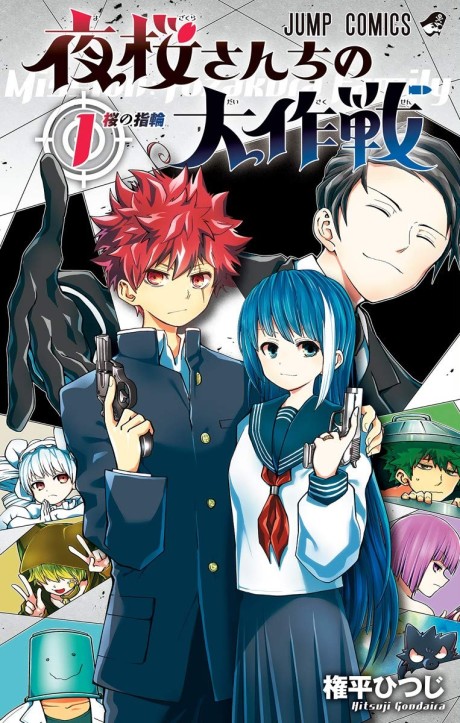
Some time ago, when talking to a friend about manga, I remember telling them "you shouldn't judge a shounen manga by it's first volume", or something to that effect. While this phrase may seem stupid to some, I believe it's of great importance when reading works from the shounen jump magazine. The works published there will often be forced to rush through an entire 'early arc' in order to cram it all into a single volume, in hopes of giving a good enough impression on their readers. Not just because it's what dictates whether future volumes will sell or not, but because those works exist on a constant state of panic over whether or not they will actually continue to exist under the Shounen Jump umbrella. If it doesn't manage to catch readers with it's first 15 chapters or so, it's usually going to end up cancelled by volume 2.
It's because of all that, that I'm sometimes surprised that Yozakura Family actually got to have as many chapters as it did. I'm not sure how good it does in japan, but it most certainly does not qualify as "popular" or "well known" in the western market, even after the release of it's anime adaptation. And that's honestly a damn shame.
Yozakura Family starts off as a comedy story about a regular guy being put into dangerous situations. It's the story of Taiyo Asano, regular teenager, who ends up marrying into a family of spies, all of them with absurd supernatural abilities and even more absurd personalities. It's also a story about Mutsumi Yozakura, the girl that he marries, and the hardships that both of them have to endure as a result of the world they inhabit. For the sake of his newfound family, Taiyo Asano puts all of his effort into becoming someone strong enough to protect them.
None of that sounds like a comedy, does it? Well, it's not completely a comedy. Yozakura Family shines in it's ability to tell this compelling story of family dynamics while also being able to keep it all light-hearted and fun. Even during it's more serious arcs, the tone is still kept mostly comical, which helps make the truly serious moments more impactful once they are needed.
Speaking of it's serious arcs, I believe one of Yozakura Family's best features is the way the story strings together all of the events that take place. Once you get past the first two volumes of the manga, all of the story becomes interconnected to the point that the events of it's final arc are tied all the way back to it's earlier chapters. This, while perhaps subtle during the reading experience, helps make the story flow into itself enough that I ended up reading a hundred and fifty chapters in the span of a week or so.
Another great feature is, by far, the characters. Even when it comes to it's secondary cast, and especially when it comes to the main ones, the characters never fail to be interesting, both in terms of design and personality. Not sure if I'd define most of them as 'complex', but they are really fun to read, which is what matters most to me.
Lastly, the romance between the protagonist Taiyo and his wife Mutsumi is probably the best feature in the story. Many other shounen out there will leave the romance of the main characters on the side up until the ending, which is why I really appreciate the fact that the story starts off by quite literally marrying them, and it only goes up from there. It's not as developed as a shoujo manga's romance, but it doesn't need to be. Every time I hear those two talk about each other, it's enough to light up my day.
As it stands right now, Yozakura Family is supposedly during it's final arc. I am not sure how much longer the manga has to go, but I'm pretty satisfied with the events so far. If you are still reading this review once the manga is over and done with, it means the ending was to my liking.
I wish I could provide you with more complex thoughts about Yozakura Family, some analysis of it's themes or anything more than this vague review, but I really don't have much to say about it. This review exists less as an attempt at analysis and more as a way to recommend it to someone else. My hopes are that one day the Yozakura Family fandom grows to double digits.
For as long as I can remember, I've been thinking about time travel. More specifically, about going back to the past; redoing mistakes, reliving good times, all that kind of stuff. I think this is a relatively common fantasy for many. To relive those memories we hold so dear, to erase those that we dislike.
One of the best periods of my life, which I often look back on, was a trip that me and a friend took back in 2019. It was so much fun, partly because I was hanging out with him most of that time. He was, and still is, my best friend. We've always had the same sense of humor, the same preferences in media, and as we grew up and changed, we've never stopped being so similar to the other.
Recently, as I fantasized about re-living that trip for the millionth time, I realized something.
I've changed. I've changed so much. I've lived through so many things in the time since that trip, that I'm no longer the same person. Neither is he.
If I went back to that moment of my life, would it truly be the same? With a person who doesn't remember the things I've done with him these last five years? Someone who's sense of humor is not the same as mine anymore? Someone who hasn't even played the videogames that are nowadays his favorites? Someone who hasn't yet acquired his taste in robot maids?
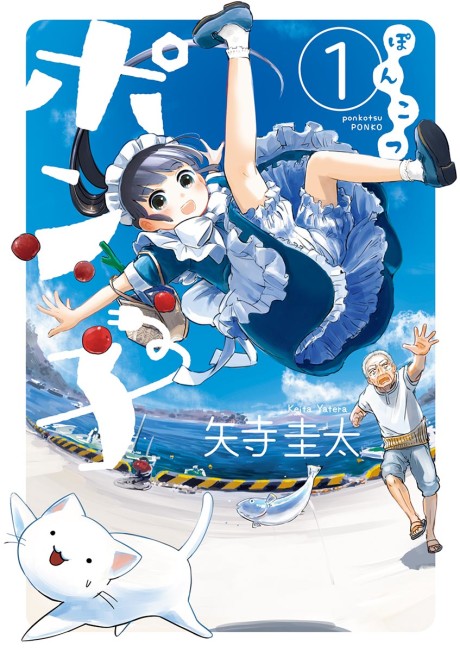
What makes us who we are? Ponkotsu Ponko says, and I'm inclined to agree, that it's our memories. Those memories are so treasurable because they've shaped the person that we are now. I wouldn't be the same person that I am right now if I had done anything even slightly different.
Every chapter in Ponkotsu Ponko can be labeled 'slice of life', because that's all they really are. They tell small stories of what the titular Ponko goes through during her daily life in this small town. Some people come, some of them stay and others go away. Sometimes it's about how a bunch of eggs hatched into chickens, sometimes it's about relatives coming over to visit, sometimes it's about falling in love with someone, and sometimes it's about cleaning your house and finding old pictures of your loved ones.
Every chapter is slice of life, sure, but it's not just funny chapters, which many other manga would limit themselves to. They are also relaxing. They are moving. They are intriguing sometimes and they are beautiful when they want to be. That's also what life is like.
There's things I've done wrong in my life. Every choice I've made has been irreversible, and I've come to terms with it. Because right now, I am happy, and I would not be here if I had done even a single thing differently. Every memory I have, and even the ones I no longer have, have led me to the moment, place, and person that I am today.
Each chapter is truly touching, in part because it gives just a vague glimpse into someone else's life. The events of Ponkotsu Ponko are not much different than hearing your parents talk about their younger years, and listening to some of the most bizarre things that you have ever imagined.
Don't let yourself be fooled. It might take place in a near future, with robot maids and flying vehicles, but Ponkotsu Ponko is about the past. It's about the cherished memories we have, and about how it shapes our present selves. It's about the experiences that exist entirely in our brains, and which we try to pass onto others, even if they may not have true value.
As it happens, I didn't find out about Ponkotsu Ponko on my own.
It was recommended to me by someone. I give you three guesses who.

GJ-bu isn't the best slice of life show in the world, and you could have probably guessed that from the fact that nobody remembers it. It's okay in all fronts, nothing to hate about it, but you wouldn't call it innovative in any significant way, either. It features a guy and four girls, they sit around in a club room and talk for 24 minutes at a time while screaming at each other and making the viewer laugh. There's a few little sisters, there's a maid, and a secret 6th member that joins later as if this was a super sentai show. It's jokes aren't particularly hilarious in the moment, just mildly funny. it's visuals are fine, the concept is standard. Is there anything to highlight about it?
Well, there is. Somehow. By the time i finished it, my review of it quite literally said "anyway GJ Club is a show that exists". And yet now that it's been year since then, I can't help but look back on it fondly. Despite being a show that i defined with a "72/100" at the time, i felt that it was more memorable than that.
Suddenly, out of nowhere, I remembered that the show had a TV Special. I looked it up, wondering if it was one of those "several 5 minute skits" specials that many other shows had. To my surprise, something with a name as stupid as "GJ-bu@" was actually an hour long episode, taking place right after the show. Something about the prospect of "GJ-bu: The Movie" filled me with excitement, and I decided to watch it.
Hearing that opening theme again after a year was... nostalgic, I guess? It filled me with an indescribable happiness. All the stupid running gags came back to me as I watched a compilation of silly skits, featuring every joke i remembered from the show and a few that I'd forgotten about. If that was all, I would have been satisfied. I've seen plenty of OVAs out there that did this same format. Just a fun extra for the people who liked the show. Nothing more than that.
But then it changed tone. The second half of the special acts as a send-off to the characters that I didn't actually care much about. And yet I felt compelled anyway. You don't often get to see a slice of life show with an episodic format have an emotional climax like this. Especially not one as forgotten as GJ-bu is. It was actually beautiful watching these characters one more time. I don't even know how to put it into words, really. It just gave me an indescribable happiness that i wasn't really expecting.
This is the second time I said that within this review. 'indescribable happiness'. And I think that's what my feelings towards this TV special are. It made me appreciate a show that I don't think I would have remembered that fondly otherwise. I think that's meaningful.
In general, I've always really treasured the stories that make me feel emotions. This, somehow, is one of them. And it's the highest praise I can give it. This score is subjective, obviously. Perhaps you watched this and you think this review I'm writing is pure nonsense, and that's fine. I just wanted to put these emotions into words. Those words being 'indescribable happiness'

Initial D is a work that i find rather important in my own time as an anime fan. Back around the time when I first watched it, i used to hold this belief that shows had their quality derived solely from "objective" factors, usually dividing it all up into "Visuals, Music and Story" as the three main categories that were worth discussing on any given show. It was my belief, as learned from years of watching other media, that the level of these three things are what dictated the enjoyment of any given piece, and that the enjoyment was thus equivalent to it's overall score.
It was so that I was shocked to find Initial D to be so good. if we looked at it "objectively", the show isn't great. While the music is a solid 10/10, The visuals are generally bad in their quality, and If i sat down and talked about the story, you wouldn't think that it's particularly great. If i were to make an average of the scores I'd give each individual piece, the show would come up as a 63/100. A passable score, for sure, but not one that you'd think twice about.
But Initial D's true worth is not something that comes from objective scores. It comes from the fourth category, the one that truly makes or breaks any given show. "Enjoyment" is Initial D's secret ingredient when it comes down to my final thoughts on it. The story is alright, and the visuals are bad, but neither of those faults matter as much, simply because I was having fun. I never had the time to concentrate in how poorly the CGI was being done, because i was so invested on the race itself that i became blind to it. I never really questioned the quality of the story, because everything else collaborated to make the experience more enjoyable that what it would have been to read it on plain text. Truth is, that initial D was a fun thing to watch, and fun things are fun.
For a more standard review, I will say that the story is better on this re-watch than from what I remembered. The character of Takumi Fujiwara is an interesting exploration of how one can learn to enjoy something that they had no prior interest in (and how that interest may have been there all along), his relationship with Natsuki is definitely outside of the standard you'd see on a traditional romantic subplot for this kind of show, and Itsuki's character is that of an idiot, but a lovable one at (almost) all times. The show's Formula may wear thin during it's second half as the story becomes a repeat of what has been going on, but that issue is solved once you go into it's second season, which I think this first season more that fully sells you on.
When it comes to visuals, 3D animation is (and has always been) a double-edge sword. It's benefits and it's downsides are really uneven, and it's no wonder the anime community loathes it, myself included. But even then, I think Initial D's 3DCG is something particular that should be viewed as an upside. It would have been impossible to truly animate some of these things in 2D without making it feel like a boring slide show, and it's ultimately thanks to this 3D animation that the directorial work gets the chance to shine the way it does, increasing the enjoyment of the show to a point that 2D animation might not have been able to ever achieve. The show at one point mentions how a bad car can still thrive in the hands of a good driver, and it's in much of the same way that I think 3DCG can thrive in the hands of a good director, despite it's quality.
Ultimately, I think Initial D is much like the AE86 portrayed in it's story. With 10/10 music, 3/10 visuals and 6/10 plot, it doesn't seem like this show could ever possibly pull off the moves to compete with more modern anime, which should definitely leave it in the dust at a measly 63/100 score. But Much like how the AE86's true strength lies on it's impressive driver, Initial D's true strength relies on how it's enjoyment level goes way beyond what should be possible, making the final score one that is as subjective as subjectivity can go, and one which I've chosen to be funny about giving. Initial D's final score, as far as I care, is that of it's main car.
