— — — —— — —
×
— —— —

will discuss full, unmarked spoilers up through Ch. 111/episode 6 of Chainsaw Man, and marked spoilers for other shounen
Chainsaw Man is about a lot of things and I only came to writing this review, or something resembling it, after going through the Public Safety Arc for the fourth time (not fully, because from Ch. 18-39 I’m waiting to see after each corresponding episode from 7-12 of the anime.) I’ve been thinking about these panels. Long after the third read did certain scenes - Himeno on the balcony, the way Aki’s face is expressed by himself, all of Makima - these remained upon me and I can do nothing but think about them as I might my memories of kindergarten. I think it’s rather fitting that I came to Fujimoto’s rowdy 1997, the year of my birth, again during my first COVID-19 isolation, a week or so of solitude and a brass tempo of depressed, unmotivated anime, manga, and film soak in which I realized that only Chainsaw Man really means much to me anymore - that and my own dream.
In the past few years I’ve become very good at selecting, rereading or rewatching, knowing my favorites when it comes to media. I have almost fifty YouTube playlists catered to different feelings or moods, sporadically recreate Top 5 lists and 3x3 grids, and recently rewatched a bunch of my all-time favorite movies. Most of these I know why they’re my favorites through a bit of self-psychoanalysis, and yet Chainsaw Man (hereby abbreviated as “CSM”) is the only manga I’ve read three or four times and I still don’t understand why I like it so much. Until now.
On two layers. First, structurally and as a manga. When we know that Tatsuki Fujimoto is a yearning film director but studies himself to this particular form. His broadband, nearly roughshod drawings when it comes to the characters as depicted in panels (more often in the simpler, living moments) - in contrast with the background, and the detail and clarity with which characters can be drawn when they’re needed, for e.g. Chainsaw Man himself (in full devil form), Makima on the beach (pain), and all of Aki (suffering). I can talk about Aki. But not now. Most manga you’ll read, especially that of “quality” (by whatever notions you use), has its own distinct visual style, usually very good, if not amazing. But for the work of literature it is, CSM is often just low-key. It almost feels as if sometimes Fujimoto just draws the bare minimum. If you’ve read Look Back, it feels like that. But in CSM’s case, that’s better. Because Fujimoto then allows us to see these characters in their rawest, most barebone depth. One of the best examples from Part 1 (because he isn’t in Part 2) is when he visits Denji on the sickbed, and uses beautifully cut apples as one of a great many instances of Pavlovian dream conditioning. There is this triptych of panels where Aki just acknowledges Denji, gets up, and is about to leave. Sequences like these - it’s harder to really recognize during the battles, which by nature act the same way - are the full expression and meaning of the superfluity if not freeness of Fujimoto’s manga direction. While it’s in character for Aki, being who he is, to so deliberately leave the room, it’s not necessarily efficient. If we compare to Jujutsu Kaisen or Blue Lock, for example, where panel space is used as sparingly as the David being carved from the stone, here Fujimoto draws and cuts as if it’s a first draft. While the entirety of his previous long-running work, Fire Punch, was the true first draft for CSM bearing some of the same core ideas but running rampant with them in a less hinged, more “kino” manner, CSM itself still reads like one and arguably the School arc still does, but at the same time with a keener, or one less held back by Shounen Jump, vision. Part 1 has its own antagonist and the function of the Gun Devil as a means of control for Aki, as it was already conquered but divided, shows a long-term purpose for the work from early on. But a lot of decisions on the smallest level show more the spirit of an auteur, than the precision of one who’s completely mastered their craft (e.g., from Bong Joon-ho’s Barking Dogs Never Bite to Parasite). But again, in this way it only strengthens CSM and makes it so fun to read. Like Parasite, CSM is one of an extraordinarily few works in any form that are of quality/arthouse/"literature"/what have you - but also so digestible; and like Parasite, it bares its themes in as many ways as it can. Rather than talk about them specifically, before getting to the second layer - what CSM means for me - I will hone in on what CSM means for the genre.
Battle shounen, or the battlefield of dreams. Blue Lock epitomizes this, as all of the cast is made up of strikers, bent on becoming Japan or the world's #1 with the herald of “ego” and enough edgy energy individually to merit each being protagonists even though only one of them is. Denji announces “dream battle” when fighting the Leech Devil, pitting his unfeathered one of touching breasts to her and Bat Devil’s of eating all the humans in the world - one very possible, one very not. By now we all understand the standard shounen protagonist’s dream of becoming something, perhaps a king of some kind, or attaining. Before it, Hunter x Hunter was the dream battle prototype, for which Gon’s dream of finding his dad really meant becoming a Hunter, which he later discovers is being someone who goes after what they really want. But Denji takes the canvas one color further, and (under the shaping of Makima) changes his dream over time. When he’s living alone with Pochita, he lists out some things that he’d someday like to do, all of which he does get, and most of them with Power, but not in the way he’d imagined. By Part 2, he now wants to be known as Chainsaw Man, and it’s almost as if he’s one step closer to having a more traditional shounen dream (becoming the strongest devil hunter or something). I don’t think Fujimoto will take it that way, especially as he’s no longer the protagonist, but he’s come a long way. Denji has left the hold that control had over him and now strives to break a new form of it, i.e. Hashida’s supervision. I could go more into detail on how Denji’s dream is affected by those around him but will simplify to the power of friendship - which it, too, is not one taken for granted but learned for Aki and Power, which Aki learns for Angel and his two new younger siblings.
I still want to talk about the panels though. Very often in shounen or in manga in general you’ll get these full-pagers of characters sobbing or otherwise having some revelation. Fujimoto doesn’t need that. It might be harder to focus on when binging the manga, but I think that his minimalism delivers. It allows us to see as much of the characters as possible with simultaneously the least detail needed, so that even with a wide range of emotions, all are shown. Some examples are Angel’s utter shock, despair, and deja-vu when seeing Aki so readily bend to Makima, just as he did before; Makima’s look of complete boredom after thinking she defeats Denji, or her laughter while lying on his lap; the one time Aki shows positive emotion in the present, when coming home to Denji and Power before eating (and barfing) to their concoction for him; and Kobeni (including the way she stands or slumps). MAPPA has taken extra care to animate facial expressions as vividly as anime movies or studio feel. might, last with Episode 6’s Kobeni terrors. With some characters like Quanxi or Kishibe, they have much the same expression almost all the time, which in light of the others, means more to their weariness; or Yoshida, who’s just enigmatic. Power is perhaps the most enigmatic, as for so much time she's her Power - Blood Devil self who relishes in Kobeni's despair and plans on winning the Nobel Prize. In Part 2, Fujimoto concentrates most of this onto Asa, who among the full cast of all CSM is particularly emotive, she’s somebody with a rather outside perspective even after becoming the host for War. Thus in Part 2 Fujimoto has completely transcended the battle shounen fabric by transcribing an element of war onto a high schooler, the typical shounen energies onto the slice of life that the latter entails. Even with the rest of the horsemen on the horizon (the older sister, and if Kobeni’s contracted with Hunger/Famine), with Denji now a deuteragonist?, even with the possible Chainsaw Man impostor and the organization telling Yoshida to keep Denji in check, Part 2 distinctly lacks the drive of your common shounen, that is the protagonist’s dream, because as of yet Asa is dreamless; thereby giving Fujimoto full and free run to direct as he please.
And now, I’ll look back to Aki Hayakawa. Upon initial meeting he gives off Sasuke Clone Trooper vibes - standoffish, black hair, competent, has some sort of revenge goal, and doesn’t vibe well with the main character. We know that the Gun Devil killed his entire family, and he goes out as the Gun Devil fiend killed by his family. His inability to smile, his difficulty with making real friends, and how he can’t look away from his insatiable goal of killing the Gun Devil - until he’s reminded, when he comes close to losing his family again to the Darkness Devil. Then he asks to withdraw from the mission, but of course he’s roped in by Makima. He was roped in from the beginning. In the aforementioned beach episode Angel asks him why he started liking Makima, and he can’t answer. When was it? It’s hinted at that, unlike Denji, Aki was bent into Makima’s control by her actual Control Devil powers from the start, in addition to the control he’s put on himself towards killing the Gun Devil. That’s all he can think about, even when he’s shown his limited future. Even when he’s contracted with the Future Devil, he’s only looking at the past, at the root cause of his motivation, and his contract with the Curse Devil works in the same way by cutting off his lifespan each time he uses his sword - in dire need, when it’s the only thing he can do for killing the Gun Devil. Both he and the reader are told early on that his time is limited, and the only time he makes his own decision free of his two controls is to withdraw, for Denji and Power - but the manifestation of Control puts him right back. He all so willingly offers all of himself to her on the beach. As a tragic character, he is fated for despair from the beginning; if Sasuke was destined to be Naruto’s great redemption and a “proof” of sorts for what it means to be Hokage, in their own dream battle by the waterfall, Aki was only destined, as part of Makima’s control plan for Denji, to die at his hands. In his last moments he’s still looking back, to a snowball fight with his younger brother - Denji - in the endless floor of the hotel, when he takes Himeno’s last cigarette, the panel immediately after shows him taking his first from her, years ago. Even more tragically, as the Gun Devil fiend his eyes are taken away, replaced by a gun. We only see Aki show positive emotion that one time in the present, when he pulls the prank on Himeno’s fallen partner’s girlfriend, and we see him happy a bunch of other times, all in the past in the snow. Himeno sees more for him in his future than he does - we saw her in episode 6 say, “There’s still a lot he has to do” - when all he wants to do is kill the Gun Devil. Aki can only look to a certain point forward, and it's rather ironic that he has to form a new contract with a devil to see the future.
I could now talk about the second layer, how the fight for dreams does reckon something for me, with my own ambition, life-painting, but only that - painting - not actually giving it color, only something to live because of, rather than for. Denji wins in the dream battle - he’s fighting for his, as much as they change, far more arduously than I am. Perhaps I now see something admirable in the pup’s chainsaw revs, as so often my dream becomes more a “hope” than something I’m legitimately striving towards. But I’ll leave it at that.
I think I’m stuck on the paneling - and almost started to reread Fire Punch, just for more - because of the hidden power that I believe elevates manga above all others. Because it’s harder to remember motion than stillness. When I think back to memories from childhood, the further I go back, the more stilted, movement-less they become; less of scenes, and more of frames, with only a single character’s movements - as if it were just one panel, given animation - recalled. I think this is the best corollary I can make to remembering the frames of Chainsaw Man, as ones actually relived, and reread in far more recent memory. While those panels that are animated may truly fade into memory, and with my tendency to save screenshots and panels into my Chainsaw Man folder, I still look back to my favorite moments over and over. With this many reads in the past four years, when I think of for example Denji and Reze sitting at the cafe, Denji and Power holding onto each other as something more and less than siblings, Makima sitting at her desk - I think of them as characters I have truly met. It’s a bit harder to focus in when characters do battle, but I imagine it as if it’s Hollywood and it’s truly a spectacle.
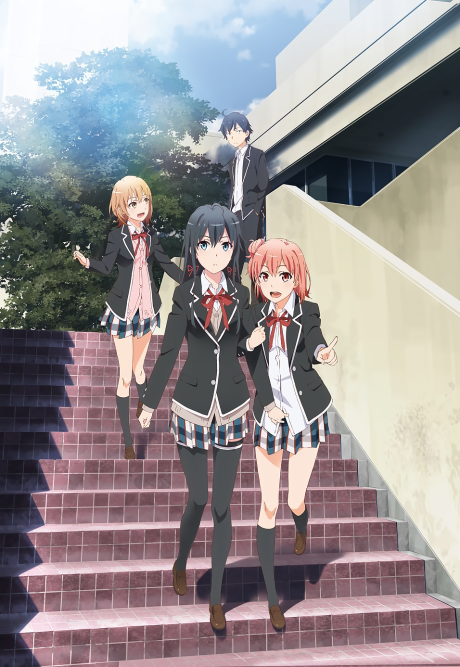
MASSIVE SPOILERS AND LAST EPISODE ANALYSIS BELOW THIS IS INTENDED FOR THOSE WHO ARE WAITING FOR SEASON 3
Hachiman yearns for “something genuine”. Season 1 began with anime’s Holden Caulfield, friendless, who really only likes his sister, Komachi, before he meets -- Yahallo! Yui Yuigahama, and “Ice Queen” Yukino Yukinoshita who become his first friends. He comments often with a blunt, almost derisive tone upon the behavior of his fellow social animals and meets others. “Hikki” begins to emerge from his shell and isn’t alone anymore. Goodbye, alone.
Zoku blows the first season straight out of the water. Brain’s Base hands the colors to feel. who continue the story with a sunset-warm fervor, outbursts of animation, and new character designs which fill out the characters more. Closeup shots of an earnest face. Tears flowing as Yui indirectly confesses to Hachiman. His own pained expression of his desire for something genuine. You then wonder, what has he been doing all this time? Was friendship not genuine? Hello alone, again.
Yui’s proposal to keep the three together after her confession, steeped out of the sociocultural motif of offering chocolates to your romantic interest, fails to prompt Yukino to do the same with hers. Both Yui and Yukino have feelings for Hachiman who, besides having shown embarrassment from both of them and Iroha, realizes, as they do in the final episode’s moments, that to confess would shatter their friendship as it is -- formed under the guise of doing service for others, merely an excuse to interact with others and come to the same place every day after school and be forced to interact. Yui, who for most of Zoku has acted her Yahallo self’s cheerful demeanor, is the one who in the last episode displays her truer self. She has been in love with Hachiman from the beginning. Yet she loves Yukinon -- I’m afraid to use the word “genuinely” -- and prizes the three’s platonic state dearly; yet she tells Hachiman, “I’ll beat Yukinon.” The three have long since achieved friendship with each other. Hachiman expresses his longing for understanding, a faculty he’d been wielding since the first episode, whether to please his own ideal of solitude or to attempt to save social tension and endangered bonds. He recognizes it as selfish, to understand another person, but to share that selfish desire with another person, to move beyond mere friendship which isn’t enough, is what he esteems. Or maybe that something doesn’t exist, but for Hachiman, to still struggle and writhe and suffer with others also on that path is what remains.
In the last episode, all three enact self-sacrifice: doubly significant due to the individual’s weighing of romantic attraction and friendship and the still-growing high schooler discovering himself or herself. Yukinon displays strong depth of uncertainty when Yui holds her hand and, while so clearly reluctant, as she has always done vis-à-vis her older sister, is about to accede and let Yui take it (as she did with the penguins, although nothing happened there) when Hachiman -- the Lone Knight -- steps in, clenching his fist. Yui for the entirety of both seasons had many opportunities to confess, and while she does so here, she only does so so that her best friend whom she knows has feelings for Hachiman also, can also bring out her other bag of chocolates. Haruno had interrupted her earlier, so Yui gives Yukino this chance, which she still doesn’t take as she hasn’t found herself yet. Had both confessed, while that is a gesture of sacrifice on Yui’s part, Hachiman would’ve been put into a tenuous position. While she isn’t that important, Kaori Orimoto, the one and only girl Hachiman confessed to in middle school, in her acceptance of him and his humor opens up the possibility. Now of course Hachiman, whether or not he ever had the guts -- but that doesn’t matter, because Hachiman steps in when he must, sacrifices himself for others because according to his ideal he is already alone and it’s his own thing. He’s been sacrificing himself this entire time. He steps in and rebuts Yui’s proposal, averring that Yukino has to fix her own problems, which is an action self-contradictory as in doing so he just helped her once again, as he did earlier when Haruno called (providing the words). Before gravity takes over Yukino asks him to save him someday -- Kan, you’re already doing it, stop it! Stop making me cry and agonize over other characters… I’m really just crying over myself. It has to end. Season 3 will be the end of this modern Austen-esque tomfoolery in which everyone is pretending or lying to themselves. Yukino will probably be saved but will that come at Hachiman’s hand or her own getting up and defying her older sister? Can the three simply do curtain call, hand in hand, walking off into the sunset simply friends? Will Hachiman “get together” with one of them? Will that entail a tragedy? You and I both know that something has to change. Why do I know this? Because it’s fiction. We’re watching these individuals and think we understand, writing reviews from our high horse.
Unfortunately, there cannot be a “someday” for these characters. To be saved someday, to return to the amusement park someday; both are the undiscovered person’s means of postponing certainty, of infiltrating the present-day despair with a residue of hope. It’s weak self-appeasement and besides foreshadowing only assuages the not knowing in the present. Hiratsuka-sensei impresses upon Hachiman the need to act in the present time and as the brouhaha surrounding Hayato’s course choice indicates, their time together won’t last, whether they move up to different classes or graduation brings a much more distant separation. It’s almost as if it’s only the romantic thread that can cement connections at this junction, that friends will have it harder staying friends after the enforcement of time; Shizuka still isn’t married and look at her, she’s still teaching at a high school and comforting herself by providing advice to the younger ones. The single inherent flaw of fictional narrative is that it has to end. Within this end-defined superstructure are the means of narrative which include character, and for characters to acquire any significance in a primarily character-driven story they have to change, realize themselves, bow and leave satisfaction as the curtain descends. Kan will bring the third act and conclusion; no matter how much they continue to struggle together, it will have to reach breaking point, and Hachiman must leave his fans and shippers and critics with a pleasing happy end.
The second act isn’t only about these three, of course, as the show’s Best Girl (and my personal ship) takes the stage as well. Iroha Isshiki -- note how her last name culminates in I and not A -- is alone. Note her despondent back as she walks back from the meeting without Hachiman. She needs him to hold her bag, which while not containing chocolates puts her in a position of dependency on him. She is the Truest Pretender who does what she does to maintain her image, greeting Hachiman “senpai” and rejecting him for apparently hitting on her over and over again in her made-up cute voice. If you’re still unsure, listen to Uraraka. As Hachiman himself notes, she “uses” him to actually accomplish things with the other student council run by Hand-Waver BS-Spouter. With Hachiman, she can be not herself and also herself, as glimpsed too briefly when she whispers into his ear on the train, “You’d better take responsibility.” She’s only gotten this far with his (sneaky) help and certainly feels some measure of debt, as well as a certain sense of her own growing feelings for him as he may be the only one who can understand the true Iroha. Note how in episode 4 she almost immediately goes to him, surprising Tobe with her speed. There are several ship moments, another being her surprise at Hachiman’s remembering her birthday (not to mention her coming to the Service Club more than once), and with Season 3’s teaser I -- I -- I ship. Yes, so far Yukino is the likeliest vessel but there’s something very appealing about Irohas’s pixie-like haircut, her voice which is just slathered with fakeness, her commitment to her propped-up image. WAIT WHAT IF IROHA X HACHIMAN ALLOWS HIM TO CONTINUE BEING FRIENDS WITH YUKINO AND YUI now see, I’m being selfish here, imposing my own desires onto the narrative without understanding… See what I did there! This is serious, you can’t just dismiss Yukino and Yui’s love. But then again, more than one person will be sad at the end no matter what, right?
And that’s how Oregairu Zoku is meta-commentary on the audience’s selfish privilege to ship characters.
But don’t worry, Rumi Tsurumi is also an “I” character who is alone. In some ways she is a preconfigured Hachiman-type, remarkably aware for her age and while she doesn’t really get friends in this season, she allows Hachiman to cut out decorations next to her. He’s drawn to the alone and Rumi, Iroha, and the single teacher illustrate this -- Hachiman’s statement that he would probably have fallen madly in love with her was he born ten years earlier. Her being Shizuka.
Pretend jokes besides, we cannot forget my boi Hayato Hayama and Best Imouto Komachi. They both score points and both understand Hachiman’s modus operandi, H. H. #2 being a quasi-rival in the endeavor to understand others (while recognizing that H. H. #1 is superior, which forms his dislike for him) and Komachi having lived with him all her life. Her moments with him are touching and far more pure than, cough. Hayato is the romantic interest for several characters and is popular as the star athlete and all-around nice guy but in Zoku he sobers up and doesn’t tell a soul about what he’s doing next year, not wanting to be the Hayato everyone expected him to be. It’s strongly implied that he has feelings for Yukino, whom he’s known the longest out of the bunch in addition to a yet undisclosed event that happened in the past, which will complicate things even further in Kan when he shows his truer self to more than just Hachiman. If Kan takes place in their third year, then Komachi will enter the picture too!
I’ve written a lot, Hachiman definitely wouldn’t have been able to write this much, and my tears have long since dried. I’ll conclude by stating firmly that Oregairu Zoku is the best high school anime I have seen to date, as far as high school anime are concerned and their shared archetypes and what they, in general, attempt to achieve. It is phenomenally written and heart-wrenchingly delicate and understands people on a whole 'nother level.
Waiting for Kan with bated breath.
