— — — —— — —
×
— —— —
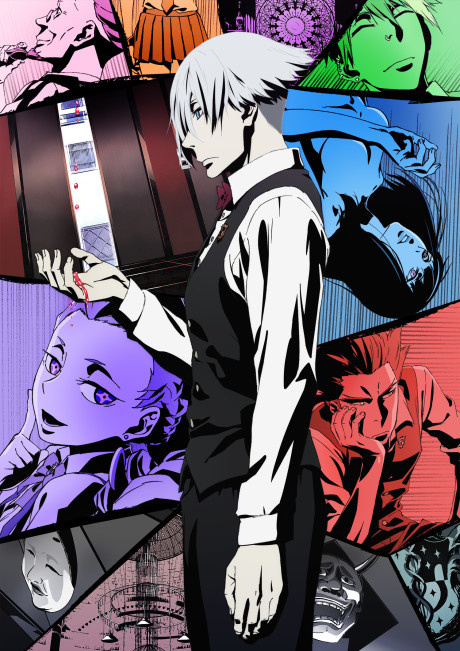
"A virtue is an acquired human quality the possession and exercise of which tends to enable us to achieve those goods which are internal to practices and the lack of which effectively prevents us from achieving any such goods."
— Alasdair MacIntyre
Without any spoilers, this show is about an arbiter/judge deciding whether people should go to Heaven or Hell through games that they are alleged to stake their lives on. These individuals are dead but have no memories of their death and their fragmented memories recover as they progress through the game, therefore they are made to believe they are still alive throughout most of the judgement. Through these games, the arbiter are able to glimpse into the people's true nature — whether they are capable of committing evil deeds in order to preserve their own.
It sounds like a great method to draw out people's innate traits, but as the plot develops, we are able to learn more about how fragmented the arbiters' and humans' moral frameworks are and how this may not facilitate coherent moral discourse; this effectively displays the flaw in the judging system and philosophically complex morality is.
Aside from the main cast, other characters did not appeal to me personally and I felt that they were underdeveloped. Some side characters were interesting but were not given much screen time and this is probably why I felt that they were underdeveloped. They had greater potential, the worldbuilding seems to have great potential, so in my opinion, I thought it was a shame they did not develop more on this.
The world building is rather strong and intriguing, but as mentioned above, many aspects of this world is glossed over and briefly talked about in the anime. There is much left unknown about this world and characters.
As I mentioned above, I felt that the world and characters are underdeveloped and are much glossed over. However, this is not to take anything away from this show. We have to keep in mind that the director has made this decision, and it could possibly have been a creative direction they have decided to undertake as much as I do not agree with it.
This direction leaves much of the show's interpretation to the viewer's discretion and for a show like this, it's not a bad decision. I'm a firm believer of Chekhov's principle so these glossed over aspects of the show feels redundant to me; but maybe for you, these "mysteries" could open up more interpretations and perspectives that I yet to consider.
I think what's great about this show is that it extends beyond "right" vs "wrong". Through characters such as Oculus and Nona, we are introduced to two vastly differing moral frameworks and it is not hard to say that they are "equally valid". And I believe that this is one of the message this show is sending. These two moral frameworks can never reach a moral consensus — any form of moral discourse is futile given how fragmented it is.
This is, essentially, saying that their way of judging is wrong and judging is wrong to begin with. And yet, given the nature of the world, they need to continue judging. All these moral frameworks, those of Chiyuki (a human), a "god", an arbiter, have different foundations. Oculus' claim that "a human cannot judge a human" highlights the impossibility for "true judgment"; for this form of judging introduces bias and does not guarantee true "fairness"/impartiality, which is why arbiters exist in the first place.
Conversely, the argument that you cannot judge someone you don't understand is equally compelling, as that suggests you are judging this individual from a moral framework that stems from a different foundation. As arbiters do not have "life", the foundation of their moral frameworks is different from that of humans. This form of judging risks an incomplete and unjust perspective how the individual's life and undermines the value of their life.
I was bored and I just wanted to yap. Aside from that, this is a meaningful show worth your time. It facilitates discussion of morality and is philosophically meaningful beyond the surface level evaluation of a binary "right" vs. "wrong".
As much as I would enjoy discussing more about this show in terms of philosophy, this is beyond the scope of what is expected of a review so feel free to DM me if you disagree with anything discussed here. I think that would make for an interesting discussion.

A coming of age theme is rather unnoteworthy and common in a fiction story. Much like "Alice in the Wonderland", heavily referenced in manga, the story usually carries an unsettling and mysterious tone. Under the fantasy setting lies a deeper story of lies and deceit, betrayals, and the loss of innocence. This is Pandora Hearts.
Pandora Hearts is a well-drawn manga by Jun Mochizuki. The character designs are, evidently, Wonderland-themed. And despite the heavy referencing, Jun Mochizuki skillfully developed designs that match their identity and personality, in a seamless manner that fully integrates them in the world of Pandora Hearts.
In a manga with two different worlds, the connection and interplay between the worlds establishes a strong foundation for the story. With two vastly different worlds, the story keeps the readers engaged in exploring the mysteries of the Abyss and uncovering the truth behind the relationship between the worlds.
Although battles do occur occasionally, they’re not the main focus of the story and I’m sorry to say that you would be disappointed if you came looking for battle scenes. The characters’ powers, however, do play a significant role. Even characters without the powers, aka Chains, play a significant role elsewhere.
But if you came looking for a great story, this is it. Pandora Hearts is a manga to be remembered for its solid storytelling. Observing the story unfold from different perspectives, we learn of the world through the lens of different characters and their realities. Despite the atrocities a character may commit, we may find ourselves sympathizing with them. Character development is one of the greatest strengths of this manga and it is difficult to argue otherwise.
As much as I’ve praised the manga, there are a few flaws it has. Towards the end of the story, the amount of information may cause the story to feel confusing and incomprehensible for most. Emotional scenes may feel forced and awkward at times, which faces the same problems as the comedic scenes. Additionally, there are times when arcs feel “disconnected” and the “continuity” is broken, disrupting the immersion.
Too lazy to write up in detail so I'll shorten the rest.
There were shocking plot twists that I didn't see coming lightyears away. There's also the theme of searching for identity, which may seem similar to coming of age, but much different once you read the entire story. It disguises itself as a fantasy story but it really is a mystery at its core.
If you have nothing else to read, or you’re just reading mass produced manhwas and isekai all day, I recommend reading this for a change of pace. But hey, thanks for reading what I wrote using the time I should’ve spent writing my college essay. I didn't mention a lot of things here but I gotta stop procrastinating, cya folks.
