— — — —— — —
×
— —— —
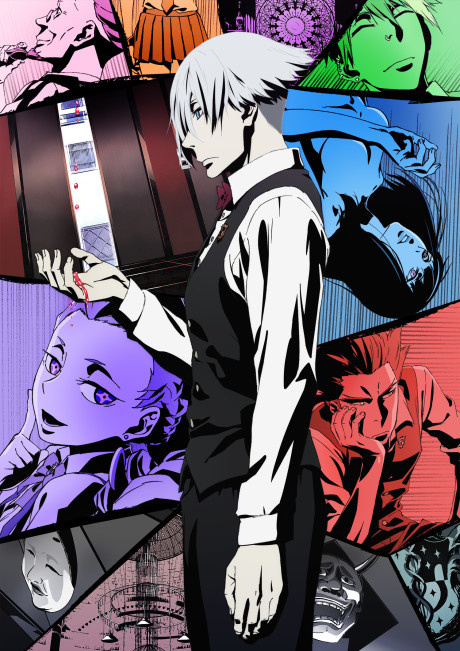
Death Parade is an enigmatic mix of emotion and emotionlessness. It centers itself around the theme of death, the place in which it garners most of its ideas. The death games provide a good spectacle, while the narrative tries to make a commentary based on the psychology of the human condition.
This show has its moments. Since it is an episodic anime, each episode revolves around a different game with different players. The games are where this show shines, be it darts, bowling, or otherwise. Each game explodes onto the set, giving way to the ominous yet powerful atmospheres that each game presents. This gives the characters a chance to display a whole range of emotions within their 20-minute time span. Furthermore, each game comes to a unique emotional peak, making the darker episodes hit harder while producing the right amount of tension to keep it interesting.
But when it comes to the permanent members, it is hard to come by development. They are mostly cast aside, while the focus is put on the storyline of the week. This makes me feel like they were more of an afterthought used to link the games together than actual characters. Although they were given moments of personality, they were tacked on, never feeling impactful or genuine. A good example of this is Oculus. He is the driving force of the main narrative and is the ‘boss’ of the arbiters. But nothing came of his storyline. Sure, he was threatening towards some characters, but these were empty threats as he never followed through or changed emotionally in any way because of it.
The overarching narrative did not fare much better. It portrays itself as grandiose, indicating some big finale to come. The tables might turn, or there could be a surprising plot twist. But anything remotely similar to that only happened within the final moments and by then, it was too late. The finale should have occurred at the halfway mark, leaving room for proper characterization, worldbuilding, and more solid stakes later on.
Nevertheless, the opening is one of my favorites. Along with it being a total bop, it creates a complete juxtaposition between its tone and the tone of the show, somewhat cleverly subverting expectations. The original soundtrack is fitting and attunes to the tension that comes with people playing for their lives. Additionally, MADHOUSE never fails to impress me when it comes to their work. The art has enough detail to be pleasing, the animation is dynamic, and their color palette is fittingly moody. All of this works well to enunciate the themes and resolutions that are reflected in the story.
All in all, I like Death Parade for what it is. The flashy games provide a spectacle full of raw human emotion, with a pseudo-introspective look into what makes us human. This is not a drama that prides itself on its insight or storytelling prowess, but rather a vessel used to showcase the games and the narratives that flourish within them.
Alterations
Emotional Score: 76/100
-6 for the underdevelopment of the main cast (Mainly: Decim, Chiyuki, and Oculus).
-2 for the underdevelopment of the main story

Few shows have gripped me from the first episode like Cowboy Bebop. From the outset, the show hits the ground running. The story weaves its way into your heart, as it takes you up into its whirlwind of smooth, clean-cut fight scenes, and vivacious chases. The jazz music provides a cool sidecar to its motorbike of madness. However, this does not last forever. Everything slows as you reach the final scenes of the first episode. You start to feel the weight of the characters’ actions, motives, and the history behind them. It shows to you how every action in this world has consequences. And that time affects every character, thus, changing who they are, and who they will be. This is Cowboy Bebop.
Cowboy Bebop even after 22 years, is still regarded as one of the best anime of all time. Apart from the elegant animation, fantastic soundtrack, and fast pacing, one of the reasons for its love is its characters. They are what makes the show whole, it may be easy to read their outlying personality, but they all contain little surprises of unexpected character. This is possible because the show leaves them room to breathe. We never get ‘caught up to speed’ with their entire life stories, and they are allowed to develop for reasons we may not entirely understand. This allows for a little mystery behind the characters' motives, which I find makes the story even more engaging.
Nevertheless, most episodes do not further the main plot. These episodes have a self-contained narrative, creating a ‘miniature arc’ within each episode. This supplements the pacing of the show, as the sub-plots develop quickly, and resolve satisfyingly. Furthermore, these episodes contain the most fluid combat, witty dialogue, and an atmosphere of a good time. However, the episodes where the main narrative is touched upon are great in their own right. I say this because it is not something I expected. Due to the episodic fashion in which the show is structured, it would be difficult to carry an overarching plot from episode to episode. But here, it just works, nothing ever feels out of place, and the story is spliced seamlessly between bounties.
Sometimes you can tell what a show is going to be like from its music choice; this rings true for Cowboy Bebop. It is composed by the brilliant Yoko Kanno and performed by the Seatbelts, which was brought together by Kanno herself. Jazz is what makes up the essence of the show. Its fast and loose attitude plays well into the tone of the show. When a fight breaks out, the music punches in with some hearty jazz improvisation alluding brilliantly to the organized chaos of the scene. I was surprised to notice that most tracks that make up the soundtrack are only ever used once. It goes to show the care and affection that Kanno put into this project.
When it comes to voice acting, there is a reason that some consider the dub to be superior to the original Japanese. It is phenomenal. I was entranced no matter who was speaking. Each voice was utterly unique, while the voice actors brought their feel, quirks, and personality to each character.
The animation smoothly dictates the flow of action, every punch, and kick carries tremendous weight. Even in less intense scenes, the animation does not stumble. All the walking, talking, sliding, and jumping follows a naturalistic pattern unique to each character. Additionally, the art is wonderful. Not only does it look clean, but each location is filled with detail while not overcrowding the composition of the scene.
Ultimately, Cowboy Bebop does everything right. When I sat down to watch an episode, it was because I wanted to see that world again. It always felt fresh in its own right. I can see that the director, Shinichirō Watanabe, was just allowed to let loose. In the end, he undoubtedly did not hold back. This is a show I can truly call a masterpiece.
Alterations
Emotional Score: 96/100
+2 to Edward, an unexpected compadre in this beautiful world.
-2 to Vicious, did he add anything? I think not.

This film is pretty darn good. For reference, I have never fully watched or enjoyed a romance film or anime. But this one is a definite exception. The director - Makoto Shinkai is known for being a master of his craft, and it shows in his biggest blockbuster yet. The film utilizes beautiful animation, an energetic soundtrack, and a fantastic direction to provide an experience akin to the hype it accrued.
The two main characters Taki and Mitsuha may be run-of-the-mill high-schoolers (cliché but hey) but the emotions they convey are grounded and realistic. They tend to remind me of the time when I was in high school, which warrants a certain relatability to them. Although, they are not as fleshed out as I would have hoped. If there was another scene or two relating to their hobbies or aspirations it would have helped in establishing both characters.
The characterization that did occur was cleverly done –
a good part being explored though the others’ body.
This limits the amount of pure exposition needed for their development. There is some romance between the two, but it forms quite subtly and has less to do with the characters’ actions and more with the expectations that the viewer has gone into it.
"It is a romance film, so they have to fall in love!”.
Additionally, the bonds between the main characters and the side/support characters could have been explored a little more. This would emphasize how the characters are acting out of the ordinary when around each other. As for the premise of the story, it may be simplistic; but it leaves room for the complications that evolve throughout. The story itself was woven together in such a way that it made it feel natural and easy to follow while watching.
In terms of Your Name’s visual and artistic merit, it passes with flying colors. The composition of every shot is clearly outlined. The effects used (blur, lens flair etc.) draw out and emphasize the emotion of the scene while not being overused to the point of it becoming a gimmick. The artwork consists of clean linework and vibrant yet natural colors. Furthermore, the animation quality is superb, richly flowing from scene to scene.
This is especially prevalent in the sake ritual scene!
Although I do not know Japanese and watched the subbed variant I could still feel the intensity of their voices. The lines are not overacted, fit the context of each scene, and have a certain warmness to them. The music features the Japanese indie rock band: RADWIMPS. The rock tone gives a sense of teenage rebellion which mirrors that of the main protagonists and the world they perceive. This makes it a perfect fit for the film. As for the sound design, I did not notice anything particularly special, but it was generally well made and mastered. Overall, this film is delightful to listen to.
Your Name was released in 2016. Has it survived the hype?
Four years later, in 2020, it is still worth the praise. The artwork is still incredible, the music is great and youth-esque, and the art/animation is still a joy to look at. I am sure it will become a classic in the years to come.
Deductions
Starting Score: 95/100
-4 for the lack of support character development
-2 for the minor lack of main character development
-1 for the minor lack of romantic ‘foreshadowing’
