— — — —— — —
×
— —— —
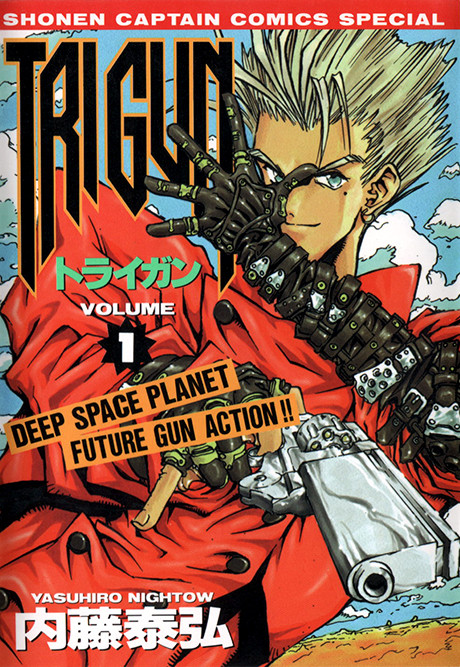
Not a single review? Okay, here we go.
Trigun is, without a doubt, one of the best battle-shonen works and of the entire youth demographic.
This title can get lost and be overlooked within the seinen demographic, which was assigned to it due to the magazine where it was distributed after about 22 chapters because of complications with its previous magazine. After that change, the work doesn't become especially different, and this can be appreciated in the parts that were adapted into the anime of the same title. It didn't change its themes, nor its formula for arcs, self-contained episodes, or its dose of comedy.

Inspired by the Western genre, Trigun prioritizes the use of weapons, taking them to all kinds of levels: from simple bandits with shotguns to giant bomb throwers or wielders of enormous machine guns. The author makes the work more creative by including various fictional combinations of weapons that take advantage of disproportionate bodies and strange vehicles.
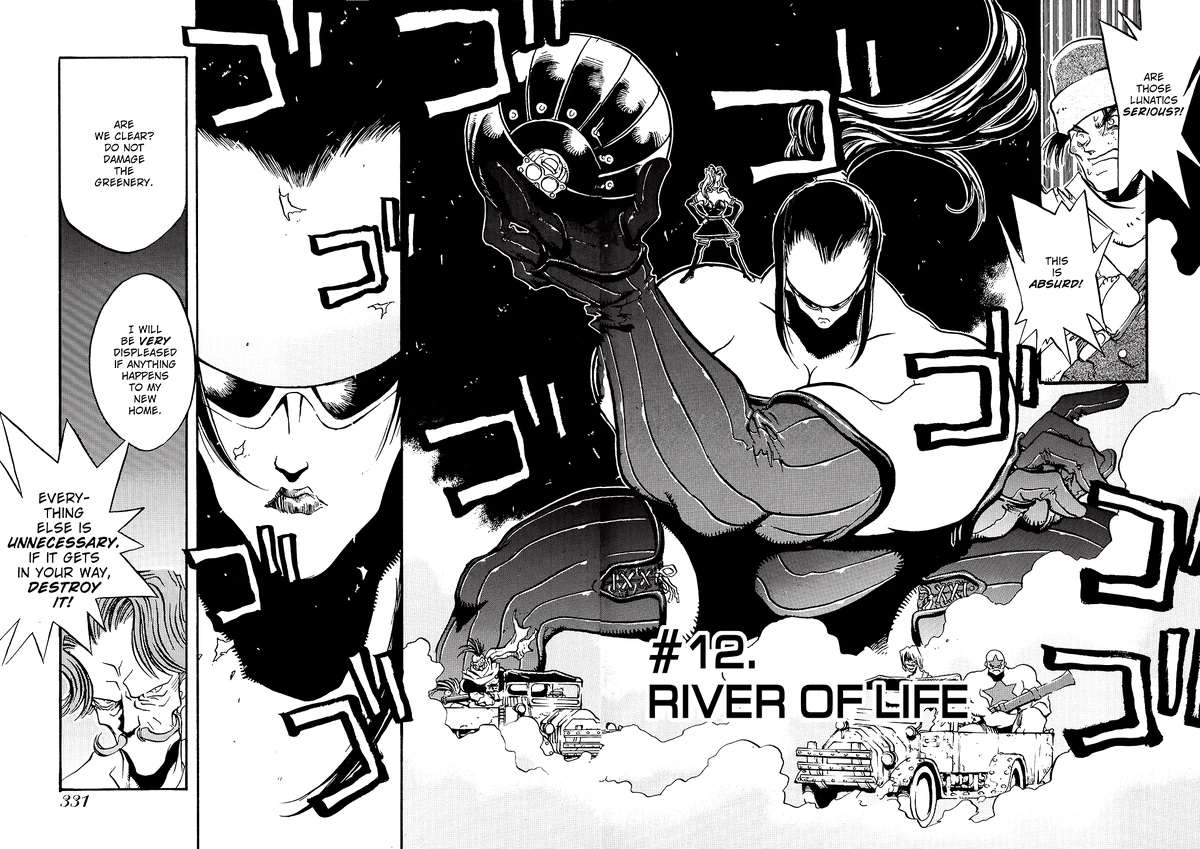
Trigun, and at times its continuation Maximum, is a relatively basic or repetitive work, structured into mini-arcs and mini-battles in which very few subplots are linked simultaneously. In fact, many times it simply follows the protagonists alongside a temporary group of people. With that and a small group of main and recurring characters, the author managed to create one of the most solidly coherent works, with very good characters, battles, and other highly introspective moments, and a plot centered on a very good villain. In this sense, you could even say it is the most solid work that makes the fewest mistakes within the entire demographic among action stories, even though its arcs are very independent without always being so conclusive in delivering a new message. It also incorporates other characters, like Brad and the people related to Nicholas's past. At first glance, it's a work that can seem repetitive on a first read, when you aren't stopping to appreciate the quality of each arc. The plots can also seem like more of the same in the sense that they always have to help someone, defeat a villain, or rescue an ally. But you just have to realize that this happens a lot in other mangas, and if it's not that, it's another type of repetitive event.
The work is not static, nonetheless; it moves well within similar scenarios in a decadent world where humanity can barely survive. It has a sense of suspense that is well rewarded with revelations about the past, a rivalry, and a very well-crafted evil plan, all of which have everything to do with the type of hero being built.
Another thing to highlight is that a few chapters can be really short, with an occasional chapter that doesn't resolve any plot thread but rather develops a character a bit. Reading it all in one go poses no problem.
Its protagonist, Vash the Stampede, is the epitome of the hero archetype who doesn't wish to kill anyone, whether good or evil. To do this, he makes superhuman efforts and has an extraordinary ability to use his weapon and fight without mortally wounding whoever is doing evil. Vash not only doesn't want to kill; he truly doesn't want others to kill, neither good nor bad, on either side. This makes him carry an enormous burden, which can be seen in the wounds on his body, caused by the countless fights he prolonged to ensure he didn't take the lives of his opponents.
Vash's internal conflict is about the past and the responsibilities he carries, how he gives up and how he gets back up to fight until he finishes what concerns him most: the plan being orchestrated by the main antagonist.

The story begins by presenting a decadent world, how people survive, and how criminals try to steal or monopolize anything of value, further reinforcing the misery and decadence to which humans are subjected on this planet where everything is scarce. During the initial events, various bandits and even entire towns try to capture Vash due to the enormous bounty on his head, a multimillion-dollar reward. Through this, he ends up meeting and being accompanied by two girls he befriends: Millie Thompson and Meryl Stryfe, two employees of the Bernardelli Agency. Both are reporters who have to stay close to Vash after entities declared him a "localized disaster," report his incidents to the press, and monitor him to ensure he doesn't cause damages so the insurance company doesn't lose more money. However, that doesn't stop the group from being heroes on multiple occasions, facing dangerous, bizarre, and well-armed enemies in conflicts where Vash's superhuman abilities prove key. This role also places the girls in a position to discover the truth about Vash and face the lack of credibility with their superiors. Something particularly interesting for those close to the press.
We are used to the early appearance of Nicholas D. Wolfwood, but in this part of the manga, he appears towards the end. At that point, he's a mysterious man we barely know, somewhat generous but not your conventional preacher, who gets involved in a dangerous place, along with the villains we saw earlier who are after Vash. His intentions and his past are a mystery for now.

Here it must be said that Trigun decided to always maintain a simple formula of a single plotline and a conflict that the protagonist must live through until it is resolved, but always maintaining the mystery of why, who Vash's target is, who he really is, why he has those superhuman abilities to survive any conflict, and what makes him so optimistic or cheerful with people.
Some enemies are temporary and products of circumstance: small-time bandits and bounty hunters with all kinds of weapons in a depressing, chaotic world who don't have the time to negotiate survival as a team. In fact, despite the situation, the bond between the inhabitants of the towns is not especially close; rather, everyone tries to look out for themselves because they are used to living surrounded by hostility. But even so, Vash throughout his life came to form many groups of friends, remembering the old ones with nostalgia and saying goodbye to the new ones with melancholy and gratitude for having met them, but this comes later in Maximum.
These events initially don't seem marked by a clear direction, but besides providing comedy, they contribute to world-building, the relationship between Vash and his 2 (later 3) friends, resolve conflicts, and at the same time develop secondary characters, thus giving the protagonist and his team a greater heroic sense, because besides saving the day, they also motivate and help good people to improve themselves and not lose hope, something that is essential in that violent desert world. Moreover, this covers the first 12 chapters of the Trigun manga, but I describe the formula because it is used again during part of Maximum's events.
Spoiler alert
What changes when the plot progresses into its main conflict? Villains appear in a city, Vash confronts them, but we are presented with flashbacks, a lot of tension, and new names. The first of them is Legato, a figure with a long cape and a psychic power capable of silently annihilating many people. At that time, he acts as a messenger who warns Vash that if he leaves, he will kill the people in the city they are in, taking advantage of the protagonist's abhorrence of people dying. This establishes a very important principle of the previously unknown antagonists: they want to make him suffer, demoralize him, and frustrate him by trampling on his sense of protection for human lives. Furthermore, they want to confront him and finish him off, but not until the time is right.
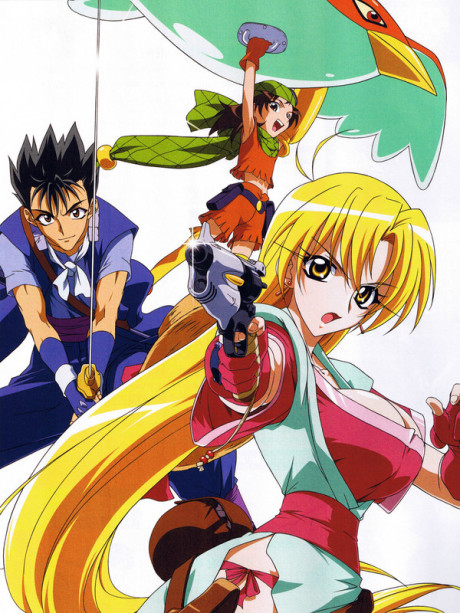
(And a strange anime where there are weapons galore but no one dies.)
Correcting a phrase from the manga, we have "A few Things Learned on the -Short- Road."
What can a shounen anime in the ecchi genre, whose premise sounds very familiar to another great manga from the same demographic with a very well-known animated adaptation, offer? Let's say a half-baked story with good ideas and some development.
I can't say anything about the manga, except that the author has no more than two known works on the internet and does have good, typical 2000s artwork.
I also can't say how I came across the anime, because it's a somewhat confusing story...

The pacing isn't always good in action scenes; they have almost no tension and not many good choreographies. In general, the fights are absurd due to the inclusion of fanservice.
Even the training shown in flashbacks seems very simple and lacking in emotion.
The characterization of the characters is just enough, and the world-building is very poor, offering mostly episodic characters and abilities that need no explanation. However, what might weigh it down the most is the absence of tragedies left unresolved or not yet processed, such as moments of shock from recent deaths.
The plot can be very boring in terms of pacing and details, yet still wrap up an episode well. It repeats many everyday situations, the problems don't generate much tension and mostly have no serious consequences, and the formula doesn't vary much between episodes. The advantage the protagonists have over the villains becomes apparent, as does the ease with which they can solve everything, needing only to take down a group of bandits or simply talk.
On the other hand, for its duration, it doesn't waste episodes; it does make use of the characters' motivations and stories to connect their paths, and each conflict is self-contained, with the story holding its own by offering a positive attitude in some tragic situation related to killing or dying.
The settings are usually the same, alternating between the road, public baths (because being an ecchi demands it), castles, and little else.
Situations escalate quickly, providing just enough characterization for secondary characters whether they are bandits, citizens, people seeking revenge, etc. Sometimes, even when two episodes are used, it feels a bit rushed and very straight to the point. Almost everything involves simple plans limited to how to fight the enemy of the moment.
The main cast has reasons to drive the story, but little is known about them: interests, values, family, other past details unrelated to their motivations, etc. This is partly justified by the kind of life they lead, but it leaves them at the mercy of a few personality traits repeated in similar situations across episodes. The villains get even less characterization time, but they have goals and positions that make them more human and not simply evil for the sake of it.

Rushuna is a mysterious gunslinger with an attitude and a vision driven to promote peace in the world, possessing the physical skills and weaponry necessary to immobilize her enemies when she cannot stop them through words.
Since childhood, she trained to be an Angel, a skilled warrior very close to the Empress, from whom she inherited the idea of convincing her enemy with a smile. The mission she embarks on is to achieve peace, disarm people in conflicts, solve problems with bandits, etc.
Rushuna's incredible dodging and shooting skills justify the complete confidence she has when facing her enemies.
Yes, it sounds familiar. Eight years earlier, Trigun also introduced a blonde gunman, also with superhuman abilities, who curiously also traveled through a dangerous world.
As a distinction, she aspires to save the world in a very different way from Vash, since the latter always had a villain to stop.
To not deviate too much from the ecchi formula, she remains a somewhat airheaded girl who doesn't care much if she's spied on or someone looks at her cleavage; she doesn't get angry about too many things and doesn't have much more than one problem to overcome. Rushuna's indifference to perverts makes her resemble a very common archetype of female character from anime that are usually not taken seriously and never end up being decent in story. Still, she breaks this mold by being an action heroine. She also has a great fondness for the co-protagonist without any special basis, but it's not something that goes against her personality.
Yajirō is a former soldier from a Rebel Army, haunted somewhat by ghosts from the past that include the death of his comrades.
He is someone dissatisfied with the Angels, because he believes they never cared about people since they didn't prevent conflicts (or he’s simply distrustful of all idealistic people like them, since he never witnessed peace in his life as a samurai). He decides to accompany Rushuna on a journey so she can introduce him to the Empress, and along the way, his perspective changes as he witnesses how his new friend solves so many problems without needing to take lives.
Mikan is the companion who joins because three is a crowd. She is a girl who grew up a bit with Rushuna's help, overcoming her desire to avenge her parents. She has a peculiar way of assisting since she can make all kinds of helpful objects out of balloons, from clothing to fast transportation. She has a fun concept in her fights and delivers some comedic lines. She doesn't stand out, but she also doesn't have such a special bond with the other two.
The rest of the characters have a basic or slightly better-defined role as allies, but generally don't stand out for any particular quality.
Spoiler Alert
Story:
The conspiracy presented against the protagonist stalls in the formula of waiting for the enemy sent to eliminate Rushuna, without the possibility of giving many clues about the conspiracy beyond that, for the protagonist, a certain person could never have betrayed her, so she fully trusts that it's all a misunderstanding. On the other side, we see antagonist members who only order the protagonist's elimination without exploring motives. Nor is a past constructed that would allow for speculation. Therefore, all questions are answered only at the end.
Fortunately, the final act takes several episodes and reveals the meaning of being a Grenadier. All the main and close characters who might be relevant carry out their own actions to facilitate the encounter that puts an end to everything.
Towards the end, there is some conflict between utopia achieved through the use of violence, with a fair double standard in the villains' ambition for power and, at the same time, in using conquest as a means to achieve peace. In reality, it seems they propose a not-so-violent subversion, but these are words that last only a short time until the conflict is resolved.
Conclusions:
An enhanced ecchi? Or a potentially good story worsened by ecchi in the action scenes? I'm not even sure myself.
Most of the weaknesses of this story have nothing to do with the extra fan service, but rather with the lack of ambition, as well as very tight characterization of the characters.
Surely a short film would work a bit better, for example by introducing the 3 characters and going straight to the most important fights. The ending has some motivations, but it should have a bit more exposition to support that the peace the princess wanted was the true path, for example by showing how they came to be at peace with several nations.
Average, potentially entertaining for those adept at watching anime with ecchi regardless of the subject, potentially boring for others. Among so many popular titles that many started with and that fail just as much or more, it's really not a bad option.
P.S. Did I mention that Yajirō risks his life to defeat an enemy at a moment when he already had the advantage in the fight?
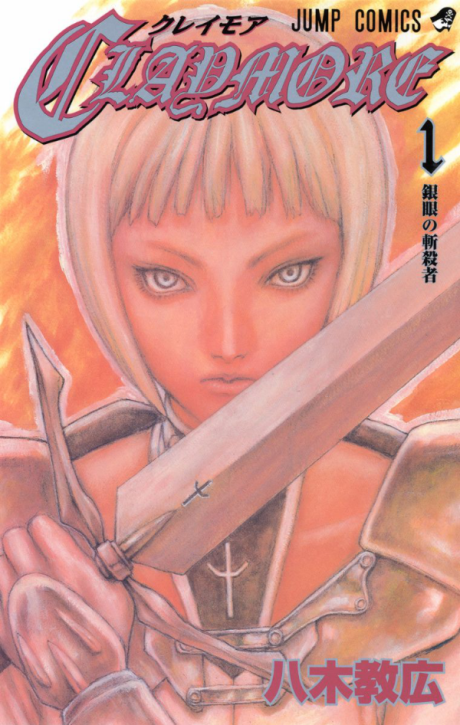
Until I clarify that spoilers begin, I will try to summarize what gives the work so much value.
Self-contained arcs with character development, valuable relationships, difficulties, and extreme situations amidst a dark conspiracy make up the first third of the work (what the anime adapted).
As the conspiracy grows, the warriors are forced to make decisions on their own, thus growing as companions and beginning to fight more for their own well-being and that of others.
Multiple events involving both new and returning characters lead to increasingly serious conflicts that will culminate in the final battles. Along the way, all the characters will contribute within their respective roles, learn from their own dilemmas, or make poor choices and learn from their mistakes.
There is no filler except for one Extra episode, and there are no unused characters.
I would try to describe the great plot twist it has regarding the conspiracy, but it would be too obvious if I compared it to that of some well-known works.
And in case it wasn't obvious, many of the best female characters in the entire demographic. And it's also a manga without intrusive humor or filler.
I give Claymore an 8/10 for maintaining a well-paced story across several mini-arcs filled with dilemmas, developments, and honor for characters who had a way of life defined by fighting monsters, and because it sins much more for what it did not tell than for the mistakes it made in what it did tell. Without a doubt, a work nearly on par with the 3 or 4 best among battle shonen.
I have a few more things to say before getting into the spoilers:
Faith and how it truly brings about miracles: a faith not tied to any kind of divine intervention. Faith is a common element driven by the polytheistic culture of these distant lands, and it helps the warriors carry on in critical moments. Later on, in different situations, they will realize that faith took them too far, and perhaps a miracle is nothing more than the idea that drives you to achieve something that seems impossible, but isn't.

In a tragic setting, with many hardships, suffering, dangers, dark setbacks, and deaths, the survival of those warriors and their camaraderie takes on a value different from that in other works. In that sense, it is the closest it comes to Berserk.
Legacies: What did the people we once knew and loved leave us? Teachings, wisdom, helpful things? In Claymore, there is a unique sense of legacy among the warriors that influences them to learn their combat techniques, fight with the swords of fallen comrades, and even carry parts of them, as is the case with Clare, for whom both legacies and miracles will unify at a certain point.

In a world living in the Middle Ages, creatures called Yoma, with an energy called Yoki that grants them powers, began devouring humans. They possess enough intelligence to use their powers and take on human form, even being able to access their emotions. That mysterious power, strongly tied to consciousness, is placed into human females by "scientists" or mysterious doctors of an organization through the insertion of those monsters' flesh into their bodies, leaving an open wound that is impossible to fully close. The result: powerful warriors who surpass human combat ability with ease, and are also capable of developing various skills through mastery of the energy contained within those monsters.

However, these warriors, despite easily being able to face these monsters, have much greater challenges to overcome: stronger monsters that were once their own comrades, but whose Yoki spiraled out of control, causing them to cross a threshold where they acquire the same craving for human flesh as Yoma. And a life deprived of total freedom: From the start, as orphans, they all lost their families and were forced to join the organization, some of them handed over by slave traders.
Thus, most warriors in this story do not look back on their past because they have few and unpleasant memories. Some carry severe traumas resulting from their hatred of Yoma and the atrocious experiences they suffered at their hands. Yes, this is a story where the vast majority of female characters have lived through the same experiences, which leave them without a past and with family ties that would only bring moments of sadness. Therefore, these pasts are touched upon very little and only at the beginning of the entire work, in order to focus on their bonds with one another.
The attacks by Yoma leave different villages marked in such a way that they avoid helping children who survived attacks, for fear that any of them might be another Yoma transformed into a human. Similarly, they avoid seeking help from the warriors they call "Claymores," after the type of sword they carry, as they are aware that their bodies are half-Yoma and fear what might happen by having them nearby. This prejudice is primarily a trait of the premise, but it will be developed and resolved for the protagonist over the first two arcs.

<center>SPOILER ALERT</center>First arcs: a solid start with developments and good flashbacks.
The first five episodes focus on characterizing the protagonist, Clare, and explaining how she met an ordinary human named Raki. Since the anime wanted to wrap up this idea in a single episode, it loses the fact that the story first portrays the protagonist as a somewhat cold person, ideal for the job, who—regardless of how people look at her—gets her work done as quickly as possible to ensure fewer people fall victim to Yoma.
Finally, an episode explains the immense burden that weighs on the warriors, as they are all orphans who have gone through terrible times, so that as warriors, one day their minds can no longer regulate the flow of Yoki, and they must call a comrade to kill them, so they may die in peace as humans. This chapter is primarily important for establishing the kind of past shared by all warriors, along with their lack of personal motivations in most cases, and their psychological profiles in others. And something no less important: that for them, it is sacred to rescue their comrades from ending up as monsters, which is why they mourn their deaths but are also fully capable of carrying out that task through a black card.
Then we have an arc so good at building a connection, even with a twist in the main plot
I didn’t see coming, though the anime stretched Raki’s words a bit. Definitely, "Darkness in Paradise" is a great mini intro arc, no doubt.
Even with such a long flashback, the author didn’t want to waste time and went straight into a tragedy handled with just the right amount of grief. That’s followed by an arc that keeps building the world and a friendship born from a common enemy but with real mutual respect, in a world where it really matters to connect with someone when your life and theirs are in danger and you’ve got no one else.
Then it kept a realistic pace where the protagonist couldn’t solve something beyond their reach, yet in "The Witch’s Maw" it established the character’s frustration, and by the way… a female main character! And an imperfect one! Kind of an antihero, with a personal goal the viewer understands after seeing what happened to her, and since she’s so far from achieving it, she’s got a long road ahead where maybe nothing will guarantee she gets there, like the uncertainty of the real world.
The second third of the work: many characters return at the pace of a work that has no filler whatsoever, and some of those who reappear have undergone significant development in their lives. The main warriors show that they never abandoned their dreams, and as soon as they were able, they went back after their own desires, and the narrative seeks to give them that opportunity. The world feels advanced: most individual characters, as well as the guard of the city of Rabona and the Organization's experiments, have progressed considerably. Some "pending" plot threads are closed, past events are explained, and most importantly, the biggest questions are resolved, and a chain of events occurs that leads to the developments of the final third. Some for the worse, and others for the better.

The final third: all the major and most anticipated battles take place. New and old characters grow. The power scale increases, we are introduced to new old characters with a clear role, though their pasts feel somewhat redundant because they involve more warriors from the Organization.
Like the other warriors who are, in their own way, persuaded by the organization's truth, Clarice undergoes a significant transformation, evolving from a warrior who feared for her life and had no ties even with other warriors, to someone who embraces her advantages and finds fulfillment alongside the people she met along the way. Dietrich, taking steady steps but maintaining her sense of responsibility to the Organization, repays the warriors and ultimately confronts the truth based on her own childhood experiences.
Even among the last warriors controlled by the organization, Roxane offers a story of how a weak warrior slowly rose through the ranks. Cassandra's spirit or remnant ended up avenging her old friend so she could say goodbye properly, as just another comrade (something she learned from her friend).
Raki and Clare are no more than 4 (maybe 5) years apart in age. Clare finished her training when she was still a bit young but already a teenager, and due to her weak level, which makes her rely on releasing her Yoki until Darkness in Paradise, it is understood that she hasn't been working as #47 for several years. Yes, Clare is a teenager at the start of the work. Raki, on the other hand, is a pre-adolescent who reaches 19 to 20 years old by the end of the story.
Many readers get the impression that the work's quality dropped significantly from chapter 66 onward. The reasons are mainly due to reading the work quickly, possibly because there is "too much action and dialogue for something important to happen."
From the timeskip onward, Claymore does nothing but characterize the new cast of warriors, reinforcing the bond formed through their training and living together, but it also exposes the vulnerabilities and flaws of both the new warriors and those we already knew: Helen's clumsiness and desire for revenge, Clare's unquestioning thirst for revenge, Miria's perfectionist and protective sense as a leader and guardian of her colleagues' well-being, Uma's feelings of inferiority and lack of purpose and talent, Cynthia's hidden sadness, and Tabitha's trust in her superior Miria.
All of this is exposed as the plot progresses, through accidents, the foolish decisions of the more immature warriors, old encounters, and all without hindering the main storyline. There really aren't many justifications for why the work supposedly declines at this point; it stems from fast reading and first impressions.

Both the bond between Clare and Raki and the influence of that bond when she half-awakens, the psychological profiles of some characters, and the powers of a few characters tied to having great hatred or great willpower, are elements that have also been used in more infamous works. They can come across as very predictable and poorly justified.
The relationship between Raki and Clare is built on two people who were almost defeated but can still move forward if they form new bonds, and on the parallel between Clare and Raki having both been rescued by someone after horrible experiences, which makes it somewhat justified. Not to mention that, from a writing standpoint, awakening is a process derived from the experimental introduction—it is very important to clarify—of a monster's energy into a human, at an early stage of the experiment where the Organization had not yet achieved the results it desired for complete control. Therefore, the mental strength required to resist the awakening process remains a mystery, and in fact, later on, it is achieved through another method. In a work about faith and perseverance in creating miracles, it is fitting to have a power system based on unknown and uncertain experimental processes, but with some fixed foundations such as improved training and careful Yoki release. Other works manage to overcome setbacks through discoveries and an established set of rules, and that is fine too.
Raki is a character who, with slight changes to his dialogue in the animated adaptation, can come across as overly sentimental, but in the manga, he uses the right words and has appropriate reasons for not wanting to abandon Clare or lose her: he had recently lost his family and had no one else in such a difficult time; he is not afraid of people, but until then, no one had helped him; he understands that Clare is a solitary person who at first does not want to open up to anyone else, and he perceives her as someone who has lost as much as he has; and he is emotionally drawn to her. Is he too sentimental? Yes, at his age of 12 or 13, during the pre-timeskip, he worries about Clare's well-being and musters the courage even to fight a warrior, because his greatest fear is losing someone again.
On the contrary, the 19-20-year-old Raki is a likable fool. He searches for Clare without worry because many years have passed since he lost his family and was separated from her; he has mustered courage, his spirits have improved considerably, and he was able to fulfill his purpose of becoming stronger to travel and reunite with Clare. He understands that the world is highly dangerous and there is not enough room to flee from threats, so he even accepts the risky task of someday killing Priscilla.
She's an apathetic person who, despite everything, prioritizes people's well-being and has friendships. Her not-very-close behavior toward Raki is well justified by the fact that she could die on any mission because she was weak, and by the frustration she carried that culminated at the end of The Witch's Maw, after which she stopped thinking about her interpersonal relationships from the moment she parted ways with her friend and entered advanced stages of training, as seen in Extra Chapter 04. That frustration is even more justified by the fact that Clare chose the difficult path, taking only a quarter of Yoma DNA, and chose to join on her own the very organization that caused Teresa's death, which makes her desire for revenge unquestionable above all else, even in advanced chapters of the story.
I won’t lie—the number of questions the work leaves behind is not small. How many warriors has the organization had? How many decades has it been in those lands? Can all warriors hold back the awakening process for several days until a comrade with the Black Card arrives? Does a warrior whose awakening was interrupted by a companion’s control of yoki also count as semi-awakened? Fortunately, I was able to see that most of these do have clear answers.
Like... Why did Cassandra have her warrior clothes if awakening destroys them?
I would add the strange sequence of scene 04. But apparently Clare didn't want to fight the yoma that followed her while she was carrying Raki, and then it walked away as she left him at the inn, losing sight of him.

The major villains in this demographic have motivations, malice, and accompanying characteristics, as well as a past and development or closure. The Abyssal Ones, with the few characteristics given to them, at least raised questions, but left much to be desired, as they left many stories untold and did not challenge the ideals or methods of the warriors or the Organization, even though some of them were ruined by the same Organization. And of course, the main antagonist is the Organization, an extremely dark group that, with perfect motivation, commits acts without hesitation against people they do not care about and likely see as inferior. The downside is that they have almost no direct confrontation with the protagonists since they are mere humans.
It becomes unclear whether the Awakened Beings harbor any personal resentment toward the Organization, because despite knowing it, they do not seem to have attempted to destroy it (possibly due to its ability to create new high-ranking warriors capable of facing any of them). But at the same time, it is understood that once awakened, they are not allowed to live for the sake of human lives, so like the first Awakened Being seen during The Slashers arc, they must kill the warriors sent to eliminate them. This is actually compounded by the three main Abyssal Ones, who happened to share a sense of territory in order to have people to feed on, as if they were animals, though this is never stated. Isley is the one who stands out the most, as he goes to war with other Abyssal Ones, having awakened with that goal in the first place, leaving an untold life story that would justify it. The indifference of these three toward the Organization makes more sense in that they know that as long as they are not ordered to be exterminated by a village, the Organization would not attack them. When this changed over the years during the timeskip, Isley was the first affected, while Riful sought a way to use the power of the two sisters to defeat him and Priscilla.
Of the three Abyssal Ones, both Riful and Isley harbor secrets about their pasts that motivated them to become who they are, leaving them as villains who simply participated in the story at some point.
Isley has a philosophy of strength, a sense of dominance over others, and proves to be cunning when he offers his help to Priscilla and when he takes Raki to live and train with him. His influence in provoking the War of the North makes him utterly despicable, and even more terrible when it is revealed that all he wanted was for his group of Awakened Beings to die in combat with the Organization.
Riful was the first warrior to awaken at a very young age, and she is capable of doing anything to build her own powerful army of Awakened Beings and continue living in those lands. Not only is she selfish, but she is also aware that, for humans, half-Yoma and Yoma are sometimes the same.
Priscilla, on the other hand, follows a different formula.
Her exposure time before the final stretch is limited to a few chapters where her actions and thoughts cannot be explored. It is justified in an extra chapter that the world is not being stalked by someone as powerful as her, and then we move to the moment when her empathy ends and she returns to behaving like an Awakened Being more tied to her aggressive and resentful side, going in search of an essence that was presented to us through the pleasant scent she felt from Raki. Priscilla does have a great mystery that can be overlooked in the work, because it is only mentioned once before being resolved near the end.
As a character, she is a giant threat that imposes a sense of immense danger ever since she awakened, but she differs from conventional villains for two reasons: deep down, she wishes to die, as requested in her final moments as a human, which she cannot bring into her consciousness as an Awakened Being, but she is subject to strong amnesia and a calm dual personality because her mental state as a human was unstable and her true nature was calm. Her crisis with her inner desire, however, does not lead to plans or intelligent actions, but to fights in which her personality as an Awakened Being prevails, one that does not hesitate to annihilate potential threats and seeks to remember what happened to her in her human days through force. This leaves a character complete in terms of past and goal resolution, but with little potential for decision-making and a rivalry with the protagonist that features almost no memorable exchanges.
The last thing that harms her is the fact that characters in the work believe she actively sought out her killer by directly placing faith in Clare as the successor of Teresa's flesh, rather than that her wish was finally fulfilled after so many years of feeling a remnant of the essence of that #1 warrior. This same phenomenon can be interpreted more logically and has no official explanation from Priscilla's character, so it can be salvaged.
Despite everything, the three Abyssal Ones die in situations where they long for and prioritize their human desires: Luciela embracing her sister, Riful protecting Dauf (who seems to have been her partner since they were human), and Isley with a positive outlook toward the days when he lived a more normal life with Raki and Priscilla. The construction of the average past and experiences of the protagonists helps give value to these closures, but as characters, they had little screen time, Isley's time with Raki was underdeveloped, and their motivations against the Organization and key moments from their human pasts remain unknown. Primarily, the context in which they awakened and how they built their personalities. Therefore, each of their closures could have carried even greater emotional weight, despite the irreconcilable situation between humans and Awakened Beings.
If you read all of this, I owe you a fried chicken.~~-
