— — — —— — —
×
— —— —

What happens if you put the Trolley Problem in front of Vash the Stampede? I think there’s no debating the answer. That man will stop the trolley. He won’t let it keep moving, and he definitely won’t pull the lever. He will jump in, stop the damn thing, and then save everyone on the tracks. To some, that might be cheap. To some, that might look like it is missing the point of the problem. By all means, it is. It is both of those things. And at the same time, in my opinion, it is beautiful. Above all, it is human.
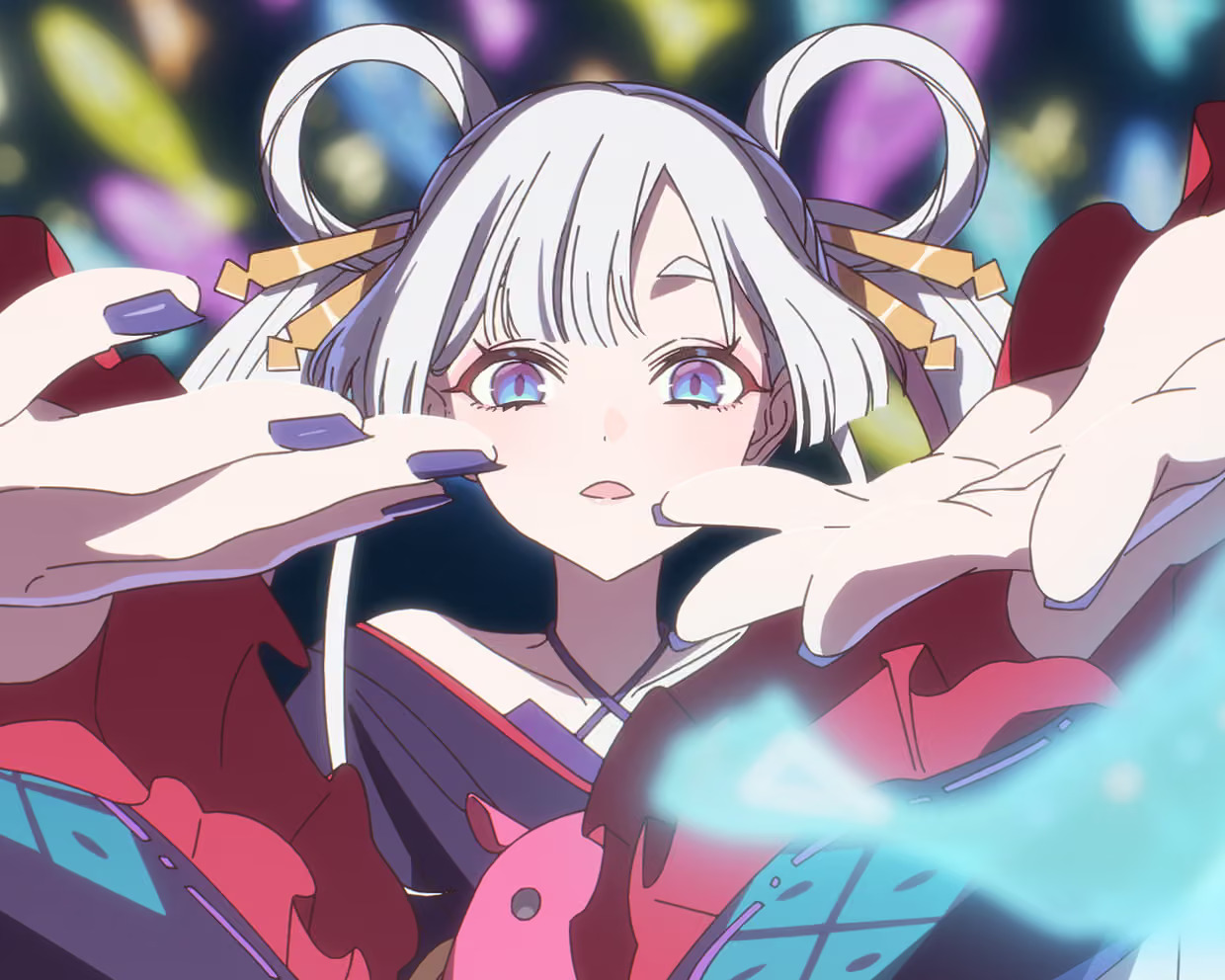
Trigun Stargaze has left me confused in a lot of ways, but mostly in a good way. When I first started watching Stampede after reading the manga and watching the original anime, I wasn’t ready for how good this retelling was. It was a great remake of the original that made enough changes to stay fresh, while still telling the same story. But it was with Stargaze that I think I understand Orange’s true vision with this series. It is not a remake, and it is not meant to be a replacement to the original. Stampede and Stargaze, put simply, are the Golden Route of Trigun.
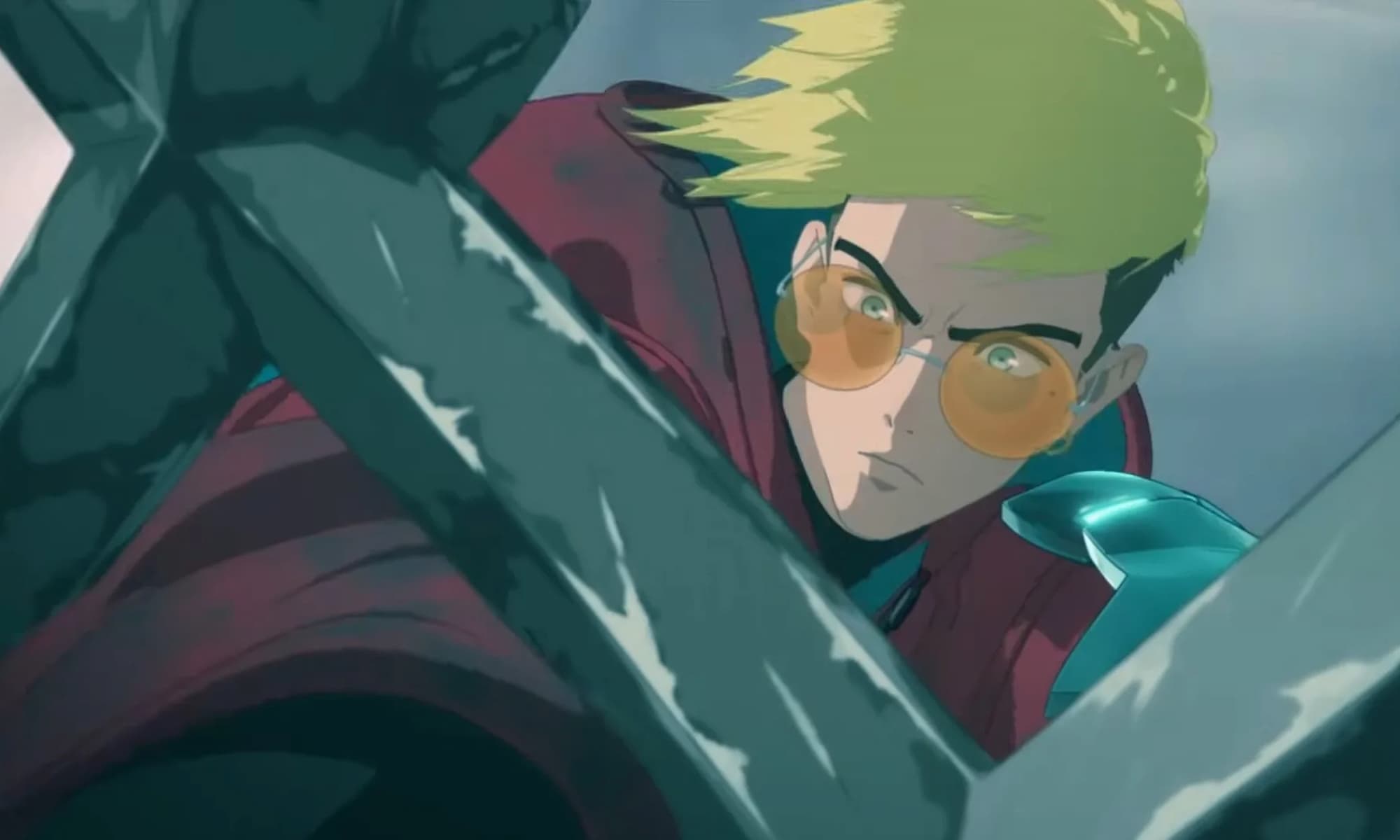
With their version of the story, Orange is not trying to reanimate Yasuhiro Nightow’s masterpiece. They are trying to question its choices and morality. They are trying to ask if sacrifices are so important when you’re trying to walk the path of kindness. If Vash really needs to kill Legato in order to fulfill his wish, or if Wolfwood really needs to lose his life to let his friend get there. Because if they do, then what is the point of their ideals? Why struggle so much, only to see it crumble in the end and fall to your knees?
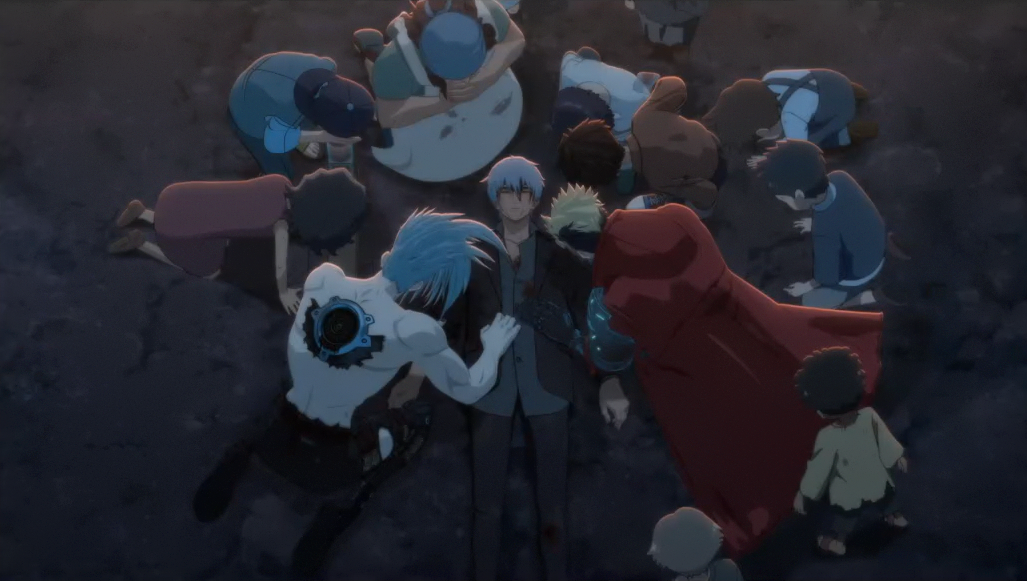
Once you’ve already been through the trauma and sadness of the original, Stargaze lets you see the Good Ending to this story. The one where Vash did not need to compromise on his ideals. The one in which Wolfwood lived, and most of the Gung Ho Guns found peace. The one where Vash was not forced to bend down to the world, but made the world bend down to his honest, simple ideals. In any other story, the lack of death lowers the stake. In Stargaze, the goal that nobody should die is the highest the stakes could possibly be.
Does this mean the story is perfect, though? Of course not. Having a completely pacifist, happy retelling of Trigun does not mean it is not a better story. It is a better message, and a better moral, but one that accepts the caveats that come with it. That is why this show confuses me in a good way. Because it allows me to review a season so perfectly realized that it becomes its own worst enemy in terms of pacing. Stargaze is not best read as a story of Vash vs. Knives. It is a story of technicality vs. artistic intent.
Stargaze's greatest strength is also, unfortunately, its greatest weakness. And that is a little thread that they started all the way back in Stampede Episode 2. The idea that there can be a retelling of Trigun in which things just end up going well for most people involved was there, but constantly challenged by Knives' presence. Every step that Vash took in the right direction was countered by a very active, very hostile antagonist.
In Stargaze, however, they decided to let this antagonist take a back seat. Thematically, it allows them to put Knives in the same position as Vash. Alone, misunderstood, and traumatized by his past. On paper, that is a brilliant idea. It helps the parallels between the brothers come across much more easily. At the same time, technically, it is a pacing nightmare. You cannot take away the main threat of your story in its final chapter and expect things to be fun. Because all you have left is a rinse and repeat formula of Vash and Wolfwood confronting a new member of the Gung Ho Guns and bringing about a change of heart. Over. And over. And over.
Once more, thematically, it resonates better than TriMax. If Vash is genuinely saving these people instead of defeating them, his philosophy and stance is stronger. He isn't just a pacifist in name only, but also in action. He genuinely wants to connect to people and bring about a world where everyone can live in harmony. And once more, technically, it takes away all tension and lowers the objective, violent stakes. The story goes from a struggle to maintain your ideals, to a struggle to win with them.
And so, when you've now saved and befriended every villain from the original Trigun, you start realizing that these are two totally different stories. As I said, this is still Trigun, but the Golden Route. A universe in which the protagonist is not hindered by a world trying to change him, but by a world so rotten to its core that it takes all of his efforts to purify it. But it is also a story of a world that is not rotten in intention, but in execution. It is people who start with good ideas, but lose their way along the path. Stargaze is not a Good vs. Evil story. It is a Good Which Perseveres vs. Good Which Gives Up story.
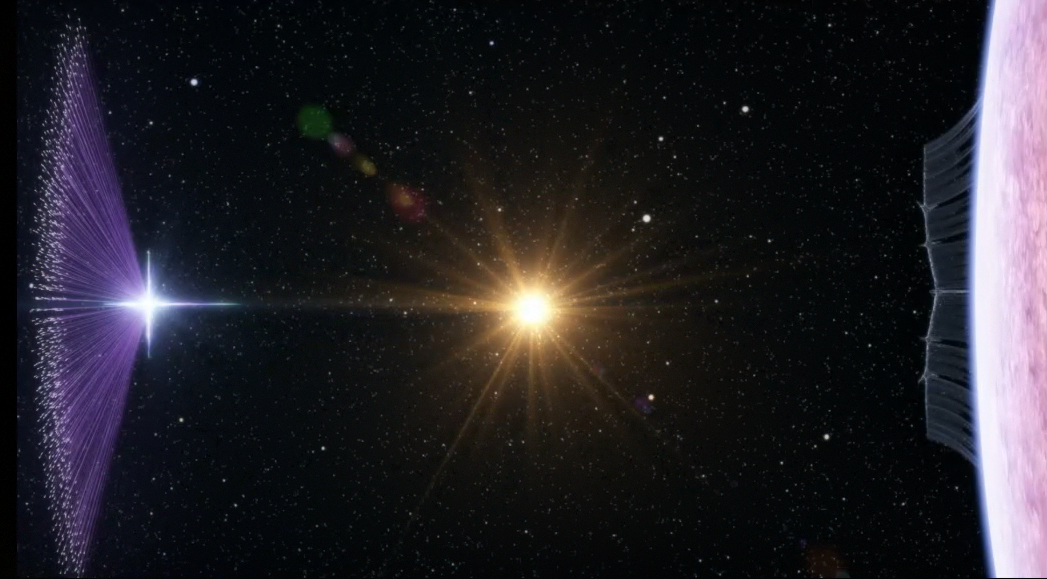
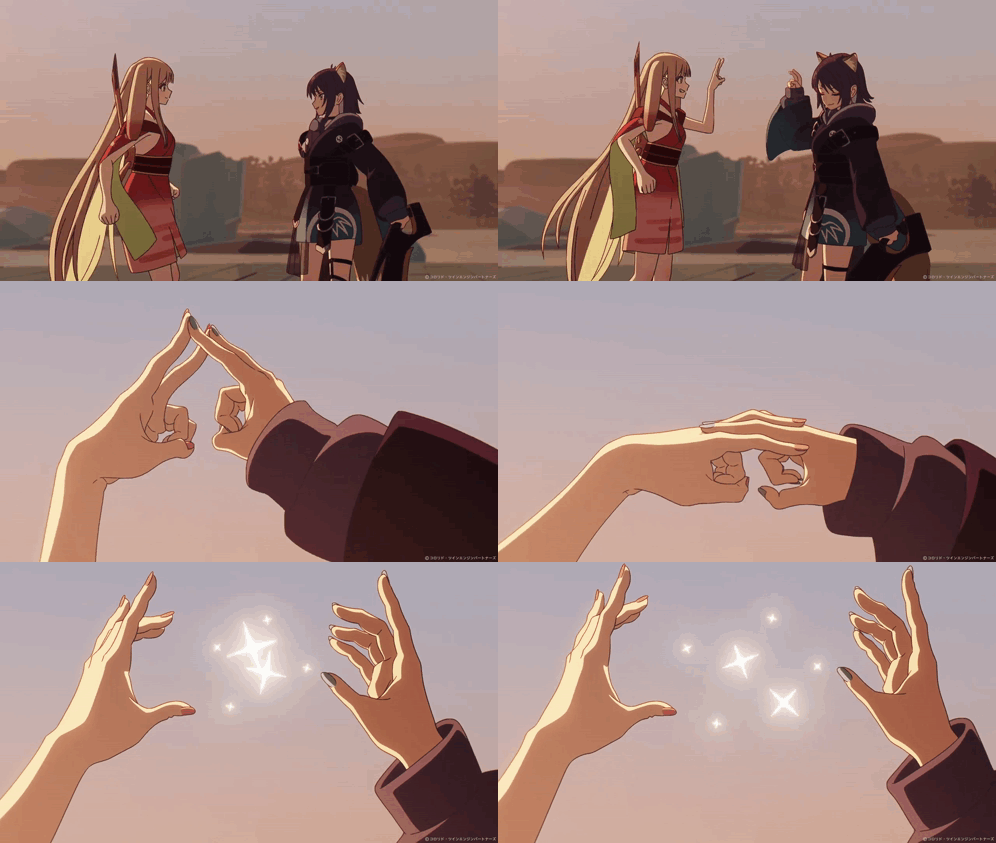
I think this comes across best in the many, many religious themes Stargaze has. There is no correct side on this chess board. There are different people who grew up in different worlds, with different knowledge, and forgot how to be kind. It is an honest reflection of the real world, but then fictionalized by Vash's presence. A soul who understands that we cannot be the same, but tries his best to look past binaries and save everyone involved. How else do you possibly tell the story of a true pacifist, if not like this? How else, if not via a story that does not just stay true to itself, but imposes that idealism on the entire universe?
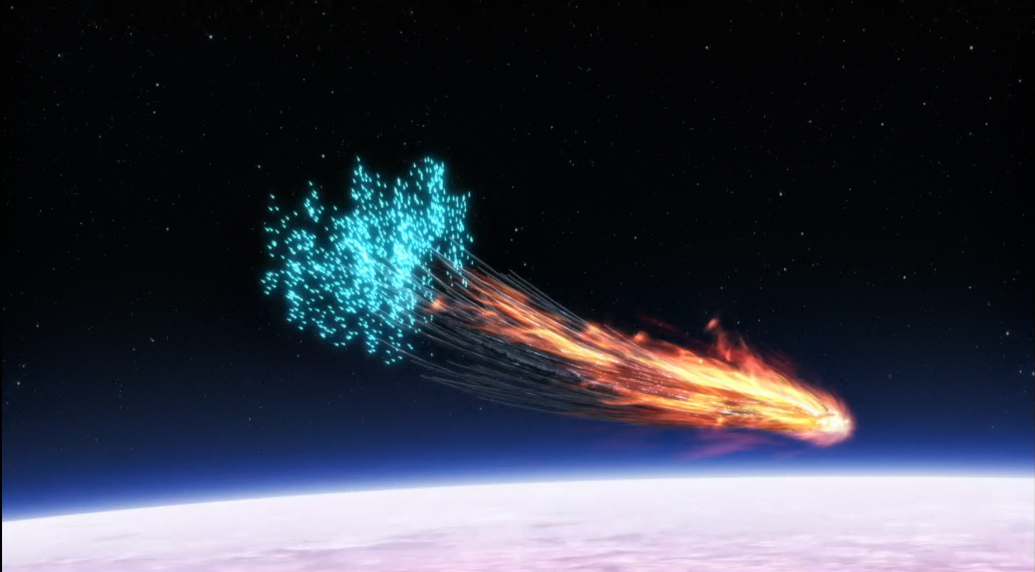
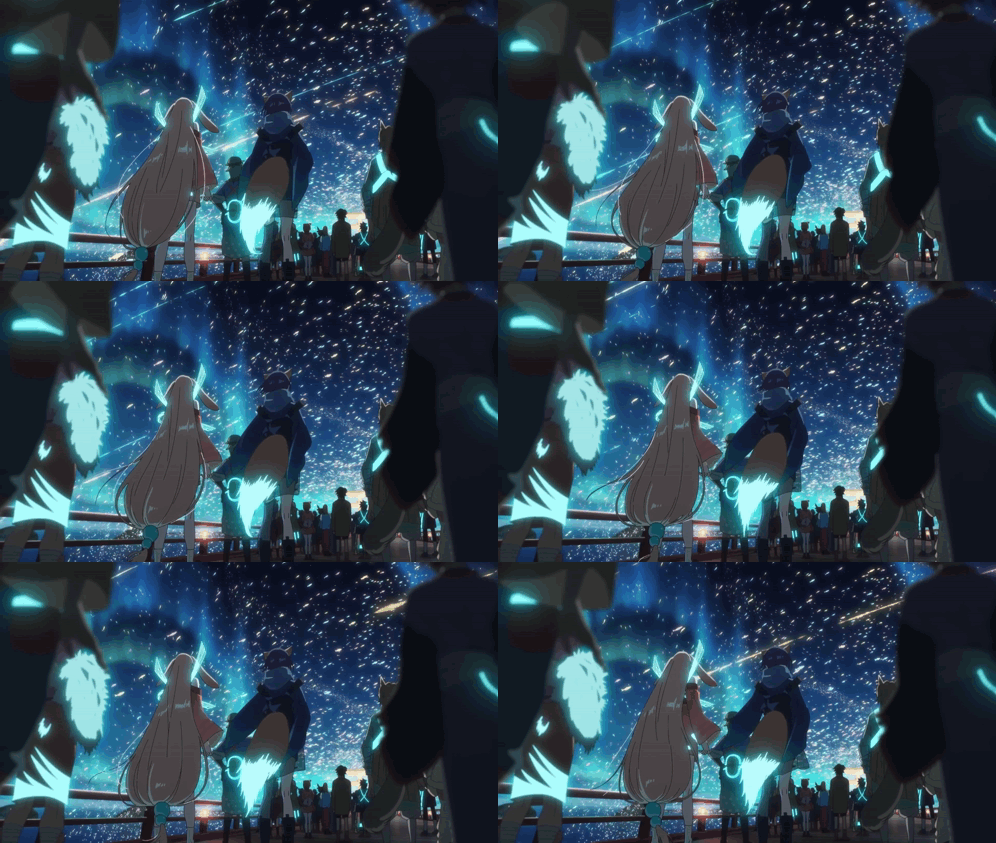
There is not much else left to say. The music is hauntingly beautiful. The animation is probably Studio Orange at their very best. Every other episode has the quality and vison of Stampede's finale. And the final episode is...special, to say the least. I've been dying to see the final battle of TriMax adapted in a visually satisfying manner, and they really, really, really delivered on that front. It might be the one of the grandest anime finales I've ever witnessed, and still one of the most subtle and humble.
Stargaze's thematic prowess cannot overpower or hide its glaring technical issues. It is undeniable that a price had to be paid to create a story that is so honest and true to the heart of its source material. So much so that it is forced to sacrifice its own technical competence (and a more faithful adaptation) to achieve it. In fact, I'd argue that Stargaze has a more Vash-like protagonist than the original manga, and that's saying something.
Either way, I can't tell you to hate it or love it. After all, that would go against the very essence of this retelling. You are free to think what you want. So as to say, with a much more cohesive and deep understanding of the phrase - the ticket to your future is always blank.
Love and Peace!

format(webp).webp)


 Story and Characters
In the manga, there is a heavy layer of subtext, lies and pretention in almost every single scene of this story. Everyone, except Denji, is trying to be someone they are not. Aki can't bring himself to admit that he cares about his co-workers, even if they are devils. The Angel can't bring himself to admit that dying would be bad, actually. Most importantly, Reze isn't able to admit to either herself or Denji that she does actually love him. However, it is her closeness to Denji (the only person who is honest with himself), that brings Reze around to changing her mind about who she wants to be.
Reina Ueda shines here the most. It's not some insane scream or particularly standout monologue that makes her the film's biggest highlight, but just her understanding of the character. There are small nuances to every line that she delivers. Voice cracks, softening, stress and so much more are placed almost impeccably in places which demand the eternal anguish of Reze's unsure mind to come across. A particularly memorable line being when she mentions that a peaceful life is most desirable, and you can make out the hurt and despair in a voice which regrets never having had any herself. Ueda does a fantastic job with such smaller, more subtle stuff with her acting.
Story and Characters
In the manga, there is a heavy layer of subtext, lies and pretention in almost every single scene of this story. Everyone, except Denji, is trying to be someone they are not. Aki can't bring himself to admit that he cares about his co-workers, even if they are devils. The Angel can't bring himself to admit that dying would be bad, actually. Most importantly, Reze isn't able to admit to either herself or Denji that she does actually love him. However, it is her closeness to Denji (the only person who is honest with himself), that brings Reze around to changing her mind about who she wants to be.
Reina Ueda shines here the most. It's not some insane scream or particularly standout monologue that makes her the film's biggest highlight, but just her understanding of the character. There are small nuances to every line that she delivers. Voice cracks, softening, stress and so much more are placed almost impeccably in places which demand the eternal anguish of Reze's unsure mind to come across. A particularly memorable line being when she mentions that a peaceful life is most desirable, and you can make out the hurt and despair in a voice which regrets never having had any herself. Ueda does a fantastic job with such smaller, more subtle stuff with her acting.
 Of course, so does the rest of the cast. There is a lot of character interactions and movement going on in this film, but the arc itself manages almost half a dozen characters very well with openings and ending of shorter development arcs, which reflects well in the film. There are standouts like the Angel Devil and Reze (and the way their arcs end up overlapping in the most beautifully crafted tragic ending), but everyone does manage to get enough of a focus to warrant their roles in the film.
Speaking of Reze, might as well get to the person the entire arc is centered around -
Of course, so does the rest of the cast. There is a lot of character interactions and movement going on in this film, but the arc itself manages almost half a dozen characters very well with openings and ending of shorter development arcs, which reflects well in the film. There are standouts like the Angel Devil and Reze (and the way their arcs end up overlapping in the most beautifully crafted tragic ending), but everyone does manage to get enough of a focus to warrant their roles in the film.
Speaking of Reze, might as well get to the person the entire arc is centered around -
 Reze is a masterpiece of a character. There is such subtlety to her execution and development - one that you do not find in shonen stuff polluted with overtly obvious characters. Despite appearing for a very small runtime, she manages to have a deep effect on not just Denji as a character, but also the audience's understanding of the entire show's themes. Her tragedy of a backstory and parallels with Denji would have been enough, but her present-day arc of struggling between brain and heart is as close as Chainsaw Man gets to spelling out its final themes so early on.
Pacing, Style, Tone
Reze is a masterpiece of a character. There is such subtlety to her execution and development - one that you do not find in shonen stuff polluted with overtly obvious characters. Despite appearing for a very small runtime, she manages to have a deep effect on not just Denji as a character, but also the audience's understanding of the entire show's themes. Her tragedy of a backstory and parallels with Denji would have been enough, but her present-day arc of struggling between brain and heart is as close as Chainsaw Man gets to spelling out its final themes so early on.
Pacing, Style, Tone
 The Reze Arc is fantastic in how it manages to pace itself as a bomb - lighting the fuse with Denji and her first meeting, and letting it run all the way to the explosion during the festival scene. And somehow, despite the change in director, CSM has found a compromise between the more cinematic first season and the insane action that MAPPA probably now wants to stick to after Jujutsu Kaisen Season 2. We still get the quiet slice-of-life montages with melodious piano in the background, but they are balanced by the raw, explosive action of the second half almost perfectly - delivering something that echoes the manga way more with its intention and execution.
The animation might be divisive, especially during the Typhoon Devil fight sequence and its way more One Piece-esque character design philosophy during the more heavy movement sequences. In my case, I find these to be an incredible way to convey chaotic movement that defies order, so I personally loved them a lot. The more cinematic stuff remains consistent with Season 1 in its lighting and camerawork, but the character designs themselves have certainly been simplified compared to before. Not a huge fan of that, but I can appreciate the effort put into trying to respect the previous work while making changes. It manages to strike a good balance.
The Reze Arc is fantastic in how it manages to pace itself as a bomb - lighting the fuse with Denji and her first meeting, and letting it run all the way to the explosion during the festival scene. And somehow, despite the change in director, CSM has found a compromise between the more cinematic first season and the insane action that MAPPA probably now wants to stick to after Jujutsu Kaisen Season 2. We still get the quiet slice-of-life montages with melodious piano in the background, but they are balanced by the raw, explosive action of the second half almost perfectly - delivering something that echoes the manga way more with its intention and execution.
The animation might be divisive, especially during the Typhoon Devil fight sequence and its way more One Piece-esque character design philosophy during the more heavy movement sequences. In my case, I find these to be an incredible way to convey chaotic movement that defies order, so I personally loved them a lot. The more cinematic stuff remains consistent with Season 1 in its lighting and camerawork, but the character designs themselves have certainly been simplified compared to before. Not a huge fan of that, but I can appreciate the effort put into trying to respect the previous work while making changes. It manages to strike a good balance.
 Continuing the idea of its bomb-like pacing, I also loved how it plays with color and lighting to reflect the mood and tone of any particular scene. Scenes with Makima usually don't have a lot of light even during the day, while scenes with Aki are well-lit even in the night. Scenes with Reze switch between being an inviting blue and a dreadfully uncomfortable red. It is really amazing to see more anime starting to play with vibrant color switches and lighting to add to characters, and I wish we see more of this in many, many more shows from now on.
Music
Holy. Shit.
Continuing the idea of its bomb-like pacing, I also loved how it plays with color and lighting to reflect the mood and tone of any particular scene. Scenes with Makima usually don't have a lot of light even during the day, while scenes with Aki are well-lit even in the night. Scenes with Reze switch between being an inviting blue and a dreadfully uncomfortable red. It is really amazing to see more anime starting to play with vibrant color switches and lighting to add to characters, and I wish we see more of this in many, many more shows from now on.
Music
Holy. Shit.
 Whoever on the committee first thought of putting Kenshi Yonezu and Kensuke Ushio on the same project was an absolute genius - and that continues to be true (with a surprise Hikaru Utada!)
Iris Out and Jane Doe have been on my playlist, on loop, ever since they released - but what blew me away even more was Ushio's score. Expectations were already high with his work on Dandadan in particular, and he somehow surpasses them.
In vast contrast to what you would expect, Ushio decides to play with loud and quiet music in opposite ways. The more wholesome, character-focused sequences are populated with the loudest orchestral scores while action is usually tinged with the quiet electronic riffs that Ushio does best. And as one would expect, the former go much harder than the latter with their absolute emotional appeal.
(On the other hand, that one track during the final fight with an entire choir singing the word 'bomb' in different ways individually stood out the most)
Final Verdict
Whoever on the committee first thought of putting Kenshi Yonezu and Kensuke Ushio on the same project was an absolute genius - and that continues to be true (with a surprise Hikaru Utada!)
Iris Out and Jane Doe have been on my playlist, on loop, ever since they released - but what blew me away even more was Ushio's score. Expectations were already high with his work on Dandadan in particular, and he somehow surpasses them.
In vast contrast to what you would expect, Ushio decides to play with loud and quiet music in opposite ways. The more wholesome, character-focused sequences are populated with the loudest orchestral scores while action is usually tinged with the quiet electronic riffs that Ushio does best. And as one would expect, the former go much harder than the latter with their absolute emotional appeal.
(On the other hand, that one track during the final fight with an entire choir singing the word 'bomb' in different ways individually stood out the most)
Final Verdict
 An easy must-watch. Reze Arc is not only a great continuation to the Chainsaw Man saga, but also a film which stands well on its own with its cinematic merit. There is an undeniable vision to its animation, style, tone and emotions - one which pays off so well quite heavily due to Reina Ueda's generational voice talent.
Take your time, appreciate the nuance and messages beyond its simplistic narrative structure and you'll find a romance tragedy that is somehow more relevant today than it was when first written. A devastating look into the power of oppressive authority, how it destroys and manipulates the misfortunate, and most importantly - the pain of growing up to the reality of rational thinking.
An easy must-watch. Reze Arc is not only a great continuation to the Chainsaw Man saga, but also a film which stands well on its own with its cinematic merit. There is an undeniable vision to its animation, style, tone and emotions - one which pays off so well quite heavily due to Reina Ueda's generational voice talent.
Take your time, appreciate the nuance and messages beyond its simplistic narrative structure and you'll find a romance tragedy that is somehow more relevant today than it was when first written. A devastating look into the power of oppressive authority, how it destroys and manipulates the misfortunate, and most importantly - the pain of growing up to the reality of rational thinking.

Loser Ranger was one of the absolute stand-outs of Spring 2024. A slickly animated and stylized first episode that instantly grabbed you with its ‘Power Rangers meets The Boys’ aesthetic and did not let go for a while. Sure, the second half slowed down and dragged just a little - but you still got some insane payoff by the end. Not to mention the absolute banger of an opening by Tatsuya Kitani that was the cherry on the top.
So, it was only logical to look forward to something that would be even better than that when Season 2 rolled around. The first episode pulls you right back into the world and its craziness, even if the distinct style and tone it had back in its first season is gone. No more interrupting texts, no more fourth-wall breaking humor that genuinely works, no more gorgeous animation. But at the very least the story was still as strong. For…right about three or so episodes.
The school time loop arc starts showing the major cracks in the adaptation of this season with the middling direction and less than acceptable editing. Even if it has some really good set pieces and visual ideas, the issues are so jarring that it is difficult to digest. For example - take a look at the scene where Fighter D starts realizing who the real boss monster is. It plays with the whole trope of repeating a few seconds over and over again to slowly build up to the reveal. But the completely tone deaf cuts probably make it the worst version of such a scene I have ever seen. It goes on forever, does not put you in the mind of the character and has zero build up of momentum as it goes on.
Once that comes to an end, however, you are in for something worse. The next episode ends with Green Keeper finding out that Fighter D is Sakurama. And then instead of building up on that for even a second, the next one jumps to a completely different plot line with the Red Keeper “dying” for absolutely no reason (like, seriously, that is never brought up again and has no actual effect on the plot). What follows is an actual fever dream.
The Ranger Force loses trust, gains trust, loses trust and then gains trust again as the Monster Protection Society rises. And, oh, did I mention Usukubo is the daughter of its head, and that they are planning on becoming monsters? Oh, and Hwalipon is helping them. Oh, no nevermind, Hwalipon is an evil boss monster. Oh, Daddy Usukubo pulled a Euphy and turned a stadium of humans into monsters. And now regular members can turn into monsters. And some of them can turn into boss monsters. And here’s lore for the Dragon Weapons. And Suzukiri is a Dragon Priestess. And there are a million Suzukiris. And now she has formed a Suzukiri cult. And Hisui is…what is she even doing, honestly? XX is with Peltrola? No, she is now against him. Sakurama (real) is a good guy? No, he is kinda ambiguous now. The Rangers are the enemies? No, we’re cool now. Sakurama dies? No, his sister dies. No, wait, she does not die either and is fine despite having her neck slashed. Fighter D is fighting the monsters, then he is fighting Tokita, then he is fighting Usukubo, then he is fighting the tiny Blue Squadron girl. Oh, now he is teaming up with Hisui to fight the big bad. And now…Usukubo loves him?
Did that give you a headache? Well, I’m sorry if it did. But that is exactly what watching the season felt like.
There is zero cohesion to any of these plot lines. Things just happen because they need to, not because they are correlated to each other. Season 1 had points like these as well, but they were used sparingly, and rather cleverly to maintain a certain uncertainty that increased the threat and horror brought by the Dragon Keepers. But because of how easily they appear in Season 2, they seem to carry no weight any more. The Red Keeper goes from being the Homelander of the show to an actual joke who takes the tension away from a scene instead of bringing more in - without any character development.
The many, many random flashbacks of random characters really want you to feel the emotions they are feeling at that given moment, but it is not easy to pull that off. And the show never does pull it off. It is a jumble of storytelling that wants to tell the tale of a minor apocalypse caused by the savior complex of a human driven mad by love, but never ends up achieving it because of how little connection you have to these characters. Seeing the Keepers be the villains for most of the show, and then slowly building them up to demonstrate their individual strengths and stories could have made the final sequence where they come together to actually save the world for once an incredible payoff, but we get a mostly-boring action sequence with slightly better animation and zero actual emotion instead.
I could go on and on about just how much of a misstep in terms of pacing this season is, but I’ll probably end up repeating myself over and over. The main point, I think, has been put across. There is nothing holding the second half of this story together. Nothing that you can actually see progress and develop, paired with characters who are more like two-dimensional caricatures being forced to be at points of mental development with no buildup. It is nothing less than chaos, and not in a good way.
It is an absolute shame that this is how this is where the trajectory of this story took it. A lot of potential squandered because of a rushed arc that had no place so early on this show’s life cycle. I’ll watch Season 3 if they decide to make it, but with tempered expectations. All is not lost, since the soft reset at the end of 2 can give time to course correct and start over. All we can do is hope that lessons are learnt and mistakes not repeated.

The more you watch shows, the more you realize that there is nothing which can be described with a 'rarely seen' or 'special'. I've used those terms to describe shows I've given a perfect score in the past, and then used them over and over again. Because those words mean absolutely nothing. There will always be multiple shows which surpass your expectations and blow you away any given year.
So, no, Apocalypse Hotel is not the greatest show ever made. It is not something that only comes around once in a century. It is not something that you'll regret your whole life if you don't watch it. It doesn't need to be. Because if there is one thing it is - it is honest. To you, to itself, and to everything that it builds up in its very short run.
I am not going to spoil anything. I am not going to tell you how it goes through a massive tonal shift after Episode 4. I am not going to gush over its brilliant emotional writing in Episodes 6 and 9. I am not going to tell you how I couldn't stop laughing at Episode 10. I am not going to tell you how well the experimental Episode 11 works on every single front. I am definitely not going to tell you just how perfectly its themes come together in its finale.
Because none of it is something you haven't seen before. All it is, is someone pouring their heart out into making the best version of their perspective of that particular trope or idea you've gotten tired of. Whether it be the smooth sakuga that comes out of nowhere in a random action scene, or the heartful compositing in scenes of quiet introspection. It isn't new or unique, but something made with passion that just works perfectly in that moment.
It is a love letter to the things that make shows wonderful, and an imprint that the Apocalypse Hotel's creators wish to leave in the pile of creativity that is the history of anime. A retread of ideas and concepts, only to help them come together and celebrate the joy of watching something that can make you cry, laugh and get frustrated without warning. A reminder of the simple themes of being kind, warm and welcoming to everyone you meet (even if they might be an intergalactic alien serial killer).
And when you've been through all the episodic randomness that this show is, appreciated the way it built up to the ending and then been surprised by the abrupt ending, you finally realize what just happened.
Just like every other character in the show - you were nothing more than a guest. One who tuned in to watch the antics of the cast every week, got something worth spending twenty minutes for, and then left. The story existed before you came in, and will exist after you've left. But in the little bit of time you spent there, you were greeted with a warmth that will stay in your heart a long time after you've checked out and moved on.
