— — — —— — —
×
— —— —
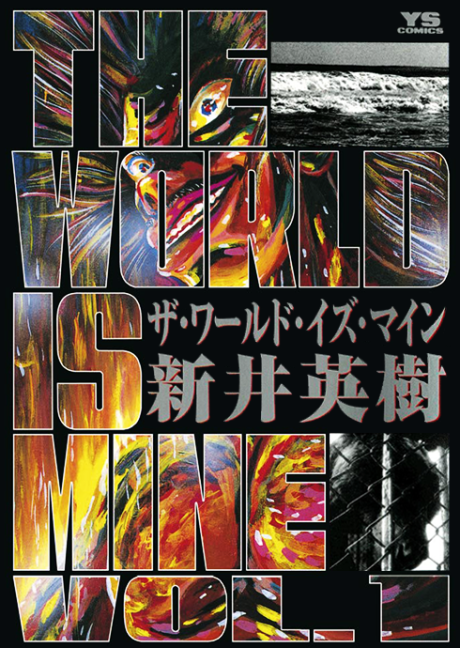
The World is Mine is a manga written and drawn by Hideki Arai, published in Shogakukan magazine between the years 1997 and 2001, consisting of 14 volumes and 163 chapters.
TWIM tells the story of Toshi, a shy boy disappointed by the society who dedicates himself to constructing explosives, Mon-chan, an impenetrable killer completely dominated by humanity's passions, and all the consequences caused by the advent of a mysterious creature. This is broadly the general picture. Now, however, I will move on to a more complete analysis of the manga, all while avoiding spoilers
So, I will first start with the narrative and its peculiarities.
The entire story unfolds during a tragic and chaotic journey through Japan, showing us various adventures, and events of many characters who with the passage of time, will intertwine with each other. Precisely, the trend will never be linear, the narration will always be broken by the incidence of numerous events and multiple flashbacks which will never fail to gather and connect every aspect of the story. The narrative is characterized by a fluctuating rhythm between frenetic action and calm moments; tinged with classic circumstances of the detective and thriller genre.
We will never run into boring, or mundane scenes, as they will always be defined by highlights, full of pathos and suspense. We encounter numerous action-packed sequences, sudden twists that are never banal, and particularly disturbing yet profound situations that lead to philosophical reflections. And throughout the narrative, we will be accompanied by great and accurate writing of the dialogues which never feel monotonous and repetitive.
The World is Mine is not a work with good intentions. Arai wants to tell us a story full of violence, melancholy, inhumanity, and brutality. He wants to describe people, now in degradation, suffering, afflicted by a thousand problems; such as corruption, nihilism, and crime. His is a full criticism of a Japan in continuous decline, full of individualistic, rotten, selfish, unscrupulous people, ready to do anything for their ends, and "to affirm themselves". The author puts all his hatred towards society, and towards every aspect of it, into the manga. And he achieves this through speeches and monologues rich in complex, dark, and uncommon themes, such as politics, equality, ethics, morals, existentialism, religion, and the value of life, among others.
The only flaw I could maybe say I found in this work is the beginning. At first glance it may turn out to be the worst part, it appears confusing, chaotic, and messy (but this will be explained over time, and with a reread it will prove more than pleasant). However, if at the beginning, we find a story, so to speak, unregulated, after a few chapters, it improves, transitioning towards a mystical, political, philosophical, and almost sci-fi narrative.
Instead, the ending is certainly the best part. It offers a worthy, absurd, and unimaginable conclusion that confronts reality head-on, and in my opinion, it's more than perfect (among the best endings I have ever seen), which leads us to reflect on how stupid, and insipid mankind men are. In the face of all the power it possesses, it transmits to us the perniciousness and danger of the choices that men can undertake thanks to the use of weapons, and finally communicates to us all the damage that they can cause.
The magnificence of this work lies in its characters. Arai is a genius in writing and characterizing every subject to the core, from the tertiary and secondary ones (memorable characters such as Maria, the minister Kanpei Yuri, the hunter Ijima and the journalist Hoshino), each with their backstory, their ideologies, their goals, and their own maturation. We will frequently empathize with each of them, even with the most irrelevant ones, such as, for example, Toshi's parents.
Not to mention the protagonists, I dare say among the best characters ever written, who do not show themselves as good, not even as anti-heroes, they are literally the bad guys. I prefer not to deal with the secondary characters because I would go too far, and therefore I would dwell on the two protagonists.
So let's start talking about Mon-chan, my favorite.
In the beginning, Mon presents himself as an almost primitive man, subjected to the most primitive and spontaneous emotions, an enigmatic person, difficult to decipher, with a restless, rather aggressive character, who kills people apparently for no reason. From this assumption, he may seem like the classic villain, without any ideal and purpose; however his soul is completely different, Mon does not possess any kind of malice in committing those crimes. And as we go on we will see how amazing his emotional progression is.
We can compare his maturation to a child who is born into the world, who grows, reflects on his inner state, and we will notice how his psyche changes and becomes more and more complicated. Meanwhile, Mon is influenced and influences everything around him, from people to the world itself, and the latter uses Mon's presence for a very specific goal, for his good, aimed at achieving pure and useful individualism, transcending the limits of collectivism.
Now, I will talk about Toshi.
Toshi is a former postman, a loser who vents his failure in life by building bombs. At first, he is shown as an awkward, insecure person. On the contrary, he is an intelligent man, who has a lot of talent, in fact, he knows various things, but because of that, he is not interested in anything.
To a quick eye, he can be seen as the classic loser, insignificant, without any type of personality; a dynamic character, therefore, devoid of concrete and concise development; however, he undergoes a significant introspective change, leading to a sublime evolution, due to his continuous exposure to an immoral community, and to his many encounters with various characters, which will make him mature leading him to be a new person.
Toshi and Mon, as we can well see, despite forming a sort of couple, have .two completely different personalities, they react differently to events, and will mature in distinct ways. Their stories are comparable with human beings who are nourished by the experience that shapes the individual in himself, thanks to the information, that is to say, what surrounds them, from people to objects. In fact, they will be constantly influenced by Japanese society, but not only that. Any information they pick up will be crucial to their psychological growth. Furthermore, the two will not only influence the entire world, reshaping its concepts and guiding it away from superficial attachments, but also steer it towards a socialist ideology; but they will influence each other, especially Toshi will be conditioned by Mon's unconscious.
The drawings are perfect for representing this type of atypical manga, and I couldn't have asked for better. The style is extremely particular and differs from the usual ones. The characters have a realistic, very peculiar, and intriguing design. Arai is not at all afraid to adopt the use of mannerism to create unsightly figures, with imperfections, just think of Minister Yuri, a plump person, but who on the other hand is attractive and enchanting. The action scenes are pretty well rendered, have their own dynamism, and are never vague. The stroke is quite clean, even if in some parts it is slightly dirty, nevertheless, it remains excellent.
In short, it was a bit complicated and not easy to talk about my favorite manga, and, above all, discussing it without revealing spoilers.
Finally, absolutely try to recover this gem.