— — — —— — —
×
— —— —
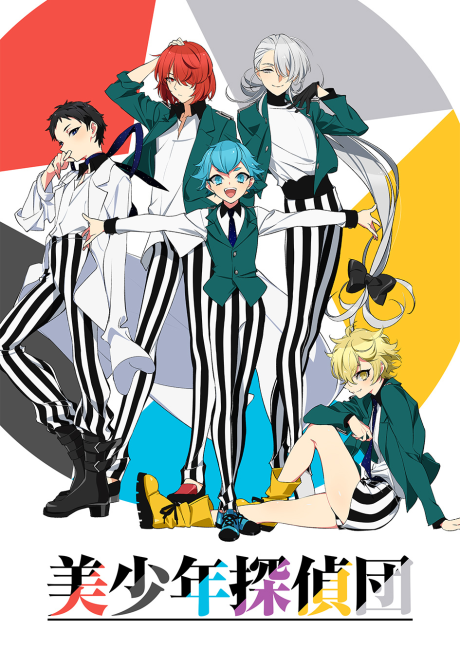
A magical pairing that once made history, is here again to revive whatever hopes you had on Shaft after Owarimonogatari's ending. In the beautiful storytelling of Nisioisin and the imaginative and creative team of Shaft studios' team, Bishounen Tanteidan is here to appeal to everyone with its charming characters, crazy screenplay and dialogue-packed plot that is sure to make you amazed at the mere thought of such a creative piece existing.
Doujima Mayumi is a regular high school girl whose eyes were always up to the sky. When she was a child she saw a beautiful star that she was never again able to see afterwards. Upon stumbling with Manabu Soutouin and a club full of self-proclaimed "Pretty detectives", they go on a hunt for such star. From that point on it's started the adventures of such club, with the premise of a child's play, and all the determination to be pretty, be boys, be detectives, and be a team.
First of all, witnessing one of Nisioisin's pieces is always a treat. The way he deals with the storytelling and is able to be innovative, though never losing his essence as a writer. Such show perfectly in this anime, with fresh and mostly unexplored themes, an astonishing set of characters and an involving progression with dialogues that will keep you on the edge of your seat as well as take laughs off of you when you least expect it.
Still on the subject of unique characters, to which we owe a special shoutout to the designer, Kinako, many of them deserve special attention, not only through the way they are portrayed, but also in the way they are portrayed by each other, each interpersonal relationship is unique in its own right, for example the way Mayumi refers each of the members with special names such as "Delinquent-kun", "Bare legs-kun", etc. Such character interaction helps enrich what's considered to be the most important point in all of Nisioisin's narratives, the dialogues.
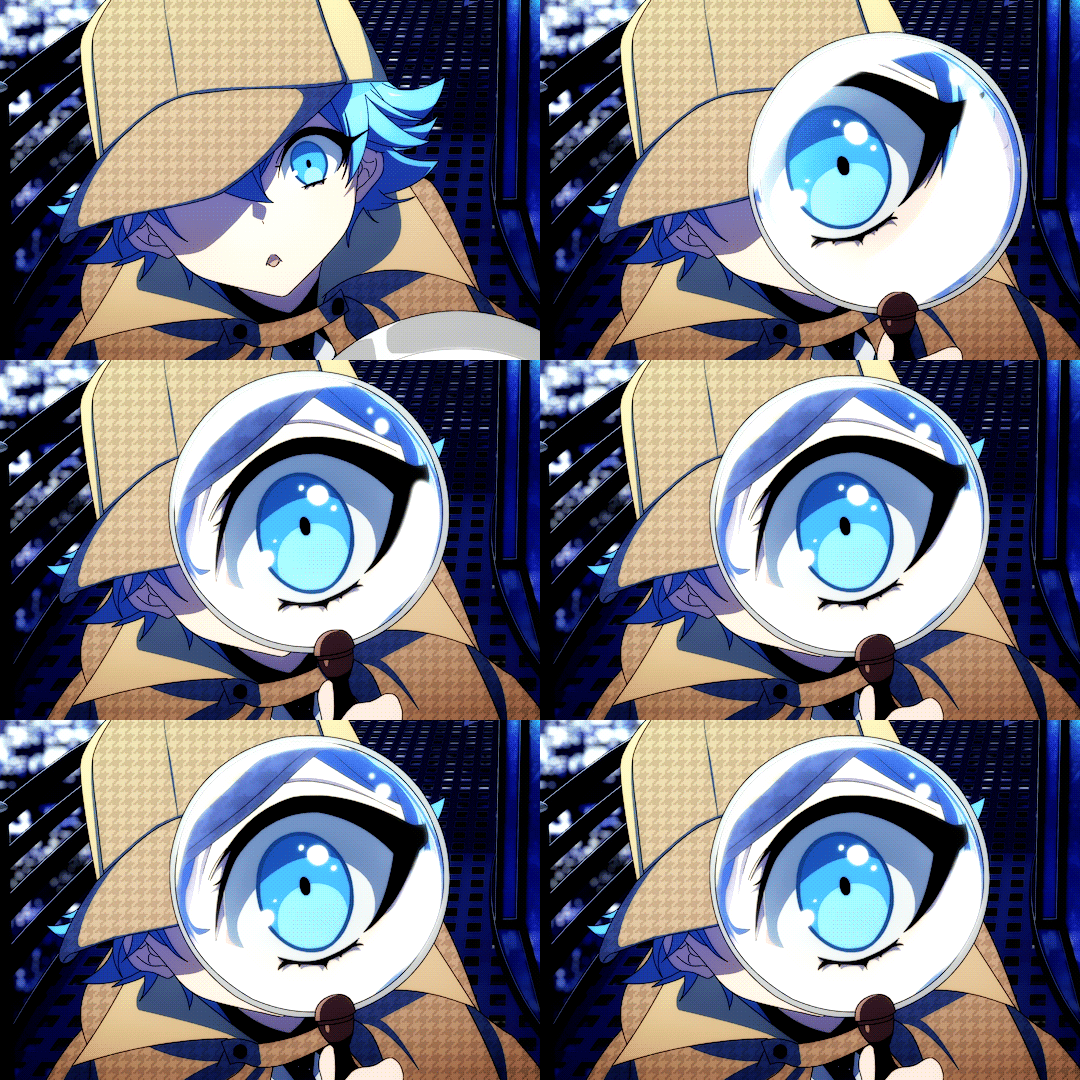
Not to be underestimated though, is the team involved in the art, which was able to perfectly transmit the work made on the manga by Suzuka Oda and translate it to a style very familiar in Shafts productions: the scuffed face expressions, the slow-mo captures and switch in artstyle for dramatic or comic effect. Shaft is well known for such characteristics that made shows like Monogatari and Nisekoi so unique. It was being highly discussed as to what was the future of this studio, upon the massive wave of talents leaving, but if such pieces continue to be created, I believe their future looks very bright
Another art sector that amazed me throughout the entire narrative was the soundtrack, with tracks by Masatomo Oota and Kousuke Moribe. The tracks filled me with joy and highly resembled other works from the same studio. Which was great, because Monogatari, [I'm sorry for using Monogatari as an example so often] for example, has my favorite OST of all times. Bishounen Tanteidan has tracks that complement the narrative and are the main element that make Bishounen Tanteidan so elegant in its worldbuilding.
With all that said though, what are the downsides?

Though not highlighted in the segments above, the story itself isn't really impressive per se, the story is mostly a catalyst to the other elements the piece has to offer, which is to a certain extent disappointing. Of course, even if the story were to be better, it would probably get ofuscated by its characters and screenplay. But from an analytical standpoint, those elements do lack and are pretty much all that's holding this piece from reaching greatness, you can, indeed, resume the story in the fact that it's just an elementary schoolers child's play.
Regardless of it not being presented with a great story, all of its other elements are perfect in its harmony and good enough to make you fall in love with the show regardless of its lack of a clear progression. The art, screenplay, soundtrack, characters and narrative all merge to what's, from my point of view, Shaft getting back in form, and another great piece from Nisioisin. I completely recommend this anime to anyone, and everyone with some free time to fall in love for something new.


It's behind all of our lies, all of our laziness, it's the reason we cheat, and ultimately is the reason to the rottenness of our species. It's also the reason we love. Not one soul can escape selfish desires. There are those who will run from them until they are at their limit, and there are those who will embrace them at every step. WHITE ALBUM 2 exemplifies those perfectly, taking the viewer away from their comfort zone and inducing reflection.
WHITE ALBUM 2 at first gives us the same impression as any other music anime, and to a certain extent it doesn't escape much from the formula. 3 high school students, though with very different personalities, get together with the goal of playing at the Student Fair. During such process, the anime already shows us glimpses of the direction the narrative is going to take us, but it isn't until after the student fair, episode 7, that it does so.
Nagisa Setsuna Ogiso is (narrative-wise) the first one to move on her selfish desires. Knowing Haruki would never turn her down (because it would make her sad), she makes a move on him. Setsuna's selfish desire is not just based off of her love for Haruki, but her love for and jealousy of her friend, Kazusa Touma, and the wish to stay with both of them forever, though knowing of their feelings for each other. Her actions tell me she's someone that embraces her desires. Regardless of how sad it makes both other protagonists ultimately.
After the Student Fair and ultimately the confession of Setsuna Ogiso, Kazusa starts distancing herself from the loving couple. Of course she would, she was scared she was gonna act on her own selfish desires, and she was hurt whenever she saw Setsuna and Haruki together, it reminded her that she lost. Even after taking Haruki's first kiss.
Kazusa Touma and Haruki Kitahara have the same selfish desire; Each other. Though seeing glimpses of those in Touma throughout the anime, they show us a flashback of Touma falling in love with Haruki, in 2 thrilling episodes. after the end of the flashback, we return to a scene of Haruki, while still dating Setsuna, kisses Kazusa in one of the most uncomfortable and shocking scenes in all anime. He ran away from them until he was at his limit, and he gave away. Through the next few episodes the narrative continues, with Haruki feeling guilty. The scene of Kazusa and him encountering each other, and sleeping together is, aswell, one of the most uncomfortable scenes in all anime, as I'm sure Masaomi Andou intended all along.
The story clearly wants to tell us and teach us one of the most important lessons in life: Not all stories have heroes and villains, most of them have only villains, and maybe victims.
(alright story review time is over)
The character writing is another point where the anime is sure to grasp you, though at any time a side character is involved in the scene, you kinda wish they would leave. The chemistry between the 3 protagonists is amazing, and you are sure to love every conversation between them.
The soundtrack is impressive, which is to be expected from a music anime. it's tracks are melancholic and fit well with the narrative, the song will never truly take grasp your attention, it's not what it's trying to achieve, but they are enjoyable to say the least. (good job, Aquaplus!)
The art is unimpressive, though not to an extent that makes it bad. It doesn't really fail to grasp the emotions of the characters, though I'm sure other studios would've probably made a better job and maybe the narrative would've been even more enjoyable. (sorry Satelight!)
Though making us uncomfortable throughout a lot of it's narrative, WHITE ALBUM 2 is an important anime that resonates with all of us to a personal level. Much like Clannad: After Story, WHITE ALBUM 2 isn't necessarily a narrative you would call easy to digest, but if you're willing to leave your comfort zone and reflect on the subjects the anime presents, you're in for a great time and I totally recommend you giving WHITE ALBUM 2 a try.


Time and time again, you are gonna see romances developing through a full 1-cour season, a movie, or maybe even 3 seasons. Are they wrong for doing so? No, nothing leads me to think that way.
But what romance appears as in many cases, is as long as a very short experience, of you meeting someone, talking to them, and something going wrong. Those situations usually disappear from you mind the month after (or become something that will always haunt you and bring you plenty of "what ifs"), but throughout you being in love, that feeling takes over you and makes you only think about that person.
The Garden of Words is the very encapsulation of that, its length also helps encapsulate what the story portraits. The theme behind them both trying to escape different — though very similar — realities, the teacher too scared to step in her classroom, and the student that sees no future in studying, find comfort in sharing the same space, regardless of the little to no communication, each others presence is comforting enough.
Speaking of communication, the dialogue between the protagonists, voiced by the ever so impressive Kana Hanazawa and the also talented Miyu Irino is one of the highlights of this movie, they — aswell as the movie itself — feel very human, respecting the level of formality you would expect from 2 strangers, and evolving along as their relationship.
The two main characters don't feel as fresh as the story itself, Yukino seems to be defined by her background, a teacher that was bullied by her students and suffers on the daily because of that. The same could be said for Akizuki, though even more extreme, he feels like a really bland character and the only thing really driving him forward is his passion for shoemaking. Regardless of the lackluster character building, the story isn't really about that, pretty much the opposite. It serves to highlight that Akizuki himself also knows nothing about the one he's in love with, and knows nothing about himself.
The track is very simple and reminds me of ReLIFE (and Zelda: Breath of The Wild): Piano tracks that are soft and do not bother the scene. Anything more complex would take away from the scene itself, so they decide to save the big track for the post-climax, with a really good song by Motohiro Hata, a strategy that would later be a common trademark for Makoto Shinkai's works.
Under the amazing photography direction of Makoto Shinkai, the scenes feel vivid and fresh, and the teams extremely impressive artstyle (this is a 2013 movie!), you can feel the passion put in this project, which would also shadow the passion of future projects, such as Kimi No Na Wa and Tenki No Ko. The art is magnificent and you can see they don't save any resources on making sure the scene looks as pretty as it can be.
The Garden of Words is a simple but impactful romance, with a lot of Sakuga to please our eyes, it tells a short story and doesn't leave a big mark, much like a short love, where you will soon forget, or maybe sometimes you'll think about it as a nice experience.