— — — —— — —
×
— —— —

Three pieces, three themes, three viewpoints and three different experiences. Memories is something that could evoke all kinds of varying responses from the audience. All three stories have their own qualities, and those stand out on their own without having to dig into them too much. It is necessary to summarise the plots to properly talk about these stories, so there are some spoilers ahead.
The first story, Magnetic Rose, is just sheer brilliance. It's a story of a spaceship crew that stumbles upon the unbelievable site of an almost royal European interior in the middle of the terrifying space known as "The Graveyard of Ships", while searching for the source of a distress signal they encounter. Inside this place, the two engineers that carry out the search comes under all kinds of hallucinations. They eventually unveil the mystery surrounding the place and finds out about its owner but one succumbs to the hallucinations while the other having to relive the pain of a past loss. The elements of yearning for love and inability to forget what is lost can be seen in this piece. A highly advanced computer system capable enough to force realistic illusions can also be found in this. The technical part of this short is also just as brilliant. The ruins from a century ago are portrayed with incredible detailing. Each and every part is a visual treat. The interchanging quiet and classi musics and the animation that makes abundant use of shadows as an element and debris as a prope evokes the terror of engineers brilliantly. It's a story full of mysteriousness, carrying the emotions of love, obsession, surprise and horror. It is worth watching Memories simply for this one short alone.
The second story is Stink Bomb. Compared to the heavy mood of the first piece, it is instead comical. This is also a story that is inspired by the "Toxic Lady" incident. It is a rather straightforward story; the gas effect of a secretly developed biochemical weapon, unknowingly consumed by a lab employee, kills tens of thousands of people. While this mayhem occurs, all kinds of methods are tried to put an end to it. It is funny how the discussions easily end up in "In other words, we have to kill him". This is a simple portrayal of how ridiculously big incidents are often taken care of by those with authority. And the following fiasco with all kinds of heavy artilleries and weapons simply reminded me of a local saying that roughly equates to "Burning the house to smoke out a rat" (The literal transliteration would be more or less "Putting the house on fire fearing a rat"). The stormtrooper logic of the person of interest never suffering any sort of damage even under such heavy artillery barrage is a bit ridiculous but it caters to the funny nature of the film. Not only that, a foreign country propaganda also is in play behind the scenes, but in the end, poetically enough, the ones behind it also falls victim to their creation; you reap what you sow. The whole story, its joking manner aside, can be considered a warning to remember how terrifying the careless development of bioweapons can be.
The third story of the lot is titled Cannon Fodder. It tells the story of a city where everyday life is fighting a perpetual war against an unseen/unknown enemy and the civilians all dedicate their life to making and loading cannons/missiles while the person of highest position ends up firing it. It is a place populated with pro war posters, media is controlled by the state, civilian life is dictated by the state, and almost all buildings are made ready to produce shellfire. The poison from the creation and usage of the weaponry has made the life terrible and the people at the lower levels suffer from physical issues, visible plainly from their appearance, and they are not financially stable either. They toil all the day but simply suffer, but the higher authority that only appears to fire the shell looks healthy and his attire is incomparably better. It is a simple and classic portrayal of the hierarchy where working class slaves themselves to provide for the upper privileged class. The kid of a working man can be seen saying that he wants to fire the cannon when he grows up and not be a cannon loader like his father. Even kids has the realisation that common people are simply cannon fodder in such a ridiculous society.
Memories is a very strong anthology with short stories that speak volumes. While Magnetic Rose is the best of it with pure quality and the one that goes best with the anthology title, Stink Bomb entertains with its funniness and satire, and Cannon Fodder draws a very strong picture with it's powerful allegory. The first short is leagues above the rest, and it is notable that there is a drop in quality throughout the story changes. But this only applies to the story. The technical aspects of all three, again Magnetic Rose being head and shoulders above the others, are beautiful. It is something that only vintage animation could pull off. Wide landscapes, attention to details, lazy color palettes and abundant yet brilliant usage of shadows are but some of its brilliance. It is an anthology that holds out and transitions to the next story very well even with stories that has no real relations. It also makes brilliant use of the sci-fi genre to tell a variety of stories that covers all sorts of topics from emotional to political and even class difference all the while not straying too far off from sci-fi itself. While the title of anthology is arguably not fitting when applied to the whole, it is no doubt that this is a very memorable watch.
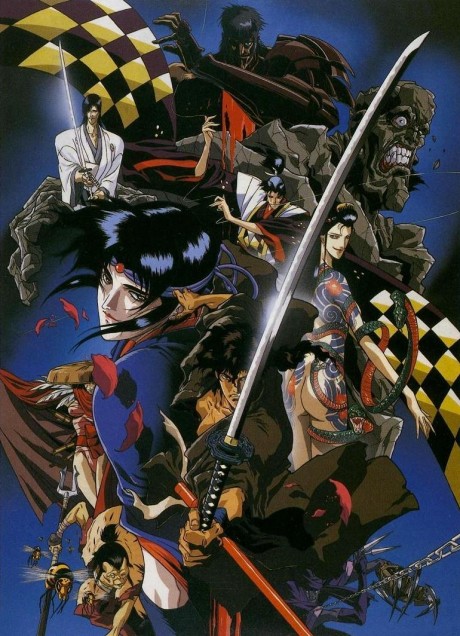
It is extremely important to discuss the history of anime and its animation when talking about Ninja Scroll. A movie considered as one of the most influential anime ever made by many, it was one of the earliest anime to popularise mature, or adult oriented, anime outside Japan, along with classics such as Akira and Ghost in the Shell. The movie was one of the earliest popular slasher anime too, showing violence, blood and gore, and even nudity and sexual assault. It's important to keep in mind that Ninja Scroll is a historically important piece to the anime culture.
Ninja Scroll is not a difficult movie to examine in terms of story. The protagonist Jubei is a good hearted and talented Ninja who gets swept up in a conspiracy which actually has connections to his past. This is just another variation of the popular theme of Samurai-Ninja movies and is nothing special in itself. Rather, it's the simplicity in narration that makes the story interesting. Jubei fights with eight different enemies who possess special techniques of their own, but defeats them all using seperate countermeasures, after an initial struggle. The process itself is perhaps common, but the idea of countering adversities with not only power but also wit is intriguing to watch. In contrast to the so called 'nakama power-up' and 'breaking limits' in shounen anime and such, this is a very refreshing experience, not to mention it is one of the oldest anime to introduce the effectiveness of the technique. Another beautiful part about the story is the emotional attachment of characters in the story as well as their emotional awareness towards their self. Kagero is a woman who's fated to never really love a man because of her body constitution and have always been considered as a poison master. The experience with Jubei provides her with the awareness of being treated as a woman and asked to treasure the life one has. It's visible that she just wanted to escape her wretched fate when she reveals to Jubei that she just wanted him to take her. One visible flaw action films have more often than not is the incapability to emotionally attach characters to the story. Ninja Scroll is different in that regard and is successful in linking those emotional elements to the story well. But in essence, it is a story that starts with the arrival of a mercenary ninja and ends with the departure of him.

The more famous and beautiful part of the film is its animation. It is an anime that is pointed out by many as an example of dazzling cell animation. The story is simplistic but the art narrates on its own. As such, it can basically be included in the 'visual poem' category. As an action anime that's praised highly for its beautiful action sequences it's already a success. The short length nature of action scenes are actually extremely suitable to the story nature as well as a non hindrance to the narration. Kaoru Wada's music also is befitting for the anime ambience and is a perfect fit for the action scenes in particular. The lovely voicing of Kouichi Yamadera and Emi Shinohara also deserves praise.
Ninja Scroll is a film that represents all the beauty of vintage anime. Its story is lacking to be called as one of the greatest anime films, but technically it doesn't really fall behind any other anime. Its style is representative of an era and it is historically important, thus it's not exactly wrong to positively call the anime a 'relic'. Perhaps it's not to everyone's taste, but it has always been one of my favourite anime movies. The song 'Somewhere, Faraway, Everyone is Listening to a Ballad' by Ryohei Yamagishi is still my favourite ending song from all the anime I've ever seen, and in my opinion the whole essence of personal relationships in the films is beautifully conveyed through its lines;
Contains spoilers.
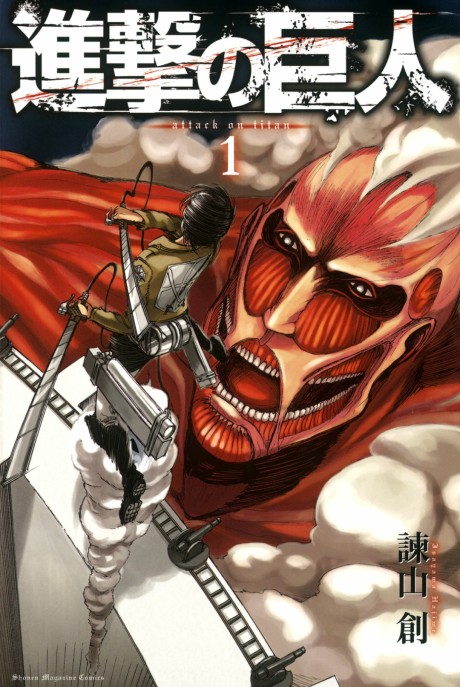
The first question is about the beginning. Did this story begin when the kids started to dream about the outer world? Did it start when the world within the walls started to crumble? Did it start two millenia ago, or did it start in the far future of absolute despair? Perhaps there's no answer to this. Afterall, the concept of time itself is meaningless. The answer is not important, and what matters is the reality. Attack on Titan is the fight for salvation in a world infected with hatred and prejudice. There's meaning in tracing the story back to its beginning, but perhaps what is more ideal is to examine the story of now.
The second question is if it's all about Eren Yeager or the world. An enthusiastic boy, Eren always dreamt of escaping the cage formed by the walls and achieving freedom. When his hometown was wrecked, he swore to destroy all titans. Ironically enough he ended up being the strongest and most disastrous monster of them all. Being reduced to a state of fighting for the past he can't change and the future he cannot protect, Eren Yeager ended up losing the sense of freedom he believed in. His attempt to change the world didn't really reward him in all honesty. Thus, is the story really about him, or was it always been about the others?
The third, final and most important question is about the world itself. What changed? Once Eldian empire terrified the world, then the world terrorized the Eldians, and in the end the Eldians retaliated. The world was left in shambles and four by fifth of its population wiped out. In the end, what exactly changed? People's understanding of others? Their attitudes? It's hard to know. But what's sure is that the fear remains as ever.
Thinking about it, did anyone ever try to properly understand each other in this story? The two sides in the story tried to fight each other on the premise of oppression of the past. Unforgettable and unforgivable as it is, people didn't really think about the present but dwelled in the events of the past. Those who once lost their freedom tried to deprive other of their freedom. It's a never-ending cycle of hatred. People succumbed to their weakness and failed to see the future infront of them. They got lost in the endless abyss of vengeance. A few struggled to live happily like Reiner, and a few were indifferent like Annie; but they all got swept in the wave and lost their goals. Reiner practically lost his mind and Annie wanted to get back to the father she once hated, and Eren who wished for freedom ended up taking the freedom of everyone. Then there's Ymir, the progenitor of all Titans. She was a slave, was treated as a sexual tool, and in the end ended up being food to her own children. The most miserable thing is that she still loved King Fritz. Thus she bore his will for two millenia. The Eldian bloodline that came from Ymir never really gave anyone happiness. The reason why she chose Mikasa to end everything was probably because she felt a similarity between both of them. Mikasa couldn't be with the one she loved, as was the case with Ymir.
Getting back to the questions, we reach a world that's ruined by one man's selfishness to keep those close to him alive. The genocide committed by Eren is certainly not good or the right thing but the shocking part is that it's hard to argue the process itself was bad. If Hitler's genocide was born from delusions, Eren's act was something stemmed from the struggle to survive. It still isn't justified, but thinking from the side of Eren Yeager who wanted to find a way for his people to live, it is hard to confidently make a statement. The world was never fair from the beginning and the story wasn't about right and wrong at all. The people's struggle to merely exist has always been the core of the world of Attack on Titan. For that matter I both disapprove of Eren's actions and finds beauty in his sacrifice. The story was always about Eren, but Eren's world had always been those around him. In the end there's the scene of a bird correcting Mikasa's scarf. That is probably showing their belief that Eren is watching over them, even in death. Birds who symbolise freedom and Eren who wished for freedom; it is perhaps his final salvation to be remembered through birds.
Yoshitoshi ABe's Haibane Renmei told the story of beings that lived inside a wall unknowing what'd happen if they went beyond it. They were beings who couldn't act up to find out anything. Isayama's character's are different in the sense that they make a conscious effort to unravel the mysteries of and beyond the wall. There are those who are optimistic about it, and those who oppose it too; but they all find it as something they need to think about. Perhaps their struggles are not as evident as Guts in Berserk, but the fact is that they are fighting to just keep exist. Attack on Titan, in such a way, has incorporated different elements into its story and made it beautiful. The story has become slightly deteriorated towards the end because of the limited possibilities that resulted from the absolutely chaotic nature, but Isayama still managed to keep it steady and nerve-wracking till the very end. The finale ended up being mild and could've been better, but that's just expectations speaking because it is the finale of Attack on Titan. Personally it was one of the first anime i watched, and the first ever personal favourite. That was two years ago, and the story still remains as one of the favourites. I do not believe it is the greatest, nor do i think it is a benchmark in the history. I do not even know if i will love it as intensely as now in the future. Yet it is an unforgettable existence and experience. Attack on Titan was one of the gateways for me, and that can't change, ever. It is one of the stories that kept me absolutely intrigued until the end, and thus it is something that will always remain special to me.

SPOILERS AHEAD
The desire for love, how far would that make you drift in the void? Mengo Yokoyari answers with Kuzu no Honkai that it's endless. Love changes you, but love can also render you motionless. You can see in the characters of Kuzu no Honkai each of these aspects. Protagonists are the core of the story most of the times and the way the two main protagonists of this story connected itself is uncommon. They are both faced with unrequited love, and the way they find to fill in the blanks left is to comfort each other physically. They both see their beloved in place of the other and yearns for satisfaction. But both of them knows that it's not real, and the gloom never leaves them. The often spreading black color on the screen is thus symbolical of their state of minds. To complicate things, not only do they have feelings for others which they know won't get accepted, they are also targets of unrequited loves. The entire story is a tug of war between the emotions of these six. Hanabi's love is not accepted, and she's troubled by the feelings that she develop later. The one who she finds to comfort her ends up leaving her, and the one who was at her side ends up being unable to do that anymore. Mugi knows that the one he loves is not an angel, but he can't stop loving her. Ecchan and Moca are rather pure and tries their best for their love to get accepted, only to be left with nothing but sadness and a few good memories in the end. Akane find pleasure in being loved by others and taking away the love of others. Kanai, quite honestly, is insane. The only thing that connects everyone of them is the love that they hold in the heart, maybe except for Akane, who's never found the love in her heart before.
Love triangles and unrequited loves aren't uncommon in romantic anime at all though. What separates Kuzu no Honkai from everything else from the same genre is the cripplingly saddening depression it shows. You can see that Hana never becomes able to find anyone. Mugi once asks there if she was afraid to be alone, and her answer that she was always alone is simply something that shows what she has gone through. She couldn't get the person she really loved, then she didn't find the person she was able to feel okay with, and she didn't get a chance to really talk with the one who loved her the most. She couldn't move on, and when she finally gathers the courage to, she couldn't find a chance for it anymore. Throughout the story Hanabi isn't able to sort out her true feelings and mindset and ends up alone. Akane on the other hand gets everything she want, and even ends up finding something she love. She casually uses Kanai to show off her superiority to Hanabi and in the ends find her love in him and ends up marrying him. She also takes Mugi away from Hanabi and leaves her to suffer. It's laughable that Akane ends up with all fortunes while Hanabi gets mentally exhausted from everything. The saying by Buddha goes that 'desire is the root of all evil', and that fits Akane perfectly. Her behaviour of taking advantage of everything ruined quite a few people. Hanabi becomes all alone, and so does Mugi. At the very least Mugi went through a phase which satisfied him to a certain extent. When Akane walks away from Mugi finally there's rain, and you can see that it's finally washing away everything from the past. The music then is sad, and probably shows how Mugi felt. The one who was able to change Akane was Kanai and he seemed perfectly insane. Perhaps it's normal for him to say everything he said to Akane, but for an ordinary person it's questioning their sanity. No logic applies to his words except for the fact that all kinds of people exist in the world. For the other two, even though Moca wholeheartedly loved Mugi she wasn't able to receive it back, and even though Ecchan is probably the one who cared the most for their beloved she only ends up with getting nothing. The beginning of the ending song of the series really gives the feel of a song by someone who wants to escape reality and to be free from everything. And the lyrics does say almost the same thing.
I've never really seen anything that could make me passionately love and hate it at the same time before, this truly is an exception. Although there might be reasons and justifications for Akane, I can never like her, never accept her, and I will probably hate her forever. I can't make sense of Kanai. I understand Mugi, but I don't want to like him. Moca for me is a pure emotional aspect of the story. If she served any purpose, that was to enlighten Hanabi. I can only love and feel sorry for Ecchan. And I will always continue to love Hanabi. I've seen all kinds of romance stories from good to bad and happy to sad, yet there were none that was as depressing as Kuzu no Honkai. And that is exactly why I'm not going to call it a romance story. It's the coming of age story of a few people trying to find their self and sorting out their feelings.
The brillaint work of studio Lerche is not to be left unmentioned. From the beautiful visuals to the fitting voice acting, everything is done to perfection. If anything, something that is lacking for the anime is the somewhat abrupt end of the story. Still, Kuzu no Honkai is really different from the mountain of cliche romantic stories and gives a totally fresh feeling. It's sad, but it doesn't lack in beauty. It's a sad memory for me, and I'll continue loving and hating it.

Blue tinted gothic buildings, abandoned landscape, and animal skeletons shattered everywhere; the post apocalyptic world presented in Mamoru Oshii's beautiful poetic work is the textbook model but creepier and more enigmatic than any.The wide landscape is mainly covered in pitch black darkness and is deserted, leaving only loneliness and the eerie sounds as a companion.
It is more gothic than anything else and the wide range of symbolisms are the only thing that makes up a 'story'.These symbolisms, appearing from the very beginning to the end, however are certainly vague and much difficult interpret and thus it is an indisputable fact that the movie isn't aimed at everyone.Oshii himself has said that he has no idea what the film is about and it is up to the viewers to interpret it.That said, his loss of faith in Christianity is definitely reflected in the work.The most common interpretations all discuss the Christian imageries and symbolisms in the film.As much as I'd love to write about all of them, I'm afraid that I'll be just borrowing those words from those who wrote about it before.
Spiritual quest aside, the journey of the movie starts from nothing and ends at practically nothing.It tweaks the existing Biblical story to break free of faith and yet finds itself cremated within the trials created by god.If the journey of the two characters served any purpose, only they will know.Simply pointing at something and saying "that's the story" won't work with Angel's Egg at all.This is probably why the movie is considered as an artform itself than a movie.It is art animated, conveying the absolute beauty and quality of vintage animation and the entire conversations in the movie constitutes upto less than five minutes in the whole movie (about which I've read that the conversations were all included in just one page of the script).
Angel's Egg is not the best anime I've seen, nor is it the only one that deals with vague themes or talks in symbolisms.But it's probably the first ever anime that is entirely purposeless and yet flows like a river to me, that too in the form or visuals and music, not conversation. Oshii said that the movie made it difficult for him to get jobs for years, which i can both understand and feel bad at.The surrealistic and visual narrative nature of the film might not suit everyone after all.The movie is a quest for nothing.I love that meaninglessness and the spirituality that dwells under the surface, and appreciate the chance Oshii and Amano gave us to experience such a beauty.
"For God so loved the world, that He gave His only begotten Son, that whosoever believeth in Him should not perish, but have everlasting life." ~ John 3:16.

What does death have in store for us?
The easiest way to explain Haibane are to call them Angels, for wings and halo together undisputably helps to form the image of an angel.As if to support that, Haibane are considered to be ones who have been blessed by god.Nobody knows where Haibane comes from, nor do they know where they take off to.They might be the reincarnations of dead people.Haibane are beings whose very existence is a big question mark.The everyday lives of such unique and blessed beings is such a tempting and cute topic, but if that's the assumption one forms before watching the series, they'd either end up being disappointed, or surprised.Haibane Renmei is a show that offers quite the unexpcted content from the first impression.
Much like the ashen colour of the wings of the Haibane, the series is neither white nor black, but deep grey.The blessed beings are said to be protected by the walls of the city, they're not to even touch the wall, let alone go beyond them.They'yre given second hand items to use.These are rules a Haibane should follow.The human side see this optimistically.The Haibane, however, are always searching for the reasons.What exists beyond the walls?Why shouldn't they ever go out? Nobody knows, or rather, nobody explains.The peaceful life beyondthe walls, however, does not necessarily help everyone.Rakka, for one, is troubled by the overwhelming peace which is too much for her belief that she's a sinful being, and Rekki is practically chained to the life inside walls.What appears to be a good life helps them only little.For the Haibane who do not have past memories, what few they remember or experience is all they have.Even the seemingly ridiculous notion of being sinful for not being able to remember their dream while in the coccoon is important to them, as the dream itself gives them an identity.Thus the limited life inside the walls are psychologically taxing on them, only the degree varies for individual.Birds, who are the most free, being synonymous with their lost things is much ironical and beautiful in that regard.The lost memories are free, while what they still have is chained.The Haibane are thus troubled, everyone in their own way.Rekki is weighed down by the guilt and regret of her past actions, Rakka can't totally fit into the world.They all want some form of hope, which is hard to obtain.Even in the end, all it reaches is a form of half baked happiness for them.The resulting internal chaos of all this is cumulative.Even Rakka's feeling that the very existence of her should be erased from the world feels right sometimes that its sense of reality is shocking.The abyss inside them is not visible to the outside, but is darker and deeper than anything else.The Haibane are seeking answers to questions and salvation which doesn't exist to begin with.
That said, what makes Haibane Renmei special is not just the intense feelings, but the narrative structure as well.Intensity is often conveyed by using psychological, narrative or visual chaos, for which anime such as Neon Genesis Evangelion, Serial Experiments Lain and FLCL are some fine examples.Haibane Renmei, however, is different.It uses the simplest of narration methods and forms a simple structure anyone can understand.Still there's much beyond surface level, but the approach taken is linear yet effective.Another thing, which can arguably be a good or bad thing, is the enigmatic nature of everything.Except for the bare minimum that concerned the daily lives and the past of the Haibane, everything is left unsaid.Nothing can be said about what kind of existence Haibane are, nor do they bother to explain what the Haibane Renmei is.Much about the walls, temple, world outside, or even the fate of the Haibane that have taken flight is unknown.One can argue that this is a plothole, but a much better explanation should be that the anime focuses on 'now'.The process is thus much smoother, and the possible chaotic nature is controlled.Much is left ambiguous and for the audience to think.
Haibane Renmei is not the first or only anime to deal with such a theme.What makes it intriguing is the way it forces the watcher to think about the past, present and future by revealing the simplest and truest of life's problems and worries.The theme and narration completely overshadows the beautifully done technical side, which does not happen very often.However, owing to its quality, it might probably appear in lists such as "Elite Anime" more often than not.I would be more than happy to call it such, but that would also make me redefine the word elite at the same time.In the end, it is yet another beautifully done brilliant anime which is often underappreciated and delivered unnecessary criticism.The anime, in truth, explores the delicate minds and makes you think seriously about even the simplest of things, and is an unmissable watch for everyone who is into stuff like that.