— — — —— — —
×
— —— —
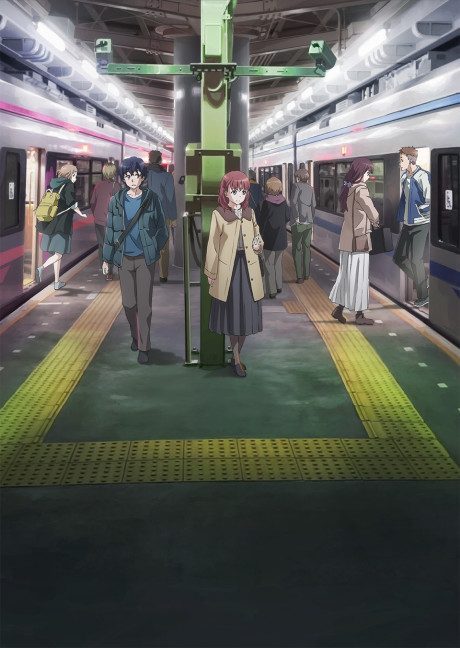
The end of high school is commonly portrayed as an extremely nostalgic period of time, especially in anime. It’s the symbolic end of youth, the moment you stop following the beaten path, say goodbye to your friends, and go your separate ways. It’s often used as a motif in stories of young adults having trouble finding themselves and still longing for those school days, but also as the symbol of inevitability for freshman and sophomores who ponder about the flow of time and come to realize how soon their youth will end.
But it’s suprisingly rare to see a story that actually focuses on the very last stage of student life, those last few months of senior year, when it becomes apparent how different everyone’s lives will become soon. Some people already have their college recommendations, others are busy studying for exams, and there are even those who are already done with their education and will join the workforce immediately after receiving their diploma. It’s the twilight of high school, and you’re at the crossroads of how you’ll begin your adulthood. On one hand it feels like being suspended between these two completely different phases of your life, on the other it’s the last minute to do the things you can only do now, before moving on. Confess love to your long-time crush, rethink your career path. Try to find a surrogate for the achievement you were never able to accomplish, in hopes of having fewer hang-ups going forward.

Just Because is brimming with the atmosphere of fleeting time. Between washed-out color palette, grounded designs and quiet, calm soundtrack, the show drowns the viewers in nostalgia and melting mood. The timeframe of late autumn-early winter definitely helps in creating a very somber, but warm and charming story. It can also feel very personal and touching at times, thanks to detailed animation of faces and gestures. This show associates a particular taste with this time period, a taste not everyone will recall from their own last few months of high school, but it’s so palpable here that almost everyone should be able to empathize with some of the characters in one way or another.
On a different note, it’s worth mentioning that this is first and foremost a love story. Some kids have feelings for one another, which they explore and decide how to act upon. Perhaps all I’ve been writing about, the atmosphere, the theme, are just a window dressing for the events of love lives of a couple of teenagers. But for me, it’s the exact opposite - the drama is just there to drive the plot, while main focus is on those little touches, background events and other aspects of the show, that combined together create its mood.
The characters aren’t very complex, largely defined by just few traits and interests, but there is some nuance to at least a few of them. The relationships between them seem to work largely on the things unsaid, and on how they dance around topics and keep thoughts for themselves, afraid of the other party’s reaction. This leads to a lot of nice, subdued moments, and a few emotional outbursts which appear powerful by contrast.

All this results in quite a unique show. Between the unexpectedly rare timeframe, lowkey drama and nostalgia oozing out of every moment, Just Because manages to find its niche in the everbusy high-school-slice-of-life genre. It’s hardly revolutionary, but it delivers on its promise and I could definitely see it being exactly what people longing for their high school days might be looking for. It’s comfy as hell, and that’s as much as anyone could ask of such show.
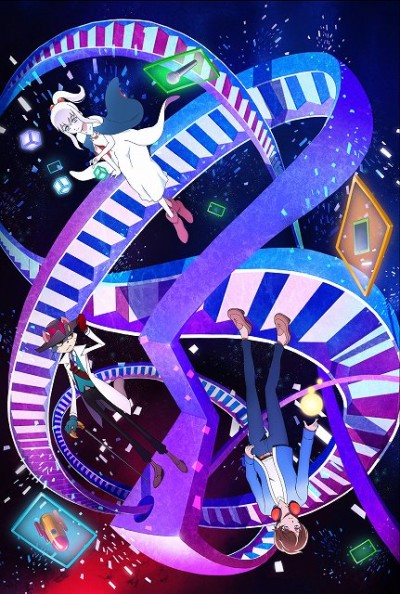
Onirism in media will always have a soft spot in my heart. The stories of dreamlike, where the audience has to constantly question what's real and what isn't. The worlds that operate on their own internal logic, which the viewer is first taught, and afterwards challenged to keep up with. The ability to completely deconstruct any preconceptions and mold them in whatever shape envisioned. Dream scenarios are the domain of endless possibilities, the ultimate blank canvas where you can do anything you want, break any rules you wish to, with no repercussions.
And that is why a dream can simultaneously become a trapping. After all, the allure of such freedom is hard to deny. For creators, who might become addicted to the consequence-free working environment and become worse storytellers because of it. And for the audience, who might partake in the little-known phenomenon called "escapism". The latter has become a staple trope in various genres, from meta-fiction to coming-of-age stories.

18if is no different in this field. A boy named Haruto enters dreams of suffering girls to figure out the cause of their misery, and do something about it if possible. The escapism motif gets explored in decent depth, looking at different cases and various responses to diverse situations. Successful, famous people yearning for simple, ordinary life. Victims wanting to exact revenge on their oppressors. Unfortunate souls that experienced a trauma and can’t move forward. The show asks the question: when is escapism OK? Why exactly is it dangerous, and in what manner? But also, can it help you, and if so, then how? But perhaps most shockingly, it ponders - what if it's neither good nor bad? Why not just treat it as a lifestyle choice?
While the individual scenarios are fairly simple and chliched, the picture painted by the entirety of the show is slightly more intricate. In fact, the worsted compiled by all the individual plot threads is so tangled, that the series doesn't even try crocheting the final chapter out of it. Instead it abandons the topic of escapism and devotes the last few episodes to its internal mythology. It's a hard decision to judge, and part of me wishes the show had just stuck with its major theme till the end. But in a sense such shift really does fit this kind of story. In the end, the task of combining all the answers and extracting thoughts on escapism is left to the viewer.
This isn't the only unusual story structure decision made by the show, as some of the messages left by individual episodes feel contradictory, as if they are meant to dare the viewer to disagree. In particular, the episode where protagonist tells a character to give up on her wishes and stop escaping her destiny comes to mind. In that sense the series feels thought-provoking, as it touches on big ideas, but absolves itself from responsibility of moralising. Instead it just rummages the topic and leaves the task of cleaning it up to volounteering viewers.

What it does put effort into is maintaining the dream-like atmosphere in all its facets. For example, there's big focus on leaving things unsaid. Open endings and unanswered questions are one thing, but what's more important are details such as the method in which professor Kanzaki enters the dream world, or how he brought his device that allows communication with real world into it, or the mechanics of what happens when Haruto falls asleep inside the dream world. None of that is explained or brought up, it just gets accepted for what it is.
In similar vein the show sometimes breaks one of the golden rules of storytelling, when it connects consecutive story beats with dreaded "and then", rather than usually preferable "therefore" and "but". This is the main tool used to make the dreamlike stories feel, well, dreamlike. After all, dreams rarely make sense. They operate on their own internal logic that works while you're inside of them, but is jarring from the outside perspective. Moreover, characters will sometimes try to make sense of the world's rules and question certain events, but usually they just accept things as they happen, which is another characteristic of specifically oniristic narration, rather than fully abstract.
The final piece of the puzzle is the use of different animation styles (along with different directors) for each episode. Between melancholic episode 3, fable-like episode 7 and narratively-experimental episode 8, every dream world has its own distinct feel, immediately setting the tone of the story and telling us a lot about the type of person whose domain it would be. Solid pacing and good audio mixing further help in immersing us into these worlds, and sometimes the series hits some serious highs.
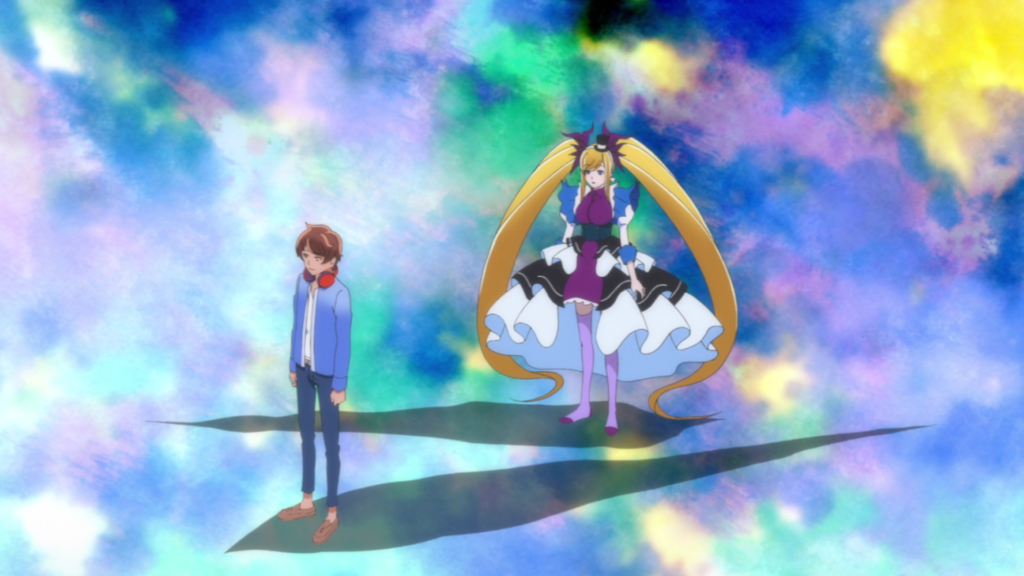
However, I find it really hard to rank it. For instance, I wonder whether I’m giving creators too much credit by assuming that the ham-fisted final was intentional. I also have to say that most of the series has very few interesting observations. It will make a funny comment about idol world here or bring up an unusual topic there, but then it just gets acknowledged and show moves on, making no impact on the way. There’s no doubt in my mind that there are plenty dream stories more worthwhile (Paprika for one). But at the very least, it’s rare to see one with “monster of the week” formula. Perhaps that is enough of a reason to check 18if out for yourself.

There's no doubt that longing for the unknown has been a major driving force in the human history, as it urged us to discover and explore. Even when the process is dangerous, the thirst for something new and grand often proves too much to care for any hazard or menace. "When your minds made up, there's no point trying to change it."
And not unlike sailors who boarded ships towards the New World back in 15th century, the characters of "Made in Abyss" can't resist the urge to get inside the titular pit which leads as far as 20 km into the ground. It boasts an unique microclimate, with fantastical plants and vicious animals, as well as the “Curse”, a mysterious illness caused by ascending within its confines. But more importantly, the depth is filled with artifacts of various characteristics which are sold to people all around the world. As such exploring the Abyss became a viable job, allowing people of all ages and backgrounds to make a living by scavenging the dangerous area for objects that could be of value.
One aspect of the unknown is that you can never know just how dangerous it really is. The Abyss is divided into layers, with first one believed to be relatively safe and a good starting point for pretty young children to practice their scavenging. But one day something unexpected happens, as during one of those training escapades, a blonde girl named Riko gets cornered by a large monster. She's all but gone, when suddenly, a mysterious stranger appears and saves her. This experience does not discourage the kid whatsoever, as she's still eager to get a higher rank and thus earn the right to delve deeper into the void.
This is pretty much the crux of this show. The abyss keeps proving to be as awful as everyone says, and then some. It's constantly portrayed as an insanely dangerous, cruel and miserable land. It's a place that no sane person should ever want to find themselves in. Yet despite all that, there are people who keep returning. Hell, some even decide to inhabit it. For all these souls, there is something the outside world can't provide them with. They have a thirst that only be quenched by this equally hazardous and fascinating land, the terrain as terrible as it is beautiful. They will stand strong in face of any misfortune and danger. Maybe that in itself is enough to be their reward. Or perhaps the real prize awaits them at the end of the journey. Who knows?
"Made in Abyss" seems to take great delight in torturing its characters, both physically and psychologically. This is done in contrast to show’s fable-like artstyle and atmosphere. They get beaten up, hurt, sick, are put in awful conditions and told terrible things. They are in constant state of terror and peril. Their victories are short lived and the dangers just line up one after another. Every misstep can cost a life, and sometimes plain bad luck is enough to end the journey in a casket (or more likely, a monster's intestines). The people molded by this crude world tend to be rough and lack sympathy, or simply forget how to express it. It may seem pointless to ask them for help, but doing so just may set you apart from those too stubborn to admit weakness, and cause a change of heart. In the world so void of earnestness, you can't help but want to get behind those who still haven't lost their spark.
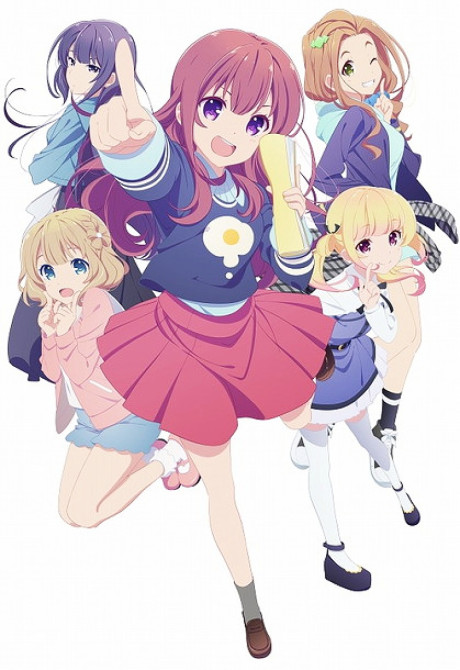
With "OreGairu", Wataru Watari has earned a lifetime spot as one of my favorite writers. His take on human relationships, sharp dialogues and wide reference-base are really all I could want from a slice of life creator. This time he ventures off from the tried and trusted formula of a high school romantic comedy and decides to instead explore the less explored teritory of the insides of anime industry.
By the way, I'm focusing on the story here, so I might spoil some themes and plot threads (while trying to obscure the particularities of course) - if you'd rather avoid that, this is your fair warning!
Meet Chitose Karasuma, a rookie voice actress whose career is having a very slow start. After playing couple of small, episodic roles, she finally lands a lead one as a result of the corporate decision to create and promote new, young stars. The other characters include her fellow cast members, rookies and veterans alike, an irresponsible producer and his assistant, the author of source material, her manager who's also her older brother and all sorts of people who work in and between the anime industry.
Quite frankly, the first few episodes were really tough to watch - in a good way. They focused on the "it's all about keeping up appearances" side of the showbusiness, letting us hear thoughts of Chitose and see how her actions actually correspond to them. But we couldn't hear thoughts of other characters, and that was just terrifying. The question "what did they mean by this?" was rushing through my head after every line and gesture.
Chitose herself is a fascinating character. She's very cynical and realistic when it comes to understanding how that industry works, what's expected of her and why she earned the opportunity she did. But at the same time she's somehow completely delusional about her own abilities and likeability, letting herself believe that things are fine and there's nothing to worry about, right until things come crashing down and it hurts inside. It's that sort of insecurity where she realises she's not the best actress and she's not that popular, but if someone suggests she's even lower than she thinks, that wrecks her. At times she appears completely oblivious to certain comments and mood changes around her, and that seems related to her complete lack of stage freight (while voice acting is done in a studio, a voice actresses life is seemingly filled mostly with promotional appearances, recording vidcasts and shooting bonus Blu-Ray content in bikinis, because anime audience amirite).
They way the story is structured is that at the beginning, it heavily centers around Chitose. Things aren't all that great, but she keeps that weird cynically-optimistic attitude of hers and we learn about the others and the industry mostly from her perspective. She overcomes her initial hurdle and things aren't looking all that bad for a moment, until she reaches a brick wall. From that moment, I honestly didn't know what to expect. For the next few episodes her arc mostly stays in place and instead we learn more about other characters, their own issues that come with their positions and we get to know them on personal level. These episodes especially reminded me of OreGairu, with issues reminiscent of those of episodic characters from that show.
Thanks to that part of the plot, we can finally identify with these characters and recognize whether they are saying something they want to or are just being polite. This serves the final thread of Chitose having to decide what to do about that brick wall she's hit, as other's opinion of herself and her situation play a big part. Overall I really like this story and while the way it presents the anime industry is certainly very cynical, there's space for some optimism, positivity and just straight up laughs.
Obligatory paragraph about the production means it's time to mention that the colors and backgrounds in this show are absolutely gorgeous (personally reminded me of The Rolling Girls). Otherwise nothing really caught my eye, neither in good nor bad way.
tl;dr Wataru Watari does it again.

Looking back on S1 of Sound! Euphonium, it didn't seem to have any overarching themes. One that comes to mind was the relationship between certain key characters and their instruments, showing how their personality and behaviour can change with a piece of brass (or wood) in their hands, but that's at least slightly far-fetched. Comparatively, S2 not only has a central theme, but also a plot building it up and then exploring. Namely - why those key characters are in the concert band, or rather, because of whom.
This is a good point to mention that I'll take some liberty with mentioning plot threads from later episodes, but I'll try to avoid spoiling particular events as much as I can.
The season starts right where we left off - the Kitauji High School Music Club has passed the first stage of the All-Japan Band Competition and continues to aim for the Nationals. In order to achieve that, additional coaches are recruited and students are putting even more focus into practicing. However, some issues from the past are rearing their heads again. The infamous "incident" that caused most of current 2nd years to quit is still finding ways to affect the band's life. Asuka continues to be an enigma, in a way that can seriously screw with people. Kumiko's relationship with her sister, which was only very briefly touched before, now proves to be its own bag of problems.
The interesting thing here is that first few episodes tell a story which centers around none of the main characters. Instead it introduces two new ones, and the entire "conflict" is between the two, whereas everyone else is only tangentially attached to it, if even that. Thus the show takes its time telling us the nature of relationship of this duo and everything around it, and by the time we know everything, the entire situation is resolved. However, once that's out of the way, four other characters simultaneously go through a very similar story. In a way, the second part of this season retells the events of the first one in more detail and on more examples, which is quite an interesting story structure in my opinion. Those branching threads share some of the particularities, while differing on other aspects. One sub-plot is about the ever-lasting conflict of club activities versus studies - truth is, most of these characters won't become musicians, so every once in a while the reality knocks on the door and asks "are you sure it's wise to practice for some competition you probably aren't going to win instead of studying for your exams?" Which in turn begs the question I've mentioned in the opening paragraph - "why are you playing in the concert band in the first place?" And I'll have you know, those answers can be quite suprising.
At this point its worth to mention that S1 adapted only one volume of the light novel series the anime is based on. S2 decides to go for two at once, which I haven't noticed in terms of the material feeling rushed or anything of that sort, but it does explain the structure of this season compared to the previous one. It seems like a good decision, although I don't know what (if anything) was omitted. Also, I have to say that it's interesting that despite looking as part of "main four" in the promotional material, there's even less Midori and Katou this season compared to the previous one, with the former being reduced to a goofball who likes to say simple cliches with completely straight face, and the latter being almost completely non-existent. Not that I'm complaining, those who were given attention are inherently much more interesting characters. Also, this shift of focus gives a nice feeling of getting closer to the characters that received more of it this season, even if this leaves others in a position of filler characters who already said their piece and can now be let go. But again, those characters were never made interesting in the first place, so it feels fully intentional and works well.
There's really nothing to say about the production of this show - KyoAni has accustomed us to high quality animation and voice acting, and I'm not the right person to explain what exactly is high quality about it. What I can commend is the directing, with some amazing atmospheric scenes and scenery shots, good use of camera shaking during emotional scenes, cuts that feel just right and great use of background music.
One thing I have to say is that the show started slightly losing me near the finish line with seemingly infinite torrent of scenes where characters loudly express their rather simple feelings towards each other, but there was enough nuance in the very last episode to leave on a high note. Additionally I have to shout out my very favorite scene of this season where Kumiko is trying to have a serious talk with Asuka, believing that her senpai for one reason or another respects her and might listen to her request even though she's been largely neglecting everyone else's concerns. However, to Kumiko's suprise, Asuka decides to challenge that notion - why does she think people respect her? Sure, you can take her behaviour as being mature, understanding, calm and collected, but you can also describe it as being wishy-washy, afraid of hurting others as well as being hurt herself and thus keeping her distance, which meant she never actually helped anyone or really had an effect on anything. While I think the intent was "why are you so sure others are honest with you", my first impression was "how can you be sure I'm being honest with you". In few sentences Asuka challenged pretty much everything the relationships in Kumiko's life are built on, which was a really scary thought, but also an interesting one. The entire conversation is definitely my favorite one in this show period and seemed like something out of an entirely different show, but it also fit really well with context of that episode and overall plot.
I wonder if we'll see a return of Sound! Euphonium. The ending seemed like something that could've been the final scene of the entire series and I would be satisfied by that, but there're easily more stories you could tell with those characters and the themes this show revolves around. I love the melancholic atmosphere this show can so effortlessly create and I have to say that I've also quickly fell in love with the setting of wind ensembles. While there seems to be a limit of how much can you do with a coming-of-age story, the good ones are quite rare so it's always great to see one executed so well. I dread the return of more light-hearted, cutesy KyoAni, but even if they never produce anything in similar vein again, I'm really happy that this series happened.

Sound! Euphonium is another series that caught me suprised. In essence, it's a show similar to Free! and K-On! in that it's a story about a high school club, produced by the famous KyoAni studio. However, compared to those two shows (which I didn't particularly enjoy), it takes some new and interesting directions which freshen up the stale formula, resulting in quite a unique series.
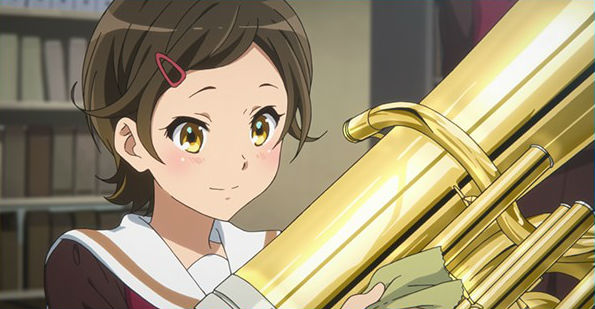
The most important part of Sound! are the characters. The series follows Kumiko Oumae, a high school freshman, who decided that she "wanted a new start" and therefore go somewhere where not many of her previous schoolmates went. Her two new friends and classmates are Midori and Katou, who are both very upbeat and friendly girls, but also the most generic moe characters in the show. However, Katou serves a certain purpose in the story and Midori is very over-the-top with her silliness and cuteness, which not only makes her a more enjoyable character, but also contrasts with how hardcore she is about playing contrabass (this is a recurring theme). Shuuichi is Kumiko’s childhood friend and a potential love interest. He's one of the few male characters and he's very bland, but his role is very minor, so it's not a big problem. The band advisor, mister Taki, is clearly passionate about the music, and is the type of person who will criticise you with a smile on his face. He has some unusual teaching methods and as a new member of the school staff he has an interesting relationship with the concert band. Furthermore, the section leaders are mostly nice and friendly, Kumiko's teacher is a strict but kind-hearted lady and various band members are mostly background characters. However, some of them get a small amount of screen time without main characters and small bits of personality, which is a nice touch that helps flesh out the world and slow down the tempo, giving the viewer breathing room without boring him.
The three most interesting characters are bass section leader Asuka, Kumiko herself and her friend Reina. Asuka is also the vice-president of the concert band club, and initially seems like a very outgoing person. She's the one talking the most to freshmen, convincing them to join the band, and later her section. She seems friendly with everyone, but also very full of herself. However, as we learn later, she’s not very reliable. Everyone wanted her to be the the president, but she didn’t want to and only agreed to be the vice-president as compromise. And she doesn’t take sides on any issue, avoids answering questions she doesn’t want to and generally refuses to take responsibility. In fact the times she seems the most honest is when she says “I don’t care”, whatever the topic is. However, she’s smart, good looking and a very good euphonium player, which makes her popular despite those vices. In fact the only time we see her upset is when she’s losing practice time due to teenage drama in the section (note - a major change of the character when with the instrument in her hands). I think she’s quite an interesting character because the longer the series goes, the more mysterious she gets - it’s very unclear what is the natural behaviour for her, and what is just a facade she keeps for whatever reason.
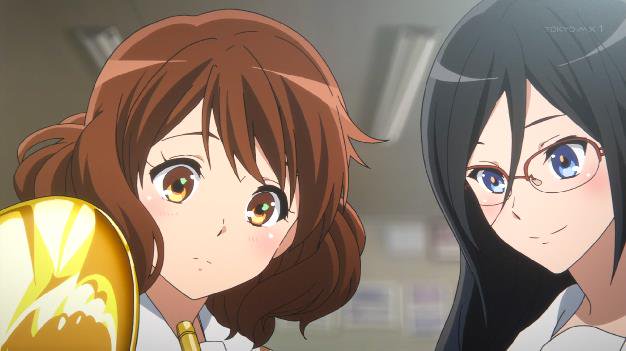
Reina is a talented and hard-working trumpet player, who previously played with Kumiko in a junior high band. On the surface, she’s polite, well-mannered and dutiful, but also distant and hard to read. However, she’s a major example of a character that is much different with the instrument in her hands. Especially because she’s very confident in her abilities, and doesn’t shy away from claiming she’s better than her seniors However, more than for any other band member, the trumpet is a mean to express herself. When band practice stops due to attitude issues, she vents by playing a fragment of Dvorak’s 9th symphony on the school grounds. When the band is nervous before a performance, she changes the atmosphere by playing a loud note on the trumpet, despite the fact they were asked not to play while waiting for their turn. She’s also notorious for practicing more than her fellow band members.
This contrast is later explained as she opens up to Kumiko and reveals her true nature - she wants to be special. She’s not interested in popularity or meeting expectations, but rather in standing out and living up to her own standard. This means not being afraid to compete against her seniors, not backing out due to peer pressure and practicing more than anyone. We also learn that she does in fact have feelings and empathy, it’s just that she holds them back from most people. And of course Kumiko becomes an exception, as it turns out she’s an opposite of Reina in certain aspects and they grow closer to each other.
What I mean by that is that Reina appears distant on the outside, but is quite passionate and caring on the inside. Meanwhile Kumiko is a nice, friendly and polite girl on the outside, but inside she doesn’t seem to care about all that much. I think it’s very interesting in how that comes out in the series. In public, with her teachers, with her bandmates and even with her new friends, she’s a very bright and modest person. Only with Schuuichi, with her sister, to some extent with Asuka and while alone is when she allows herself to either become absent or hostile towards people. Another example of her naturally distant nature is the fact she tends to space out, and it happens the more often the more she is invested in something. This is evident especially towards the end of the series as she focuses on practicing the concert piece and even her new friends start noticing that she’s becoming distant. But whenever something is bothering her, she pays very little attention to the conversations and her surroundings in general. She also has a habit of speaking her thoughts out loud, as if she forgot that there are people around her. Furthermore, her fellow section members point out that it seems like Asuka is acting a little different towards Kumiko, as if she had more respect for her than for other performers. Which is quite interesting considering that Asuka herself seems like a very distant person, and very strict in how close she lets people near herself.
But then again you can’t ignore how stressed she gets in more than few situations. At the beginning of the series she is very uncomfortable around Reina, as Kumiko is afraid that she is mad at her for a comment she made back in junior high. However, she is able to comfortably talk about the situation with others - going as far as pointing out that she doesn’t think her comment was out of line, even though it upset Reina. Later she becomes very anxious about having to compete for a spot in the main band with an older, but less experienced euphonium player (as traditionally the players were chosen by seniority), which almost makes her withdraw from the auditions. She also has hard time dealing with her childhood friend quitting the band when the practice time gets too long and starts interfering with her studies. However, in my opinion those emotions don’t necessarily contradict with her distant nature, as in all those cases it’s the fear of being pulled out of her comfort zone and drawn into a conflict that make her uneasy. If her nature is to be distant then it’s only natural that she panics when there’s a risk of being forced to deal with people.
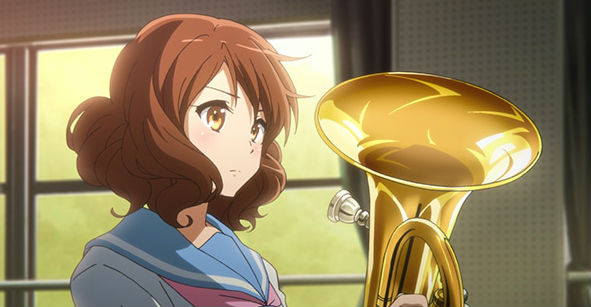
Kumiko also has a very different relationship with her instrument compared to other characters. For starters, at the beginning of the show she doesn’t even want to play euphonium and would rather try something new. The only reason she played it for so long is because it’s an unpopular instrument and her previous bands needed someone to play it, which happens again in high school as well. But as Kumiko matures, so does her relation with the instrument. First she starts to notice the urge to improve, as she pours more and more of herself into practice, even admitting that just like Reina, she also wants to be special. However, it’s only a setback that makes her realise how much she likes the instrument and how important it is to her to become good at playing it (and also how important is it in life to have something you enjoy doing). Once that happens, it seems like she is much more comfortable with showing her true character, which admittedly doesn’t result in a huge change on the outside, but subtly shows the culmination of her growth and maturing throughout the series.
Something else interesting about KyoAni productions is that they take a very holistic approach to the topics of their shows. In this case, that means showing all parts of life in a concert band - instrument maintenance, transport to the location of performance, tuning instruments, individual practice, group practice, lots of different exercises that musicians do… Overall - trying to show being a part of concert band for what it really is, instead of ignoring the “ugly” parts to make it cooler. And that approach works really well for this show, as it helps set up the nice, slow tempo and generally helps with the immersion. Simultaneously they don’t put too much attention into other parts of characters’ lives, such as their pastimes or studying, only briefly mentioning them when they are somewhat related to the band. On that note, I must also mention that I really liked that romance was a very small part of the series, and whatever we got was very vague - perhaps that’s my personal preference, but I like that the show took a fairly unique approach on that front.
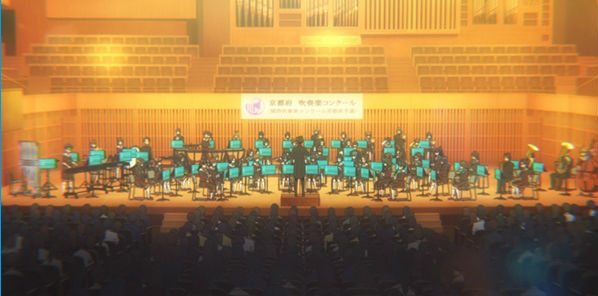
Overall I think the tempo of the show was fantastic. It tackled issues one at a time, only giving hints of what might be a next problem before the previous is resolved. It distributed information very slowly, not afraid of keeping secrets from the viewer when his focus should be on a different thread. The production (backgrounds, animation, voice acting) was flawless and while I’m not a classical music aficionado, I liked the choice of compositions performed in the show.
In my opinion Sound! is a coming of age story, more than any other KyoAni show I’ve watched. It deals with themes such as finding your identity, deciding what you want to do in life, maturing, and changing. It shows people’s paths joining, separating and crossing. Its messages are few, simple and told gracefully. Most of all, the series focuses on creating interesting characters and meaningful interactions, and I believe it succeeds at that. I’m not the best person to judge how it fairs in the endless stream of high school slice of life/drama series. But as far as the coming of age stories go, this one is fresh and unique enough to be worth recommending.