— — — —— — —
×
— —— —

Note: I have yet to read Akira because I want to purchase the complete set. Though, I have experienced some works of Katsuhiro Otomo and others who worked on Akira. Hope to keep this review a little in-depth since its my first review. Also, I won't go into the story details so it's a non-spoiler review!
A HIGHLIGHT ON MY OWN EXPERIENCE
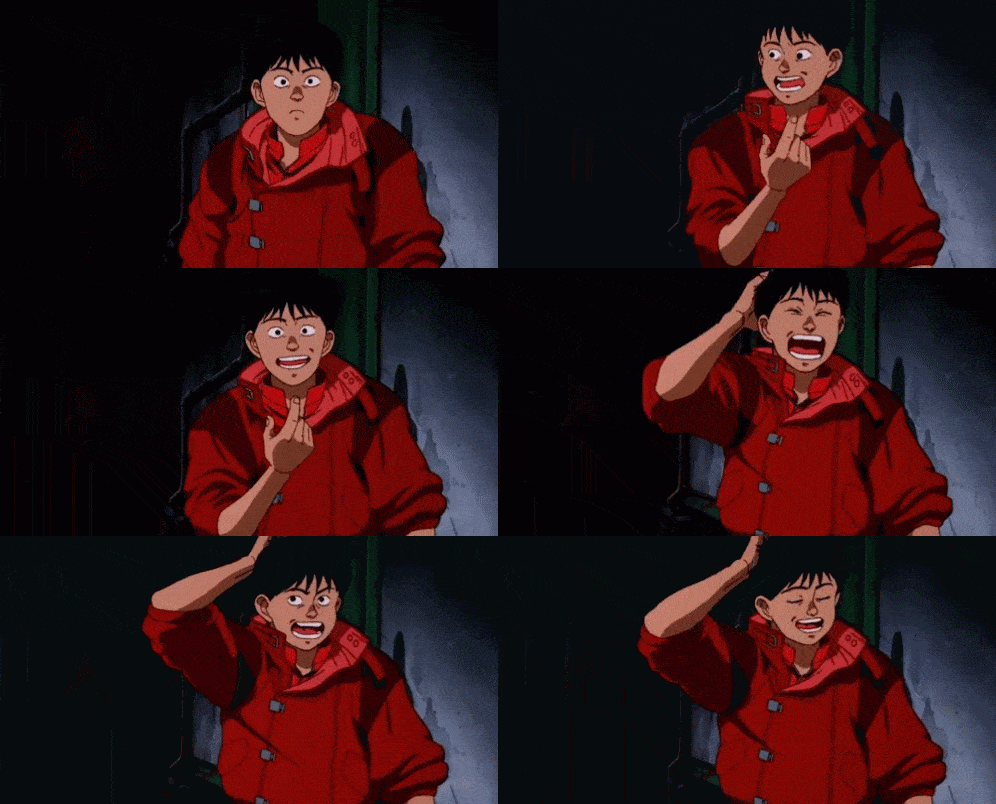
As an aspiring animation student and an admirer who was first introduced to anime through Studio Ghibli's 'My Neighbor Totoro' at a very young age in theatres, I was thrilled and encaptivated in sudden awe when I saw Akira as a teenager. I have seen it 3-4 times by now and I'm always amazed how it holds up even after 35 years!!! It is surely ahead of its time and among many reasons that compelled me to purse animation. It also inspires me to be a director like Katsuhiro Otomo.

A BROAD VIEW ON ITS SUCCESS AND IMPACT
So, when I say "it had an impact", imagine that Akira explosion in your head. KA-BOOOOOM!*
Akira was released in 1988, around this time period - Japan saw an economic growth and the rising global popularity was a perfect opportunity for its success, which established animation as a significant and profitable business. It has inspired many artists and filmmakers because of its celebrated landmark achievements. It pushed the boundaries of what was possible in hand-drawn animation. Akira had a high budget of approximately 1.1 billion yen (around $10 million USD) and was considered the most expensive animated film at that time. Therefore, it's still impactful as a ever in anime industry and the growth of Japan.

A LOVE LETTER TO ASPIRING ANIMATORS AND FILM-MAKERS
This film wouldn't have been a success if it didn't have the right people who were passionate enough to embark on this ambitious film. Let me emphasis again that this Film was all hand-drawn!! Katsuhiro Otomo drew about 783 scenes for its storyboard, apart from just taking from his own manga. Ultimately, around 2,122 shots with level of detail and intricacy in every frame. The animators paid close attention to every aspect of the animation, from the movement of the characters to the smallest details of the background art. The animation is fluid and dynamic, with a sense of energy and intensity that is rarely matched in any medium. Incredible use of color and light featuring a vivid and striking color palette, with bold hues and intense contrasts that add to the dystopian atmosphere. The animators also used lighting and shading to great effect, creating a sense of depth and texture that enhances the film's visual impact. The film features a range of dynamic action sequences, including motorcycle chases, gunfights, and explosions, and each of these scenes is expertly choreographed and animated. They took lot of inspirations from real world to make it look realistic. The film's use of motion and movement helps to create a sense of visceral excitement and tension, and it is one of the key reasons why the film remains so popular among fans of anime and action movies. The attention to detail and realism creates a sense of immersion.

MY FINAL THOUGHTS ON AKIRA
What Akira has achieved in animation is just truly remarkable! The film's attention to detail, fluidity of movement, use of color and lighting, and commitment to realism all combine to create a work of animation that is both technically impressive and emotionally resonant. Akira remains a benchmark even for today's animation standards, and it continues to inspire me. TBH, Akira is an almost 10/10 but I can see how Akira might be psychologically dark or confusing at first and also, no such thing is perfect because there is always some room for improvement like a few human mistakes while making the art. Animation is Hard.

