— — — —— — —
×
— —— —

If I had to choose a shonen among dragonball z, naruto, one piece or full metal alchemist, I would choose the last option because it is simply much better (although I admit that I also like dragon balll, especially the first part).
Edward and Alphonse Elric are two brothers determined by the abandonment of their father and the death of their mother, which they tried to reverse with alchemy. In an attempt to revive their mother, the Elric brothers break the most important rule of alchemy: human transmutation. Using alchemy as a weapon is a dangerous thing, since it is a magic that charges each act with an equivalent energy level or matter. As a consequence of her daring, Alphonse sees her body fade away. Her brother Edward, who has lost his left leg, also sacrifices his right arm to save his brother's soul and seal it in iron armor. Thus begins his search for the philosophical stone, the only thing that can help him recover some of what they have lost.
The series does not need more than its psychological maturity to capture and be exciting. Apply the very principle of alchemy in the script.
Each plot and obstacle they face ends up being reflected and has a reason to be in its protagonists.
Cryin’ won't pave a way to forgiveness
Every sin you carve is ever lasting
I’m lost in this maze of emotion
Who am I waiting for?
Again- Full Metal Alchemist opening
Fullmetal Alchemist is both a manga and an anime acclaimed by the public and I have no doubts about its round story, or the charm of its characters, but despite that it has things that frustrate me a lot.
I can't hate FullMetal Alchemist but it really annoys me when they force scenes to no avail or when they lengthen and add unnecessary stresses in situations that are irelevant because of their predictability.
Certain deaths are expected, but there are plot changes that are intended to make some surprising changes that lose their effect because of how basic and boring they are such as the alleged death of Maria Ross.
Beyond all the helplessness it can generate, I must admit that in addition to its soundtrack, the games between ethics and morals on which the series is based are excellent.
Also sinning stereotypes and very basic plot forms in shonen, the anime poses much deeper dichotomies and reflections than we might expect regarding a series of these characteristics and with its supposed type of audience.

Let's talk about Evagelion, one of the best works of Japanese animation. They do not believe me? Even the Japanese Ministry of Education, Culture, Sports, Science and Technology confirmed in 2007, through public surveys, that this series has been chosen as the best anime of all time. Few series can cause a stir more than twenty years after their premiere and this is the case of Neon Genesis Evangelion.
A cult anime that was born from the mind of Hideaki Anno when he was in a depressive well, perhaps that's why many of us identify with various characters haha
Neon Genesis Evangelion is a science fiction series of a post-apocalyptic future, a fragmented world that licks its own wounds, just like each of its characters, who fight for a tomorrow and for their own happiness. It is a series of action and adventures of great psychological weight in which each character saves a space to be occupied by the viewer, and thus present a change. What exactly is happiness and human strength to live? Or more interesting still, what is the individual compared to the rest? Why do people feel the need to bond with each other even despite the damage and destruction they inflict?
In the first chapters one gets bored thinking that it is a common and ordinary wick without any sense, but as the story progresses, a totally new world is created that makes you change your mind. Not only is the physical action of the Eva fighting against the Angels captivating but also the psychological question behind it. Are the Eva alive or are they zombies? Are angels aliens or really disciples of God? Who is and what is God?
Something I always like to talk about is the psychic complexity of its characters; as someone said, "in Evangelion everyone is totally crazy". There is not a single character that does not have some kind of obsession, complex, trauma or morbid fixation, which gives them a wealth that no character in the anime had before.
The plot is very elaborate, with exceptional documentation and fantastic Biblical references. So many stories arise, so many reflections and dilemmas of the human race.
Many love it but also many hate it and perhaps it is because of its strange ending that today leaves many in doubt of WHAT THE FUCK HAPPENED HERE AND WHY EVERYONE BECOME ORANGE JUICE?
Toussaint Egan in Paste Magazine says: Perhaps one of the most nihilistic, edgy, and devastating endings of an anime series ...
But its story is not the only good thing, the soundtrack is excellent.
let's start with its opening, Cruel Angel´s Thesis
IS AMAZING but his ending is not far behind, the series gives us a beautiful cover of fly me to the moon originally composed and written by Bart Howard
His soundtrack is so wonderful that even the Japanese military band performed it at the JSDF Marching Festival 2017
From head to toe, wherever you look at this anime is a work of art.

There is no place to hide. Wherever you go everyone is connected.
I was talking to a user who has failed to understand Serial Experiments Lain. It is a complex series and that everyone can understand it from different points.
It touches controversial issues like reality, identity, the collective unconscious, or mental problems such as dissociative identity disorder. Philosophical themes with high degrees of abstraction such as pure existentialism are also discussed, adding theological elements such as the existence and composition of "God". The content of the series ends up being implicit in the introspection itself that forces you to make, added to that, a plot is generated that seems immobile when in fact it is the opposite.
It is for these reasons that I consider it a completely rich, diverse, and interesting audiovisual material, but at the same time complicated, since it is not for everyone because of its complexity, it requires a concentration that does not allow you to distract yourself with what is merely explicit.
A fundamental aspect for the development of the plot in "Serial Experiments Lain" is the constant use of puns, close-ups, and silences of the series. For example "Lain" sounds similar to "Line" but it is pronounced differently: "Lain" is pronounced "Lein" and "Line" is pronounced "Lain", making explicit reference to "being on the Line". In the first chapter, whose name is "Strange", reference is made to rare and unusual events. Interestingly, "Weird" bears some resemblance to the term "Wired", which translates to "red". Therefore, we deduce that all the "strange" events that occur are directly related to the network ("wired"). All the chapters are called "Layer", referring to all the stages that our protagonist has to go through to get to the bottom of the matter.
At Serial Experiments Lain we follow in the footsteps of Lain Iwakura, a Japanese teenager who lives in a Tokyo between the futuristic and the contemporary in which technology, and more specifically computers and the Internet, are an indispensable part of the life of the entire society. Lain is an introverted and reserved girl, with evident socialization problems both with the outside world and with her family, and even with herself. One day, both Lain and several of his high school classmates receive an email from Chisa, another of the students. Until now everything was normal if it wasn't for Chisa having committed suicide and in the message she talks about her death as a transitional step to abandon "her flesh" to break her ties with the earthly world and be with God in the new world that it is part of the network. After the enigmatic event, Lain installs a new Navi, a state-of-the-art computer, backed by her father, who believes that technology can help his daughter end her social problems and be a little happier and more complete. Lain begins to use the Navi more and more, relentlessly delving into a whirlwind of technology, hackers, secret groups, conspiracies, places, and people of dubious recommendation with the aim of to unravel the mysteries surrounding the death of Chisa and its enigmatic warning from beyond.
From the first moment, this anime takes a basic premise of Socratic theories: know yourself. In this series we constantly change who we are, both for ourselves, for society, the world, or even for the time. This is a fundamental premise, since only when we know ourselves can we understand the rest of the things that surround us and that are part of reality. Lain shows us that there are several "I's", and that they do not depend only on us, since each person or environment with which we interact has a different perception of the ego that we know. That is, at the same time that there is a self in your head with characteristics and a way of being that you know and understand, there are a multitude of diverse beings who do not depend on you, but on the vision that the rest of society has of you. A way of complicating things that, however, is inevitable, since the human being cannot live far from society, he is part of it and the form at the same time that it shapes it. And at this point, the Internet, the network, comes into play, a possibility of staying permanently connected with other people and apparently freeing us from the difficulties we always encounter.
The network becomes the representation of another of the Platonic theories, which is the existence of a supersensitive world, a world of pure ideas and full freedom that is linked to the paradise governed by God. A higher level that can only be accessed by renouncing "the meat" and living entirely by and for the cyber environment, a suicide that in Lain has two ways of representing itself, both in a real way, with the suicide of Chisa or with Lain's True Social Isolation. This is directly connected with the idea of whether the soul exists or not, and if the human being is the body and soul together, and they cannot exist separately, or if the body is only a wrapper for that set of unknown things that we do who we are.
In short, Lain talks about approaches to existence, about what makes things real.
I don't know if I was helpful, sorry. I express myself better speaking than writing haha
You can find many reviews and explanations online, even when I wrote this some opinions helped me.
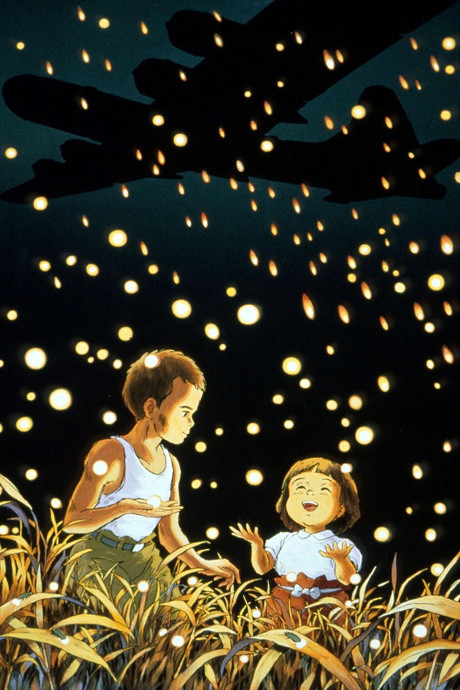
"September 21, 1945 ... that was the night I died."
This is how this movie begins, with a few words your skin bristles and sadness increases.
There is probably no sadder story than The Grave of the Fireflies (Hotaru no Haka). Even if you are looking for something that compares you will not find it. The film is based on the author's story Akiyuki Nosaka published in 1967, which, in turn, is based on Nosaka's own experiences during the war. He confessed that The Grave of the Fireflies is a "lie" (fiction) and that he was not as kind to his sister as Seita was to her. The Japanese author, in fact, blames himself for his death; In one of his autobiographies, he confessed that he ate the food he should have shared, that he hit Seita's head to stop her from crying, and that he wrote The Grave of the Fireflies to honor his little sister and face the tremendous feeling of guilt that he had as a survivor.
This movie is generally seen as an anti-war story, however Isao Takahata has denied it. According to his words, it is about the isolation of the two brothers and empathy towards youth. If it were against the war, many would think that war can only be avoided by showing the misfortunes caused, but the director does not think so.
Don't expect a happy ending movie because it's not.
from the first minute to the end you suffer.
the animation? it's excellent.
the plot? devastating.
This story, unlike American movies, doesn't show Japan's war side, a feature I like to highlight.
It is undoubtedly one of the saddest movies out there, but knowing that it has a real side is even more devastating. Wars have killed many innocents, including children.
The real events behind the film are the Kobe bombings.
I consider this film as a true masterpiece.
The feelings of the protagonists are transmitted perfectly, causing devastation, helplessness, pain, hatred and nostalgia.
The war leads Seita and Setsuko to create an autonomous world far from reality. One without electricity and full of black rains (the rains after nuclear bombs). And so the title; Like fireflies, the world that Seita and her sister Setsuko created is destined to shine and die.
It is certainly a work that collapses the belief that animated cinema is only for children.

I would like to talk about Naruto as a great anime that I would recommend, but unfortunately it is not. It tells the story of a teenage ninja named Naruto Uzumaki, who aspires to become Hokage, leader of his village, with the purpose of being recognized as someone important within the village and among his companions. Counting it this way it sounds good and interesting but all the good things in this story remain in the manga.
As a child I can admit that I wanted to be a ninja like Naruto but the reality is that I was 6 years old but actually I do not understand how this anime for children under 14 years of age has been so famous in people from 16 to 20.
I never understood the fanaticism that there is with this series. Naruto is a fairly common story in anime, where there are things that repeat over and over again.
It really bothers me that shônen anime girls are generally the worst characters of all. For example, Sakura, she is a really good character but every once hated her because in the anime is so useless. Well honestly this anime is painful... But the soundtrack it has is not bad, it often helps in bad chapters and becomes iconic.
Naruto's biggest mistakes are made by anime. Basically it is the same story of self-improvement that we have already been told thousands of times in almost all shonen but this time with ninjas. The bows constantly transform into boring and repetitive loops. It's full of cliche characters
What is the real need to dedicate five chapters to a battle where only the eyes are focused?
Sometimes the game of identifying Naruto with successive characters is abused in the same situation as a child disowned by his people or abandoned by his parents who feels deep pain that is difficult to bear and his subsequent "rehabilitation" after meeting with the boy.
After finishing the story of the manga there are almost 100 chapters of pure filling with absurd and boring stories. No matter how fan you are of the series, you will end up hating the filler. But there is no harm that for good does not come, since absolutely nothing happens in the filler, all you have to do is skip it and go directly to the second part of the story: Naruto Shippuuden, but although one thinks that the second part is better, sadly it is a very big mistake.
