— — — —— — —
×
— —— —
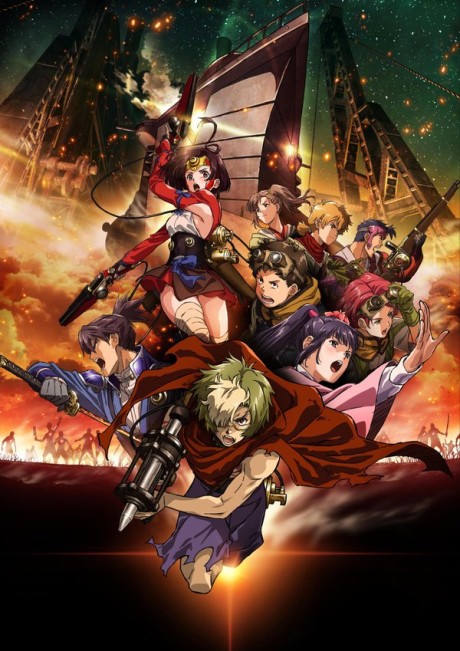
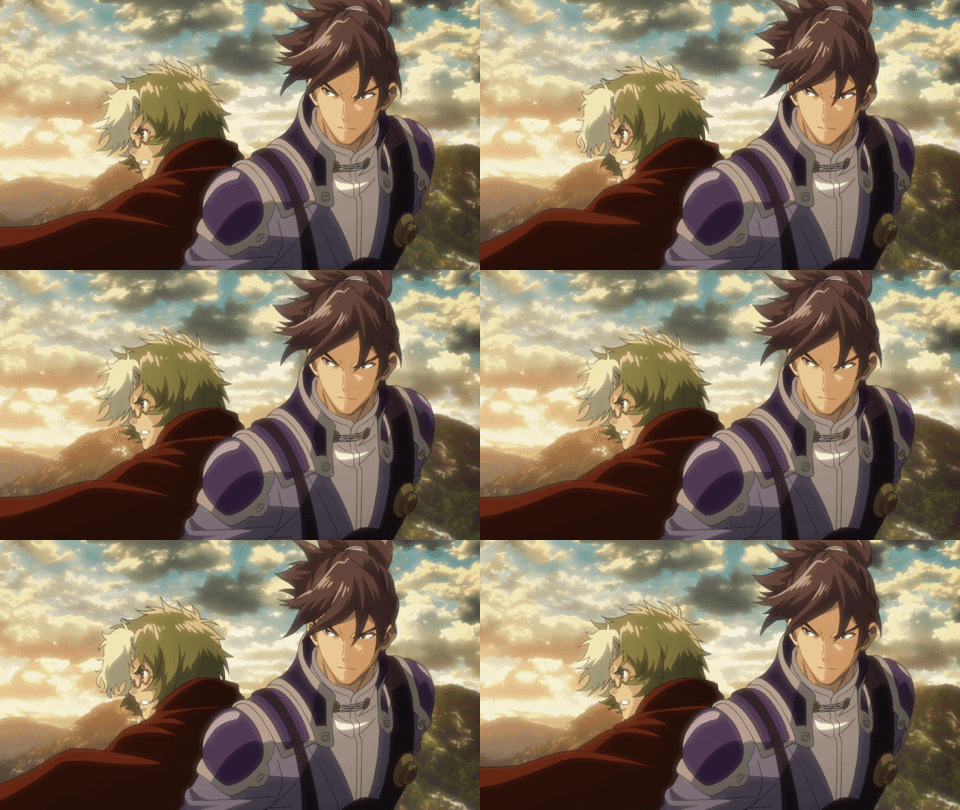
When I initially read the summary of this anime, I was more than willing to give it a shot because it was directed by Tetsurō Araki, who also was a director for Attack on Titan. The entire premise of the show centers around the Kabane, a species of zombie-like creatures that exist to reign terror on the people of Hinomoto. Those on Hinomoto are surrounded by a giant wall to protect themselves, but the only way to access what lies beyond the wall is by train. Said train is armored with steel and was made purely to transport large numbers of people to Hinomoto. The fight against the Kabane was largely futile, as the weapons (steam-powered rifles) were not effective against them. The only way to kill a Kabane is by piercing through their hardened heart. If a Kabane bites a human, [they] will become one, which allowed for the number of Kabane to increase exponentially. My hopes were high, so I dived right in, expecting the same greatness that came from one of the hottest mainstream anime. But what began as pure excitement soon crashed and burned.
I actually quite enjoyed the first few episodes. They certainly had a familiar feeling/pacing, akin to Attack on Titan, which was what I had expecting. Ikoma, the main character, is the typical "chosen one" type character: righteous and fueled by pain from the past. Essentially, he creates a weapon that is able to pierce through a Kabane's heart. The twist: Ikoma himself becomes a Kabaneri, a hybrid of human and Kabane when he is bitten by one. He teams up with Mumei, another Kabaneri with a tragic past (which will be briefly discussed later) to fight again the Kabane. Together, they are extremely strong on the battlefield. Mumei possesses inhuman agility, allowing for her to kill the Kabane at an impossible rate. Ikoma's new weapon, paired with his resistance to the bite of the Kabane, makes him a priceless resource as well. Over time, they grow quite a close bond with each other, sharing experiences no other human could possibly understand.
Despite their utility value, I found myself having a bit of a hard time connecting with both of them. I wanted to understand and empathize with Ikoma, but I just couldn't. I found that his lack of depth and development hindered me from really garnering a ton of affection for him. He seemed to be the same character at the beginning and end of the show. Sure, he was "the chosen one", but I could find that in literally every other show like this. There wasn't much for me to latch onto.
In terms of Mumei, I found her story to be a bit more interesting. Her motivations for becoming a Kabaneri are far more nuanced and in part that is due to the presence of choice. She chose to become a Kabaneri, but Ikoma did not. She is a total badass on the battlefield but also has genuine emotions, a rarity in anime in this genre. In other words, I loved that her femininity was not demonized or erased. However, Mumei also was a bit rough around the edges. Her bursts of immaturity were not well set up beyond the trope of infantilization ("Oh, she's just a kid, she doesn't know better") which I found lazy. Sure, of course, kids mess up and make the wrong decisions, but as the show progressed, it just seemed random. Mumei was set up to be this kickass character, but her flaws seemed almost out of the blue and appeared only for convenience purposes. I wanted her flaws to be natural, but they seemed a bit forced. (My thoughts on Mumei are all pre-arrival of Biba --> post-Biba thoughts follow).
In terms of story, I thought the plot was going to be a lot more interesting than it actually ended up being. The threat of the Kabane could've been so, so cool. But the plot seemed to not dive too much beyond "Kabane evil, humans good." This gets thrown for a bit of a loop through Mumei and Biba Amatori (notorious Kabane hunter whose intentions lie far beyond the destruction of the Kabane; Mumei calls him "Brother"), with "the weak die and the strong survive" discussion, but there's honestly not much nuance beyond the surface level. I wish they had done more with this philosophy because Biba's influence is what makes Mumei more of an interesting character. I don't know if brainwashing is the word I want to use, but I think it's close to it. Biba's indoctrination leaves Mumei conflicted and if I had gotten more of that, it would've made the show a lot stronger. But that fire ended as soon as it began.
My final thoughts are this: this show had a lot of potential, but it was wasted. This could've been due to the lack of air time/seasons, but even with the small number of episodes, there was plenty of room to expand on characters and story. The characters were undeveloped and the plotline itself was pretty surface-level. If there was to be a second season, I may give it a chance to see if there was anything added, but it would be unlikely. I enjoyed some of the action scenes, as those were actually done pretty well and drove the story somewhat. Overall, Kabaneri of the Iron Fortress was not what it could've been.
TL;DR
