— — — —— — —
×
— —— —

Around four or so years ago, I first picked up the Chainsaw Man manga, diving into a vivid world of calamity and crass. And yet the Bomb Devil arc lingered in my thoughts in the later months and years, what made this 14-chapter story so wrenchingly captivating? I love this arc, I love Reze as a character and a symbol of many things, I appreciate Tatsuki Fujimoto breaking down the psyche forcing me to look at myself in this story through the lens of Reze and Denji. Walking into the theater, I held relatively lofty standards after the first season. As disjointed early Chainsaw Man was and the 5/10 rating I gave it, I acknowledged the mere potential that Studio MAPPA could reach. Upon leaving, I quietly questioned my standards because what did I truly expect? Simply blown away. Filmmaking teetering on the edge of fervent perfection. Expressions that gave me chills as if the film were reading my very thoughts. Chainsaw Man – The Movie: Reze Arc only reaffirms me of the best Chainsaw Man has ever offered.
I’ll discuss my interpretations and thoughts of specific parts of the movie here on out. I do apologise if the following sections are more disjointed than desired, just restating my raw thoughts to text.
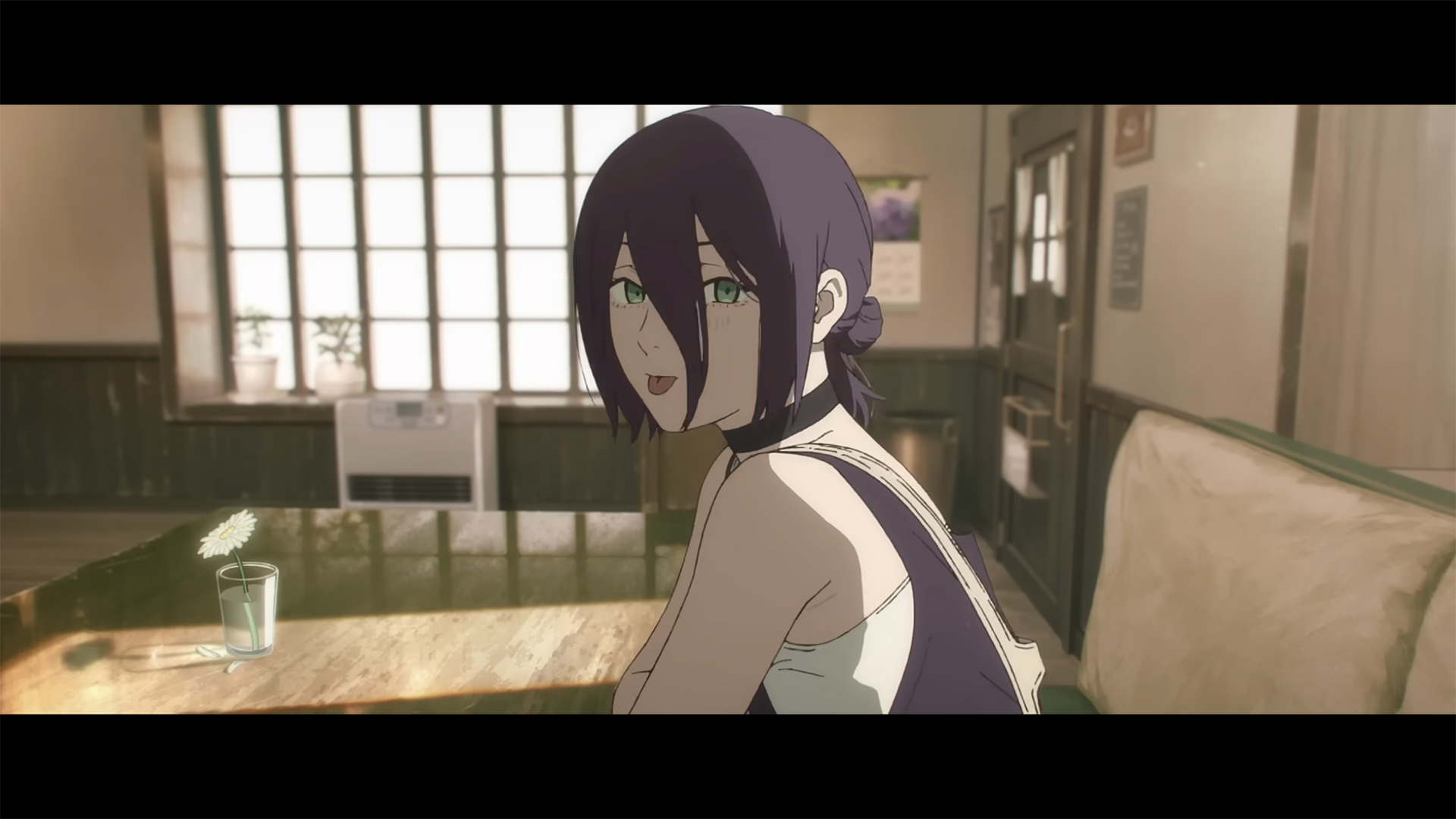
I watched this movie in 3D and can only express my satisfaction with the immersion provided to non-action scenes. There is an intimate feeling of depth when it comes to non-verbal communication which is utilized tremendously. The action scenes are stellar to be expected of Studio MAPPA, considering the already existing usage of drawing perception and depth. Reze’s characterization explodes across the screen with how she draws in the viewers with her bubbly personality, movements, and gaze. I geek out when I see clever camera shots and character head tilts, Reze in her contrasting display to Denji’s elementary nature is constantly gravitating the viewer to her. When Reze first appears, we can’t see her eyes - driving this mysterious and dividing aura alluding to the proverbs “The eyes are the window to the soul” and “There’s more than meets the eye”.
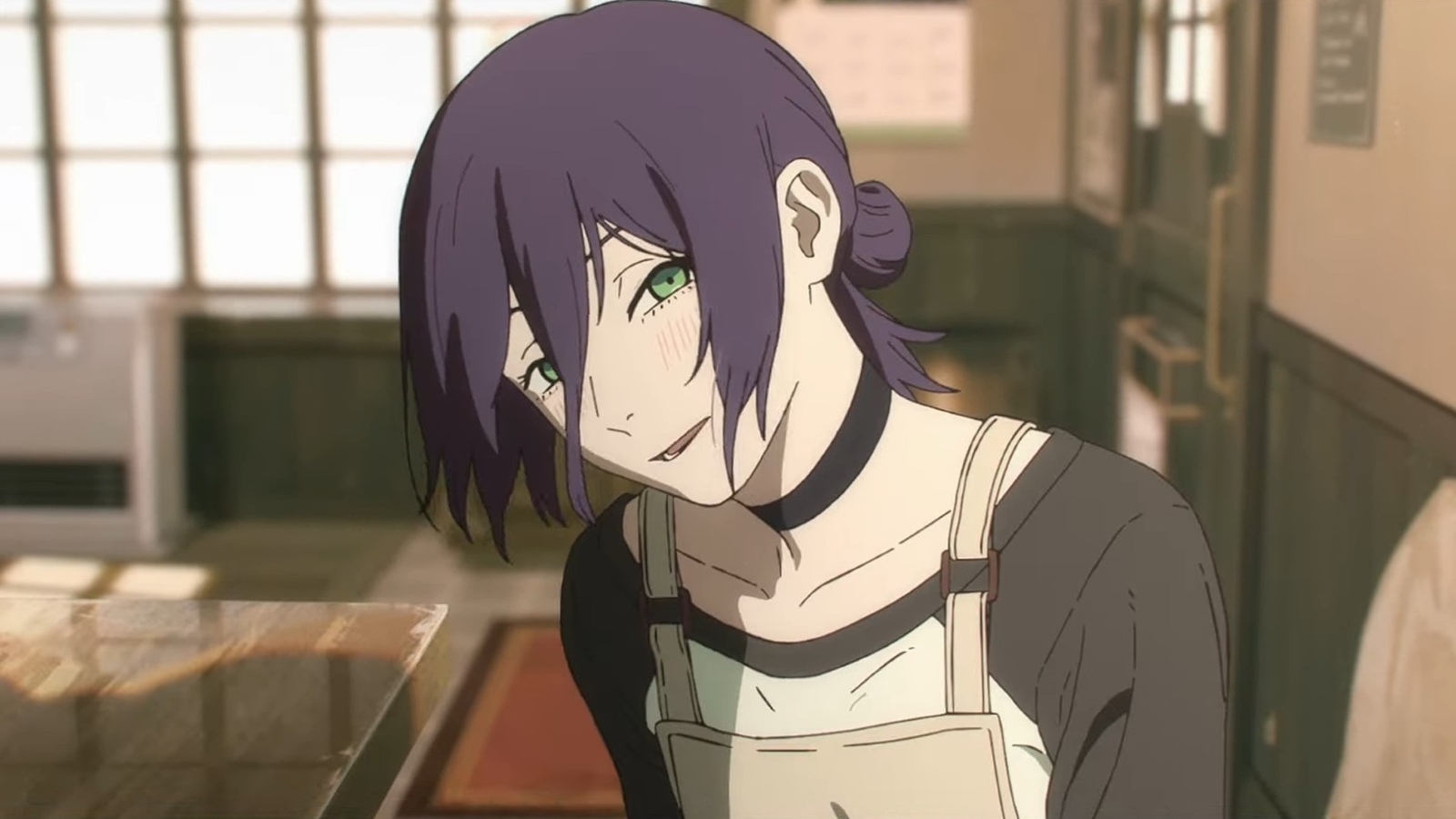
As we get more screentime with Reze, the viewers get a glance of her eyes. Striking and imposing with innocence, harboring unease and unfamiliarity in combination with her head tilts. Those little movements subtly feeding into our gravitation to her, it’s bewitching in many scenes of the first half has the viewer in eye level with her. Reze’s green eyes pull you in with an inability to read her nonverbal cues as if something is idling with intention. Her eye colour is the rarest type occurring naturally in 2% of the population, which only represents this stroke of romantic luck for Denji’s life to this point. Bittersweet as that is.
I love Kensuke Ushio’s ambient works, Ping Pong the animation, Liz and the Blue Bird, Heike Monogatari – and I know I must get around to watching A Silent Voice and Devilman Crybaby one day. Somber pianos, soft electronic beats, and into techno and metal, the soundtrack practically screams hold on to the seat. Within an hour and 45 minutes, the soundtrack almost makes me feel like I’ve lived another life, bursting with raging, contemplative, and mournful subtleties.
The Makima Date is a funny part that I found decently compelling concerning the meta commentary. Particularly when Denji and Makima are crying at the “boring” movie and Denji comments, “That scene isn’t even that important.”. I will forget the fight scenes after a while; however, I won’t forget moments like Reze’s gazes.
I can’t talk about this movie and disregard the influence of the pool scene. The absolute most enthralling scene of the film is in its depiction of unsullied purity, youth, and human connection. Reze strips off with little hesitation, on the other hand, Denji is reluctant because he cannot swim and his growing affection for her. Denji’s reluctance shows in this moment he is the personification of the country mouse and not the town mouse he claims to be. Time and time again, Denji is reluctant to take the next step because he is afraid of losing the luxuries of the town life.
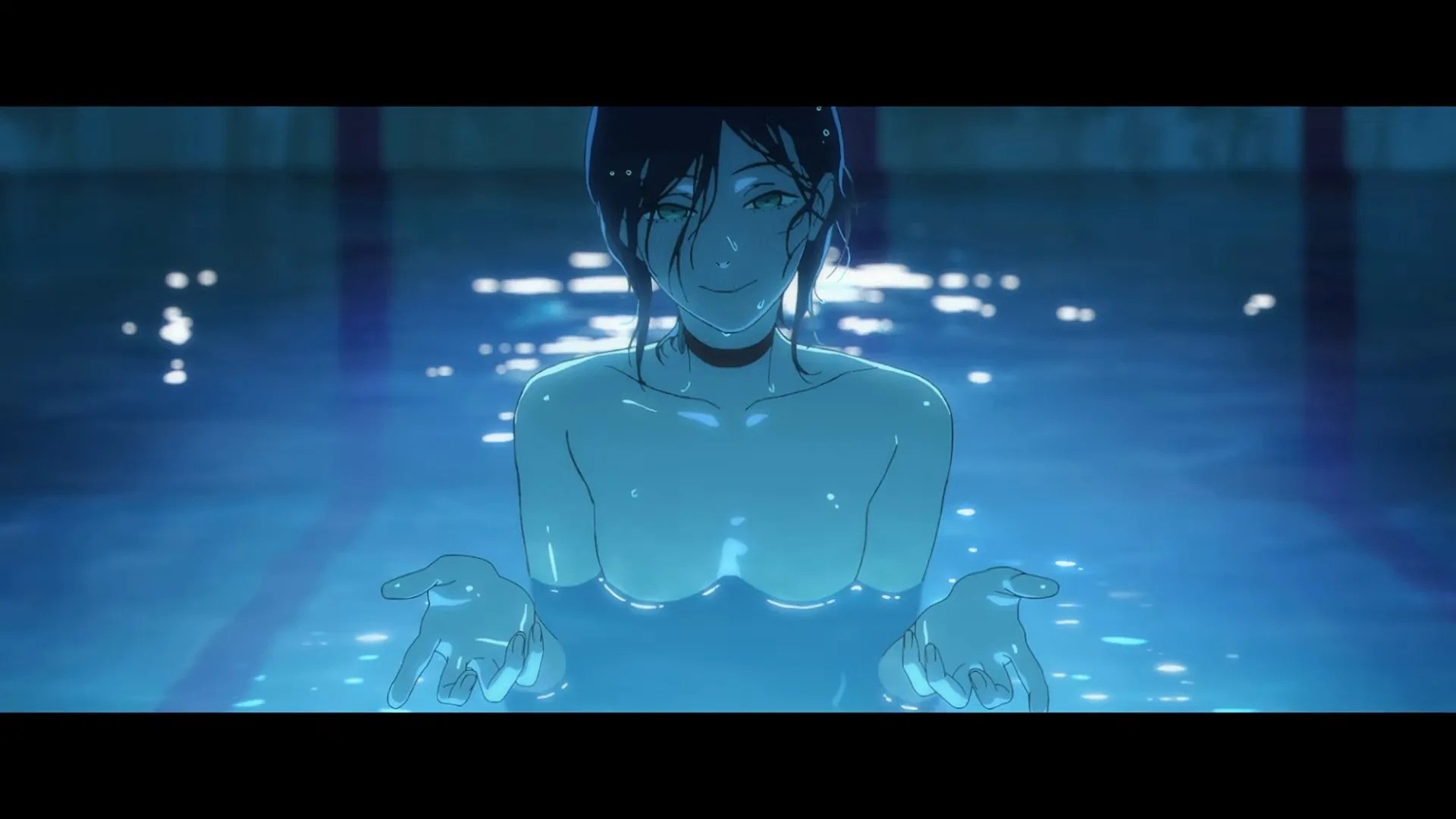
Denji does strip down and join Reze in the pool into a montage that is artistically crass and unbecomingly normal. This short portion of the film is so symbolic of the escapism that encroaches the story of Chainsaw Man. This scene puts two not so human youths into a moment of validation, affirmation, and connection that is their most human moment of their lives. And yet in typical Fujimoto mannerisms (Everyone must suffer), they cannot have that because they are star-crossed lovers whose circumstances prevent them from being truly human.

I really enjoyed the mood shifts keeping the viewers balanced between crude comedy and discomforting thrillers particularly when Reze is attacked in the school. Reze dropping a bombshell to viewers when she kills the assassin and begins singing in Russian - then panes to a plane flying over, following a rain droplet falling onto her eye with a bomb drop sound effect is a spectacular way to allude to her identity.

Clearly Reze is the centerpiece of the film, but she absolutely captivates considering her lasting influence on the series and the viewers. Despite her short cameo in the series, her character symbolizes a great extent of overarching sentiments in the desires of belonging, love, and intimacy. Reina Ueda was fantastic in the Japanese version with her unique timbre, expressing everything from purity and youthfulness to uncouthness, vulgarity, and suffering. Reze in simplest terms was the perfect yin to Denji’s yang. Even throughout her transition from lover to tragic enemy, the film retains hope (a huge part of Reze) because truthfully neither one desires to kill the other.
The beach scene following their final battle calls back to the pool scene, albeit with a difference, the chains holding their embrace, a cruel unsustainable love. Through all of this, Reze once claimed she preferred to be the country mouse, despite her insistence on Denji to do more and escape with him, she is afraid because of her tragic reality. It’s almost cruel walking out of the theater subsequently hearing Reze say that she had never gone to school either on her deathbed, being forced into the role of the town mouse because of her human experiment past.
Chainsaw Man – The Movie: Reze Arc tugs so heavily at empathetic natures, we must question ourselves of the town mouse and the country mouse. These moral conclusions must be suspected because experience is complex and subjective. Choice is not a guarantee, and we may have to be the town mouse to become the country mouse. It’s just in our nature to want more. So, what do I take away from the film? Mostly just reminders of the constant questions we hold about anything. What hurts more? An absence of something or losing that something. Living with complacency versus the sorrowing possibilities that come with pursuing more in life. It isn't perfect, but I think it's perfectly imperfect.
I thank you, Tatsuki Fujimoto, Tatsuya Yoshihara, Kensuke Ushio, etc for giving me another reason to think a little harder today.
