— — — —— — —
×
— —— —

This review will contain spoilers.
I don't remember how old I was when I first watched this movie. Maybe it was during the lockdown, maybe it was a bit after or before, I really don't know. Which is strange, considering that I can't remember how I was before watching it. It's almost like I've always watched it, ever since I was born, at it has been engraved in my soul ever since.
There's not much more than can be said about A Silent Voice that hasn't been stated before multiple times. Boy bullies deaf girl, boy regrets later and tries to reconcile with girl. And it's as beautiful, as touching and as vulnerable as everyone says it is.
There's something that invokes such a fragile feeling in me while watching this; maybe its the animation that almost feel like a sentient canvas, flowing seamlessly on the screen. Maybe it's how the story corporates guilt in its most primal and devastating way possible, maybe its how the soundtrack translates all of that into a simple piano. Maybe it's how this movie is looking directly at me, staring into my very being and talking with me. But before I talk about that, I have to talk about everything else.
At first glance, the selling point is undoubtedly the animation. Kyoto Animations put so much care in what they do that their drawings make you feel everything. I'm not specifically talking about the emotional feel, rather just the physical feel. You can feel the heat, you can feel the rain, you can feel the breeze, something even live-action movies very rarely achieve. But you can also feel the guilt, you can also feel the shame, the yearn. You can feel the desperation, be it from Shoya's mom when she finds out he wants to kill himself, from Shoya himself trying to make up for Nishimiya, from herself trying so hard "not to be a burden", from Ueno trying to go back to how things were, not only thanks to the overall beauty of the drawings, but the art directing as well. In that aspect I have to give huge props to the directing and voice acting as well.
Miyu Irino as Shoya is exceptional: he hits every scream, every sob, his tone is perfect. Again, you can feel everything, even if it's left unsaid. Saori Hayami, as Shoko, is a much subtler performance, but that almost makes her even more impressive. Expressing as much emotion as the other characters while mimicking the dialogue of a girl with impaired hearing is surreal. All voice actors come together to give life to their character's words, their wishes, themselves, all alongside the directing which man, its so good. Like for real, it's bizarre. I've never seen camerawork (we're talking about an animation here) that manages to express so well anxiety. How the camera pans to the ground when we're in Shoya's pov is so amazing. And the "X"s. Yoshitoki, you are a genius. It's so simple but work so, so well.
And finally, the story and the music. This is an unique movie where I feel like I can't talk about one without simultaneously discussing the other. As I said, boy bullies girl and wants to make up for it. But here's the thing: boy thinks there's no escape. He feels like he has sinned so greatly, his entire life will serve as punishment. He thinks himself as repugnant, a villain. Shoyo cannot let go of the past, he cannot let go of his actions and therefore, he cannot grow, something he desperately needs. He feels he has stripped Shoko of something so important, that he must strip himself of the most important thing he has: his life. He is missing something in himself, that love. That's when the soundtrack comes into play as well.
This soundtrack is a dialogue. It speaks with you, it is complementary. It is the exclamation point at the end of the sentence, it's the final stroke of the pen before the end of the sentence. Not only does it obviously set the tone with happy music during happy scene, but it elevates it to another level. Like how inv(l.i) leads the scene with each note, how acc gives that feeling of freshness among the other depressing tracks just like the scene it's played over, how van (personal favorite) perfectly incapsulates that serenity of proximity, the surprise of intimacy; the feeling when what you thought you hurt the most tells you "thank you". And how the start and the end of the movie play the same song, but the start is incomplete; Shoya has not completed his own song, and it is only when he finally looks everyone in the eye, he finishes it, and that's when lit(var) is born.
All I said before had to be discussed, because they are all the pillars of the story. Even the plot itself works as a pillar to something greater. A plot filled with sadness and light. Shoya and Shoko are both tormented by their pasts, by their actions. One cannot forget what he has done, and blames himself for all unfortunates that have happened to him, the other blames herself being a burden, since others cannot comprehend her, neither can she. Both blame themselves for existing, both want to die, both want the other to live. Suicide is selfish. You are sending your pain to others. You cannot find a way out, no matter what you do. But you are so, so important. You can only think yourself as a burden when you still have love and compassion within you. You cannot exist alone, that is something both our characters find out. Shoya can make up to Shoko by just existing next to her, being a source of warmth. Shoko can make up to everyone by realizing she doesn't need to do so. They don't need to blame themselves for all eternity. They have grown. They can forgive themselves now. That is the main message I got: everyone will grow. Everyone will change. You can forgive yourself.
I feel like this movie was made for me. I know it wasn't but still. It speaks with me in a language I thought only I spoke. It welcomes you with open arms to the vulnerability of it all, to all the beauty and pain, and to all the change. This movie has affected me in ways I cannot comprehend myself. I disintegrate whenever I watch it because maybe, my suffering can be as meaningful and as beautiful and as grotesque as this. Maybe I can change too. "I want to fix what I destroyed". "It's the time you spend trying to change that matters". "I want you to help me live". These words resonate with me to a molecular level. It is enchanting, bewitching. And warm, so warm. Watch it.
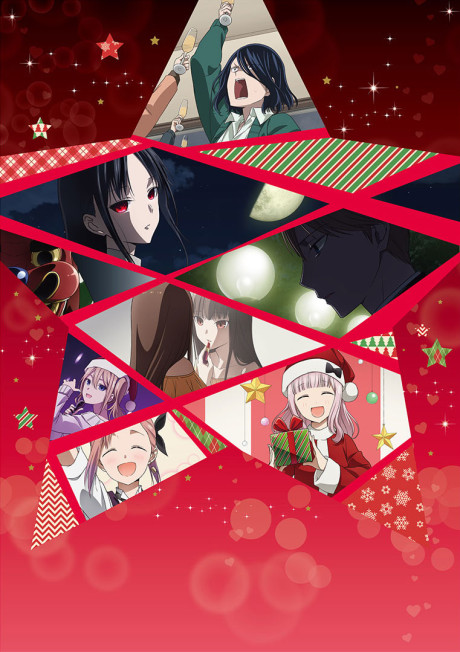
This review will mostly focus on Shirogane's and Kaguya's relationship throughout the story and during this season, how it connects to the story, themselves, and to me. Also sorry for the length lol
To get this out of the way, I'll already point out that this series is perfect in the directing department; the people that made this knew exactly what they were doing. The most visually creative show ever since Monogatari for me. With that out of the way, let's begin.
Kaguya-Sama: Love is War is a story about love. There's no argument to be had there, it's a romance about two geniuses trying to make each other confess, period. At the beginning, this is very much the case. It still is, even later on, but I've found that it's not just about love, but it's mostly about fear. It's baffling how long it took me to realize that considering the entire story revolves just around that: two teenagers who are so afraid of who they are and what might happen that they can't do the one thing that makes them not afraid.
Even though like I said, at the beginning this is nothing more than a romcom with an interesting twist, but as time passes and we see these characters being slowly dissected until we see nothing more than their pure, raw phobias and dreams. And the most prominent manifestation of that would be our protagonists, Shirogane and Kaguya.
It's really interesting how fate works. It seems to act its strongest wills when you barely notice its presence. One small event changes how you live your life, depending on who you are. Shirogane and Kaguya come from two very different backgrounds; one, the daughter of one of the richest families in Japan, taught how to be a proper member of the Shinomiya family. She grows into a cold, distant person, often seen by others as selfish and mean. Shirogane, in the other hand, was born in a normal family, but his mother had great expectations, enrolling him on many schools, only for him to fail each exam, prompting her to leave her family. Shirogane now saw himself as someone who wasn't good enough, and that his true self wasn't sufficient, pushing all his limits to be better. Both of them are incredibly caring and thoughtful, but their inner voices tell them otherwise. Both believe they can't be themselves, as it only leads to ruin. For them, being themselves is as selfish as they can be.
One day, however, those two enroll in the same highschool. While Kaguya doesn't even acknowledges Shirogane's existence, he is the first to truly fall in love; realizing she is someone who will take action, someone who isn't selfish like previously thought, she keeps herself distant in order not to hurt anyone with her icy personality. The reason I'm explaining all of this is because these 4 episodes are the culmination and the explosion of all those insecurities both harbor. The feeling that they'll both hurt those around them if they're being their true selves, as that was what they were thought. But, it is from the deepest parts on two people's mind that they find the most meaningful similarities, and that is when a relationship is born.
"I have such an awful personality. I'd forgotten about it for so long. That fact that if I'm myself, I end up hurting those around me."
When I first read this sentence on the manga, I thought it was Shirogane saying them, and I considered that to be his favorite moment, so it caught me by surprise when I heard Kaguya's voice saying those exact words. That's when I realized that it wasn't one of the other saying, it was both of them. And also, me.
After Shirogane's realization of Kaguya's true intent, and him getting a better grade than her, that is when their story began; Kaguya, who once thought others would only do good things for others in exchange for something else (as her family taught her), sees Shirogane doing everything is his power to help others for the sake of it, while he's desperately trying to never stop giving his all to be in Kaguya's sight, and to not have to keep calling himself a failure.
Even after much time has passed, and their love has grown exponentially, that fear of their true personalities surfacing again and hurting the ones they most adore is still present, preventing them from confessing. And when they do, and it seems it's all over, Kaguya's "Ice Princess" personality takes control of her body. Initially that is alarming for both the viewer and the couple, all afraid of what she might do, but it's actually the most tender thing ever: for Kaguya, who's upbringing made her a frosty person, showing the person she loves the most that same personality, her weakest form, is the purest form of love. She wants to be accepted by him, not just the happy Kaguya, but also the Kaguya who is afraid and alone, and that never got to be happy with Shirogane.
However, she fails to make him show her who he really is. He is so certain that he is a worthless, horrible person, that he is utterly terrified of Kaguya falling out of love with him after being vulnerable with him. That is the word that has been in the back of every interaction between these two, even before they even truly interacted: vulnerability. The conjunction of love and fear, as they really can't be separated in two. Vulnerability is what makes relationships things so magical.
They both know that, but years of pain have made them retreat behind masks they themselves made. And what an absolute relief it is, to finally put them down and look face to face with someone that you've yearned to be with for so long. Shirogane still can't show himself to Kaguya and she understands him, and so does he. As "A relationship in which you don't hide your soul" is what she yearns, he tries to do that, even if he is reluctant do to soThings won't change overnight, they'll slowly work out how to drop their masks and learn to be vulnerable. That's what a relationship is. Above everything, these two just want to love themselves after so long.
To love yourself is so, so difficult. It's something I still struggle to this day and will probably struggle for many years more. To accept you are who you are seems almost impossible. That's why this vulnerability is so important, this love is so important and even the fear. If it wasn't for the fear, neither of them would have such an intricate connection. And this is what this show celebrates; the absolute worsts of ourselves that mix with the bests that we one day feel completely comfortable to pass them on to someone else just as hurt as you.
Its incredible that no matter how lonely and alienated you might feel, somewhere someone is feeling the exact same thing you are. Its no exception. We are so interconnected to a level we cant even begin to comprehend. All of us have the same fear, the same love, that our ancestors had millenia ago. We are the product of years of people loving each other, product of centuries of connections, product of millions of years of nothingness and celestial beauty. We are bound by our very being. Even when we die, every single little thing we've done for others stays with them (even if not in memory, rather in themselves). We are interconnected to everything around us.
To watch this show and to see my reflection, as if I was staring directly into a mirror facing my soul, hearing the exact same thoughts ive had my entire life but cried out by someone else is so beautiful. I long to be a warm light on everyone around me. I try so desperately to be kind because otherwise I cant really be anything. And when I'm confronted with those same thoughts and told its going to be okay because all those years of fear lead to the most significant thing about love; vulnerability. To be able to rediscover what it means to be yourself in the presence of someone who seeks the same thing with yours. Love is so utterly profound that two silly little characters from a japanese tv show made me realize how amazing just being around people really is. It is for experiences like this that I love this medium so much, as well as why I love to live, in general.
So, yeah. These four episodes are the culmination of what Kaguya-Sama really is about.. To see something like this is beyond a blessing, really. It's about first passions, the weirdness of our teenage years, weight of expectations and even a damn good critique to modern masculinity. Above all, it's a beautiful exploration of our desire of love (as you can see from me repeating this word for the 20th time), warmth and the fear we feel of those. But our curses turn into our blessings, our scars turn into our entrances. Be it not what we fear that swallow us whole, neither that which we adore; rather, their blend into a sweet, warm soup that we share with someone, with warms hands interlocked, moist by tears of relief and acceptance.

I started my reading on chapter 89, which is where the adaptation ends
I stopped writing this review midway because I went eat out, and on my way to the restaurant I realized I was practically only writing about my feelings, and not really explaining this manga as a whole. But I think that's the biggest magic of Sangatsu no Lion; how you can't just describe it with words. You have to describe it with feelings and emotions and yourself. Just wanted to say this before anything.
"Human beings are the embodiment of chaos"
No one can be just one thing. Even if one tries, we are too complex and too desperate to be something forever fixed. We are like a sheet of paper, one side facing up and the other hiding behind. Yet both of those sides are scribbled, written and drawn on a thousand times, and in every corner there is a doodle that tells a different story from the rest. No one is "one thing", and that adds so much complexity to our lives, so much beauty.
Sangatsu no Lion does nothing more than show both sides of the paper, as well as explaining every single one of those doodles in the most detailed and tender way. We see the good and the bad; the attributes that makes someone lovely and the drawbacks that make them lovable. The happy and the sad; Rei finding a place where he can peacefully be, and himself thinking he doesn't deserve it. It shows the beautiful and the ugly in complete splendor.
I must say though, that reading this manga straight after season 2 is quite a shock, but that's fully thanks to Shaft and the masterful job they've done. If you're doing that as well, have in mind that the manga is a lot more "calm", even calmer than the anime. It's never really a drawback though, as the silence of the words Umino writes on paper are just as impactful as the echoing of voices.
It is no surprise that this series' metier are the characters or more specifically, their relations (with others and themselves). It delves deep into each one of these people and dissects their very core until we see nothing else than their essence as we fell an immense sense of empathy for even the minor characters. Umino is a master at this; with only a few pages she is able to create someone. Not a character, really "someone", with many dreams and different personalities that's hard to keep track of. There're the folk at the shogi hall; Shimada constantly doubting if he made the right decision, Name-kun being amazed by the humanity of the sport, Nikaidou in a constant fight against himself. Then there're also the Kawamoto family, all fighting together to move on from the people that left then, Akari dealing with the feeling of failure towards Hina and Hina being that pure storm of emotions that she is, and at the very center is Rei. The eye of the tornado, manifestation of the entire meaning of this manga, "The search for a home".
As the story progresses, specially after the Bully Arc, you could very much say that the core is now shared by Rei and Hina and their shining dynamic, but not because Rei now shares the spotlight of main character with her, rather that now we can see her essence as clearly as his: they're just two lost souls trying to find a place they can rest. Well, pretty much everyone in this is doing that to some extent, but all in their own individual way. Everyone is just trying to do their best even with everything holding them down.
To summarize this messy conjunction of me trying to portray my feelings as best as I can, whats truly magical about this story is how alive it is. Almost like if you just let the narrative become a static camera, hovering over any of the characters, you would get just as a fruitful story as we got. It even had the opposite effect with me, with me constantly realizing my own desire to merge with the pages, become one with this world. It presents the pain and the ugly with so much warmth, almost as welcoming as the hug that makes that same pain vanish in a second.
Reading March Comes In Like A Lion was an incredibly unique experience, as you can probably tell from this mess. But I needed to write it, or else I was afraid this feeling would fly away. No other story like this has ever made me this vulnerable and this hopeful, almost as though the constant struggles and overcoming of the characters were a message from the future me that doesn't exist yet telling me everything was going to be ok. The pain is there to make you who you are. It is for experiences like this that I read manga and just live in general. Beautiful, beautiful, beautiful.

When I first started writing this review, I had an entirely different structure in mind. I was going to write an entire text dissecting this franchise as a whole, explaining it's roots and describing my favorite aspects about it. Whoever, it didn't feel write. It was as if I was unintentionally turning a blind eye into a greater aspect of this work; it's very essence. It's "soul", you can say. What that soul is, is entirely up to each person's interpretations. As the movie kept replaying on the back of my mind, I ended up reaching an agreement with myself on what that said "soul" was.
Ever since it's release, Madoka Magica has been known for being the deconstruction of the magical-girl genre. While other entires that came before were whimsical, adorable adventures, Madoka masked itself as such and took an incredibly dark turn. Playing with the visuals and the character's psyche in a very gruesome manner, it left it's mark as something very unique and disturbing. That was what I thought too after finishing the original series. A despairing reality, filled with nightmares and tragedies. But that wasn't everything.
What really caught my attention was how this dire situation was used to explore the character's minds in ways that couldn't conventionally be done. Your surroundings change you, and this show was the best example of that. How your actions, the places you frequent and the people you share bonds with change you, or how they ultimately make you who you are. It isn't so much the deconstruction of a genre, more the deconstruction of everything inside of it. This movie was exactly the same: creepy backgrounds, eerie soundtrack, tragic characters, grief, betrayal; As it went on, however, I realized there was something else: greed.
People are very greedy, be it in the thirst for money, pleasure, or a search for meaning. It's an endless hunger we possess. The search for love is a very common type of hunger. That hunger might exist without the person even knowing. It's in all of us, we can't function alone. When that hunger is too great, whoever, and the person finds someone to love, problems may arise.
This is exactly what this movie is about, and it made me realize this entire series has the same "soul". The more I thought about it, the more I realized just how many aspects and actions exist solely because of love, the hunger it derives from and it's exploitation. The wish Kyuubey provides to help the girls achieve something they love. Mami finally founding reason to fight by the love the others gave her. Sayaka turning into a magical girl so she can protect the ones she loves. Kyoko using her wish to help her father. Madoka considering literally selling her soul so that she can help others (which she does in a way). Homura's entire arc. It's all because of their desire to keep the things they love. But nothing ever lasts forever.
Bringing forth the next topic is exactly that: time. This entire story wouldn't even have happened if not for the Incubators wanting to prolong the universe's time. Letting go of things is something extremely hard to do, specially when whatever the thing that is departing is dear to you. However, it's a fate everyone must face in order to mature. Nothing lasts, and you can't prolong their stay. The fear of saying goodbye can "corrupt" love, as the person becomes obsessed with finding a way to saving the thing they love no matter what must be done. An obsession is formed when you can't control your mind's desire, and subsequently, your body. It's a feeling of alienation. It makes you despise your actions and who you are. Homura goes through a path similar to that. She tortures herself (and others in a way) so she can save Madoka. Yet every time, at the end, she realizes everything has to be the way it's meant to be, even if she doesn't want to.
Just like love, the obsession that derives from it might be unnoticed for a long time. So much that sometimes, it must take others to point them out. They will manifest as self-hate, depression and sometimes, violence. Homura doesn't understand that Madoka needs to always be next to herself so that she can love her. It's only when Homura finally tells Madoka about her fear of losing her, that she finally realizes her actions. In her fake dimension, Homura created barely a shell of Madoka, the idea of her, in which she was obsessed by. But when Madoka's warm words reached her, she remembered not the idea she was obsessed with, but with the person she loved. Homura's own fear of departing from that which was dear to her ended up distorting herself and everything around her. It doesn't matter if she suffers, as long as what she wishes for to be safe is indeed safe, it's fine. That is a line that is incredibly hurtful to pass, and incredibly difficult to leave.
"Being able to talk to you like this and feel your kindness one more time makes me so happy."
Rebellion is the manifestation of this story's core. The hardships of the path to maturity, the blindness of love and how ultimately flawed humans are. It's never afraid to hold back on it's messages, and it always hits you at full force. It's disturbing, it's special effects create an atmosphere of creepiness, it's soundtrack make a feeling of witchery, uncertainty and imagination. Even so, underneath it's disturbing exterior, inside is a warm message and warning. Nothing is infinite. Nothing we desperately try to do will ever change that. Saying goodbye to things might be hurtful, but understanding that is the very first step towards maturing an towards becoming someone new. I hope that if you have not yet watched this, when you do, that this show resonates with you as much as it has with me.

Ever since the beginning of human history, the need for bonds between people was necessary for survival. Surviving alone was a ridiculous, hopeless and downright impossible thing to do. And it still very much is. No one is capable of living their lives without the help of others. Everyone wants to connect with others. However, not all realize that.
Through it's weird premise, Masturbation Master Kurosawa "tricks" it's reader into thinking they'll be presented with somewhat of a twisted and dark comedy. That's what I thought at first. There's no real story for the first few chapters, as all we've got is Kurosawa furiously beating his meat in the girl's bathroom. There are minor glances at what this story grows into, but they're shrugged of as normal high-school occurrences. The curtains are finally pulled when his plan is busted, and he must deal with constant blackmail of his bullied classmate Kitahara.
I had no idea what to expect from this, so it might be why my heart was bombarded with so many odd feelings. From what was once a weird and silly story to a riveting tale. This manga best depicts the exact opposite of it's ultimatum message; even though we must all create bonds with others to live, some might be scared to do so.
Kurosawa embodies that fear through his very lack of desire to find other who he can call friends. He is the manifestation of the comfort zone that is created when we accept our reality as is, and think that only there is no need to change, it's impossible to even do so. The entire conflict starts from the fact that he has nothing to lose. He might hurt others, but since none of the victims' pain would affect himself, he doesn't mind as long as he's left out of it.
But it's inevitable. At one point or another in our lives, we will look at others or find someone that will spiral our most human desire. As comfortable as we might be, we need to leave our idea of safety so we can become whole. Kurosawa realizes of his desire, but due to many circumstances I will not spoil, it becomes a hassle to do what he wants. When he finally begins to accept his wish, everything around him breaks, and he does what he does best: give up.
Giving up itself is a thing that sometimes we can't even control. It all comes down to fear. The fear of believing, and then being disappointed. People like that would rather prefer to do nothing instead of doing it and there being a chance of disappointment. They don't want to suffer more. Nobody wants to of course, but as Kurosawa comes to realize, pain is only one step into fulfillment. Love comes in a cloud of death, you can say.
This manga is never afraid of showing the dark, depressing points someone can get to, which is necessary to show just how much all the pain is worth in the end. It's a kind story, and at the end of it all, despite everything that happened, Kurosawa is still him. He might've suffered, he might've gone through things that hurt only to think about, but now that's part of him. He's the person who he is, despite of everything. Nothing will ever change that. Nothing will ever change the fact that you're you.
Another extra thing I really, really love about this manga is how it deals with it's main "plotpoint": masturbation. In a medium where loneliness, loss and sadness are thoroughly explored, masturbation is barely ever mentioned. This story makes masturbation feel something human, which is very much is. I really appreciate it for that.
Masturbation Master Kurosawa might seem like a weird idea at first glance, but what lies inside is a tale of youth, redemption, and ultimately, acceptance. A story of bonds and desires, put it all together, and you get a one-of-a-kind love letter to those who might be going through harsh times. If you haven't yet, give this a shot, you might find a lot of yourself in it.