— — — —— — —
×
— —— —

Arusu was an ordinary Japanese preteen who had enjoyed an average, ordinary upbringing. The only particularly strange detail about her life was that her father raised her to believe in magic and witches, which would become her obsession... And he also gave her a large, elaborate book of magical spells that would become her most prized possession. One day, while attempting to retrieve her book from the hands of two of her classmates that she had been messing around with, she starts to receive strange visions, and is instantly transported to a real, genuine magical world! However, society in this world isn’t anything like her fantasies. Witches, warlocks and wizards live in strict opposition to each other, poorly performing witches get banished to the human world, fairies are captured and exploited for their magic power, and it turns out her book is some crazy magical artifact that holds the key to world domination! With two new friends at her side, Arusu sets out to not only survive this world, but to change it.
Tweeny Witches was produced by Studio 4°C, and if I’m being perfectly honest, I’m not a big fan of theirs. They’re probably one of my least favorite Japanese animation studios. You know that effect some anime sometimes use called the runny eggs technique, where the animators temporarily give up on consistent character model framing and turn a character into some kind of broken, twisted monstrosity to heighten their articulation and/or emotional resonance without spending any extra money? Sword Art Online and Toradora are good examples of this, in fact it was my one complaint about Toradora particularly. Yeah, Studio 4°C basically built their resume on this style, and I want to be clear about this, it IS a style. It’s a very deliberate artistic choice to utilize this aesthetic, it’s not necessarily an issue of budget or quality. Some anime will dip into this technique in short bursts for various reasons, but other anime... Particularly anime produced by Studio 4°C... Will use it as their main auteurist aesthetic, once again, for various reasons.
Because it is its own distinct style, your take on it will be entirely personal. You can’t really assign a specific level of objective quality to it, you can only go off of your own personal tastes, and I’ll stop burying the lede, I hate it. I’m not saying you’re wrong for liking it, or that my sense of taste is better than yours, but I really do not like this style. I think it looks ugly as fucking get out. I don’t like the angles it uses, I don’t like how it makes characters look, and on an even more personal note, I don’t like that it’s always being done on purpose by people who could very well draw and animate far more visually pleasing characters if they wanted to. Granted it’s not always bad... Certain anime like Mind Games have deliberately leaned into how uncanny it looks to hit a certain bizarre mood with their stories, which I do support... And I haven’t seen Memories, which I think also uses it, but I’ve heard good things, so maybe that’s an exception as well. Either way, any anime using this style is fighting an uphill battle with me.
Tweeny Witches uses this style, and yeah, no surprise, it looks ugly as fuck. It’s also really poorly directed during these sequences, with some truly laughable close-ups, and genuinely questionable cinematography choices. Thankfully, it doesn’t always do this. It can slow down and look like a normal anime sometimes, especially during more tense or dramatic moments, which is a blessing, because at least they knew better than to undermine the material that they wanted us to actually take seriously. The runny eggs technique mostly pops up during action scenes, and in comedic scenes where Arusu is interacting with her friends and certain other people. A lot of these shots happen during lengthy conversations, which is kind of similar to the way Akiyuki Shinbo’s style is sometimes used. There’s also CG animation peppered throughout, but it is not integrated very well, and it looks jarring as fuck more often than not, especially when it’s used to animate actual characters flying.
I should add, when the story actually WANTS to look cool, it usually does succeed. With more dynamic visuals like Arusu’s visions and the unspoken episode previews at the end of the credits(which I do not recommend skipping) the visuals are far more striking and dynamic, especially in the ways they’re lit and shaded. Part of this is due to the fact that behind all the messy animation, the actual design work in this show is pretty badass. Every single environment, from the more traditional fantasy aesthetic of the witch kingdom, to the more futuristic look of the warlock realm, to the suffocating expanse of the wasteland inbetween them, and especially the occasional ruins, look amazing. Even the forests, deep and dark and bordering on unnatural, never feel even slightly generic. Granted, only a handful of characters really stand out visually, and a few of those stand out for the wrong reasons(I enthusiastically dislike the design of Lennon), and I didn’t care for how the interior of each character’s hair is shaded green. Still, the fairies look cool and diverse.
I don’t usually talk about music anymore, but I did have a few comments to share about the opening and ending themes of this show. The opening is, well, not great. The song is okay, it sounds like a perfectly pleasant minor instrumental tune that you might find on one of those celtic CDs they used to sell in the candle aisle at Walmart, but the accompanying visuals are just randomly chopped up and sewn together clips from the show, and this is by no means the only anime I’ve ever seen do that, but I don’t remember ever seeing it done this badly. The clips aren’t even mostly good looking clips, and they don’t flow together at all, especially not in time with the music. The ending theme is a little better, it’s just shots of the girls flying, accompanying a pretty little Japanese cover of a fairly common ballet ballad. Still, I found myself skipping both of these while watching most of the episodes.
The English dub was produced by Animax for a south-eastern Asian release prior to its stateside distribution, and I’m kind of torn, because sometimes, it damn well feels like an anime that wasn’t specifically dubbed for native English speakers. There are names in this cast that I’ve never heard of before or since, and a few of them don’t make a great case for themselves in general. On the other hand, the main three protagonists are played by some genuinely talented voice actors who were veterans at the time, and are still working today. I mainly know Julie Maddalena from Battle Athletes Victory and Monster High, and she imbues Arusu with enough strength and passion to sell her as an earnest beacon of hope, rather than letting her idealistic platitudes make her sound annoying. Cindy Robinson has to go to some dark places as Sheila, the loyal follower who has to face tough realities about the people and system she believed in, and Mela Lee... I mean, she’s a good actor in general, but sometimes she does this high pitched young girl voice that hits my ears like artificial sweetener... Think Rena Ryuuguu, but without the psychotic duality to make it interesting... I don’t like it, but it could be worse.
One final note about the dub is that anime really seems to like naming characters after the titular protagonist of Alice in Wonderland, which is unfortunate because they always fuck up the pronunciation, and more often than not, the resulting English dub winds up carrying that burden. Thus, Alice becomes Arusu in both languages, and I really wish this particular anime had taken the initiative to fix this problem and just called her Alice. In any case, it’s a mixed bag of a dub, but it’s serviceable enough.
If you couldn’t tell from my comments on the opening, this show does not make a very good first impression. Before we even get to the story itself, we have to look at the amount of shit you have to swim through to even watch an episode proper. You start by panning over this weird mural that I’m sure had some deeper meaning to the story, but I never got it, and I enjoyed the story just fine. After that, you get a previous episode recap, and the opening. That doesn’t sound too bad, right? Well, it’s not, except for in the most important area possible: The first episode. The first episode, you have to go through all this, and if you’re wondering how they give a previous episode recap before you’ve even seen the first episode, don’t worry, they found a way. Before you’ve even met Arusu as a character or seen her journey, you have a narrator telling you about her and how she got isekaid.
Then, after the opening credits, we catch up with her in the other world, SHE tells you who she is and how she got there. And then, halfway through the episode, you finally get to see how she got there. That is the exact order all of that happens in. Instead of just starting the damn episode by showing us Arusu’s origin, you have it explained to you twice before it’s shown to you. This isn’t just getting off on the wrong foot, this is hopping up and down on the wrong foot while chanting “Drop me, drop me, drop me!” Which is a real damn shame, because once you get over this little speed bump that’s parked right outside of the gate, Tweeny Witches is actually really good. I’m sorry to drop that assessment on you so early in the review, but this is a show with a very complex and intricate plot that I can’t say too much about without getting into some pretty heavy spoilers.
What I can say is that the actual plot set-up is a fairly familiar one. It’s your basic fish out of water story where a newcomer in a strange land has to both adapt to their surroundings, and bring about some necessary changes to their world in the process. Granted, this sort of story doesn’t always work... There’s a line of cultural disrespect that is far too easy to cross, and it can sometimes come off like the world was made unbelievably stupid or dysfunctional so the main character can come in and fix it, which can wind up feeling idiotically naive at best, and condescending at worst. This happens in basically any story where a normal person suddenly becomes royalty, it’s the basic plot of Idiocracy, I’ve seen more than one isekai anime where the protagonist uses knowledge from the internet to teach people how to do basic things they should have figured out generations ago like sustainable farming techniques.
There is a way to make this work, though, and I wish I could be more straightforward and specific with this, but you have to find some way to make the world the protagonist is entering make sense, at least to the people who live there. People who have to be told they don’t have to eat rocks might as well just keep on eating rocks. Thankfully, Tweeny Witches does find a way to pull this off. There are a lot of problems with the magical world, but every single detail of it is intricately woven together into a technically functional, but by no means ideal, society. The first issue that Arusu notices is the subjugation of fairies, which she strongly opposes, because she believes they should be free. According to this society, fairies are the source of magic that witches draw upon, so letting them go free would cause their society to gradually collapse, so you understand WHY their society is like this, but Arusu’s point is still valid, as not only is slavery wrong, but their usage is a disturbing taint on what her father taught her about magic making people happy.
This creates a highly nuanced situation where you, as the viewer, have no idea what the right answer is, but you’re encouraged to have faith that somehow, some way, Arusu will be the force of hope who finds it. And of course, the plot thickens from there, as Arusu’s actions, however noble, set off a chain reaction that threatens a possible armageddon of the magical world, as secrets about the true nature of the world come to light, and multiple different factions with drastically different outlooks and goals engage in a conflict against one another that keeps getting worse and worse, the stakes keep getting higher and higher, and Arusu and her friends are constantly involved in all of it, and never in ways that feel forced or unnatural. They grow and change as the plot challenges them and their beliefs. They make mistakes, and sometimes they make the wrong choices, and the situation keeps unraveling in the most chaotic, but more or less logical, ways possible.
I guess you could say that the plot can get a little convoluted and overly complicated at times, and if you’re not paying attention, it’s easy to get lost in multiple spots. This is not the kind of anime you want to watch while browsing on your phone. The pace moves very quickly, the narrative does not hold your hand and make sure you’re paying attention, and admittedly, this can make it a little hard to follow at times, which is especially unfortunate, because aside from that one detail, Tweeny Witches would probably work best as a children’s show. Personally, I could see myself liking the animation and art style a lot more if I were watching it as a kid, I also just generally paid a lot more attention to what I was watching back then. Actually, I’ve noticed that Little Witch Academia seems to have taken some influence from this series, and it wouldn’t be unfair to call that show the fully realized version of Tweeny Witches. Still, I do recommend this series, if you’re looking for a hidden gem to add to your spooky october watchlist.
Tweeny Witches is out of print from Media Blasters, but it’s very easy to find a cheap copy on Ebay. Honestly, the old box set is designed to look like Arusu’s book, and it looks pretty cool. A six episode OVA is also included in most releases.
Tweeny Witches is not a terribly deep or meaningful anime. What it is, though, is thoroughly well written and executed. The plot is engaging and constantly developing, and the story never gets boring or stale. The characters who matter are likeable, the ones who don’t are largely forgettable, and while there are a few specifically intended antagonists, it’s hard to say any character is entirely in the wrong, as their motivations make sense, and everyone is reacting to the threat to their world in their own believable ways. That threat, by the way, is taken exactly as seriously as it deserves, in a story that thoroughly understands its own stakes, and it gives you plenty of reasons to care about it as well. The visual style isn’t really my thing, so I do have to knock off a point for that, but your experience may vary, so I do think it’s worth checking this show out and seeing if it casts a spell on you.
I give Tweeny Witches a 7/10
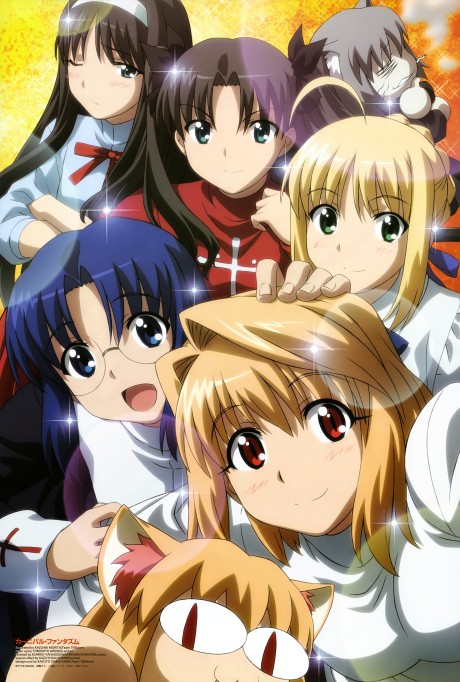
My knowledge of the Type Moon fandom is somewhat limited, but I have experienced the majority of the anime incarnations of the Fate series, from the highs of the first season of Fate/Zero to the lows of the second season of Unlimited Blade Works. I’ve also seen the Tsukihime anime, but it was dog shit and I don’t rmemeber it to any sort of vivid degree. I’ve never played any of the games... Sue me... And i’m vaguely aware that there’s a thing called Melty blood that exists, I might watch that at some point. I still think I know just enough to enjoy Carnival Phantasm to the fullest, as the humor is well-written enough to not be lost on newbies, at least for the most part.
In any case, this OVA is a non-canon comedy collection featuring the stars of Type/Moon’s various intellectual properties, with the excuse being that a certain Carnival has caused a rift in time and space, allowing people from different worlds to meet, or something. I never could catch all of it, because I was too distracted by the sight of tiny little cat people trying to make serious expressions and nodding their heads enthusiastically, making me laugh so hard that I’m literally shaking while typing this sentence.
Thankfully, most of the material is based around the original Fate/Stay night and Unlimited Blade Works, and the Tsukihime material is easy enough to grasp. The skits and scenarios are diverse, but for the most part, it works around one core joke... The Fate universe is super-serious, and this universe is super silly. You might think that would be too narrow a concept to base a two-and-a-half hour series on, but it works, mainly due to the fact that it heavily emphasizes both extremes. It knows how 100% serious Fate was, so everything about it is lampooned and played for laughs in the most ruthless ways possible.
Honestly though, as enjoyable as the comedy is, the opening theme is probably the best part... It's insanely catchy with a ton of fun visuals that represent some of the more notabe and ongoing jokes in the series.
Whether the contestants in the Holy Grail War are drag racing, playing on a game show, trying to survive mundane every-day tasks, dressing up and eating each other, or just watching Lancer die over and over again, this was an idea that couldn’t possibly fail, and you can just tell that Type/Moon was having the time of their lives with it. And hey, if that’s not enough, this OVA comes with it’s own OVAs! Seriously, you can watch the Holy Grail battlers face each other in a Mario Party style game to face the boss Ilya in her Berser-Car! It’s a laugh a minute OVA comedy series, and it couldn’t be parodying a more perfect series.

The word ‘Biology’ can have plenty of different meanings, especially to those who dedicate their lives to the study of it. For Biology major and current Biology teacher Tetsuo Takahashi, it isn’t the bottom of the ocean or the microscopic lifeforms inside our bodies that has captured his interest, but rather, the demi-humans. What may have always been considered fictional monsters in our world are part of everyday life in his world, even if they are extremely rare. Born as human mutations, these beings have their own unique quirks that set them apart from the dominant human population, and Tetsuo has made it his mission to study them and learn everything he can about them to develop enough of an understanding about them to benefit their lives as well as their ongoing relationships with human beings. By offering his counseling services to a cheeky Vampire, a shy Dulahan, and a frail Snow Woman, and by working alongside a Succubus coworker, Tetsuo seeks to change the world through his Interviews With Monster Girls!
Interviews With Monster Girls was produced by A1 pictures, so you should know the drill by now, this show is absolutely gorgeous. A1 has always had one of the strongest resumes of any production company that I’ve ever been aware of, and the fact that they hired director Ryo Ando is even more promising, because his body of work is just as impressive. True, this might be his only primary directing credit, but he’s had name attached to some genuinely well-regarded titles as an episode director, which may not be as elevated of a title, but directing even a couple of episodes of 86, Gate and One Punch Man is nothing to scoff at. He was still relatively new on the scene when he was hired for this show at the time, but A1 took a risk on him, and in my opinion, it definitely paid off.
For the most part, Interviews doesn’t look like the kind of anime that would require a lofty budget to be perfectly functional, and in a way, it’s not. This is a light hearted slice of life highschool comedy after all, it’s very dialogue heavy, and it could have gotten away with being extra cheap, and yeah, you do get your standard frozen key frames once in a while, but there’s also more than enough fluid motion going on while the characters are talking and interacting with each other that you might not even notice. In addition to this, there’s a special amount of attention paid to facial expressions, and each character has their own unique body language that informs their personalities and how they interact with other people. The quality of the animation does fluctuate, but I mean that in the best way possible, as less exciting scenes will utilize just enough money for the characters to appear alive, while saving the rest for when it’s needed.
While the quality does dip during such scenes, it never dips below the line of being, at worst, competent. On the higher end of the scale, you can get some jaw droppingly beautiful shots, like one towards the end where Hikari approaches Tetsuo on the beach, while a gorgeous sunset illuminates her from the background. There aren’t very many main characters, maybe a handful in all, but their designs are unforgettable. They follow a bright and cheerful, yet not quite garish enough to be annoying, color palette, and the handful of human students in the secondary cast look all right as well. There are a small amount of 3D visual effects, like the blue flame erupting from Kyoko Machi’s neck, and they of course look perfectly well integrated. This is a very pretty looking show, even if the school setting and school uniforms look a little on the generic side.
As far as the English dub is concerned, this title was a Funimation effort that was recorded under the direction of Jad Saxton, and they of course had all of the talent they needed at their disposal. Honestly though, the only role that really mattered, and the only one they objectively needed to get right, was the vampire girl Hikari, who plays a very important role in the dynamic between all the other characters. She’s energetic and full of youthful exuberance, and could easily be seen as the heart and soul of the story, or at least its mascot and vastly most marketable character on all the merchandise. Thankfully, Bryn Appril knocks it out of the park. She shines with all of Hikari’s enthusiasm and outgoing social energy. Her sister Himari is played by an uncharacteristically reserved Jamie Marchi, and the two have very relatable chemistry for anyone out there who has siblings.
One particular dark horse in the cast is Morgan Garrett as the adult succubus Sakie Satou, a lonely 20-something who is constantly at odds with herself over whether she can ever be able to engage in a real romantic relationship without worrying about the ethics of unintentionally using her seductive powers to tempt someone into into her embrace. Her approach to the character is the perfectly tight-wound bundle of nerves, just barely able to function in the throughs of her anxieties. Sarah Weidenheft and Terri Doty are also very well cast as the other two demi-human characters, but this material might not have worked if it wasn’t for Chris George playing Tetsu as such a kind and relatable guy, because he could have been a lot more boring in the wrong hands. Over-all I’d say it’s a really strong dub that I’d recommend.
Ever since I returned to writing reviews, there’s one thing about my taste in media that I’ve never been shy about admitting; I like creativity. I like to watch pieces of media that put forth some kind of crazy and unorthodox idea, and then they explore it from every possible angle, for the better or for the worst. One of the best kinds of story to try this with, and that lends itself to countless opportunities for creativity, is the kind of story where some supernatural element exists in the real world, giving any writer worth their salt an excuse to brainstorm and think up every possible detail of how said element interacts with the real world that we know. What’s especially bizarre about this sub-genre is just how consistently good it is. Most stories I’ve come across like this were, at the very worst, interesting enough to hold my attention. The only bad example I can think of is the Netflix movie Bright, which could best be described as A Centaur’s Life, but lazy.
Speaking of A Centaur’s Life, I kind of consider that and Interviews to almost be sort of spiritual counterparts to each other, as the approaches they take to the monster girl genre could be seen as yin and yang to one another. And I mean aside from the fact that one focuses on monsters while the other focuses on fantasy and mythology races. A Centaur’s Life is pretty infamous for taking a hardcore approach to world-building and social commentary, looking at not just differences in culture and racial inequality in the modern day, but throughout history as well, going as far as to create their fantasy world’s own version of the holocaust... It’s a really bold approach, to be sure, but the characters, who are likable, do tend to take a back seat to the bigger picture of the story. Interviews With Monster Girls does not go anywhere near as far with it’s concept as A Centaur’s Life does, but the trade off is that it focuses a lot more intimately on the characters, fleshing them out and making them feel like real, natural people.
And when I say it doesn’t go as far with its world-building and concept, I’m not saying that’s a bad thing, or that it’s really leaving anything on the table. Interviews With monster Girls is very explicit about the fact that demi-humans are an extremely rare minority, so very little about their history or society had to be rewritten, and there really aren’t any new cultures to be constructed, which makes perfect sense for the story being told. In addition to this, the writing does have fun exploring the biological differences between humans and demis, and it’s in that little bubble that the creative side of this anime is truly able to flourish. How crucial is blood to Vampires? How does a Dulahan function while handling her head all day? How can a Snow woman control her ice? How true are all of the stereotypes about these very real beings, and how do they feel about the way they’ve been represented in fiction? Yeah, it’s a more restrained approach from what we saw in A Centaur’s Life, but I’ve always believed that creativity can thrive just as beautifully under restrictions as it can with absolute freedom.
Of course, like A Centaur’s Life, there are metaphors mixed within all of this, and there is some social commentary, but it’s not as blatant here, it’s a lot more subtle, and honestly, I’m not sure how intentional it was. There does seem to be one overarching theme to this one, that being how those who are born different are treated by a majority who aren’t like them. I’ll stop burying the lede here, I’m talking about discrimination, whether intentional or not. Now, I’m a white, cisgender male, so I’m really not prepared to talk about the struggles that women, trans folk or people of color face on a daily basis, and in the past whenever something like that has come up in a review I’ve tried to speak in really broad strokes to avoid exposing my own ignorance, but I am asexual and on the autism spectrum, so I do have some experience with being, as I would call it, different from normal people. I know what it’s like to be bullied and excluded, and I know how it feels to have this massive invisible barrier separating you from your peers. Thus, there are aspects of this series that I do relate to.
For one early example, Machi(The Dulahan) is talking to some human friends, and she makes a small joke about her head. Her friends act a little uncomfortable, not knowing what it’s okay to say, and they change the subject and move on. It’s later explained that it’s kind of up to her to set the bar and show them through example what it is and isn’t okay to joke about, which kind of reflects my experiences as an asexual. When I come out to people, I have to be prepared to explain what asexuality even is, and since I know people often use humor to familiarize themselves with unfamiliar concepts, it’s my policy to allow ONE plant joke. Yeah, haha, good one, but for real... Make another one, or compare me to a biblical eunuch(which has happened) we’re gonna have words. On a similar note, when Hikari says she’s totally game to answer questions about vampires, but starts to regret her decision as the questions get increasingly invasive, yeah, I’ve also been there.
Granted, the way this show reflects my experiences may not resonate with everyone, I’m sure there are people out there who found something in here that offended them in some way, and that’s understandable too. Using fantasy creatures as a metaphor for real world social issues is always going to be a double edged sword. For one, I’m very curious about how female viewers feel about the metaphorical side of Miss Saki, the Succubus teacher. I said before that I’m not a qualified expert on stuff like this, but seeing a female character have to dress down and try to make herself look less appealing to avoid setting off the uncontrollable urges of the men around her definitely feels like something more is being said. It makes perfect sense at face value, due to her Succubus powers and all, but she’s also drawn like she’s extremely conventionally attractive, so the lines do feel a bit crossed here. I am genuinely curious whether or not a female viewer would see this as an accurate reflection on their experience being sexualized by men, or would they be insulted by the insinuation that it's their responsibility to not dress provocatively in the first place?
Actually, you want to know who is way more of a succubus than Miss Saki could ever be? The main character, Tetsuo, because there is no being on this planet who has more unfair bullshit attractiveness powers than a fucking harem protagonist. To be clear about that label, this is not an ecchi show by any means... Most of the characters are not explicitly sexualized, outside of Kyouko’s occasional bath scene and quite a bit of fanservice from Miss Maki... But this is a show where one oblivious male protagonist is the center of the fucking universe for the entire female cast. True, only Kyouko and Miss Maki are shown to be in love with him, but Yuki(The Snow Woman), Hikari and her sister are shown to have crushes on him to some degree, or at the very least are shown getting jealous of the other girls or blushing while singing his praises. He is not an interesting character. He just happens to occupy the role of the kind, generous guy with common sense who does what the rest of the world should have been doing for years, which is prime fucking real estate for a self-insert, and of course the only reason he doesn’t reciprocate or even notice any other characters’ affections is so you can fantasize about being in his place and responding to your favorite fantasy waifu the way YOU would want to.
He is not an unlikeable or particularly annoying character to any extent, but the way he is written is so fucking transparent. Thankfully, he is not the main attraction here, because other than Miss Maki, who is written as a pathetic lovestruck simp, having fallen head over heels for Tetsuo simply because he happens to be good at pretending not to have fallen for her Succubus powers, the other girls are more than just harem tropes, they are very well written and likable characters. They have strong chemistry with each other, they go through very relatable struggles, and they are constantly generating memorable moments that are both heartfelt and funny. Hikari in particular is the standout, not only because she’s the most quirky and outgoing of the girls, but because she has this aura that seems to automatically ease the tension and lighten the mood of any situation she gets involved in. We also know the most about her, since she’s the first girl Tetsuo meets, they have the most natural dynamic, and we get to see the most of her home life, and her relationship with her human twin sister is probably the most charming material in the entire show.
Unfortunately, it’s really easy to put the whole monster girl gimmick aside and just look at this series as your bog-standard high school slice of life series where the main character is just a well meaning mentor to a handful of girls, with another teacher as his love interest, and while it may be above average for a series of that ilk, its actual entertainment value is going to vary from person to person. It’s a very light-hearted series with no real plot or stakes to speak of, and while I can easily see some viewers enjoying it just for the chill vibe as their comfy anime, it’s also really hard to not see that it can get a little boring at times. This is probably true for any viewer who can’t get on board with Tetsuo as some kind of studly mary-sue character whose only remarkable flaw is his tendency to see people as more science problem than human, who thus doesn’t realize just how irresistible he actually is to every woman around him.
One of the oldest genre assessments of all time, and which still holds true today, is the fact that comedy is subjective. What one person considers funny may leave another viewer feeling cold and unamused. Comedy also happens to be one of the most basic cores of a slice of life anime, alongside melodrama and lessons about friendship, and it's important for any given series to know exactly what brand of comedy is right for the tone of the material. Thankfully, I do think Interviews With Monster Girls made the right choice by avoiding more common fare like slapstick or ecchi humor, and focusing on more character-specific interpersonal humor, and as a result, it can be pretty damn funny at times... But humor is not its main priority. The main focus of the series is Tetsuo analyzing and explaining the girls biologically, and when it works, it can be genuinely compelling and engaging. When it doesn't work, it just turns into boring exposition that's hard to pay attention to, and the comedy... While funny on its own... Is not always strong enough to support it, due to a lack of variety that becomes more pronounced as the series reaches it's end. Still, these are mainly nitpicks against a genuinely funny and charming series.
Interviews With Monster Girls is available from Crunchyroll. A bonus episode taking place over summer vacation is included in physical releases. The original by PETOS is available from Kodansha comics and through Kindle.
All in all, Interviews With Monster Girls is definitely enjoyable for what it is. The actual monster girl side of the anime gave me everything I needed from it, the concept was explored about as far as I needed it to be, but on the other side of things, a slice of life anime with no plot or stakes, and no real driving force to the story other than a random conflict that gets dropped on Tetsuo out of nowhere in the penultimate episode, is going to hit each viewer differently. For me, there are parts of it that work... I'd honestly go as far as to say most of it works very well... but it also falters in just enough areas to just fall short of greatness. It's cute, and I'd highly recommend it to anyone looking for a lighthearted anime with likable and sincere characters, top notch production values, and a decent amount of depth as the cherry on top.
I give Interviews With Monster Girls a 7/10
I was born in 1986, and graduated high school in 2004, so it’s safe to say I didn’t grow up with youtube. Hell, I didn’t even get to experience the internet until my my teens. I distinctly remember sitting in my high school computer lab one day, wishing there was a video sharing site where you could conveniently watch music videos without having to get really lucky and catch them at random on TV.
Having said that, I do still believe that I have a connection to the site, due to the fact that I started using it in 2005, so while I may not have grown up with Youtube, Youtube did kind of grow up with me.
Fast forward to today, and it feels like people have been oddly silent about the 20th anniversary of the site, which is probably because it’s become ubiquitous enough to be considered an essential utility along the lines of electricity and water, and people tend to just forget that there was a time that it didn’t exist... Or maybe it’s because most people using it just weren’t alive when it didn’t exist.
In any case, I’ve been watching Youtube for the long haul, and over the last two decades, I’ve picked up a bunch of favorite youtubers, some of whom fell by the wayside, others of whom are still chugging along, and one of those favorites is Takena Nagao, a stop motion claymation artist whose works mostly lean towards horror, and are actually considered to be legit anime titles.
One of my favorite things to do when I’m getting into a youtuber’s work is to take a deep dive through their catalogue, and experience all the weird shit they put out when they were still new to the platform and throwing everything at the wall to see what would stick, and as I mentioned in my last Takena review, he is no exception to this. Takena has done more than just claymation horror... He’s done wrestling shorts, bizarre superhero shorts, and whatever the hell Shitcom is supposed to be.
He’s also done a couple of computer animated MMD shorts. He published two of these 3D projects almost a decade ago... Nine years, to be precise... And they simultaneously look nothing like his other work, and everything like his other work.
For this review, I’m going to be looking at the second of these, called Love Bites. It is technically the sequel to the first one, but there is almost no content in the first one to actually talk about. It will be relevant, though, so to catch you up, Kokuhaku is a POV shot of a teenage yandere waifu approaching you all flirty like and then stabbing you and reveling in your blood spray, that’s basically it.
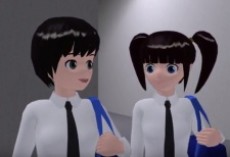
Love bites is much longer, and one curious detail I’ve noticed is that the quality of the animation depends on whether or not you’ve picked up on the actual beats of the story. It looks really cheap and low quality at first glance, but you kind of can’t blame Takena for that, because most 3D anime do not look good, period, and the few that do look impressive have some major asterisks attached to them. FF7 Advent Children looks great because it’s basically a feature length video game cutscene with a ton of money poured into it. Land of the Lustrous looks great because it’s a story about gemstone people, so the uncanny valley effect actually works for it. I’m currently in the middle of Girls Band Cry as of this writing, and I’m gonna call that the exception that proves the rule, because it looks basically perfect and I have no idea why.
Love Bites at first looks really jarring, and that’s because it kind of is... The characters faces are just weird. Their eyes are too big, but not in a moe way, in a horrifying “I’ve seen too much” kinda way, and the way their lips are drawn is just awful. They look like ten year old boys trying their mom’s lipstick for the first time. The way they walk is also really stiff, like they’re training to be the next Robocop.
Editing-wise, there are a few poorly cut shots, like a shot of one girl walking out of the shadows, but the camera lingers on those shadows for far too long without really drawing any suspense out of the situation... But then, halfway through, everything starts to click into place. From the moment the yandere girl sits down with her victim, the story finally becomes engaging and starts to suck you in.
Taking a step back, it might take you a few watches to figure out what’s going on... It certainly did for me... But the girl with the pigtails approaches her friend, the girl with the Rock Lee haircut, who has just received a love note, and she stuffs it into her bag before Pigtails can see it. She hurries off to meet her secret admirer, as Pigtails follows her. Rock Lee sits down on the bench, only for the yandere girl from Kokuhaku to step out of the shadows to sit down next to her.
The curious way she stares implies that Rock Lee wasn’t expecting to be approached by a girl, and the subtle way she reacts to Yandere’s gaze implies she’s not sure how to respond, but the way she smiles when Yandere takes her hand implies she actually might be okay with this. By the way, once you’ve put the story together, the lengthy shot of shadows actually starts to feel a lot more effective.
Anyway, spoilers in this paragraph. Yandere pulls out a box cutter and cuts Rock Lee’s hand, before sucking the blood from her cut, and the sound design in this scene is fucking diabolical, it just feels so visceral listening to that attack as it happens. Yandere makes a psycho face, complete with wide spooky smile, until Pigtails comes to the rescue, stabbing her twice to stop her, and causing Rock Lee to faint. The fact that Pigtails was armed and ready implies that she’s familiar with Yandere, either as an individual serial killer, or as a supernatural creature. She rushes to Rock Lee’s aid, and just as it looks like they’re about to have a romantic moment, Rock Lee bites her neck, killing her as Yandere disappears from the bench, and Pigtails’ movements as she struggles against her fate look so eerie despite the limited animation budget.
The animation may look cheap, but it is still impressive, albeit within the parameters that Takena had to work with. There was a ton of effort put into making the character movements feel genuine in spite of his lack of money and experience, and to make the expressions feel relatable despite how uncanny they were. There is a real story being told, and while it may be subtle to the point that most viewers may not pick up on it at first, it’s full of suspense, eerie ambience, shocking plot twists and imagery that expertly walks the line between sensual and disturbing, and it might actually be one of Takena’s most unforgettable projects because of this.
Love Bites is not one of Takena’s best works, let’s be real. Being a complete change of medium and art forms, it was never going to be, and that might be why he never did another MMD project after this one. Still, I personally consider it fascinating just how much story he was able to tell within these harsh limitations, and it also stands out as probably his only piece of Yuri media. I could watch it over and over again, and I invite you to do the same, even if you have to look past all of its flaws in order to do so.
I give Love Bites a 7/10
So, Monster High is one of those franchises that I’ve always wanted to get into, but could never find a good entry point.
I’ve been working in retail for pretty much my entire adult life, and for a pretty good chunk of that time, I worked almost exclusively in the toy department. During that time, I bore witness to countless toy lines, some of which would go on to have long life spans, others of which fell by the wayside.
One of the lines that I found the most interesting, however, was Monster High, which was like Bratz, except they weren’t boring, and had more than one gimmick and personality trait. I thought they looked really cool, with their alternative fashion designs and different monster personas, and I always enjoyed opening up a shipment box to see which creative new characters and designs I was going to add to the mod.
Well, they were mostly creative. I’d love to meet the Mattel employee who came into work hungover and wrote down “Venus McFlytrap” in order to just collect their check and go home.
In any case, I never actually bought any of the dolls, and it wasn’t because I was safeguarding my masculinity or anything... Let’s face it, what masculinity? One of my favorite anime is called Princess Tutu, who the fuck am I trying to impress. No, it was because I prefer to collect solid-mold, show-accurate merchandise that look cool on a shelf, and toys where you have to brush their hair and change their outfits never really appealed to me. No shade intended if that’s your thing.
I watched the first 23 minute special... I’m sorry, “Movie”... And while I didn’t like it, I thought the theme song was really cool. I kinda fell off and didn’t make anymore effort to break in until the year I started writing reviews again, when I watched the Monster High anime, and while I ultimately placed it on my back burner, I knew I would review it eventually.
Well, it’s 2025, the year of eventually, and I figured it would be a great addition to my “Cute girls doing spooky things” theme month, but I still didn’t want to approach this review from the perspective of a complete outsider, because I didn’t think that would be fair. Thankfully, there is plenty of Monster High media to choose from nowadays, and while I had no idea where to start, I had to pick something to watch in preparation for this review.
I wound up choosing the 2022 Nickelodeon cartoon, solely for the fact that it looked like the closest thing the franchise had to an official series. I had no idea it was a reboot. I had no idea it was the third generation. I had no idea this franchise even had generations. And I especially had no idea that it would be fucking awesome.
I’m not kidding, when I first looked up this series on Paramount Plus, I thought it would be extremely bad, and that I was just going to submit myself to a couple of episodes of modern day Nicktoon cringe just to get the gist of the franchise, but instead, I wound up binging two whole seasons in a week, which is something I haven’t done since My Little Pony Friendship is Magic. It’s funny, it’s creative, it’s smartly written, I like all the characters, and its pun game is strong enough to put Squidgirl to shame.
The more I learn about this franchise, the more it occurs to me how perfect it would be for a Japanese audience. It’s a slice of life high school series about monster waifus. That’s about as anime as a spiky haired teenage protagonist who sits in the back by the window and has a female childhood friend who’s hopelessly in love with him. Thus, it really strikes me as odd that there IS a Monster High anime, and it only got eight 4-minute episodes.
This leads me to the property I’m actually reviewing, which is titled Monster High, Kowa-Ike girls, and I’m sorry it took me this long to get to the point, but another fact I’ve discovered is that there’s no quick or efficient way to talk about Monster High. It’s a rabbit hole within a rabbit hole, and that’s just where you start.
Kowa-Ike Girls was produced by Shogakukan Music & Digital Entertainment, whose resume seems to consist of a lot of titles I’m personally unfamiliar with, as they produced the animation for the extensive Duel Masters franchise, as well as doing music work for shows I’m a bit more familiar with like Pokemon and Hayate, and CG animation for a bunch of anime that occasionally needed that kind of animation to be spliced in. They mostly seem to focus on child-friendly properties that are highly commercial and sell a lot of toys, but it’s hard to put them down for that, because Kowa-Ike girls looks pretty damn good.
At first glance, there is kind of a look of cheapness on the surface, as it seems like the characters were animated using Flash, so there is kind of a stiff marionette-quality to their movements, but it’s largely forgivable. In the 2022 show, they used a sort of 3D animation that was tweaked slightly to give it the appearance of stop motion, and in a similar vein, this animation does make the characters appear more doll-like.
Besides, even if the character models themselves move a bit stiltedly, there are a ton of really beautiful effects layered over them, from their intricately designed and flowing outfits to the occasional environmental effect. Also, the color palette is extremely pretty, and the characters are all really fun to watch as a result of how their color schemes make them pop on the screen. The occasional CG effects are also blended into the 2D environment so well that they can be pretty easy to miss, which shouldn’t be surprising, given Shogakukan’s experience.
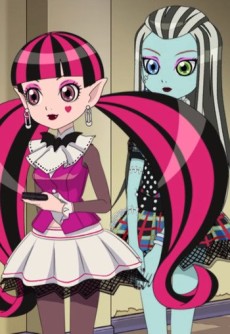
I thought it was also really interesting how each character takes a different approach to the infamous anime expressions and mannerisms... For a couple of examples, Frankie being really blushy, Draculaura cycling through all of the extreme countenances that emojis are made out of, and Cleo doing that really haughty and pretentious villain laugh.
As for the cast, they really only focus on eight characters... The main cast is made up of Frankie Stein, Draculaura and Clawdeen Wolf. The supporting characters are Ghoulia Yelps and Lagoona Blue, with Cleo De Nile as a sort-of antagonist, and Abbey Bominable and Spectra Vondergeist basically reduced to late-game cameos, although Spectra's plot was a pretty fun idea. There is nobody else. No male characters, just those eight and their pets.
It’s hard for me to judge how they’re portrayed, as I haven’t really done a deep dive into generations 1 or 2 just yet, but they mostly seem very gimmicky... Draculaura and Cleo probably have the most defined personalities, with Draculaura being the most openly emotionally expressive, and Cleo playing your basic egotistical bully archetype. Clawdeen and Lagoona kind of got shafted, as all Clawdeen really does to set her apart is obsess over eating meat like Luffy, and Lagona is just a wide-eyed space cadet who is always applying skin lotion to herself, which makes me miss the adorable chomping addiction of Honduran Lagoona. I like what they did with Frankie and Ghoulia, though. They play up the fact that Frankie is only two weeks old by having her constantly ask what basic concepts are, and she mimics anyone her thread becomes attached to, which is a very funny gag. Ghoulia can’t talk, her owl talks for her while she just falls over, which can also be funny.
These gags aren’t outliers, either, this ONA can be downright hilarious at times. The humor is fast-paced, there are constant background gags you have to pay attention to, and the cast’s monstrous traits can be played up in some very inspired ways... Unfortunately, there’s little to no depth to it. This ONA doesn’t really have anything to offer other than a series of quick, bite sized chunks of comedy featuring the infamous monster girls, and while it doesn’t necessarily need to have anything intriguing or thoughtful to say, the shallow nature of the material can render it a bit empty and boring on rewatch.
The short length of the series, both in terms of episode and series length, is a blessing and a curse. On the one hand, it suits the pacing of the comedy, and each episode is over and done with before it overstays it’s welcome. On the other hand, it feels like a lot of more interesting ideas and expansive content is left on the cutting room floor, and the episode ideas they came up with don’t hold up to very much scrutiny. You know that old cartoon trope where a character thinks everyone forgot their birthday, only to find out at the end of the episode that their friends were just planning a surprise party for them all along, and the audience figured this shit out long before they were supposed to because the idea is overdone as fuck? That’s the final episode of this ONA. That’s the note they went out on, spoiler warning I guess.
But the bigger problem, I feel, is one that’s not really the ONA’s fault. Remember, I’m coming at this anime from the perspective of someone who has already seen the Nickelodeon cartoon, and this is a problem because basically everything this ONA does, is something I’ve seen done better. Every single character presented in this anime is someone who I personally liked a lot better in the newer version. I’ve seen so much more depth and complexity in their individual personalities and in their relationships to each other. I’ve seen this world explored to a much more satisfying degree.
Does that make Kowa-Ike Girls bad? No, not by any means, but I am struggling to figure out what purpose it has. Don’t get me wrong, I have some idea of why it exists... Monster High is apparently popular in Japan, and there was a planned toy line tie-in that ultimately got scrapped, or so I’ve heard. But who is this for specifically? I could see the original generation 1 and 2 animated features being enjoyed and treasured by their target audience. Hell, the Japanese fans themselves would probably rather watch these features dubbed into Japanese than watch this ONA. I’d personally much rather recommend the 2022 show to any actual modern day adults who are curious about the franchise.
Kowa-Ike Girls just seems to exist as a very curious novelty, which is saying something for the Japanese adaptation of an American property. It’s not substantial enough to be accepted as an adaptation that explores a beloved franchise in a new light, like the RWBY and Suicide Squad anime. It’s also not enough of an embarrassing train wreck to gain any ironic infamy, like the Rick and Morty and Powerpuff Girls anime.
If it had been given more time and money, and a real chance at being a legitimate anime series, it could have realized it’s potential to a much more significant degree... Or, it could have been exposed as having no ideas of its own that were strong enough to support a longer run time. The world will never know which of these camps it would have fallen into. As it is, it’s fine. If you’re curious about what a Monster High anime would look like, it’s not a waste of your time. It’s cute, it’s well produced, and it’s funny enough to leave an impact in the little time that you’d spend watching it, and if you’d like to do that, it’s up for free on youtube.
I give Monster high, Kowa-Ike Girls, a 6/10
2016 was an awful year. Yes, I know, that doesn’t sound like much from a modern perspective, as the world’s been getting steadily darker and darker for nearly a decade, but 2016 really was special in all of the worst ways. Despite the fact that there was no global pandemic to speak of, celebrities were dying at a rate that we hadn’t seen since 2009, and the world was about to make a consequential decision that would light the fuse to democracy’s ongoing downfall that we’re still witnessing.
If ever there was a year where the human race needed something joyful to distract us, it was 2016, and we were granted just that by one of the few things in our world that was still joyful, innocent and uncompromised: Pokemon.
Now the obvious answer to this is to bring up Pokemon Go, which was a revolutionary new way to explore the Pokemon franchise, although I wouldn’t know this personally, because I’ve never played it. Instead, I’d like to point to something I only discovered recently... Something I’m pretty sure I actually only discovered this year during one of my extended vacations from work, while attempting to buff my Completed list with a bunch of Pokemon music videos.
That’s right, we’re here to talk about the Magikarp song, which I’m going to link here for your convenience.
Now for those who don’t know, Magikarp is a basic unevolved Pokemon from the first generation, dating all the way back to the late nineties. It’s generally known as one of the many examples of duality in the Pokemon franchise. That is to say, it’s cripplingly weak at first, but can evolve into one of the coolest Pokemon in the entire game, Gyarados.
And when I say weak, I mean it. Magikarp has pitiful stats, and a moveset that contains no actual offensive moves, unless you breed it to know Tackle. It was kind of a genius move by the Pokemon creator to add a pokemon like this, because in order to raise a Gyarados, you had to work on some kind of clever battle strategy to level up your pitiful Magikarp without it constantly faiting... At least you did, until the games added experience sharing items, and later made experience sharing a core feature, because these days the games are either too easy or too complicated, with no middle ground.
Because the internet is what it is, all of these details surrounding Magikarp quickly evolved it into something equally impressive as Gyarados; A beloved meme. People love Magikarp, hell, if you count ironic love alongside the unironic, it’s probably even more popular than Gyarados. People love it’s dumb little face, the way it says it’s own name in English, they just love to watch it flop around helplessly, possibly because it reminds them of their efforts to succeed in a capitalist society, or just because they want to protect it’s derpy existence.
All of this leads me to the fantastic anomaly known as The Magikarp song, which I really wish I could say more about, but it really is just a song with a really cute music video... It’s hard to describe things like this, because there’s no real depth to it, there’s no actual subject matter, all I can really say is that it is one of the most precious gorram things in existence. The art and animation on display is of course impressive, because I'm assuming it had the budget and artistic integrity of the Pokemon company behind it, but whatever the case may be, it is very pretty and easy on the eyes.
The song is in English, sung by what sounds like a child, whose voice is damn near angelic. I honestly don’t know if there’s a japanese version, because while the lyrics do sound like a translation at times, the comments are turned off, so who can even tell. Either way, whoever wrote thi song was clearly very knowledgable about Magikarp, fitting an astounding amount of lore into the lyrics in a way that flows naturally and rhymes perfectly without straying from the beat.
The actual attitude the song has towards Magikarp is equal parts adoration and ridicule, happily roasting the poor golden fish while also glazing it worse than Ellis glazed Shrek, and I will be the first person to say, it is just so gosh darn funny that I can’t not recommend it to anyone who even has a passing interest in Pokemon. There’s an aura to this video that I can only compare to the insane brilliance of Akiba Maid War, it’s just so perfect in it’s weirdness that you have to experience it for yourself.
I give The Magikarp song a 10/10
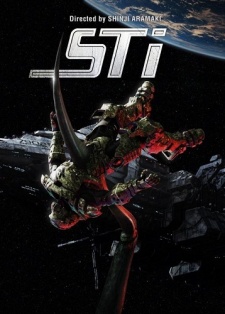
There are many theories about how the war between the humans of Earth and the bugs of Klendathu started. Some say they attacked us first, sending a meteor off course to hit us as an act of aggression. Others say we were always the aggressors, and that the meteor was a false flag operation meant to drum up support for the war and silence protestors(because we weren’t hanging them fast enough). Whatever the case may be, the war is on, we’re in the thick of it, and there’s no turning back. Our war against the bugs has stretched to all corners of the galaxy, so when a distress signal goes out from Fort Casey, a space station that was unknowingly built right on top of a bug nest, nothing initially seems out of the ordinary with this... Until it turns out to be a deadly trap, one that threatens the lives of not only the soldiers performing the rescue operation, but through an unexpected chain of events, the fate of Earth itself. As it turns out, an ambitious high ranking officer has been fucking around, and we’re all about to find out.
Starship Troopers: Invasion is, no surprise, not your typical anime. I’m honestly kind of surprised it qualifies as one, but I’m not about to look a gift bug in the mouth. As a direct to video fourth installment of the Starship Troopers franchise, I guess you could call it more of an OVA than a movie, but either way, it has a pedigree that’s pretty tightly suited to titles of its ilk. There are a few entities that I can find attached to this project, with director Shinji Aramaki, and production companies like Wonderium, Sola Digital Arts and a few others. Between them, the majority of their primary credited work seems to consist of OVAs and movies attached to popular franchises, with a few standalone titles for good measure. Aramaki in particular stands out due to his involvement in the critically reviled Rick and Morty anime projects. I don’t remember Vexille very well, and the only thing I remember about Halo Legends is the AMV Hell clip it appeared in, but Appleseed Alpha? Woof, I remember roasting that piece of crap with some friends.
All of that is to say that yeah, this is a pretty unconventional anime title, and while the names behind it might not be promising, it actually looks pretty good. Well, for the most part, anyway. See, it has one advantage that most of its contemporaries didn’t, and that’s the fact that the characters spend most of the movie in suits of armor and big metal helmets, a benefit that Appleseed Alpha sorely needed. The vast majority of the film consists of soldiers in full armor fighting giant bugs, and when it’s just that, I’ve gotta say, it looks pretty fucking sick. The fights are directed and choreographed well, thebugs are made to look super terrifying in their numbers, and seeing the soldiers mow them down with a hail of bullets as they still manage to inch ever closer to them is somehow simultaneously suspenseful and satisfying.
The combat armor the characters wear largely does look the same, with slight nuances between them, and the same could be said from the bugs, but in my opinion, Starship Trooper armor and the basic soldier bugs have always looked awesome and they’ve always complemented each other well, so I’m not about to complain. Besides, this movie does introduce some new bug designs, including a terrifying new queen design that looks like a mix of Volcarona, The Predator and Mother Brain, which I think looks super fucking cool. And then you have the humans themselves, which, yeah, that’s where things kinda go downhill. There are a few memorable designs in the bunch... The main three female characters are easy to distinguish from each other, at least, Varro looks like an acceptable action hero, and Johnny Rico looks pretty cool in his limited appearances... But for the rest, I’m sorry, the only way to really tell any of them apart is with their gimmicks and their voice actors.
And the animation on the humans when they’re out of their armor is just straight up not good. These troopers might as well have been on a mission to the uncanny valley for all the good it did for the aesthetic of the movie. From what I understand, most of the animation was based on motion-capture models, and I distinctly recall there being a making-of feature on the DVD I used to own that showed the English language voice actors being the ones acting as the models, but I have the feeling their movements were over-articulated in translation, because even the most casual of movements go just slightly too far in most interactions. Also the facial animation can be stiff as hell sometimes for everyone other than Johnny and Carmen, and the nudity looks more like a bad Tomb Raider nude mod than anything intentional. What bothers me the most is that around the same time, Red vs. Blue was airing volumes 10 and 11, which went over the backstory of Project Freelancer, and they used similar motion capture technology for the entire storyline, and it looked way better, faces and all, and I’ll eat my hat if they had half the budget Sony gave Invasion.
It doesn’t appear as though Sentai Filmworks handled this dub, it seems to have actually been credited to Sony Pictures Home Entertainment, but with the names involved, come on, Sentai had to have been involved. David Matranga and Luci Christian return from Appleseed Alpha, and thankfully, Steven Foster gave them a better script this time. Not a lot better, the banter between the soldiers is honestly pretty awkward at times, but better. This honestly might be one of Foster’s best dubs, which isn’t saying much, I know. Luci Christian is full of fire as the scorned Carmen Ibanez, and David Matranga makes you feel every ounce of pain that Johnny Rico has lived through to get to where he is, and the two have the perfect level of chemistry for a pair of estranged lovers torn apart long ago by their duty. Emily Neves is so charming as Trig that she almost makes the backstory exposition dump she has to deliver sound natural. For most of the cast, though, this is basically just a casting call for people with tough sounding voices, so Andrew Love, Leraldo Anzaldua, David Wald, Jovan Jackson and Melissa Davis are right at home in their roles. The casting ranges from good to outstanding, no duds in the bunch, highly recommended.
Starship Troopers is one of my favorite movies of all time. It’s one of the only movies I know where I’ll drop everything to watch the censored version on TV, despite owning the DVD version. It’’s a perfectly well made movie from all angles, I could talk about it for days. Not only is it an awesome popcorn movie, it’s smart, and has layers upon layers of actual depth. The more you watch it, the more you read about it, the better it gets. It also spawned two sequels, which were absolutely terrible pieces of shit, but I still love them in the same way that only a mother can love her own ugly-ass baby, because as bad as they are, they still give me more Starship Troopers, and they’re at least entertainingly bad. I even loved the American cartoon series, which, well, it had it’s own problems. I’ve never read te original book, all I know is that it’s some right-wing pro-military fascist propaganda, which the movie did a fantastic job subverting and deconstructing, telling the same story with pretty much the opposite message. Pretty ballsy if you ask me, and sure enough, this is a pretty ballsy franchise.
So with that all established, how well does Invasion hold up against the legacy it was built upon? Well first of all, on a purely functional level, the Starship Troopers franchise has a surprising amount in common with Attack on Titan. You have a dedicated army of human soldiers who basically signed up to be cannon fodder, and know they’re probably not going to survive to see the ultimate victory, battling it out against single-minded terrifying monsters with superior numbers who are able to swarm and outnumber them very easily, and while one or two main characters may have plot armor, nobody ever feels safe from the danger these forces represent, and named characters that you probably like and feel attached to are constantly and heartlessly being killed off. To that end, Invasion does not disappoint. The action is fun and intense, but sometimes also nerve-wracking and stressful as the stakes are constantly being raised, and the situation is ever-evolving, full of sudden twists and game changers.
Also like Titan, the primary cast is made up of a group of three lifetime friends, and here’s where the legacy becomes really important, because those friends happen to be Carmen Ibanez, Johnny Rico, and Carl Jenkins, the main trio of the first movie. Why didn’t they bring back Ace Levy? Presumably because creating a 3D rendering of Jake Busey would have been too terrifying even for this franchise. Also apparently this film ignores the existence of movies two and three, which is fair, because again, as much as I love them and will protect them from slander with my life, they are terrible. In any case, this film is intended to work as a sequel to the original film, and it does work as one. The war has advanced in more or less believable ways, and the dynamic between Rico, Ibanez and Jenkins does feel completely solid. These are three people who have grown apart, followed their own paths and grown into their own careers, but they still have a history together, and they still have very strong opinions on each other and their work. Watching this movie, it genuinely feels like I’m catching up with these characters twenty years down the road.
Aside from them, though, this movie does not have very many of what I would call actual characters. The closest to a fleshed out human being is probably Trig, even if her backstory was just an exposition dump. Other than her, mostly everyone else is either an interchangeable gimmick or a plot device, like we’re watching the Doom movie all over again. Hell, most of them have call signs and nicknames instead of real names, and I just can not take that shit seriously anymore. I’ve either seen or read plenty of pieces of media that went to great lengths to discuss how dehumanizing this kinda thing is, from the novel The Savior’s Champion to the Clone Wars cartoon, and while I didn’t love the first season of 86, this is something they made a profound fucking point about. Besides, it’s just so lazy and edgelord. “He’s called Ratzass because he doesn’t give a rat’s ass!” Oh, you’re so fucking clever. The guy laying bombs is called Mech, because of course. There’s a religious dude who marks his skin called The Goat... Oops, wait, that’s what he was called in Doom, he’s called Holy Man here.
And look, I already said I love the live action sequels, so technically speaking these movies don’t have to be good for me to like them, I’m willing to put up with a lot. There’s a guy whose gimmick is that he’s a martial artist, so later in the movie he kicks a bug to death, but then he’s immediately killed by a bug behind him, and I’m behind this kind of goofy bullshit one hundred percent. The problem is, you’re not really given a reason to care about any of these people. They keep getting killed in sudden, brutal fashion, but none of them really leave an impact on the story or your emotions. Throughout the entire movie, there’s only one character whose death I felt sad about, and if you’ve seen it, you can probably guess who it was. Don’t get me wrong, there’s still a lot of suspense, and every single human loss represents a step forward for the enemy of humanity on a grand scale, but individually, they're just cannon fodder.
I don’t care what happen to shock jock in Starship Troopers, just like I don’t care what happens to The Hunter in The Savior’s Champion or 5555 in The Clone Wars. Thankfully, I can call The Hunter Orion, and 5555 Fives, but I’m pretty much stuck with Shock Jock. Fuck Shock Jock, there’s about a million middle schoolers waiting to enlist and earn that nickname. Actually, going back to Clone Wars, isn’t that why The Bad Batch was a flop? Cool nicknames first, characters second? And don’t even get me started on Ice Blonde, what the fuck does that even mean? What the fuck is an ICE Blond? What is that, the color of Kristi Noem’s highlights? But more importantly, this all leads to the movie’s biggest and most crippling weakness, the fact that it doesn’t have a main character. Sure, the three legacy characters do feel kind of important, but the narrative doesn’t start treating them that way until deep into the second act. Everyone else is just another interchangeable, and ultimately expendable perspective that we haphazardly alternate between. Don’t get me wrong, I like this movie overall, but when you tally up who dies vs. who survives, I’d be lying if I called the note it goes out on anything other than empty.
Starship Troopers Invasion is out of print, along with most of the franchise, although pretty much all of it is easy to find online for cheap. The first movie gets released occasionally by Sony. The original novel by Robert Heinlein is available both physically and in audio format from Amazon. There’s a new video game that I just learned about, but haven’t played yet.
As much as I like Starship Troopers: Invasion, I don’t think I can really give it a strong recommendation. It is paced fine... It’s an hour and a half long, and it only feels slightly longer than that. It doesn’t waste too much time on the stuff that overtly doesn’t work, we spend maybe fifteen to twenty minutes on the ship between the two main missions of the story, but the lame stuff does stick in your memory. Scenes between the soldiers that don’t involve action, more often than not, feel so derivative that if someone told me that this movie came into it’s existence with the Starship Troopers branding being slapped onto a generic science fiction space marine script that nobody wanted to produce, I’d believe you in a heartbeat. But it’s still fun. The action is incredible, as long as you’re not being asked to actually care about anybody, and I do personally consider it a worthwhile entry in the franchise.
I give Starship Troopers: Invasion a 6/10
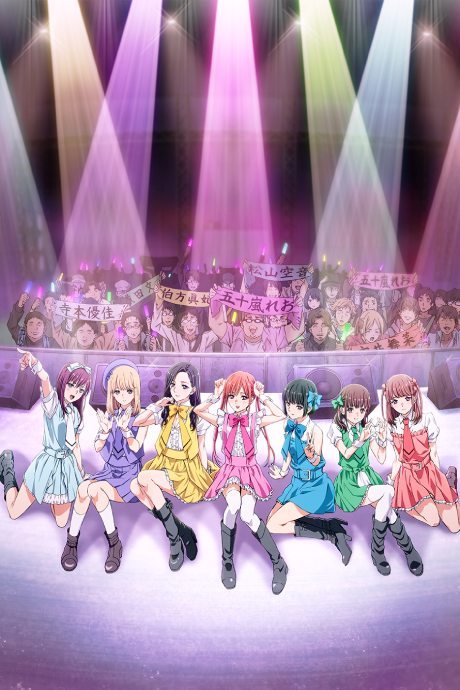
Truth be told, we don’t know that much about Eripiyo. We don’t know her full name, or her level of education, or exactly how her journey through life brought her to the park on that fateful day when she was approached about visiting a local idol concert. All we know is that she’s an adult, she has a ton of work ethic, and after experiencing the idol group ChamJam for the first time, she’s fallen head over heels for its most bashful member, the diminutive Maina! It’s been two years since then, and Eripiyo has dedicated every day of her life, and every penny she’s owned, into supporting her icon as much as humanly possible! Or at least, she wants to, but whenever they interact, she’s noticed that Maina’s been acting cold to her. Is she just being shy, or have Eripiyo’s obsessive tendencies been creeping the poor girl out? One can never truly see inside the heart of another, and in Eripiyo’s case, she’s not even sure what’s in her own heart. The very thing that brought her and Maina together is now the one thing keeping them at a distance, so she’s going to put all that confusing stuff aside and cheer Maina all the way to the Budoukan!
The anime I’m reviewing today is called “If My Favorite Pop Idol Made it to the Budoukan I’d Die,” which I am simply going to call Oshibudou for short. It was produced by Eight Bit, a company I’ve never heard of before today, because while I have seen a few of their titles before, I’ve never taken the time to look up who produced them. Out of the few I’ve seen, the only one I watched recently enough to comment on was Encouragement of Climb, a cute and kind of ambitious slice of life anime that I recall looking really pretty. Oshibudou is also really pretty, at least in terms of its soft, watercolor aesthetic and it’s flowery, shoujo manga designs, but it also does look very obviously low budget. You can fin the usual budget cutting tactics all over the place... Talking heads, key frames with moving lip flaps, repeated animation cycles, long panning shots, character portraits bouncing to create the illusion that they’re walking, you name it, it’s in here. And yet, in spite of all of that, it’s not a half bad looking show.
This show was not Eight Bits first rodeo, nor was it anything new for Yusuke Yamamoto... No, not Tamaki Suoh’s actor, the other Yusuke Yamamoto... The director of the series, who brought a ton of practical experience to the table. As obvious as the budget cutting techniques may be, they’re not jarring or distracting, and you probably won’t even notice them if you’re not looking for them. A good director knows how to make a cheap anime look good despite their limitations, and while I have seen it done better in other shows, Yamamoto still did an admirable job. The color palette is very bright and easy on the eyes, and the character designs are really distinct and memorable, for the most part. Weirdly, it’s the idols in this show who can sometimes look a little on the generic side, even among the main cast, as there are several members of the ChamJam group that look strikingly similar to each other aside from subtle hair color and outfit differences. It looks better than it probably should, so we’ll count that as a win.
The English dub was a Crunchyroll effort, and it might be where Oshibudou shines brightest. Megan Shipman pulls out all the stops in her portrayal of Eripiyo, her delivery an astounding blend of over-the-top and nuanced, dialing her vocal range up to eleven to play an insane character who shows little sense of shame or self awareness to a degree that would make Jessica Calvello proud. Brynn Appril is shy, reserved and sounds very believable as someone with social anxiety who struggles to talk sometimes, making her the ideal Maina, and Jim Foronda is lovable as Kumasa, a character who could have easily turned out to sound boring and bland. I don’t remember specifically, but I know a couple of the songs were sung in English, while others weren’t, and I don’t know why, but I appreciate the english songs we got. My only complaint is that, I’m sure this was a mistranslation on some level, but the title of the series is said four times in the dialogue, and it’s said differently. It’s said as “If my Favorite Pop Idol made it to the Budoukan, I could Die Happy,” not the shorter version. I wonder about that.
There’s a lot to like about this anime, and there’s also a few things I’m not too crazy about. To start off on a positive note, this show is really damn funny. The original material already had whip smart comedic timing, and the English dub absolutely nailed its adaptation in that regard. Not all of the material is self aware, but when it is, it’s never shy about poking fun at itself. Eripiyo herself is a very funny character, her earnest devotion to Maina causing her to overwork herself to a hilarious degree as well as going through some genuinely funny slapstick that often ends up with long term injuries as a consequence. On top of this, I adore her relationship with her other otaku friends, as their dynamic is probably my favorite thing about the show. Chasing after idols for years would be boring if you had nobody to share the struggle with, so thankfully her and Komasu are akin to a pair of bros. Their dynamic is both believable and kinda based, I wish I had friends that honest and supporting.
While Eripiyo and another one of her friends display some questionable habits, the character of Kumasa could be considered the wholesome and healthy one, which is not apparent from his design, he looks like your stereotypical slimy otaku sleeze, so it’s surprising just how wholesome he actually is. He deals out smart life advice, treats his favorite idol like a human being, and he never makes a single advance or creepy comment to his cool female friend. He goes a long way in giving otaku a good name, and it also helps that Eripiyo is one of ChamJam’s only female fans, and she’s just as vocally obsessed and unhinged as anyone else whose been sucked into that rabbithole, which is also pretty progressive I guess. Their friendship is, as far as I’m concerned, the heart and soul of the series, just these three like-minded raccoons that found each other in the dumpster and decided to form their own twisted little family, it’s actually pretty heartwarming to see.
As much as I liked the fanboy/fangirl half of the show, the actual idol half feels severely lacking to me. There are seven members of the idol group Chamjam, and while none of them struck me as bad or unlikeable characters, they did kind of feel shallow, to the point that as I’m sitting here, I’m struggling to recall anything about any of them outside of relationship details between them and their occasional uses in the plot.. Lets see, Maina was really shy... One of them, I think her name might have been Aya, was kind of an instigator who was insecure about being called a loli... I think that’s it? Nobody really stands out aside from Maina, and that’s just because of how often the plot focuses on her. As frar as I can remember, there are two potentially lesbian couples that form within the group... I say potential because on both counts it’s teased but never confirmed... And I legitimately can only remember one of them. Or was there only one couple, and I mistook them for two? Who fucking knows.
One huge problem that I noticed with this cast of characters is that not a single one of them, at any point, has an actual backstory. Well, okay, we know Kumasa has been following Reo since her previous group broke up, but that’s all we get. We don’t know why any of these girls wanted to become idols, what kind of lives they lead previously, or what kind of families they come from. This is really bad for Eripiyo and Maina in particular, because we have no previous context for why they would fall for each other so quickly and deeply, we meet them at the exact moment they meet each other, and that’s it. People seriously accused Whisper me a Love Song of relying too heavily on the love at first sight trope, when this show also exists? At least in that show, the proposed yuri couple don’t let misunderstandings get in the way for long. Eripiyo and Maina’s relationship is like a cereal box called “Oops, all Misunderstandings!”
It’s embarrassing how far this show will bend over backwards to keep Eripiyo and Maina at arms length, to the point that they’re both highly selective with what hints they will and won’t take. When Maina displays incredulity at Eripiyo for not buying as many CDs as usual, Eripiyo starts rambling about trying to sell her organs. This confuses Maina for some fucking reason, when the implication that Eripiyo’s having money issues should have been blisteringly obvious from that one clue. When Eripiyo gifts Maina a box of chocolates, she later asks her if she ate them. Maina says “of course not!”, which conveys to Eripiyo a sense of rejection, rather than the actual reason, IE Maina treasures them too much. And yet, and yet, when Eripiyo carries around a blue item(that’s actually mostly green, which she also pointed out) Maina immediately jumps on the wrong conclusion, thinking it means Eripiyo is into another group member, because Maina’s only allowed to be perceptive when she’s wrong.
This alone makes them an incredibly frustrating couple, not only because I know almost nothing about either of them besides their relationship with each other, but because they spend the entire series chasing each other’s tails like the most useless disaster lesbians on earth. This is kind of a spoiler, but they make no progress or development whatsoever the entire series outside of being able to talk to each other a little easier. To make matters worse, the actual nature of their feelings for each other keep flip flopping from episode to episode. Sometimes Maina openly implies having romantic feelings for Eripiyo, other times she’s wondering if they’ll ever be friends. Eripiyo is constantly expressing her love, but outside of a scene where she refer to Maina as “The girl I like” while begging for money, none of her romantic overtures feel genuine. I guess there is some depth to the idea that Maina’s idol status brought them together, and now it’s also creating an insurmountable distance between them, but it’s boring never seeing them make a genuine attempt to cross said difference.
One potential reason for this is that Oshibudou is one of those many yuri anime where the very idea of homosexuality is never explicitly called out or addressed, like it takes place on an alternate earth where there was no real separation of sexualities, and heteronormativity just never existed, there are a lot of LGBT anime tht are like this, and it can make for a very positive and affirming fantasy that the world needs more of, but when the characters involved are underwritten, it can also serve to exacerbate the shortcomings of a story. There’s a scene where Eripiyo invites a coworker over to watch Maina on TV, and while Eripiyo was fangirling in front of her, I was practically pleading for the coworker to say something like “Huh, I didn’t know you were gay, that’s cool,” because a comment like that could have performed the double duty of both forcing Eripiyo to examine the nature of her feelings, and maybe... Just maybe... Doling out some actual backstory. Which she needs, because Eripiyo may be funny and a more or less good main character, but she is nowhere near a strong main character.
While we’re on the subject, I also think it’s really interesting how one of the idols starts to lose fans and support when rumors start to go around that she has a boyfriend, and it’s acknowledged by other members that this can be disastrous to her career, and yet none of them seem concerned about what might happen if they had a girlfriend. This is something I’ve seen elements of in the Vtuber world, as the reveal that a talent has a boyfriend can be just as devastating as a straight up doxxing, especially on the Japanese market, but female Vtubers in particular will openly flirt with each other with little to no pushback, and while actual couples might be rare, they’re often as popular as the individual girls themselves. Why is this, I wonder? Why is having a boyfriend considered a betrayal, while having a potential girlfriend is barely considered a threat? This is something I wish the series would have explored more, but let’s be real, I highly doubt it came anywhere near this subject matter on purpose.
As much as I have complained about Eripiyo and Maina being a frustrating couple that makes no progress, I’m not sure the opposite would be a good idea either, because there is something about their pairing that is going to make a lot of people uncomfortable, myself included. If you’ve never heard of a parasocial relationship, it’s what happens when you become a dedicated fan of a public figure. Everyone experiences this at some point in their lives, but most of us were at least able to keep our fanhood from crossing the line. But that line can be hard to see, and there’s one hell of a slippery slope waiting on the other side, and that’s where stalkers come from. This line means a lot to me in particular, because I’ve been on the wrong side of it... I was once so obsessed with a particular youtuber that I did some detective work to figure out their real name, along with some other information, which I almost made public before I realized what I was doing, stopped myself in the nick of time and threw up in the shower out of disgust for my own actions.
And at least I stopped myself, because there are countless stories out there of people who didn’t. If you’re a wrestling fan, you’ve heard about what happened to Sonya Deville a few years back. If you haven’t heard what happened to the Vtuber Camilla, check out my Vtuber legend review. For a more mainstream example, Christina Grimmie was a very young musician on youtube and former contestant on The voice who, in 2016, performed at a concert in Florida. Afterwards, she sat down in her autograph line, where a stalker got to the front of the line, pulled out a gun, and shot her dead before also taking himself out. This is real shit, and once you know about it, it makes it really hard to watch an anime that portrays romantic feelings between a pop idol and her #1 fan in a positive light. Sure, it’s fine to tell a story that examines the intense feelings of a fan, but when those feelings are reciprocated, that’s when you have a problem.
This is maybe a bit of a spoiler, but Maina has (sometimes)romantic feelings for Eripiyo, and they are entirely based on the fact that Eripiyo is her most loyal and devoted superfan, and do I even need to explain why that’s a problem? If this scenario doesn’t encourage delusion and entitlement, I don’t know what will. Don’t get me wrong, I know most people wouldn’t get the wrong idea about this, but most is not all. You only need one delusional fan in the wrong frame of mind to take the text of your series as “Hey, you never know, maybe she does feel the same way” to cause some real, life-threatening problems. And before you say it could never happen to you, guess what, I’ve been there, and if it happened to me, it can happen to you.
Or hell, even if I’m just overreacting and no harm could ever come of this harmless little yuri set-piece, that doesn’t make it easy to sit through a piece of media that looks at a topic from such a shallow perspective that it absolutely refuses to address the darker implications of it’s premise that you know about all too well. In real life, idols are characters, being played by normal human beings who live out their normal, boring lives behind the scenes. They appreciate your support, probably, but they don’t know you, and they never will. In Oshibudou, Idols are exactly what you see on the surface, and they form intensely personal and reciprocal relationships with anyone who shows an interest in them. They have a boundary in place that keeps them from dating their fans, but the relationships they DO form are worryingly codependent in nature, mewling over how much money you're spending with all the grace and dignity of strippers trying to work you over for a better tip. You can enjoy this fantasy if you want, I’m not going to judge you for that, but you can also find it deeply uncomfortable and creepy. Even a mutual, non-stalkery relationship between a fan and a celebrity would have a huge power inbalance at best, and be openly exploitative at worst.
If My Favorite Pop Idol Made it to the Budokan I Would Die is available from Crunchyroll. The original manga is available from Tokyopop. A live action drama adaptation is not available stateside.
I have issues with Oshibudo, but it’s hard to hate any anime that makes you laugh, and I think this show is pretty damn funny. Eripiyo might not be a very strongly written protagonist, with no real depth or history to speak of, but for a comedy anime, she’s good enough. Her over-the-top sincerity lends a sense of charm to what should be some genuinely creepy behavior, and her antics result in some pretty consistently good slapstick. I love her friend group, their camaraderie and overall vibe is amazing. Unfortunately, the premise touches on sensitive subject matter that it either doesn’t understand or is willfully ignorant of, and there are several prominent story arcs that are never resolved, resulting in a neverending cyclical purgatory that shows little development at best, and utter stagnation at worst. I still don’t believe in ‘shows where nothing happens, but this is definitely a show where nothing exciting happens, although I did enjoy it more often than not.
I give If My Favorite Pop Idol Made it to the Budokan I Would Die a 6/10

It’s often believed that the supernatural only exists in our imaginations and in the world of fiction, but in reality, small occurrences that defy rational explanation happen every day right under our noses. Small miracles, events with astronomical odds of occurring, are more common than you might think. One of these events comes to pass on the day that a famous young idol named Ai Hoshino strolls into a remote hospital to give birth to her secret twins. Her doctor, Gorou Amemiya, has been a huge fan of hers ever since catching the idol bug from a terminally ill patient of his who found inspiration in Ai’s performances before passing away. He dedicates himself to the job, until a mysterious stalker catches him alone outside of the hospital and murders him, leaving his body to rot at the bottom of a nearby cliff, to never be found again.
However, as fate would have it, this is exactly when one of those small miracles was about to occur... Gorou is suddenly reborn, with all of his adult memories, as Ai Hoshino’s child! Well, one of them, and coincidentally his new twin sister is also a reincarnation. His new name is Aquamarine, and hers is Ruby. Going through his formative toddler years with his favorite Idol singer as his mother is a surreal experience, not only because their existence has to be kept secret, but because he soon realizes that Ai is not the brightest bulb in the shed. Still, she loves her two babies with all her heart, no matter how creepy they are, talking and acting like full grown and fully articulate adults. But then, fate deals him another cruel hand, as his mother is murdered in cold blood by the same man who killed him previously! Vowing to exact revenge on the mastermind behind the attack, Aqua enters his teenage years with a target in mind: The only man who could have possibly arranged both attacks. His and Ruby’s birth father!
It’s been three years since I reviewed an anime from Doga Kobo, when I shredded Himouto Umaru-chan. Anyway, some things have changed since 2022. Back then I hadn’t seen very many anime by this studio, and I didn’t exactly love any of the ones I had seen. Nowadays, however, I’m a huge fan of Koihime Musou, and Sleepy Princess in the Demon Castle is pretty special too. What I’m noticing now more than then is that there don’t seem to be any real specific trends between the anime released by this studio. If anything, it feels more like one of those studios that gives enough creative freedom to their directors that the style of their output varies greatly depending on who specifically was in charge of it. I also believe I said at the time that Himouto Umaru-chan was the best looking anime I’d seen from them up until that point, but boy howdy is that not the case anymore.
From what I have seen that I think I can say with some certainty, Doga Kobo is way more likely to give an anime production a generous budget than it used to be. Most of their early work tends to range from cheap looking to average, and before you call that an insult, that description applies to shows I very much like, such as, again, Koihime Musou. It does appear that they were able to modernize their output successfully... Sleepy Princess looks great, Alya Sometimes Hides Her Feelings looks great, and Oshi no Ko looks absolutely phenomenal. It takes a classic shojou aesthetic, but infuses it with the kind of rich, immersive coloration that you’d see from certain younger studios, the kind where characters have deep rainbow y eyes for no real reason. Aside from some of them having your typical wide, expressive anime eyes, most of the characters are anatomically realistic, with more or less believable hairstyles and hair colors.
On top of all that, the animation is basically flawless. I can’t tell for certain, but the idol dancing seems to be using a blend of rotoscoped-2D and MMD 3D that comes off as perfectly smooth and not even remotely distracting. The backgrounds are immersive and complex, and it’s directed extremely well. I know this is easier to do in animation than in real life, but there’s some real, genuine depth to the cinematography, and the visual style only becomes obscure or avant-garde when a character is really going through something in their inner monologues, so it never feels excessive or pretentious. I don’t have a lot to say about the music, but the performances accompanying it are downright breathtaking, so as far as the visuals go, high marks all around.
I can’t say a lot about the English dub, because not only is the cast made up primarily of names I’m not familiar with, even the ones I have heard of are ones I’ve never spent a ton of time thinking about. The highlight by a mile is Jack Stansbury as the lead role, playing Aquamarine Hoshino. Not only does he pull off the cold and calculating side of the character exceptionally... Basically portraying this the same way Brad Swaille did as Light Yagami, albeit with a lot more subtlety... But he also has no problem turning on the charm whenever his character is forced into a situation that requires a false smile. Chaney Moore deserves her flowers as well for doing something very similar while playing his smaller child form. It's also really nice to see that Marcy Bannon is still working. The singing is done in Japanese, which I’m not a fan of, but whatever, that’s just the way it goes. It’s a great dub, I have no complaints, but I also have no other important comments.
One thing the medium of animation is known for is that you can use it to bring any bizarre, abstract, or dare I say even original idea to life. Whether it’s a fully animated feature, or just a CGI animation intermingling with a live action film, there’s no idea too out there for animation to bring it to life. This gets even more true when you venture over to the anime medium specifically, which is deservedly notorious for throwing out the most insane premises humanly possible. From the darkest horrors in the corners of the most twisted minds, to the craziest gimmicks attached to the new shonen hero, there is no idea that can’t work in an anime... But that doesn’t guarantee it will. An insane story concept tends to be high-risk, high-reward, because when executed successfully, it can result in a story that will be all the more memorable for it’s originality... But if it fails, that concept will render it a million times more embarrassing.
If you couldn’t tell from my plot synopsis, Oshi no Ko has one such concept. Not only is it one of the most original and insane ideas for a story that I’ve ever heard, it also comes off on the surface as one that is immediately questionable. Reincarnation s a premise does seem to be enjoying some second-hand popularity thanks to it’s association with the isekai genre, but it is possible for a character to be reborn into their own world... Although, being reborn as the baby of your favorite Idol? That’s a new one. The closest anime that I’ve seen come to that was Dog X Scissors, where the main character was reborn as his favorite author’s puppy, and yeah, nobody ever wants to be compared to that piece of shit. Unfortunately, Oshi no Ko does carry some of the same red flags. I think about how the author in Dog x Scissors wanted to lose her virginity to a fucking puppy, and I immediately expect a concept like the one from Oshi to lead to some severely fucked up mommy-baby play fetish content.
But that’s not what happens.
On the other side of the bizarre idea dichotomy, I absolutely adore when an anime presents a unique or out-of-the-box concept and puts all possible effort into exploring and even analyzing the hell out of it. I’m sure at some point we’ve all asked, hey, what would it be like to start life over from infancy with our memories intact? How would the physical limits of early age affect our ability to retain memories? Would our advanced early vocabularies make us come off as creepy? What are the ethics of breast feeding with an adult brain? This anime puts way more thought into the idea of an adult being reincarnated into a baby genius than Saga of Tanya the Evil and Jobless Reincarnation did, and for the record, I loved both of those shows. Granted, you only get to see the main characters as babies for the first episode... Which is an hour and a half long for some reason... At which point we get our second inciting incident, the murder of Ai Hoshino, which kicks us into the time skip, and starts the series proper.
I don’t want to get into too many spoilers beyond this point... Honestly, spoiling the first episode was probably too much, but I couldn’t think of any good way around it... But the true magic of this series lies in the siblings themselves, and I mean that in more ways than one. First, thankfully, they fall on the more realistic side of sibling dynamics. They bicker, but they get along. They have opinions about each other’s love lives, but they’re not obsessed over it in any sort of unhealthy way. They see the best and worst in each other, and they have exceptionally strong chemistry. More importantly, they complement each other in ways that massively benefit the series. There’s this psychological concept called right-brain, left-brain, which says that the different sides of our brains determine different aspects of our character... If you want more information on this, there’s a pretty catchy Bo Burnam song on the subject.
This concept is complete bullshit, an old wives tale along the lines of “We only use ten percent of our brains,” but it can be really useful in character writing. Going by this concept, Ruby is a right-brained individual. She’s socially conscious, artistic, expressive, sensitive, compassionate, a true dreamer. Aquamarine is more of a left-brained individual, as he’s calculating, mathematic, practical, a true realist. More importantly, though, is in how this affects the tonal balance of the show. Aquamarine carries the plot of the series, with his desire to exact revenge on his birth father giving us a long term goal that we want to see him achieve, as he works his way through industry obligations and his own calculated plans to get there. Ruby carries the emotional side of the show, chasing her dreams of Idol stardom, and giving us a bright, warm smile to get lost in whenever we need a break from Aqua’s sociopathic social climbing. Her sincerity does a lot of heavy lifting to balance out Aqua's duplicity.
And sure enough, they both have backstories that reinforce their twisting paths, with Aqua’s connection to his mother’s murder, and... Okay, I’m not going to spoil Ruby’s past life, but it’s very similar to the second best episode of Angel Beats. Anyway, the writing uses the two of them to create a strong balance between two very strong tones that should not work together, but do, thanks to the bond between them. Having said that, there is a third character whose presence is integral to the narrative, even long after her death, and that’s Ai. Ai Hoshino was a very strongly written character, with explicitly defined positive and negative qualities, neither deified nor idealized, a believable inspiration for multiple characters. Her presence never fades from the series, even after her death, as she stands as a sort of motif connected to the anime's multiple different themes. It is true that Aqua kind of has an Oedipus complex about her, but thankfully it’s neither romanticized nor sexualized, rather the writing seems self-aware enough to just stand back and observe/explore this connection, which is how this sort of subject matter should be handled.
As for everything this show has to say about fame and the Japanese entertainment industry, it really is just a means to an end in the story, but it still does deserve to be analyzed. I’m going to be honest, I don’t personally know very much about this subject... Hell, I don’t really know anything about the American entertainment industry, aside from what I’ve gleamed from various tell-alls and memoirs... But it feels authentic? This could just be my ignorant American ass being gullible, but just going off of vibes, it feels like the series knows what it’s talking about. If it is an honest portrayal, then it’s a fascinating one, and the story that the Hoshino siblings have been weaving through it have been absolutely breathtaking, full of emotionally resonant high and low points, several heart-stopping twists, and a mystery that’s slowly being unravelled in the background, I haven’t seen an anime that kept me this far on the edge of my seat in a long time.
Oshi no Ko is available from Sentai Filmworks, with a second season forthcoming on physical release, and a third season set for release later this year. The original manga by Aka Asaka is available from Yen Press.
I love Oshi no Ko. They say you can make any strange idea work in an anime, and with it’s clever execution, sophisticated writing, strong heart and creativity, this anime definitely proves that statement to be true. I’m not going to say it’s perfect, or a masterpiece, because if I went over it again with a fine toothed comb I’d probably find a bunch of small flaws and shit, but that kind of doesn’t matter, because there’s nothing about it that I don’t like. It looks great, it sounds great, it’s engaging, it's funny when it wants to be, and it has so much genuine depth to its ideas that I feel like I’d learn something new about it if I ever come back to it for a second or third viewing. I haven't seen the second season yet(As of this writing) but there are so many intriguing direction this story ould be taken in, and I can’t wait to continue watching the Hoshino siblings pursue their goals, and hopefully, find something worth living for beyond them.
I give Oshi no Ko a 10/10
There’s a popular new sport sweeping the nation of Japan, and it’s called Keijo. It’s sort of like a form of sumo wrestling that takes place on a floating platform in the middle of an olympic sized pool, except the competitors are exclusively female, and they’re only allowed to use their breasts and buttocks as weapons. If they’re knocked into the water, or if they fall down on the platform, they lose the match. Truly a sport that could only rise to prominence in Japan. Every year, a fresh stock of high school graduates enters their local Keijo training school with hopes of making it big, and this year, the bright eyed, enthusiastic Nozomi Kaminashi is among them. Inspired just as much by a recent loss as she is by her very real and unconcealed avarice, aiming to make a much prize money as possible, Nozomi has embarked upon her personal quest to become the best Keijo player in the world, which may prove to be more difficult than she expected, with some amazingly powerful opponents, and her own physical limitations, standing in her way.
Keijo, also known as Hip Whip Girls, is the result of a collaboration between two forces that I never expected to see combined into one project. The first is Studio Xebec, who probably have one of the worst track records among the endless list of animation companies who have ever operated in the anime medium, and who are generally not seen as promising news when they’re attached to an adaptation. The other force, however, is Hideya Takahashi, who you may know as the director of Sword Art Online and the modern Jojo’s Bizarre Adventure television adaptation, and lord what a difference he makes here. In most cases, the best looking Xebec anime were able to stand out because they had directors who knew how to work on a limited budget and overcome that kind of burden, but Takahashi was just born for this shit. He doesn’t just make cheap animation look good, he makes cheap animation look downright cool, by finding the most visually appealing ways to lean into it instead of try to cover it up.
Of course, the money he saves by doing this goes directly into the action scenes and CG effects. I swear, you might not realize how historically challenging it is to make animated water look good, but the pools in this anime looks so borderline realistic I want to swim in them. The actual action scenes aren’t just girls smashing their tops and bottoms into each other, the nature of their attacks gets more and more out there with each battle(I am not calling them races because that’s fucking stupid) and the CGI effects pretty much have to be on point to keep up with all that power creep, and Takahashi is more than capable of this. The cheap shots are used mostly for character interactions that are intended to be funny, or for Nozomi’s grand speeches, or the odd panning shot for an exposition dump, and while not all of this worked for me, they are all really smart choices in direction. The character designs are hit or miss, but I don’t blame him for that. Nor do I blame him for how grotesquely absurd the jiggle physics animations are, I’m pretty sure that aspect of the production was just plain unavoidable.
The English dub was a Funimation effort, which would usually be a promising note, except there really isn’t anything special about this dub. It was directed by Monica Rial, which would normally be a good thing, because she is one of the best people in the industry at respectfully translating a dub as accurately as possible while still changing just enough to make it culturally accessible, she’s right up there with John Burgmeier in my book, but unfortunately, this is one of those shows that could have used some spiced up dialogue. As ridiculous as this concept is, and as insane as the visuals tend to be, the writing takes itself super seriously, presenting a straightforward inspirational sports story, and I wish Funi had tried to have a little more fun with it. Like, remember Master of Martial Hearts? The Funimation dub full of lame puns about the weird character gimmicks was the one thing that made that show bearable. Here, you have characters blasting each other with ki attacks out of their assholes, and not one fart joke? Seriously? Anyway, the actors do a fine job, nobody sucks in it, but none of them really stand out aside from Anastasia Munoz and Jamie Marchi in some minor roles.
And when I say this show could have used some spicing up, I mean it, because this is one bland-ass anime. Now that shouldn’t be possible, right? Anime is the perfect medium to explore ridiculous and over-the-top ideas to their fullest extent, and you have to admit, this concept is pretty fucking out there. You have an anime that takes some of the most iconic tropes in history... Fanservice revolving around the female body, and intense gritty action that would be impossible for real life humans to recreate... And combines both of these elements together for possibly the first time ever, I mean I haven’t seen every anime ever made, but I certainly haven’t seen anything like this before. The possibilities are endless, but as is sadly often the case, that doesn’t mean you won’t be disappointed. This show mainly seems to have two major selling points, those being constant fanservice and the novelty of seeing a ridiculous scenario played off as something commonplace, and while I suppose this is enough for some people... This show is highly popular after all... In my opinion, these selling points hit diminishing returns faster than you can say “My Anaconda don’t.”
Starting with the fanservice, let’s try a quick thought experiment. Let’s say there’s an anime coming out that’s all about baking cakes, and you’re pretty hyped for it. You’ve been waiting to see this show for so long, but when you finally watch it, you’re confused to notice that you can’t actually see any cakes. Oh, there are cakes in the story, constantly being baked, shown off and eaten, but they’re always obscured from view. Censored, even. You ask about this online, and people are outright hostile to you about it. “Oh, if all you care about is seeing cakes, then watch the food network, fatso.” You see people claim how glad they are to experience this story without all that sugar being shoved in their faces, and you just stare at these comments in disbelief, thinking “Then why watch a show about cakes? Why would they adapt a story about cakes when they’re so against letting people see cakes?” They showed cakes in the manga, uncensored, a lot, so at least you have that. You don’t even really need to see cakes, it’s not the end of the world, but the fact that someone chose to adapt a manga about cakes and then went to all of that trouble to not let people see any of the cakes just feels absurd, and even a little insulting.
If you can’t tell, I’m using cake as a metaphor for nudity here. Specifically, female breast nudity, because that’s the highest level of nudity you can legally show in Japan, thanks to their decency laws prohibiting the depiction of genitalia. It used to be fairly commonplace, but in recent years, Japan has quickly caught up with the rest of the world in believing that the female body is the most offensive thing in the world. Using Goblin Slayer as an example, you can show a full-body shot of a woman getting raped, as long as you have her hair covering her boobs, and that’s pretty fucked up. More and more often, you’ll see manga that featured uncensored nudity receiving adaptations that remove it in some way, and that’s not always a deal breaker for me... This exact phenomenon happened to Summertime Rendering, a show I still highly enjoyed... But that’s because, in most cases, nudity really is unnecessary. At least ninety percent of nude scenes in media are just voyeuristic excuses to see some skin, with conversations taking place in the bath that could easily take place on the couch. That’s not the case with Keijo, though.
I haven’t read the original manga, although I did skim it while watching the anime to see what differences there were, and it really does feel like Daichi Sorayomi went out of his way to make visible nudity as integral to his story as possible. In one battle, a girl rubs her boob until her nipple grows hard, then exposes it and uses it to snag her opponent’s bathing suit for a body slam. In the anime, her nipple is hidden by a lens flare. After Nozomi is informed that something about her body is holding her back, she strips naked for her best friend to observe her, before getting thrown out of the room. In the anime, her friend’s head is strategically placed in the way of her breasts while she describes her nipple that we can’t see. In the manga, there’s an entire story arc where the cast (including the main characters) are trapped in the communal bath and have to find a way out, and they are all buck naked for several chapters... So the anime just skips that arc, presumably because even they know using steam, hair and light beam censorship for an entire episode would have made said episode borderline unwatchable.
I know I’m making myself look like a giant pervert right now for daring to talk about this, but you have to admit, when a studio is clearly this uncomfortable with the material they’re adapting, maybe instead of censoring the shit out of it, they should just hand it over to another studio who’s more suited to said material. This is a show about boobs and butts where you’re not allowed to see boobs and butts, based on a manga that loudly and proudly featured boobs and butts. I have seen one defense of this that I actually liked, though, which was that it’s kind of a deconstruction of fanservice, where instead of ogling the bodies of female characters in voyeuristic settings, the body parts you’d usually lust after are thrown in your face unapologetically in a way that gives them more power and agency than a shower scene ever could... The problem is, you can do that WITHOUT censorship. Softenni was another anime BY XEBEC that featured plenty of on-screen nudity, but it did so as weirdly as humanly possible, like it was just openly mocking you for seeing bare boobs as anything to be feared OR lusted after.
As for the story itself, well, I said earlier that this show was really bland and way too straightforward, that kind of covers it. None of the characters are interesting. Nozomi’s best friend at least has some semblance of an arc, but that’s about all you get. From what I gleamed from the manga, it does appear that Nozomi has a solid backstory, with a home and a family, but I’m pretty sure the anime cut all of that. As a result, she’s a pretty basic Mary-Sue. She’s optimistic, enthusiastic and spirited, and driven to succeed, but none of that is unique or special. You could say the same about Akari Kanzaki from Battle Athletes Victory, but she was also bogged down by her issues with codependency and a never-ending cycle of self-doubt manifesting as self-sabotage, and her anime went out of it’s way to show every step of her growth and development. Yoshika from Strike Witches isn’t nearly as complex, but her background as a healer informs her objection to the war, and Cherami Leigh did a fantastic job making her feel strong, caring and lovable. Nozomi’s only flaw is her naivety, and come on, that’s not fucking good enough. She is not a compelling protagonist, and I feel no compulsion to root for her in a competition that really doesn’t have any major stakes.
Her athletic development also kind of falls flat... Like, for example, she wants to learn some super powerful ass-ki technique, but he teacher says it’s too dangerous because that technique would damage her hips and spine over time and ruin her quality of life, but like, come on, wouldn’t that be something this sport would do to you anyway? Literally this entire show is full of scenes where characters twist and contort their spines into unnatural angles and positions during combat. But sure, why not, THIS MOVE is where things get risky. As for the other characters, there was her best friend with her judo background, which was cool. There’s a girl who doesn’t have the confidence to speak, okay. There’s a country bumpkin with a really soft and absorbent ass. There’s a yaoi fan, a villain with a spoilery disorder, a lesbian who’s constantly sexually assaulting her straight peers, I think there are a pair of twins that are on screen for like thirty seconds, yeah I already don’t give a shit about anybody here.
And that brings us to the show’s strongest selling point, the sport of Keijo itself. The way this sport is portrayed starts out fairly straightforward... Just sumo with T and A... But things escalate jarringly fast. We go from Nozomi in shock and disbelief that a girl can stun her opponents by creating shock waves with her boobs, to later in the series where a girl summons a wall of asses like a Jojo stand while claiming she can use the powers of every ally she’s groped before. Remember in my Smartphone Isekai, how I said that while having a working smartphone in an isekai setting is a genuinely cool idea, it becomes overshadowed when the MC starts using his phone as amplifier for other, more conventional magic attacks? Yeah, the novelty of women wrestling with just their boobs and butts wears off quickly when they start firing ass-kamehameha blasts at each other.
I can take the existence of a sport like Keijo. My suspension of disbelief will fully accept this as a thing. What I can’t accept is the existence of magic, ki, and superpowers in this world, as there is no explanation behind any of it, everyone just seems to accept it as part of their reality, and that bothers the hell out of me. Do other athletes in this universe have superpowers? Can football players run like the flash? Can baseball players hit balls with a roundhouse kick like Segata Sanshiro? Do the super powerful abilities that exist in this universe ever get exploited and repurposed for warfare? Why is all of this bullshit relegated to just the world of one dumb titty sport? There is no logic behind any of this, the characters can literally just pull whatever bullshit they want out of nowhere without any effort on the part of the writer. There’s a sequence where a woman spreads oil on her chest to reflect the sun and blind her opponents, and she’s countered by another woman whipping off her top(censored, of course) and throwing it up in the air to block out the sun. I wouldn't be surprised if one of these girls shat a kaiju out of her ass to fight for her like a pokemon... In fact, the fucking Pokemon anime make more sense than this. If you had an issue with Pikachu using Rhydon’s horn as a lightning rod, steer clear of this bullshit.
Probably the worst moment in the series is when we’re introduced to a villain(because everyone competing against the main character’s school is just a villain by default) whose superpower is... And I swear I’m not kidding... Shooting playing cards out of her asshole. We see this happen once when her bottoms are pulled down, but when they’re still up, a card just phases through them as if they weren’t there, which is officially the stupidest ass-based logic I’ve seen since Sanjay from Sanjay and Craig put duck tape on the outside of his pants to stop himself from farting. I swear to God, if this had happened in episode 2, I would have dropped the series right then and there, not only because it reminds me of Mac and Devin go to High School, which is one of the worst movies I’ve ever seen(that chick smoking a blunt with her ass still haunts my nightmares) but because it told me just how little of a fuck this story gives about anything it does. I didn’t drop the series at that point, because I only had one episode to go, but I had given up enough that I just fucked around on my laptop with the final episode as background noise.
Keijo was available from Funimation, which means it’s probably available from Crunchyroll now. The original manga by Daichi Sorayomi is not available stateside.
I am fully aware that Keijo is a popular series that was both critically and commercially successful, and that most anime fans I interact with online are going to be huge fans of it. I think you should be fully aware that I have never been afraid to have a controversial opinion. I’ve defended anime that most people hate, and I’ve gone nuclear on shows that everyone loves. If I were afraid to go this hard against the grain, I never would have reviewed Assassination Classroom. Just like that series, I cannot grasp for the life of me why so many people love Keijo. With the exception of the visual direction and animation, I can’t think of a single thing that I liked. The concept, which had potential, falters in the face of lazy world-building and idiotic power creep. The characters are uninteresting, the story is bland and takes itself way too seriously instead of fully embracing it’s own ridiculousness, and the fanservice is barely a shadow of what the manga had to offer due to a neutered presentation that often actively undermines the integrity of the material. I didn’t find the material funny, smart, sexy, or entertaining in the slightest, and I’m not even entirely sure it was TRYING to be any of those things, but one thing it definitely succeeds at being is a huge disappointment.
I give Keijo!!! a 2/10
A massive pair of jugs fled across the desert, and the gunslinger followed.
Well, I mean, he didn’t just follow boobs, but as a lonely seventeen year old horndog struggling to survive in a post-apocalyptic Japanese wasteland, his hormones ache for feminine contact, and since he doesn’t have a telepathic canine companion to act as his conscience or mentor, he’s pretty much on his own when it comes to managing his priorities. He of course also pursues resources like money and water, but he could frankly die happy if it meant not dying a virgin. Wearing an iconically oversized helmet, Kanta utilizes a certain set of elite skills to carve out a name and reputation for himself among all the other scum of the Great Kanto Desert, even if his hijinks and escapades go awry more often than not. Whether battling his rivals, matching wits against the busty Junko or striving to set a good example for his new apprentice Kosuna, every day is an adventure for the one and only Desert Punk!
If you couldn’t tell from the aspect ratio, this anime is just over twenty years old, and it very much looks like a product of its time. Desert Punk was produced by Studio Gonzo, who have always been known to be heavily inconsistent with the animation budgets that they’re willing to allot to their projects, pushing out cheaper anime more often than not, but Desert Punk seems to fall curiously in the middle. At first glance... Well, at many glances, it does not appear to have been a high priority for the studio in terms of resources, but it doesn’t look anywhere near as bad as some of their cheapest titles. True, it does look really stiff and stilted most of the time, with its constant use of long, drawn out key frames and countless shots where they up the intensity with speed lines and shaky pan-ups, you know basically every corner-cutting trick in the book, but there are two saving grace for this production, and they are both due to the series’ primary director, Takayuki Inugaki, who you may know from Rosario Vampire?
I’m going to be honest, Inugaki has been credited as the primary director of several high profile anime titles, but I haven’t actually seen any of them, with the exception of Desert Punk and... Oh my God... Indian Summer, of all things, so I can’t personally attest to his abilities in that kind of position of project leadership, but from what I can see in Desert Punk, the fact that the series is bearable to look at period is due to his efforts. First off, I’ve said multiple times in the past that I really appreciate when a director is able to direct an anime so well that it looks good despite being burdened with a shoestring budget, and by that metric, Inugaki certainly does the best he possibly can, but it was always going to be an uphill battle with Gonzo. Thankfully, this show is mostly a silly gag comedy, so he seems to have made the smart call to lean into his financial limitations and use the inevitably stiff animation to his advantage, making it part of the show’s visual style and matching it to the pace of the comedy.
As a positive result of this, he was able to save money for the action scenes, which actually look quite good, with their more fluid movements, and a clever technique of blending shadows into the characters frames as they moved. The combat in this series is easily its biggest highlight, with Kanta enjoying several visually pleasing and engaging action set pieces against his numerous enemies, but this doesn’t make up for just how recognizably cheap the series looks the rest of the time. The designs are also kind of a mixed bag, because while they look really cool up front... Kanta’s desert armor looks so simple, yet so awesome at the same time, and there is a nice aesthetic to the honeycombed sand structures that are all that remain of some lost past society... There’s little to no variety to any of it, and the few assets that do look appealing at first start to become boring after a few episodes. Can we please have another setting other than the wasteland and the drably colored villages that inhabit it? Or maybe just a little color in general, other than just the bright pink Kosuna?
The character designs are even worse, because while Kanta does look pretty badass at first, there’s only about four different desert armor designs across the whole cast, and none of them look that much different from Kanta’s. Also, most of the human characters look absurdly ugly, including the so-called ‘attractive’ characters, and especially including Kanta himself, who we see without his mask way too early and way too often, long before any kind of mystique can set in or a proper face reveal can be built up. Aside from the human cast, the only real animals I can remember seeing are giant bugs, which people basically treat like purse dogs, and there is a clever idea there, but all I can focus on is how this detail does NOT help to improve the show’s aesthetic. I feel like this series probably looked a lot better back in 2004, when it was actually released, and standards were lower, but from a 2025 perspective, all I can say is that it looks archaic at best.
The English dub was a Funimation effort, and thankfully, this part of the show is actually really good. Eric Vale was in charge of writing the script for about sixteen episodes, which means he was writing his own off-beat dialogue as the lead role of Kanta, and I have to admit, His efforts... Along with ADR directors Jeremy Inman and Zach Bolton... Resulted in a script that was just as edgy as it needed to be without ever going too far overboard, and full of clever references. He was also clearly having a blast playing his part. I’m guessing the same can’t be said for Stephanie Young in the role of his main love interest Junko, as she changed her credited name from Stephanie to Callie after only three episodes, and given the direction her character went I can’t really blame her, but she did provide the perfect blend of sultry and spunk. Luci Christian practically carries some extended parts of the show as Kosuna, and Kenny Green’s Rain Spider is pretty amusing. Most of the 2004 Funimation stable appears at some point or another in various roles, they all do their jobs as well as you’d expect, dub fully recommended.
And speaking of 2004, this is, uh, this is definitely a show from 2004. Oh boy does this show wear the 2000s on it’s sleeve. For those of you who either weren’t born yet in the mid-2000s, or were just too young to keep up with what was popular among older demographics, the 2000s were a very, very different time from today, at least in terms of media. With South Park arguably at its peak, network executives were scrambling to fill the airwaves with edgy, irreverent comedy, most of which has not aged well. Now, I’m not saying that just because they were offensive. For example, there was a cartoon on Comedy Central at the time called Drawn Together, which was relentlessly offensive, and yet it’s still one of my favorite things ever because of the amount of effort, cleverness and creativity that went into it, or at least into the first two seasons. This wasn’t the case for a lot of media back then, because rather than offensiveness, the real issue with this brand of comedy is that at the time, it really didn’t have to try.
Back in the 2000s, you didn’t need a lot to succeed in comedic spaces. You’ve got a hyper masculine concept, that’s able to make fun of everything including masculinity itself? You’ve got attractive, well endowed women who are willing to be objectified for a paycheck? You’ve got a TV network that’s willing to let you get away with anything as long as you don’t incur any serious FCC fines? You’ve got a hit mid-2000s comedy! It was trendy at the time, and brought in a short term profit, but it eas never going to hold up. Do you remember the Spike TV adult animation block that featured such classics as Gary the Rat and Stripperella? Fuck no, you probably don’t even remember Spike TV. Remember The Man Show? Maybe, but it’s basically unwatchable through a modern lens, as it’s just three jokes interspersed with TV-safe fanservice that wouldn’t hold up against the results of a thirty second internet search. And yeah, a handful of Adult Swim shows still have a following, but most of their original programming was just stupid ugly bullshit.
This kind of material is hard to watch today, not just because it’s offensive, but because being offensive was the only fucking thing it had going for it, and this is the kind of thing I found myself reflecting on while rewatching Desert Punk, because I’m sorry, that’s how I feel about this show. And yeah, I know it's from Japan, but it's not unusual for anime to be influenced by American culture. I don’t think I always felt this way... I either liked it in 2009, or I just pretended to like it so I could fit in with my friends, I genuinely don’t remember... But right from the first episode, I found this show unbearable, and I’m pretty sure that has something to do with another way this show has aged poorly, that’s not entirely its own fault. Everything that may have been funny about it at one point has been beaten into the ground over the course of the last twenty years. I’m sure at one point, it was funny to see hapless male protagonists with high libidos that are never satisfied because they can’t catch a break, when all they want is to just get laid... Nowadays, that’s the most prevalent and annoying cliche ever. I could just as easily watch Highschool DXD for the same shtick, but with better fanservice and a much better story to boot.
And as far as Kanta goes, as a quippy, sarcastic antihero following a mix of selfish, questionable AND honorable motivations? Who happens to solve every problem through a mix of creativity, intelligence, quick wit and just pure dumb luck? Do I even have to fucking say it? That sort of thing has already been revitalized, perfected, and then buried right back into the ground through the combined efforts of Deadpool and Rick Sanchez, and Kanta brings nothing to the table that could ever compete with them. The vast majority of this series is a seamless blend of boring and unpleasant, with no overarching plot whatsoever, a backstory and lore that is relegated entirely to exposition about things we don’t get to see, and a story that I’m sure was fully fleshed out and engaging in the manga, but here, does anybody fucking care? Your investment in the series relies entirely on how badly you want to see Kanta succeed, survive and either grow up, get laid or both, so what reason does anybody have to care about the relationship between the mercenaries in the desert and the government of some place we never see called “The Oasis?”
The best way I could describe this series to anyone who hasn’t seen it is that it’s like Trigun, if Vash were actually the good for nothing horndog that he portrays himself as. He is every bit as punchable as that makes him sound, and if you want to make the argument that he’s meant to be a parody of male perversion and his frequent failures are some kind of feminist statement, well, that argument falls apart when you realize how awful of a character Junko is. Junko is basically the Fujiko Mine of this story, a love interest who’s always dancing just out of reach of the protagonist while constantly playing both sides, but there’s actual depth, complexity and allure to Fujiko. She feels like a real person, and you want to know more about her. Junko is basically just whatever the vignettes she appears in needs her to be at any given time. I’m not going to pretend I don’t enjoy seeing her beat the shit out of Kanta, but I also have to see her giggle like a schoolgirl while he pokes her in the breasts with his rifle. That is in no way an exaggeration or a metaphor.
The saving grace of this series is the character Kosuna, although to explain why would involve multiple spoilers from multiple points in the series. All I’m going to say about her is that while I don’t like the fact that Kanta is literally grooming her... That is, by definition, what their relationship is... She has a solid arc, and she’s a much better main character than Kanta is. Hell, if I’m being honest, the second half of the series is a lot better than the first half, because a lot of the show’s worst elements get toned down, they actually start making some halfway decent jokes that finally manage to get a couple of chuckles out of me, and the pacing finally takes its time to breathe. I wouldn’t say it ever gets good, although that might just be because I checked out kind of early, but it gets a lot more watchable, with a few fairly effective twists and reveals that I did appreciate... But when you consider the fact that the first half featured an episode where Kanta locks Junko in a sex dungeon to torture and degrade her while secretly stroking his sandworm, you take whatever improvements you can get.
Desert Punk is out of print from Funimation, but can be streamed on Crunchyroll and Amazon Prime. The original manga by Masatoshi Usune is not available stateside.
When you say that a piece of media hasn’t aged well, or that it was a product of its time, there are plenty of potential reasons for this. They can range from content that’s no longer considered acceptable, to tropes that have become cliches, to comedy styles that are no longer as effective as they used to be. Desert Punk is kind of all of these. I don’t want it to sound like I’m saying no effort at all went into it, because that’s stupid, it’s an anime after all. Literally hundreds of people worked on it, and I do genuinely believe that the director poured his heart and soul into making it look as good as it could on a limited budget, and I have no desire to slander him for that. The writing, though? I’m sorry, I just don’t see it. I just don’t see anything meaningful hiding below the juvenile and off-putting surface of this one. It is a comedy at the end of the day, and everybody has a different sense of humor, so I guess I would recommend checking out the first episode to see if it resonates with you, but for me, this show just doesn’t hold up.
I give Desert Punk a 4/10
Himari and Yori are like yin and yang to each other. What they have in common is that they have never experienced romantic love, and where they differ is the reason for it. Yori is a lone wolf who prefers to keep to herself, and avoids getting entangled in other peoples’ lives. Himari is a social butterfly who loves everyone and everything, but only as a friend or idol. Under normal circumstances, these two girls would never have met, or even if they had, they wouldn’t have likely taken notice of one another, and yet fate works in mysterious ways. When Yori fills in for her best friend’s band, replacing the singer they just lost, Himari just so happens to attend their concert... And she just so happens to become a huge fan of Yori’s. She professes this to Yori, using the poor yet prophetic choice of words in saying that she “Fell in love at first sight.” Yori takes this the wrong way... Or is it the right way, since this unintended confession actually managed to tug on her heart strings? She soon realizes what Himari actually meant, but it’s too late to stop this romantic comedy of errors from placing them both on a collision course that will change their lives forever.
So I am at a complete loss for words in regard to the production history of this show, because the primary studio behind it is one that I’ve never even heard of before, Yokohama Animation Laboratory. It’s only been around for about five years, and they’ve only released a handful of titles, the only other one I’ve heard of being The Genius Prince’s Guide to Raising a Nation Out of Debt, which was recommended to me at some point by a friend at work. Luckily for me, there’s another animation studio that was involved for the first ten episodes, which... Oh wait, no, I’ve never heard of Cloud Hearts either, nor of any of their other titles! Thankfully the director is someone with experience stretching back before the current decade, that being Akira Mano, who has actually had his fingers dipped into the pies of quite a few high profile and damned impressive anime projects, so it’s not like I have absolutely nothing to work with here.
What makes all of this especially fitting is that even before I looked up all of this information, I was firmly under the impression that the only person behind this project that had any idea of what they were doing was, in fact, the director. That’s a bold assumption to be sure, and I’ll acknowledge there’s an element of hyperbole to it, but this series looks to me like a dead ringer for the kind of anime that did the best it could under a cruelly miniscule budget. Again, I’ve never seen any of the other anime from the two studios that worked on this series, but I’m willing to bet that they’re just as dirt cheap as this one. I will say, though, as a testament to Akira Mano’s abilities, that I didn’t realize just how cheap the animation looked until at least a couple of episodes in. This is likely because there are several things that Mano did right in order to compensate for his lack of resources.
This is, despite its production related shortcomings, an extremely well directed anime, with an engaging visual style and most importantly of all, a gentle and soothing color palette. The characters’ facial expressions are able to convey really intricate emotions, when they're drawn right at least. Still, he is just one man, and there are plenty of visual weaknesses in play that Mano was unfortunately unable to alleviate. First of all, it is kind of obvious that some form of rotoscoping was used during the band performance scenes, and this is by no means the first music-based anime to do this, but it’s not quite as convincing as Your Lie in April and Beck were at it, and honestly, it feels kind of awkward. There is a very noticeable and downright distracting disparity between the animation in the rest of the series and the animation of the performances. But hey, we should probably talk about those ordinary moments inbetween concerts, right?
Again, it took me a while to notice all of this, because the direction, design work and color palette were engaging me to the point of distraction, but when I was actually paying attention, this show does look broker than back mountain. There’s the constant use of key frames, some of which stretch on for a few seconds too long, and actual movement on screen is minimal at best. What’s even worse is that every so often, as I alluded before, a character’s face will go off model, especially with how the eyes are aligned, either being crooked, too far apart or two close together, and shots from an angle only make this even worse. Still, like I said, Mano does the best he can with what he was given, and more often than not, he directs the series in a way that highlights the emotion of a moment rather than exposing the shortcomings that again, more often than not, I did have to specifically look for. Visually speaking, I think it’s fair to call this one a mixed bag.
It’s not very often that people give me warnings the second they see me register that I’ve started a new anime, and it’s even less often that I find myself almost immediately disagreeing. I mean it’s not rare, I did just experience that same phenomenon with Rent a Girlfriend, but regardless, it’s unusual. From the word of mouth that I picked up after watching episode one of this girls’ love series, this show is low key famous for presenting a rushed, bare bones love story... Or as my arch nemesis put it, a powerpoint presentation of a yuri. Now right away, the idea that it was ‘rushed’ sounded a bit questionable to me, as this is Pride month, and I literally just finished watching two yaoi anime in a row where the main couple were kissing and even fucking by the end of episode 2. I guess that’s not a fair comparison, though, as yaoi anime tends to get to the action right away, and yuri anime tends to be much more of a slow burn, so it is interesting to find a yuri anime that bucks the norm.
Having watched the series, I think I can pinpoint the actual point of contention, and it’s a little more complex than that... This series just has a really, really weird structure. There are going to be mild spoilers beyond this point, so be warned; This is a twelve episode series. The first six episodes are decicated to Yori and Himari and their relationship, which is then mostly resolved. The final six episodes shift their focus to another story arc entirely, dealing with the bands, and some intrigue the former singer who Yori replaced, and these two halves do not fit together as snugly as they should. The first half does foreshadow the second half a bit, but the sudden change in focus is jarring, not just because the first half made me really care about Yori and Himari as a couple, and seeing that relationship pushed into the backseat was always going to be a tough pill to swallow, but because the second half just isn’t as good as the first half. The story lose some steam at that point... Not a ton, but enough to be noticeable.
The first half was fun. It was fast paced, it was sweet, and I could barely look away. I have seen people saying that Yori and Mihari aren’t the most interesting or fleshed out characters, and yeah, I can kind of see where they’re coming from, neither one gets a lot of backstory, but I never complained. They’re likable enough, and they have undeniable chemistry. I was rooting for them, and I think that was the point. Besides, at least in the case of Himari, you get to see her grow and change as she’s gradually exposed to the nuances of romantic love, not just her own, but the complicated circumstances she gets dragged into the middle of as a result of her inclusion into Yori’s circle. Speaking of Yori, she does open up more and start to let people into her life as a result of her pursuit of himari, and while neither character is ever going to be taking home any rewards for how well they’re written, I think they’re both serviceable enough romantic leads.
Another complaint I saw a lot of is the unrealistic nature of Love at First Sight, which I both agree with and disagree with. I agree, because real life isn’t the Valdemar books, and people don’t just lifebond with each other at a glance. I disagree because this is fiction, and love at first sight is a time honored trope that became a trope because it’s an effective and efficient story element that can totally work. Besides, we’re talking about queer anime here, you think THAT is too unrealistic? I can’t count the number of yaoi anime I’ve seen where 90% of the cast were gay males, nor the amount of yuri I’ve seen where the cast were 90% gay females. That’s not realistic either, but just like love at first sight, it’s a damn nice fantasy to have, which is why you see that kind of thing in so many stories. Besides, I don’t think they did fall in love at first sight. I think Yori is a dumb teenager who blew her first ever crush way out of proportion, believing her first love to be of world-ending significance due to her lack of experience, go ahead and tell me THAT isn’t fucking realistic. We were all naive like that at one point.
But you want to know what my absolute favorite thing about this series is? In most romance anime, particularly in the yuri sub-genre, a good chunk of the story revolves around misunderstandings. Perfectly compatible love interests will dance around each other awkwardly for far too long because they don’t understand the meaning behind each others’ actions or words, they make the worst assumptions possible, and thus a will-they-won’t-they dynamic will ensue, and I’m not saying that it can’t work, it can be some genuinely compelling material, but you have to admit that it’s a little too pervasive. Not in this show, no, not in this show. My favorite thing about this series is just how often the characters use clear, honest and direct communication with each other. Early on, this results in serious misunderstandings either being resolved or outright avoided, and in the latter half, it results in some genuinely surprising plot twists, not because of how random they are, but because of how logical and sensible they are, which is such a weird reason for me to not have any idea what's going to happen next in a story. It’s like I’m not even watching a fucking anime anymore.
But that does unfortunately bring us back to the second half of the series, which wasn’t bad per se... It wasn’t boring or painful by any means... But when the relationship between Yori and Himari wasn’t the focus, I found it difficult to stay emotionally invested, even when I could acknowledge that what I was watching was well written and complex. And with this in mind, it is unfortunate that they do take a back seat to the romance between two other characters, neither of whom I disliked or anything, it was just kind of a disappointing step down. As far as Yori and Himari are concerned, things do get weirdly lopsided, as Himari continues to play an active role in the story, but poor Yori has nothing to do. She’s more plot devise than protagonist at this point, as the narrative seem to care more about the way characters are connected through her than it does for her as a person. Still, things do come around in the end, with Himari’s proactive intervening and several honest conversations leading us into a really very nice and touching ending.
I’m a little torn as to whether I like this series the way it is, or if there’s a way it could have been executed a little better. It’s possible that the series would have been technically better written and more of an audience-pleaser if the two halves of the series had been combined in some way, with the two main plots playing out side by side instead of one after the other, but I don’t think I would have liked it as much. This anime is kind of a mess, but I enjoyed this mess. I don’t expect perfection, and sometimes emotional story-telling has to work in illogical or messy ways to truly grab a viewer’s heart. If I could describe this series in one word, it would be ‘refreshing.’ It’s refreshing to see characters for once do what I want them to do to avoid unnecessary drama. It’s refreshing to see a yuri anime that doesn’t fuck around or drag things out, and has an actually satisfying ending that you don’t need to read the manga for. It’s refreshing to see a couple that trusts each other, talks things out and deals with their jealousy in healthy ways, can you tell I just watched Junjou Romantica?
Just about every episode of that infamous yaoi non-con-fest featured somebody grabbing their partner’s wrist in a controlling or abusive manner, one of the many things that happen often enough in that show for me to suspect they must be one of the author’s fetishes, and which the tone-deaf narrative often justifies in some forced manner. In this show, however, it happens twice that I can remember? Once, when Yori is proactively trying to clear up a misunderstanding, and then a second time out of jealousy... Although immediately afterwards, she realizes what she’s doing, backs off, and expresses remorse, after which the jealousy is rationally discussed between them, do I seriously need to list any more examples of how refreshing this show is? It’s also funny(mostly in the first half) and charming, and sweet, and full of touching moments... I should mention, I guess, that there was a huge hiatus between episodes 10 and 11, which I guess might have turned a lot of viewers off, but I only watched it for the first time this week, so I didn’t experience that myself. I’ll take it into consideration to be fair, but whatever, I still really liked this series.
Whisper Me a Love Song is available for streaming from Prime Video and Hidive. Apparently there are a couple of recap episodes, but I skipped them on principal, so no comment. The original manga from Eku Takeshima is available from Kodansha Comics.
It’s not unfair to call Whisper Me a Love Song a mixed bag, but I think it would be more accurate to call it a split bag, as it really does divide neatly into two separate six episodes halves. The first half is, in many ways, the anime equivalent of the song Pink Pony Club. It’s a bright, uplifting story full of youthful optimism and innocence, excited about the prospect of a fun, fulfilling LGBT lifestyle. The second half is more like the song Good Luck Babe, like it’s being told from the same voice, a few years older, and sounding much more tired, having come to the realization that “Okay, damn, I guess this shit is more complicated than I expected it to be.” It has it’s flaws, some of them arguably pretty big, but I enjoyed the experience as a whole, as even its worst moments had something of value to offer. If I could review the two halves individually, I would give the first half an 8, and the second half a 6, so overall I guess it’s only fair to shoot for the middle?
I give Whisper Me A Love Song a 7/10
Shuichi Shindou is a rising rock musician. Acting as the lead singer for Bad Luck, the band he’s been pushing since high school with an old friend of his, the struggle to break out is all he can focus on. One night, as he’s sitting alone in the park, working on his lyrics, one sheet is ripped away from him by the wind, landing at the feet of a tall, silent stranger who picks it up, and after only a glance, hands it back to him, declaring him completely talentless. Furious at this rebuke, Shuichi tracks down this stranger, a successful novelist by the name of Eiri Yuki, intending to give him a piece of his mind... Instead unintentionally handing over a piece of his heart. From here, a chance encounter blossoms into a roller coaster of complicated romantic entanglement, with each new revelation either drawing them closer together or tearing them apart. Will the trials and tribulations of their turbulent romance guide Shuichi towards his bright future? Will Shuichi be the key to unlocking Eiri’s tragic past? Or have they both just been Bad Luck for each other all along?
Sometimes it genuinely surprises me that Studio Deen is still alive and kicking. It doesn’t have as cursed a resume as Xebec, but I do think it’s fair to say that their output has been more miss than hit over the years, and their track record doesn’t paint the most assuring of portraits overall. They have done quite a few impressive looking anime over the years, but let’s just say they had to dig through quite a bit of dirt to find that gold. It’s telling that their best period was probably in the nineties, when anime had a good excuse to look bad. Still, Gravitation isn’t their worst looking title. That’s not to say it looks good, what with janky and limited character motion, and some very obviously reused footage in the concert scenes, but it gets by just well enough. The director was at least savvy enough to never push the animation beyond its financial limits, generally saving as much money as he could for Shuichi’s impressive array of physical gag comedy.
Other than that, this series is mostly grounded in reality in it’s visual presentation, and if Shuichi isn’t being extra, the cheaper animation does work with the show’s sense of humor and direction of dialogue. The designs, unfortunately, are highly generic and monotonous, with only Eiri and Yuki really standing out, and very few other characters being visibly memorable from scene to scene. It’s easy to get characters mixed up once in a while, especially with the mostly anatomically correct aesthetic they all follow(This is probably due in part to the fact that there aren’t a lot of female characters in the cast, and there are only so many hairstyles and colors that the audience will take seriously, Shuichi being pink is already pushing things) and a fairly consistent color palette that can switch from bright and colorful to drab and boring pretty abruptly. I mean that in reference to both the characters and the backgrounds, by the way, with some shots feeling like they took place in entirely different universes.
The English dub is sadly not that much better. I'm not entirely sure who made it, as I keep running into conflicting information, but the cast is almost exclusively full of no-names and small-timers who peaked and were forgotten twenty years ago. The only two names I recognize are Megan Hollingshead and the late Rachel Lillis, both of whom are impressive in their very small roles. I’m not entirely sure how I feel about Rich McNanna in the lead role though... He’s an actor I’ve never heard of before, but to his credit, he tries really hard to match the chaotic energy and sincere charm of Shuichi, it’s probably the best performance in the show, but I can’t help thinking how much better Greg Ayres would have been in the role. True, Rich does match the Japanese voice in the undubbed song sequences pretty well, but the solution to that would be to let Ayres sing his own songs. Everyone else is either bland or forgettable(except for ADR director Bill Timoney, who was clearly having a blast hamming it up as the band’s manager) but the only other actor I’m going to comment on is Rome Elliot, who plays Yuki with the emotional range of Microsoft Sam. Like with Shuichi, I couldn’t help imagining another actor in the role, namely Chris Patton, who could have easily added a layer of condescending sarcasm.
So here we are again, talking about a yaoi anime, for reasons that I’ll get into later on in the review. I’ve had my hang ups about this kind of content in the past, so before we get any deeper into this, where does Gravitation stand with the problematic elements that I’m usually on the lookout for? Well, first off, everyone’s of age, that’s a good thing. This series isn’t afraid to be known as a gay anime, so the actual yaoi element of the writing isn’t buried in subtext. And most importantly, there’s almost no non-consensual eroticism in sight! Well, when I say almost, there are a couple of uninvited kisses, which is a terrible idea in real life, but it’s usually not too over the line in a fictional romantic fantasy, especially if they don’t FEEL like violations. I’d place it alongside Bloom Into You in terms of severity, uninvited kisses that just happen to lead to better results than you’d expect. There;s a bit more, but it’s a big spoiler, I’ll just say it’s handled pretty well. Beyond that, Yuki is occasionally kind of a dick, but his relationship with Shuichi isn’t straight up toxic or anything.
Actually, their relationship is one of the two pillars of the show, the other one being Shuichi as a character in general. Since I brought him up, I might as well start with him, Shuichi is a fantastic main character. He’s not just likeable, he’s outright lovable. He’s one of those characters who’s too dimwitted to be dishonest, too innocent to be negative, and too sincere to be disloyal. He is, to put it bluntly, the best possible variety of dumbass, the kind who wears his heart on his sleeve at all times, and while he can be self-centered, it’s not with any malicious intent, he would never screw over his friends on purpose... And somehow, despite the fact that he’s extra as all hell, he never comes off as annoying. Part of this is because of how well balanced the comedy surrounding him is. He’s kind of a Looney Tune, constantly breaking reality with his antics, which would normally bother me in a series where everything else is largely grounded in reality, but his defiance to such rules is at least kept consistent throughout the series.
Also, he is just genuinely really funny about it. Like yeah, he’ll pop into a conversation out of nowhere in a silly costume for no fucking reason, but then he’ll deliver a serious speech while still wearing the damn costume, and I can’t not laugh at that. There are moments that are so thoroughly divorced from reality that I almost can’t justify how hard I laughed at them, like the strangest reaction to a sniper attack that I’ve ever seen. Eiri Yuki isn’t quite as likeable as Shuichi... Hell, call a spade a spade, he’s flat out not likeable. On his own, he ranges from boring to just plain unpleasant, and just barely sympathetic when elements of his past are revealed. Thankfully, that’s just on his own. Paired with Shuichi, well, I actually really like them as a couple. They have wonderful chemistry together, combining the old ‘Fool and Straight Man’ dynamic to its most romantic possible conclusion, as the energetic goofball Shuichi relentlessly tries to get close enough to Yuki to break down his barriers, while Yuki alternates between fighting with himself over letting someone get close and protecting his adorable pursuer. Opposites are very much attracting in this situation, and it’s some genuinely compelling stuff.
As for the story itself, it’s fine. Both Yuki and Shuichi have their own individual character arcs that are, at worst, serviceable enough. There’s a ton of screen time dedicated to the rise of Shuichi’s band as he deals with the backstage politics and bureaucracy of the music industry, while Yuki is dealing with other aspects of his life such as his tragic backstory, his family and an inconvenient arranged engagement. There’s a lot of intrigue going on, some backstabbing and some genuinely tough choices that characters have to make, and while I didn’t find any of this boring or tedious, it kept my attention well enough, it’s not that memorable, and I really only cared about any of it as far as it was a backdrop to Shuichi’s antics and his developing relationship with Yuki. The main character, and his chemistry and dynamic with his love interest, was what carried this series for me, and those two elements are, in my opinion, what makes this show worth watching and recommending to other people. Shuichi is a great protagonist, and paired up with Yuki, they form one of my favorite BL anime couples, period.
But all of this has been leading to a question that I’ve been meaning to address for a while now, even though I have no idea if anyone has actually been asking it; Why do I watch so much yaoi these days? I’m not gay. I don’t get the same kind of erotic thrill from it that I sometimes get from yuri. So why is this, of all things, what I’ve been seeking out lately? Well, it’s time for me to go off on another one of my long winded tangents, and it’s gonna be a political one, so if that’s not something you want to deal with right now, skip to the conclusion.
Unless you’ve been living under a rock, life for the LGBT community has been getting increasingly difficult over the last few years, and it was frankly never that easy in the first place. Hatred and bigotry are on the rise to a degree that hasn’t been seen in decades. A violent backlash against the progress of the early 2010s has pushed far-right extremism from the fringes of society into the mainstream. Book burnings are back in force. Anti discrimination laws are vanishing. Conservatives have found clever ways to reappropriate the names of actual serious crimes to describe things they hate. They refer to LGBT related literature as pornography, so they can screech about schools making porn accessible to children, so they can spread anger amongst people who don’t question their logic. They refer to LGBT people and anyone who affirms the non-straight identities of minors, or even lets kids know that homosexuality exists and is an option for them, as groomers.
Remember Kevin Conroy, the voice of Batman for generations? After he died of cancer, conservative groups branded him a groomer for being a gay man who kids looked up to. By that logic, Elton John must also be a groomer, since he was my childhood icon, fuck you. This year, America kicked off Pride Month with the murder of actor Jonathan Joss, his husband and his dog by homophobic neighbors who also burned his house down, and this happened in fucking 2025. The people responsible for all of this targeted outrage hold all of the power, and it’s disturbingly likely that they’ll find a way to subvert or outright cancel any upcoming election that threatens their power. Life is getting darker and bleeker for this innocent community, and there’s very little you can actually do about it, almost none of which stands a chance of creating any actual change. You can protest and speak out, you can offer a safe haven and travel assistance, you can be a supportive presence in the lives of any LGBT people that you know... And you can watch a ton of gay media.
Now, you may be asking, how does that help anybody? Well, from one perspective, it doesn’t. What you watch on your own time, in the privacy of your own home, isn’t going to improve anybody’s lives in any tangible way. But it can change your own perspective. One of the first reviews I ever wrote was for Free! Iwatobi Swimming Club, a show I really liked, but that my friends were skittish about. One of them asked me, “How gay is this show?” And I basically called it a gender flipped K-On, where characters are close friends, and their interactions are only flirty if you interpret it that way. When I wrote the review with these people in mind, I spent three paragraphs describing how it wasn’t a gay anime, and while my intention was to assure my straight friends that it wasn’t “like that,” the review comes off as very accidentally homophobic, which is why it’s the one review I’ve never posted to Anilist. I didn’t watch much yaoi back then, but now that I do, I would not have made that same mistake if I reviewed the series today.
The more gay media you expose yourself to, especially if you take the time to discuss said material with actual LGBT viewers, the more you educate yourself on the topic, and the more you normalize homosexuality in your own mind. You can change the world, even just a little bit, by indulging in this material regardless of whether it’s good or bad. It’s a good way to breed solidarity and understanding, and a little bit of both goes a long way. Okay, you ask, so why yaoi specifically? Because there isn’t a whole lot of trans anime to pick from(Wandering Son FTW) and yuri is something I would watch normally anyway, and have been for years. Besides, if we’re being brutally honest, lesbian representation has always been easier to find than gay male media. Like, I love the new Shera cartoon, but have you noticed how Bow’s Dads are the only same--sex couple on that show who never kiss on-screen? Or how all of Steven Universe’s queer representation involves female-coded gems? Or how every canonically confirmed LGBT character in RWBY is female? Or how in comic books, Harley Quinn and Poison Ivy get to have a full-fledged romance, but every major male character like Loki, Deadpool and Constantine who get confirmed as bi or pan have that side of their sexualities relegated to jokes and vague references to previous events we didn’t get to see? There’s also Legend of Korra, Adventure Time, Arcane, Camp Creataceous, the list goes on.
I am not going to pretend to know why female queerness is considered more socially acceptable than male queerness. Frankly, that’s a discussion for another day. What it means to me is that watching yaoi feels like a significant act of defiance against a society that conditions men to fear and ridicule anything that might pose a threat to their manhood, and even moreso to the political movement that sprang up from it. “Dude, you watched a gay movie, does that mean you’re GAY now? laughs” Yes, I grew up in the nineties and early 2000s. My point is, not everything deserves to be normalized... Some things really SHOULDN’T be normalized... But this is something that should be. You should watch yaoi especially if it makes you uncomfortable, hell, you should watch it until it STOPS making you uncomfortable, because even if there’s nothing else you can do to make the world a better place for someone else, that little offering of solidarity and understanding, and that little step towards normalcy, is literally the least you can do. Or maybe I’m just an ignorant Asexual who should stay in his own lane, who fucking knows, it just feels right to me.
Gravitation has been available on DVD and Bluray from several sources over the years, but seems to currently be the property of Crunchyroll, who also stream the series. An OVA duology that I haven’t yet seen is available on most physical releases. The original manga by Maki Murakami is available from Seven Seas.
So this review went a little off the rails, but I do enthusiastically recommend checking out Gravitation. It’s not a perfect show, it definitely has its flaws... The visuals are mediocre at best, the English dub only has a few bright spots, and the actual plot and cast of characters outside of the main couple are nothing to write home about. The humor may not work for everyone, what with its loose grasp on reality, and the presentation is a little rough, but it succeeds where it needed to, presenting a compelling, engaging and genuinely well-written love story between two queer characters, and we need more stories like that in our current political climate. In any case, if you’re looking for somewhere to begin your Boys Love journey, Gravitation is a good place to start. It’s a pretty good show. It’s not the best yaoi, or my personal favorite yaoi, but where Love Stage could be seen as too explicit, and where Yuri on Ice could be seen as not explicit enough, Gravitation is the porridge in the middle that’s just right.
I give Gravitation a 7/10
So there’s this interesting phenomenon that happens when a content creator you’re a fan of starts to become genuinely successful. According to one of my current favorite Youtubers, the best advice he ever got was that when one of your videos blows up, the very next thing you should do is make the same video five more times. It’s not uncommon for media personalities to use this method to figure out what direction they should take their career... Some may call it selling out, but hey, sometimes selling out is just the right move.
I, however, often find myself becoming far more fascinated with the opposite side of this coin. Rather than looking at the content that made someone famous, it’s way more interesting to experience all of the weird shit they threw at the wall before then that didn’t stick. Content they may be embarrassed by, or that maybe hasn’t aged well, or my personal favorite, the weird, experimental content that’s no longer on brand for them, but that they had the freedom to create, once upon a time, in what feels like another life.
How does all of this relate to Takena Nagao? Well, Takena is mostly known for creating horror anime shorts using the medium of claymation, but while he ultimately hasn’t put out that much official content, some of the earlier stuff is way outside of his current range. Sure, you could classify Shitcom as a type of horror... His secret agent action serials and Girl X are at least horror adjacent... But he’s also dabbled in a handful of videos featuring clay figures just beating the shit out of each other, and to my endless joy in particular, one of them is a gorram clay professional wrestling match.
The video I am reviewing today is called CCW, which stands for Crazy Clay Wrestling. Takena released it way back in 2007, long before he had built up any real notoriety in his career, and while I can’t find any conclusive commentary from the man himself explaining where it came from, it’s hard to not imagine him as a young man, having only been exploring his passion for a few years, experimenting with the different possibilities of claymation.
I know how demanding this art form can be, having to move these models a centimeter at a time, taking pictures in between, probably having to follow your own meticulously drawn storyboards for each and every shot, but working with these two simplistic characters against an empty background had to be a lot easier, and probably even a lot more fun, than having to pay special attention to the gore effects of a cast of comparatively realistic characters, and as such, this short does have a much more loose, fun vibe than most of his other works.
Speaking of that empty background, though, I guess I should comment on the bare bones production values here. Again, there are two sides to this issue, and I do like how the simplistic nature of this piece affects its aura, but you might find it disappointing that the setting is so bare bones... There’s no audience, no referee, no flair from the presumed promotion, and worst of all, there are no ropes or ring posts. The entire focus of this piece is on the match itself, and while I personally find this fault to be mostly forgivable, it may bother you a lot more than me.
What I can’t forgive is the audio, which is just awful. With a few exceptions, all you really hear are the sound effects of the in ring action(which is impeccable, to be fair) some reactionary noises from the crowd(sure) and the crowd constantly, constantly, chanting “CCW,” except for the few odd moments where they say “She she W.” Now, chants like that aren’t unheard of, at least not in every promotion(basically just AEW, ECW and TNA), but they’re usually only used to react to something really impressive that you would presumably only see in that promotion. You don’t have to put up with that shit all match.
Yes, there is a silent version available if you want to track it down, but I would prefer if Takena had written and recorded a commentary track, which I don’t think would have been that hard. All you would need to do is have the serious commentator describe what’s happening in the ring and praising the face, while a color commentator cracks jokes and blows smoke up the heel’s ass. Varying up the crowd chants would also be a good decision overall.
All of that being said, the highlight of this piece is the actual wrestling. This is clearly all Takena cared about regarding this production, and it shows, because while the match itself may feel kind of generic in real life, the fact that he was able to replicate a very believable professional wrestling match in stop motion couldn’t possibly be more impressive.This isn’t just aimless fighting, there’s a surprising amount of in-ring psychology on display here, and the body language of both combatants communicates so much story-telling and background information to the viewer.
The combatants don’t have a ton of personality, but what they do have is enough to make them distinct from one another. The yellow guy feels like an older technician, the underdog journeyman who’s been around a long time but has yet to earn his due. The orange guy feels like the much younger musclehead who’s been systematically working his way through the promotion, using ultra aggressive and dirty tactics to leave countless bodies in his wake. Their clash was inevitable, but nobody really believed Yellow could put an end to Orange’s undefeated streak... Nobody but Yellow, who believed in himself to the point that you just couldn’t help believing along with him!
Honestly, having a title belt involved would have elevated this dramatic contest, but it is intense, it is suspenseful, it’s very well paced, and it blows my mind just how well planned it was, you can feel the inspiration that Takena poured into it... Unfortunately, he was only able to capture one element of a multi-faceted form of entertainment. Wrestling isn’t about just the wrestling, it’s about the pageantry, the production, the personalities involved... It’s about crowds that can be damn near impossible to predict, and who definitely have more than one chant they can pull out. The actual fight choreography and animation is amazing, and I stand in awe of the amount of work that went into it, but the essential elements that it lacks are unmistakable, and tragically hold it back from the much higher score I wish I could give it.
I give CCW, Crazy Clay Wrestling, a 6/10
Tooru is having a difficult time. Being small for her age and lacking in social skills, she only really has one friend, a bubbly space cadet named Run who she’s known since they were children. Run is a year older than her, and as such, she got into high school one year prior... But now Tooru has freshly graduated from middle school, becoming a first year at Run’s high school, only to find out that Run is much more popular than she expected, already having two close female friends, and even worse, being infuriatingly popular with the boys. Her old friend is now just out of her reach, but Tooru will dutifully rise to the challenge, pushing past her limits to befriend Run’s friends(the intellectually mature Nagi and the anatomically mature Yuuko) and defend her from the advances of her male classmates, all while coming to terms with her own complex feelings towards this wide-eyed social butterfly. Thus begins the every day lives of Tooru and the quirky upper-classman friend group that Run has recruited her into, and yeah, that’s basically it.
I was surprised when I was preparing to write my Worlds’ End Harem review, because not only had Studio Gokumi produced an anime that I’d reviewed previously... The slightly underrated Nakaimo... But they had also cut their teeth on A Channel, an anime that I was planning to review in the near future. Well, that future is now, and for Gokumi’s first serious animation project after splitting off from Studio Gonzo, 2011’s A Channel was a damn impressive debut effort. Being yet another slice of life anime starring a cast of cute girls just doing stuff, and based on another one of those infamous four-panel comedy mangas, Gokumi had every excuse in the world to rest on their laurels and put this show out for yennies on the dollar, because material like this never really needs a high budget to be successful, but damned if anybody told THEM that.
To be clear, I’m not saying there aren’t ANY high budget anime of this particular sub-genre, but A Channel has to be one of the most expensive looking slice of life anime I’ve seen, to the point that it often feels like it’s just showing off. The actual character animation is always on point, with graceful movements and highly expressive facial expressions, but to make matters even more impressive, a ton of extra effort went into smaller moments, like how background extras don’t always freeze, and all of the little extra flourishes in a character’s motions. There were so many individual bits where I would find myself thinking “There were a ton of cheaper ways they could have done this,” or “They could have skipped that little detail entirely and nobody would have noticed,” but it never really feels like the idea of saving money ever entered the producers heads... Well, except for the very occasional close-ups on an object while characters conversed off-camera, but that’s basically all I ever found in terms of corners being cut.
The character designs are quite unique, like the halfway point of a morph from realistic to chibi. Characters have large cartoony heads, with big eyes and specially angled chins, with everything below the neck looking a little too skinny for comfort, but otherwise anatomically correct, with this juxtaposition making them feel like caricatures that a japanese girl drew of her friends in her notebook rather than your typical anime characters. The only time this design choice ever feels uncanny or strange is during fanservice scenes, of which there are more than you’d probably expect, and the character’s proportions... Especially the relatively well-endowed figures of Run and Yuuko, the latter of whom the anime constantly sexualizes... Look really weird with their borderline Funko pop-like bodies. It takes some getting used to, but it should feel more or less normalized after a handful of episodes have gone by.
Either way, I haven’t gone seeking out the original manga or anything, but I’d be willing to bet whatever issue you might have with the design work is more attributable to the mangaka. What’s way more impressive about this series from a visual standpoint is, however, just how consistent it is. The character designs are a matter of taste, you’re either going to love or hate them, but they’re always on model and there’s never any distracting shift in style to break their frames for enhanced movement. You may not like the fanservice, but at least the character’s bodily proportions remain faithful regardless of whether they’re clothed or not. There’s never any dip in quality, and unless that sleepyhead Run is having a daydream, the world around them never devolves into fanciful Looney Tunes shit. With the characters already being half-chibi, there’s barely any super-deformed humor, and what little we do get just feels like apart of the show’s universe. Studio Gokumi did a fantastic job for their first solo outing as producers, and it’s a shame they’re not more well known for it.
It’s amazing what 13 years can do for your opinion on a piece of media. I first watched A Channel back in 2012, when the DVDs were on sale from Rightstuf, and I remember not liking it all that much. The humor didn’t really do anything for me, I found the writing mostly boring and lame, and I just thought of it largely like an Asylum film... A lazy and soulless rip-off of a bunch of other superior properties. I don’t know what it was specifically that brought me around to rewatching it in 2025, nor why I thought I would have enough to say about it to justify a review, but here we are... My second viewing of A Channel is now in my rearview mirror, and if I’m being completely honest, I really enjoyed it this time around. I no longer think it’s lame or soulless, I definitely don’t find it boring, and I quickly found myself appreciating the artistry of it a lot more than I did upon my first time through the series.
Well, one thing I was right about back in 2012 is that this anime is, in a lot of ways, a rip off of the entire 4-koma slice of life sub-genre, as it doesn’t take very long before you start spotting all of the individual elements that this anime stole from other, more successful anime, especially when it comes to individual character tropes. There are two ways, however, that my earlier assessment was wrong. First off, I watched this show for the first time about a year before I started writing reviews, and it didn’t take me very long into my hobby to develop an appreciation for good rip-offs, because there are a lot of fascinating and intriguing ways to use and reinvent stolen story elements. It is possible to base a cast of characters on really shallow tropes and just change the names... The entire cast of Haganai, and Kaori’s parents from Your Lie in April, for example... But a rip off can also be genuinely smart and transformative, like with the 2013 installment of Rozen Maiden.
Besides, considering how many ‘cute girls doing cute things’ have come out this millennium stole something or other from Azumanga Daioh, K-On and Lucky Star, rip-offs are more expected than not at this point. It doesn’t matter what you took, so much as what you do with it, and A Channel seems to have made the smart choice to build each of its four main cast members out of a blend of previously existing characters, creating something almost new in the process. Starting with Tooru, she is basically Konata from Lucky star, only without the constant media references, and she’s been combined with every dead fish-eyed little girl character you’ve seen before, and in fact, she feels to me like the kind of teenager that Renge from Non Non Biyori would eventually grow into. There is some depth to this, not just because she’s hinted to be an LGBT character(which I find slightly dubious, given how that aspect of her character is never directly confirmed, and Japan does have that old ‘romantic female friendships' thing), nor because she seems very neurodivergent coded(Which I can say with some confidence because I’m on the spectrum myself).
I say that because given her apparent social impairment and her desire to be close to the one special friend she can’t live without, it is genuinely fascinating to explore the world through her perspective as the main character, what with the way her own classmates perceive her lack of interest in them, to the dynamics she has to form with Run’s friends as she’s pretty much stuck interacting with them to be close to Run. Speaking of Run, you could describe her as a combination of energetic and bubbly characters like Yui from K-on, naive and sensitive characters like Tsukasa from Lucky Star, and space cadets with very unique thought processes like Osaka from Azumanga Daioh, with a little dash on narcolepsy on top. It’s not hard to understand why people gravitate towards her, as she comes off as both fun to be around and someone you kinda want to protect. I fully understand Tooru’s obsession with her. Nagi is your basic straight man character, obsessing over her weight and reacting to other character’s weird quirks like Koyomi from Azumanga Daioh, also showing some hints of maturity, responsibility and tsundere, like Kagami from Lucky Star, yet she’s just as willing to get up to mischief as her friends are.
And that brings us to Yuuko, probably the least interesting, but also possibly the most memorable of the main four, because lord is the lion’s share of the fanservice based around her. She’s the tall, busty girl with pretty long black hair who looks to be a mature beauty on the outside, but has a deceptively frail constitution on the inside, like Sakaki from Azumanga Daioh, Mio from K-on, and Miyuki from Lucky Star. She plays an important role in Tooru’s quest for Run, as she gives her underclassman something to be jealous of, leading to a one-sided contentious relationship full of surprisingly funny tit-punches. These four characters are absolutely great, I love how well they work off of each other, they all have fleshed out and distinct personalities, and while some pairings are more entertaining than others, there’s always some kind of funny situation that could arise from their interactions. The supporting cast isn’t quite as effective, in fact I kind of hated the teachers, but unlike Lucky Star, they’re used sparingly and don’t take up half the show.
Ultimately, though, the quality of any slice of life comedy comes down to, what else, the comedy. The problem with REVIEWING a comedy, ultimately, is that humor is extremely subjective, and there’s only so many ways you can say “I found it funny” or “I found it unfunny” before you’re just giving away the best jokes in a series. What’s even more unfortunate is that there isn’t THAT much complexity or depth to this particular series, with it’s biggest selling points being the characters and the comedy, so I could have very easily fallen into the trap of having nothing to say about it beyond this point... If it wasn’t for the fact that I did actually notice something very distinct about this show’s sense of humor. The one thing A Channel does that strikes me as unique is that it really seems to enjoy playing around with timing.
There are plenty of jokes I could describe from this show, if I were in the mood to start spoiling shit, where the writers seem to have been going out of their way to fuck with the expectations of the viewer, sometimes dragging out the period between set-up and a punchline a few beats longer than normal, or pushing your patience to the absolute limit, before giving you the punchline at the exact moment when your guard is down, so that even if you predicted something perfectly, it still hits you in an unexpected way. One of the best examples of this is right in the first five minutes of episode one, where Run is talking to some boys, and we see every detail of Tooru’s quest to assault them, from her running through the school, getting closer and closer with each cut, until she finally reaches Run... And just sort of waves the bat at the boys adorably, rather than laying out the expected smackdown.
There’s only two reactions you can have to that kind of a joke. You can either just stare at the screen bemused, not getting what the everloving fuck somebody sees in that kind of deliberate anti-comedy, or you can get it immediately and laugh yourself out of your seat. I have had both reactions, one for each time I’ve watched this show, so I know for a fact that they’re both legitimate. This kind of comedy is either not for you, or you’ll fall in love with it right away, and I guess I’m living proof that it depends both when, where and WHO you are when you watch it. I just vibed hard with a show that I once denounced as low grade derivative shovelware. I do think that lack of mass appeal is one of the reasons why A Channel never really caught on, but even moreso, I think the main reason is because it has no real sense of identity. Yeah, I can absolutely get behind the writing and the comedy, but as far as actual story content, it doesn’t really do anything that hasn’t been done better both before and since.
It doesn’’t have a unique setting, it doesn’t have a unique concept, the girls aren’t part of a club and they don’t really share any common interests, it doesn’t really go anywhere or do anything memorable with the implied yuri element... Hell, even Chronicles of the Going Home Club was easier to describe to people than this show. The only quirk to it’s identity is how grounded in reality it is, and how that aspect lends a nostalgic, relatable atmosphere to the moments between jokes. Aside from that, you could make a strong argument for A Channel not being a very interesting anime, and I’d be hard pressed to disagree with you, but I stil think it’s really entertaining and underrated for what it is.
A Channel is out of print from Sentai Filmworks. There is an OVA that may or may not be included on the stateside DVD, I’m honestly not sure. The original manga is not available stateside.
So if you haven’t picked up on this from my review thus far, A Channel is not for everyone. The comedy isn’t going to work for some people, and if the comedy doesn’t work, unfortunately, nothing else it does is really strong enough to justify sticking around. Give it credit, though, it also happens to be one of those rare anime that let you know right from the start, and with some degree of accuracy due to how consistent the writing and production values are, whether or not you’re going to like it. Personally, I really enjoyed it. Unlike 2012 Kyuubey, the humor struck me in exactly the right way, I love how experimental that humor can be, and the characters were immensely likeable both individually and as a group. It falters a bit with the supporting cast, and the scenes inbetween jokes can be a bit boring just as often as they can be chill and relaxing, but thankfully it’s only twelve episodes long, which I think was the perfect length to cover up those weaknesses while offering up some bite-sized fun.
I give A Channel a 7/10